SUBSCRIBE TO OUR FREE NEWSLETTER
Daily news & progressive opinion—funded by the people, not the corporations—delivered straight to your inbox.
5
#000000
#FFFFFF
To donate by check, phone, or other method, see our More Ways to Give page.
Daily news & progressive opinion—funded by the people, not the corporations—delivered straight to your inbox.
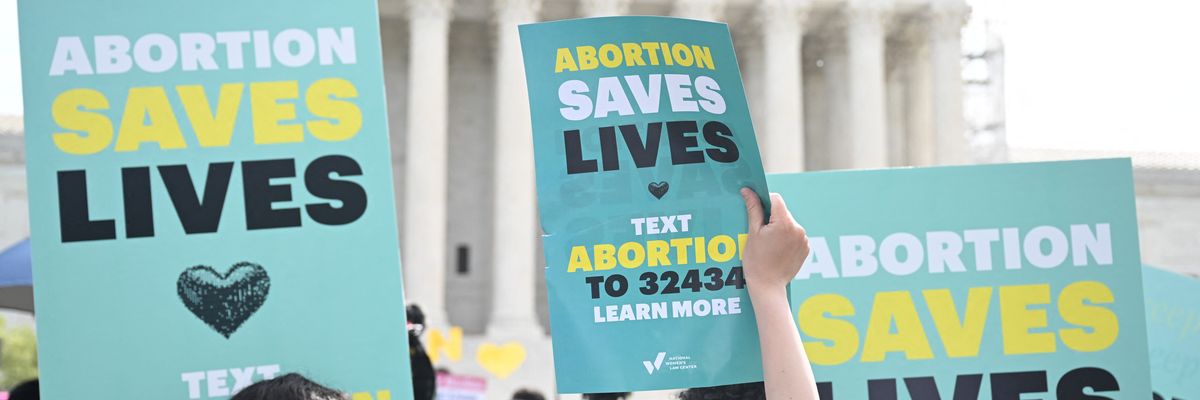
Pro-abortion rights activists rally outside the U.S. Supreme Court in Washington, D.C. on April 24, 2024 as the court hears a case regarding an Idaho abortion law.
"If legislators were trying to trap men in states where they couldn't get healthcare, we would never hear the end of it," said one advocate.
Nearly two years after it was first proposed by Republican lawmakers, an Idaho law that, as one rights advocate said, essentially "traps" people in the state to stop them from getting abortion care, was permitted to go into effect on Monday after a federal appeals court ruling.
The Ninth U.S. Circuit Court of Appeals ruled that Idaho can prohibit people from "harboring or transporting" a minor who needs to leave the state to obtain an abortion, which is still legal in the surrounding states of Oregon, Washington, and Montana.
The law, originally proposed as House Bill 242, makes the so-called crime of "abortion trafficking" punishable by two to five years in prison, even if the pregnant person obtains an abortion in a state where the procedure is legal.
The law was blocked in its entirety in late 2023 by a judge who found it violated First Amendment rights, because it also included a ban on "recruiting" teenagers to obtain abortion care across state lines.
The appeals court on Monday found that the "recruitment" portion of the law did violate the constitutional right to free speech because it could be applied to anything "from encouragement, counseling and emotional support; to education about available medical services and reproductive healthcare; to public advocacy promoting abortion care and abortion access."
"Encouragement, counseling and emotional support are plainly protected speech under Supreme Court precedent," wrote Judge M. Margaret McKeown, an appointee of former Democratic President Bill Clinton, in the majority opinion.
" Republicans want to scare anyone who might help teens access abortion—whether it's a beloved grandmother or a local abortion fund."
Wendy Heipt, an attorney representing the Northwest Abortion Access Fund and the Indigenous Idaho Alliance as well as a lawyer and advocate who sued the state over the law, said the portion of the ruling regarding "recruitment" was a "significant victory for the plaintiffs, as it frees Idahoans to talk with pregnant minors about abortion healthcare."
But Jessica Valenti, a writer and advocate who writes the Substack newsletter Abortion, Every Day, said efforts to establish traveling for abortion care as a crime should be "front page news every single day."
"If legislators were trying to trap men in states where they couldn't get healthcare, we would never hear the end of it," wrote Valenti.
Republicans in Idaho have pushed the law as one that would "stop adults from taking minors across state lines for abortions without parental permission," Valenti added. "In truth, the law criminalizes helping a teenager obtain an abortion in any capacity—anywhere."
She continued that the ban's "sweeping language... could send someone to prison as a 'trafficker' for lending a teen gas money."
"That's the point, of course: Republicans want to scare anyone who might help teens access abortion—whether it's a beloved grandmother or a local abortion fund," wrote Valenti. "They're targeting the helpers."
Tennessee Republicans have also passed an "abortion trafficking" law, but a court blocked it from being enforced in September, with U.S. District Judge Aleta Trauger writing that the state had "chosen to outlaw certain communications in furtherance of abortions that are, in fact, entirely legal."
"It is, therefore, a basic constitutional fact—which Tennessee has no choice but to accept—that as long as there are states in which abortion is permissible, then abortion will be potentially available to Tennesseans," added Trauger.
Republicans in Mississippi, Alabama, and Oklahoma have introduced similar legislation, while Alabama Attorney General Steve Marshall has suggested states can restrict pregnant residents' travel.
Valenti wrote that Monday's ruling "is not just about Idaho" and that laws barring travel for abortion care will not "stop with teenagers."
"Young people are the canaries in the coal mine," she wrote. "What happens to them today comes for us all tomorrow."
Dear Common Dreams reader, It’s been nearly 30 years since I co-founded Common Dreams with my late wife, Lina Newhouser. We had the radical notion that journalism should serve the public good, not corporate profits. It was clear to us from the outset what it would take to build such a project. No paid advertisements. No corporate sponsors. No millionaire publisher telling us what to think or do. Many people said we wouldn't last a year, but we proved those doubters wrong. Together with a tremendous team of journalists and dedicated staff, we built an independent media outlet free from the constraints of profits and corporate control. Our mission has always been simple: To inform. To inspire. To ignite change for the common good. Building Common Dreams was not easy. Our survival was never guaranteed. When you take on the most powerful forces—Wall Street greed, fossil fuel industry destruction, Big Tech lobbyists, and uber-rich oligarchs who have spent billions upon billions rigging the economy and democracy in their favor—the only bulwark you have is supporters who believe in your work. But here’s the urgent message from me today. It's never been this bad out there. And it's never been this hard to keep us going. At the very moment Common Dreams is most needed, the threats we face are intensifying. We need your support now more than ever. We don't accept corporate advertising and never will. We don't have a paywall because we don't think people should be blocked from critical news based on their ability to pay. Everything we do is funded by the donations of readers like you. When everyone does the little they can afford, we are strong. But if that support retreats or dries up, so do we. Will you donate now to make sure Common Dreams not only survives but thrives? —Craig Brown, Co-founder |
Nearly two years after it was first proposed by Republican lawmakers, an Idaho law that, as one rights advocate said, essentially "traps" people in the state to stop them from getting abortion care, was permitted to go into effect on Monday after a federal appeals court ruling.
The Ninth U.S. Circuit Court of Appeals ruled that Idaho can prohibit people from "harboring or transporting" a minor who needs to leave the state to obtain an abortion, which is still legal in the surrounding states of Oregon, Washington, and Montana.
The law, originally proposed as House Bill 242, makes the so-called crime of "abortion trafficking" punishable by two to five years in prison, even if the pregnant person obtains an abortion in a state where the procedure is legal.
The law was blocked in its entirety in late 2023 by a judge who found it violated First Amendment rights, because it also included a ban on "recruiting" teenagers to obtain abortion care across state lines.
The appeals court on Monday found that the "recruitment" portion of the law did violate the constitutional right to free speech because it could be applied to anything "from encouragement, counseling and emotional support; to education about available medical services and reproductive healthcare; to public advocacy promoting abortion care and abortion access."
"Encouragement, counseling and emotional support are plainly protected speech under Supreme Court precedent," wrote Judge M. Margaret McKeown, an appointee of former Democratic President Bill Clinton, in the majority opinion.
" Republicans want to scare anyone who might help teens access abortion—whether it's a beloved grandmother or a local abortion fund."
Wendy Heipt, an attorney representing the Northwest Abortion Access Fund and the Indigenous Idaho Alliance as well as a lawyer and advocate who sued the state over the law, said the portion of the ruling regarding "recruitment" was a "significant victory for the plaintiffs, as it frees Idahoans to talk with pregnant minors about abortion healthcare."
But Jessica Valenti, a writer and advocate who writes the Substack newsletter Abortion, Every Day, said efforts to establish traveling for abortion care as a crime should be "front page news every single day."
"If legislators were trying to trap men in states where they couldn't get healthcare, we would never hear the end of it," wrote Valenti.
Republicans in Idaho have pushed the law as one that would "stop adults from taking minors across state lines for abortions without parental permission," Valenti added. "In truth, the law criminalizes helping a teenager obtain an abortion in any capacity—anywhere."
She continued that the ban's "sweeping language... could send someone to prison as a 'trafficker' for lending a teen gas money."
"That's the point, of course: Republicans want to scare anyone who might help teens access abortion—whether it's a beloved grandmother or a local abortion fund," wrote Valenti. "They're targeting the helpers."
Tennessee Republicans have also passed an "abortion trafficking" law, but a court blocked it from being enforced in September, with U.S. District Judge Aleta Trauger writing that the state had "chosen to outlaw certain communications in furtherance of abortions that are, in fact, entirely legal."
"It is, therefore, a basic constitutional fact—which Tennessee has no choice but to accept—that as long as there are states in which abortion is permissible, then abortion will be potentially available to Tennesseans," added Trauger.
Republicans in Mississippi, Alabama, and Oklahoma have introduced similar legislation, while Alabama Attorney General Steve Marshall has suggested states can restrict pregnant residents' travel.
Valenti wrote that Monday's ruling "is not just about Idaho" and that laws barring travel for abortion care will not "stop with teenagers."
"Young people are the canaries in the coal mine," she wrote. "What happens to them today comes for us all tomorrow."
Nearly two years after it was first proposed by Republican lawmakers, an Idaho law that, as one rights advocate said, essentially "traps" people in the state to stop them from getting abortion care, was permitted to go into effect on Monday after a federal appeals court ruling.
The Ninth U.S. Circuit Court of Appeals ruled that Idaho can prohibit people from "harboring or transporting" a minor who needs to leave the state to obtain an abortion, which is still legal in the surrounding states of Oregon, Washington, and Montana.
The law, originally proposed as House Bill 242, makes the so-called crime of "abortion trafficking" punishable by two to five years in prison, even if the pregnant person obtains an abortion in a state where the procedure is legal.
The law was blocked in its entirety in late 2023 by a judge who found it violated First Amendment rights, because it also included a ban on "recruiting" teenagers to obtain abortion care across state lines.
The appeals court on Monday found that the "recruitment" portion of the law did violate the constitutional right to free speech because it could be applied to anything "from encouragement, counseling and emotional support; to education about available medical services and reproductive healthcare; to public advocacy promoting abortion care and abortion access."
"Encouragement, counseling and emotional support are plainly protected speech under Supreme Court precedent," wrote Judge M. Margaret McKeown, an appointee of former Democratic President Bill Clinton, in the majority opinion.
" Republicans want to scare anyone who might help teens access abortion—whether it's a beloved grandmother or a local abortion fund."
Wendy Heipt, an attorney representing the Northwest Abortion Access Fund and the Indigenous Idaho Alliance as well as a lawyer and advocate who sued the state over the law, said the portion of the ruling regarding "recruitment" was a "significant victory for the plaintiffs, as it frees Idahoans to talk with pregnant minors about abortion healthcare."
But Jessica Valenti, a writer and advocate who writes the Substack newsletter Abortion, Every Day, said efforts to establish traveling for abortion care as a crime should be "front page news every single day."
"If legislators were trying to trap men in states where they couldn't get healthcare, we would never hear the end of it," wrote Valenti.
Republicans in Idaho have pushed the law as one that would "stop adults from taking minors across state lines for abortions without parental permission," Valenti added. "In truth, the law criminalizes helping a teenager obtain an abortion in any capacity—anywhere."
She continued that the ban's "sweeping language... could send someone to prison as a 'trafficker' for lending a teen gas money."
"That's the point, of course: Republicans want to scare anyone who might help teens access abortion—whether it's a beloved grandmother or a local abortion fund," wrote Valenti. "They're targeting the helpers."
Tennessee Republicans have also passed an "abortion trafficking" law, but a court blocked it from being enforced in September, with U.S. District Judge Aleta Trauger writing that the state had "chosen to outlaw certain communications in furtherance of abortions that are, in fact, entirely legal."
"It is, therefore, a basic constitutional fact—which Tennessee has no choice but to accept—that as long as there are states in which abortion is permissible, then abortion will be potentially available to Tennesseans," added Trauger.
Republicans in Mississippi, Alabama, and Oklahoma have introduced similar legislation, while Alabama Attorney General Steve Marshall has suggested states can restrict pregnant residents' travel.
Valenti wrote that Monday's ruling "is not just about Idaho" and that laws barring travel for abortion care will not "stop with teenagers."
"Young people are the canaries in the coal mine," she wrote. "What happens to them today comes for us all tomorrow."