SUBSCRIBE TO OUR FREE NEWSLETTER
Daily news & progressive opinion—funded by the people, not the corporations—delivered straight to your inbox.
5
#000000
#FFFFFF
To donate by check, phone, or other method, see our More Ways to Give page.
Daily news & progressive opinion—funded by the people, not the corporations—delivered straight to your inbox.
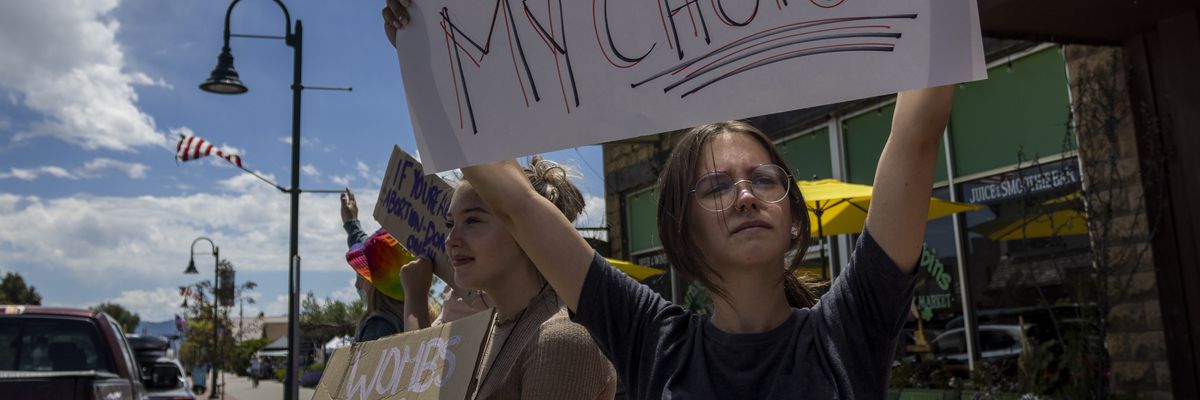
A group of teenagers protests the Supreme Court's decision in the Dobbs v. Jackson Women's Health case on July 2, 2022 in Driggs, Idaho.
"Human trafficking is a terrible crime where one person takes another person against their will," said one state Democrat. "It is very different from helping a young woman seek medical care without her parents' knowledge."
Reproductive rights advocates and Democratic state lawmakers in Idaho on Wednesday condemned a Republican proposal to create a new crime in the state using the invented term "abortion trafficking," which would criminalize people who help minors to obtain out-of-state abortion care.
The bill (H.B. 242) is widely expected to pass in the state Senate and easily passed in the state House earlier this month on a party-line vote, with 57 Republicans supporting the proposal and and 12 Democrats opposing it. GOP Gov. Brad Little, who has strongly supported the state's abortion ban, is expected to sign the legislation.
H.B. 242 would establish so-called "abortion trafficking" as a new crime and would restrict minors' ability to travel to get abortion care without parental consent.
Any adult who, "with the intent to conceal an abortion from the parents or guardian of a pregnant, unemancipated minor, either procures an abortion... or obtains an abortion-inducing drug" for a minor could face felony charges and up to five years in prison.
Family members of a minor who obtains an abortion across state lines—or the person who impregnated the minor—would be permitted to sue the providers who helped facilitate the procedure for a minimum of $20,000.
"Human trafficking is a terrible crime where one person takes another person against their will," Wintrow added. "It is very different from helping a young woman seek medical care without her parents' knowledge."
Last August, one of the nation's most restrictive anti-abortion laws went into effect in Idaho, two months after the right-wing majority on the U.S. Supreme Court overturned Roe v. Wade.
The law bans abortions after six weeks of pregnancy—before many people know they are pregnant—with exceptions in cases involving rape or incest or when the pregnant person's life is in danger. Exceptions to save a pregnant person's life have already resulted in medical providers refusing to provide care in cases when the patient is growing progressively sicker and their fetus has no chance of survival.
Women's March said the bill is likely "the first of many fascist, unconstitutional bills" that will seek to limit pregnant people's ability to travel for abortion care.
Mistie DelliCarpini-Tolman, the Idaho state director for Planned Parenthood Alliance Advocates, told lawmakers this week that the legislation will place many vulnerable young pregnant people in harm's way.
"For young people living in abusive households, disclosing sexual activity or a pregnancy can trigger physical or emotional abuse, including direct, physical or sexual violence, or being thrown out of the home," said DelliCarpini-Tolman.
Republicans in the state are seeking to further criminalize abortion care days after the state's northernmost hospital announced it will soon close its obstetrics department, citing staffing issues that have following Idaho's abortion ban.
On Tuesday, Republicans in the state announced they would not consider a bill to expand postpartum Medicaid coverage.
"Last year, legislators said they wanted to pass policies to support the health of mothers," Hillarie Hagan, health policy associate for the advocacy group Idaho Voices for Children, told News From the States, "and now they're about to leave town without passing House Bill 201, which would've done just that."
Dear Common Dreams reader, It’s been nearly 30 years since I co-founded Common Dreams with my late wife, Lina Newhouser. We had the radical notion that journalism should serve the public good, not corporate profits. It was clear to us from the outset what it would take to build such a project. No paid advertisements. No corporate sponsors. No millionaire publisher telling us what to think or do. Many people said we wouldn't last a year, but we proved those doubters wrong. Together with a tremendous team of journalists and dedicated staff, we built an independent media outlet free from the constraints of profits and corporate control. Our mission has always been simple: To inform. To inspire. To ignite change for the common good. Building Common Dreams was not easy. Our survival was never guaranteed. When you take on the most powerful forces—Wall Street greed, fossil fuel industry destruction, Big Tech lobbyists, and uber-rich oligarchs who have spent billions upon billions rigging the economy and democracy in their favor—the only bulwark you have is supporters who believe in your work. But here’s the urgent message from me today. It's never been this bad out there. And it's never been this hard to keep us going. At the very moment Common Dreams is most needed, the threats we face are intensifying. We need your support now more than ever. We don't accept corporate advertising and never will. We don't have a paywall because we don't think people should be blocked from critical news based on their ability to pay. Everything we do is funded by the donations of readers like you. When everyone does the little they can afford, we are strong. But if that support retreats or dries up, so do we. Will you donate now to make sure Common Dreams not only survives but thrives? —Craig Brown, Co-founder |
Reproductive rights advocates and Democratic state lawmakers in Idaho on Wednesday condemned a Republican proposal to create a new crime in the state using the invented term "abortion trafficking," which would criminalize people who help minors to obtain out-of-state abortion care.
The bill (H.B. 242) is widely expected to pass in the state Senate and easily passed in the state House earlier this month on a party-line vote, with 57 Republicans supporting the proposal and and 12 Democrats opposing it. GOP Gov. Brad Little, who has strongly supported the state's abortion ban, is expected to sign the legislation.
H.B. 242 would establish so-called "abortion trafficking" as a new crime and would restrict minors' ability to travel to get abortion care without parental consent.
Any adult who, "with the intent to conceal an abortion from the parents or guardian of a pregnant, unemancipated minor, either procures an abortion... or obtains an abortion-inducing drug" for a minor could face felony charges and up to five years in prison.
Family members of a minor who obtains an abortion across state lines—or the person who impregnated the minor—would be permitted to sue the providers who helped facilitate the procedure for a minimum of $20,000.
"Human trafficking is a terrible crime where one person takes another person against their will," Wintrow added. "It is very different from helping a young woman seek medical care without her parents' knowledge."
Last August, one of the nation's most restrictive anti-abortion laws went into effect in Idaho, two months after the right-wing majority on the U.S. Supreme Court overturned Roe v. Wade.
The law bans abortions after six weeks of pregnancy—before many people know they are pregnant—with exceptions in cases involving rape or incest or when the pregnant person's life is in danger. Exceptions to save a pregnant person's life have already resulted in medical providers refusing to provide care in cases when the patient is growing progressively sicker and their fetus has no chance of survival.
Women's March said the bill is likely "the first of many fascist, unconstitutional bills" that will seek to limit pregnant people's ability to travel for abortion care.
Mistie DelliCarpini-Tolman, the Idaho state director for Planned Parenthood Alliance Advocates, told lawmakers this week that the legislation will place many vulnerable young pregnant people in harm's way.
"For young people living in abusive households, disclosing sexual activity or a pregnancy can trigger physical or emotional abuse, including direct, physical or sexual violence, or being thrown out of the home," said DelliCarpini-Tolman.
Republicans in the state are seeking to further criminalize abortion care days after the state's northernmost hospital announced it will soon close its obstetrics department, citing staffing issues that have following Idaho's abortion ban.
On Tuesday, Republicans in the state announced they would not consider a bill to expand postpartum Medicaid coverage.
"Last year, legislators said they wanted to pass policies to support the health of mothers," Hillarie Hagan, health policy associate for the advocacy group Idaho Voices for Children, told News From the States, "and now they're about to leave town without passing House Bill 201, which would've done just that."
Reproductive rights advocates and Democratic state lawmakers in Idaho on Wednesday condemned a Republican proposal to create a new crime in the state using the invented term "abortion trafficking," which would criminalize people who help minors to obtain out-of-state abortion care.
The bill (H.B. 242) is widely expected to pass in the state Senate and easily passed in the state House earlier this month on a party-line vote, with 57 Republicans supporting the proposal and and 12 Democrats opposing it. GOP Gov. Brad Little, who has strongly supported the state's abortion ban, is expected to sign the legislation.
H.B. 242 would establish so-called "abortion trafficking" as a new crime and would restrict minors' ability to travel to get abortion care without parental consent.
Any adult who, "with the intent to conceal an abortion from the parents or guardian of a pregnant, unemancipated minor, either procures an abortion... or obtains an abortion-inducing drug" for a minor could face felony charges and up to five years in prison.
Family members of a minor who obtains an abortion across state lines—or the person who impregnated the minor—would be permitted to sue the providers who helped facilitate the procedure for a minimum of $20,000.
"Human trafficking is a terrible crime where one person takes another person against their will," Wintrow added. "It is very different from helping a young woman seek medical care without her parents' knowledge."
Last August, one of the nation's most restrictive anti-abortion laws went into effect in Idaho, two months after the right-wing majority on the U.S. Supreme Court overturned Roe v. Wade.
The law bans abortions after six weeks of pregnancy—before many people know they are pregnant—with exceptions in cases involving rape or incest or when the pregnant person's life is in danger. Exceptions to save a pregnant person's life have already resulted in medical providers refusing to provide care in cases when the patient is growing progressively sicker and their fetus has no chance of survival.
Women's March said the bill is likely "the first of many fascist, unconstitutional bills" that will seek to limit pregnant people's ability to travel for abortion care.
Mistie DelliCarpini-Tolman, the Idaho state director for Planned Parenthood Alliance Advocates, told lawmakers this week that the legislation will place many vulnerable young pregnant people in harm's way.
"For young people living in abusive households, disclosing sexual activity or a pregnancy can trigger physical or emotional abuse, including direct, physical or sexual violence, or being thrown out of the home," said DelliCarpini-Tolman.
Republicans in the state are seeking to further criminalize abortion care days after the state's northernmost hospital announced it will soon close its obstetrics department, citing staffing issues that have following Idaho's abortion ban.
On Tuesday, Republicans in the state announced they would not consider a bill to expand postpartum Medicaid coverage.
"Last year, legislators said they wanted to pass policies to support the health of mothers," Hillarie Hagan, health policy associate for the advocacy group Idaho Voices for Children, told News From the States, "and now they're about to leave town without passing House Bill 201, which would've done just that."