SUBSCRIBE TO OUR FREE NEWSLETTER
Daily news & progressive opinion—funded by the people, not the corporations—delivered straight to your inbox.
5
#000000
#FFFFFF
To donate by check, phone, or other method, see our More Ways to Give page.
Daily news & progressive opinion—funded by the people, not the corporations—delivered straight to your inbox.
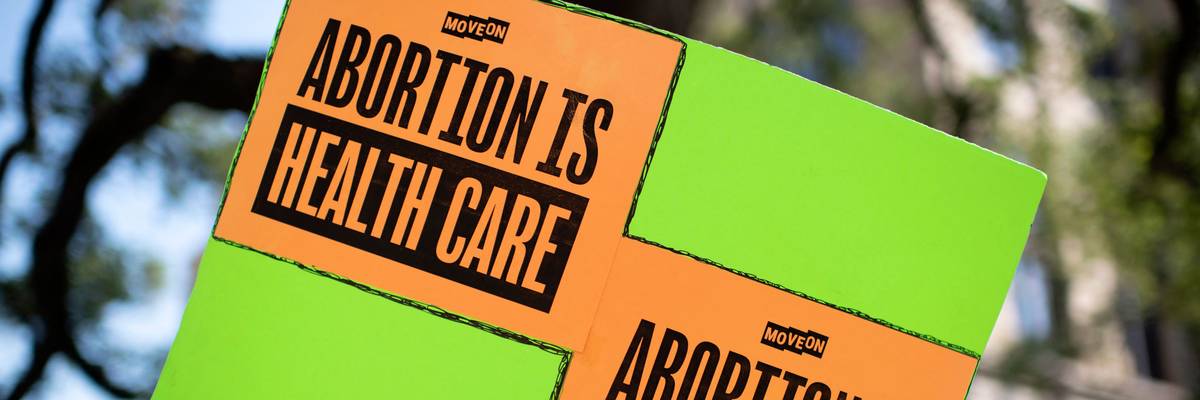
An abortion rights demonstrator holds a sign outside of the Harris County Courthouse during the Women's Wave march in Houston, Texas, on October 8, 2022.
"Everyone, no matter who they are, where they live, how much money they make, or how they get their insurance, deserves access to abortion care without barriers."
On Wednesday, reproductive rights groups marked half a century of abortion care being "baselessly set apart from all other healthcare," with coverage for abortions blocked in government-funded healthcare plans like Medicaid, which about 16 million women of reproductive age rely on.
"Our constituents have suffered the consequences," said the Congressional Reproductive Freedom Caucus, chaired by Reps. Diana DeGette (D-Colo.) and Ayanna Pressley (D-Mass.).
For 50 years, the Hyde Amendment—proposed by the late Rep. Henry Hyde (D-Ill.), who expressed his wish to prevent "anybody having an abortion" and said blocking federal funds within the Medicaid program from being used for care was the best way to do so—has stopped hundreds of thousands of people from obtaining abortion care, and has been called by anti-abortion groups "one of the greatest achievements of the pro-life movement to date."
The Reproductive Freedom Caucus denounced the budget rider that has been reeimplemented in appropriations bills every year since 1976 as "a dangerous, racist, and classist abortion ban. An abortion ban for the working class and people of color, who disproportionately receive health insurance through the federal government."
The caucus noted that more than 200 House Democrats have supported efforts to repeal the amendment, and advocacy groups on Wednesday called on Congress to pass the Equal Access to Abortion Coverage in Health Insurance (EACH) Act, which would permanently repeal the Hyde Amendment.
"Without solutions like the EACH Act, the Hyde Amendment will continue to force people with low incomes to struggle for the care they need or carry a pregnancy against their will," said the National Women's Law Center (NWLC). "Everyone, no matter who they are, where they live, how much money they make, or how they get their insurance, deserves access to abortion care without barriers."
In addition to low-income people who rely on Medicaid, said the National Network of Abortion Funds (NNAF), the Hyde Amendment blocks abortion care for Indigenous people who use the Indian Health Service, people in federal prisons, disabled people, military service members and their families, and federal employees, among others.
Twenty-nine states follow Hyde Amendment restrictions, which include "exceptions" for pregnancies resulting from rape or incest or cases in which a pregnant person's life is at risk. Twenty-one states use state funds to cover abortion care, but nearly half of US women of reproductive age who use Medicaid live in states that either ban abortion care or bar them from getting abortions using the federally funded healthcare plan.
NNAF highlighted the network's decades of work to counter the Hyde Amendment by ensuring people who need abortions can access funding, which abortion funds across the country obtain through grassroots donations as they also advocate to end the Hyde Amendment.
"By the 1990s—less than two decades after Hyde first passed—28 abortion funds had formed across the country. Twenty-two of those funds started the National Network of Abortion Funds (NNAF) in 1993," said NNAF. "We joined together to build strategic power and end the Hyde Amendment. Today, our network has nearly 100 member abortion funds, and our fight against Hyde continues."
"The fierce abortion funds in our network have raised money, arranged travel, connected folks to clinics, provided practical support, and fought restrictions in their states and communities," the group added. "Despite endless challenges, their tireless work has built power for our collective goal: Make abortion accessible for all."
Abortion funds have helped people obtain care across the country, but the NWLC emphasized that the Hyde Amendment has still left hundreds of thousands of women with no choice but to pay for abortions out of pocket—often pushing them to delay care while they gather funds or to carry a pregnancy to term when they don't want to or can't afford to become a parent.
"While abortion costs vary by location, facility, and stage of pregnancy, the median out-of-pocket costs in 2023 were $563 for medication abortion, $650 for first-trimester procedural abortion, and $1,000 for second-trimester abortion care," said NWLC. "Those costs account for just the procedure itself, not additional expenses. And yet, nearly half of American families cannot afford the true cost of living... So, when the Hyde Amendment denies someone abortion care, the compounding costs can push people further into a struggle to survive and meet basic needs."
Dr. Jamila Perritt, president and CEO of Physicians for Reproductive Health, remembered Rosie Jimenez, a 27-year-old mother and aspiring teacher who died in 1977, almost exactly a year after the Hyde Amendment was passed, after being denied Medicaid coverage for an abortion.
“Hyde has harmed generations of people seeking abortion care," said Perritt. "Women like Rosie Jimenez, the first known person to die because of Hyde Amendment restrictions, should still be here. No one, no matter what insurance they have access to or who they are, should be denied abortion care, full stop."
Stateline reported Tuesday that with weeks to go until the midterm elections and President Donald Trump's approval rating plummeting to record lows, anti-abortion groups are increasingly concerned that a Democratic majority could repeal the amendment, which it came close to doing in 2022.
“If there becomes a pro-abortion majority in Congress, then Hyde is going to be one of the first things to go, probably, especially because it’s been in the spotlight more recently,” Gavin Oxley, spokesperson for Americans United for Life, told Stateline. Particularly since Trump told Republicans to be "a little flexible" on the Hyde Amendment when the party was pushing to end subsidies under the Affordable Care Act, Oxley said "there are some Republicans who may not be as committed to protecting Hyde.”
Perritt expressed hope that Congress could pass the EACH Act, which now "has the highest amount of support... ever seen with over 200 co-sponsors."
"As a DC-based OB-GYN and abortion provider, I see patients burdened with the cost of abortion care, forcing them to choose between basic living needs and lifesaving healthcare," she said. "The Hyde Amendment is a zero-sum constraint that is not about patients’ health and autonomy, but instead about punishing people for making informed decisions about their bodies, families, and futures. Enough is enough."
"We do not need another Hyde Amendment anniversary," said Perritt. "We need to repeal the Hyde Amendment for good.”
This country and this world are at a monumental crossroads. US voters have an opportunity to beat back the forces of fascism and confront the billionaires who are rigging the economy, our media system, and our democracy, making it increasingly impossible for ordinary people to get by. We’re not just talking about the election. We’re talking about what must be done once these fascist elements are vanquished from power. We need a bolder set of solutions than what either major party has so far been willing to offer and a working-class movement ready to fight like hell for it. Trump didn't emerge from nowhere. The conditions that fueled MAGA authoritarianism were created by decades of radical neoliberal economic policies and a corrupt political system dominated by corporate interests. They slashed taxes on the super-rich, promising that the benefits would trickle down. They said giveaways to the corporate titans would make life more affordable for the rest of us. It was all bullshit. And when a bitter, betrayed populace searches for someone to blame, right-wing demagogues have little trouble finding scapegoats. People know when they're being lied to, but you won't hear any of this from the corporate media. Only independent journalism—powered and funded by people who believe in building a better world—can deliver truly trustworthy daily news. If you share our vision, please contribute whatever you can to sustain our work. |
On Wednesday, reproductive rights groups marked half a century of abortion care being "baselessly set apart from all other healthcare," with coverage for abortions blocked in government-funded healthcare plans like Medicaid, which about 16 million women of reproductive age rely on.
"Our constituents have suffered the consequences," said the Congressional Reproductive Freedom Caucus, chaired by Reps. Diana DeGette (D-Colo.) and Ayanna Pressley (D-Mass.).
For 50 years, the Hyde Amendment—proposed by the late Rep. Henry Hyde (D-Ill.), who expressed his wish to prevent "anybody having an abortion" and said blocking federal funds within the Medicaid program from being used for care was the best way to do so—has stopped hundreds of thousands of people from obtaining abortion care, and has been called by anti-abortion groups "one of the greatest achievements of the pro-life movement to date."
The Reproductive Freedom Caucus denounced the budget rider that has been reeimplemented in appropriations bills every year since 1976 as "a dangerous, racist, and classist abortion ban. An abortion ban for the working class and people of color, who disproportionately receive health insurance through the federal government."
The caucus noted that more than 200 House Democrats have supported efforts to repeal the amendment, and advocacy groups on Wednesday called on Congress to pass the Equal Access to Abortion Coverage in Health Insurance (EACH) Act, which would permanently repeal the Hyde Amendment.
"Without solutions like the EACH Act, the Hyde Amendment will continue to force people with low incomes to struggle for the care they need or carry a pregnancy against their will," said the National Women's Law Center (NWLC). "Everyone, no matter who they are, where they live, how much money they make, or how they get their insurance, deserves access to abortion care without barriers."
In addition to low-income people who rely on Medicaid, said the National Network of Abortion Funds (NNAF), the Hyde Amendment blocks abortion care for Indigenous people who use the Indian Health Service, people in federal prisons, disabled people, military service members and their families, and federal employees, among others.
Twenty-nine states follow Hyde Amendment restrictions, which include "exceptions" for pregnancies resulting from rape or incest or cases in which a pregnant person's life is at risk. Twenty-one states use state funds to cover abortion care, but nearly half of US women of reproductive age who use Medicaid live in states that either ban abortion care or bar them from getting abortions using the federally funded healthcare plan.
NNAF highlighted the network's decades of work to counter the Hyde Amendment by ensuring people who need abortions can access funding, which abortion funds across the country obtain through grassroots donations as they also advocate to end the Hyde Amendment.
"By the 1990s—less than two decades after Hyde first passed—28 abortion funds had formed across the country. Twenty-two of those funds started the National Network of Abortion Funds (NNAF) in 1993," said NNAF. "We joined together to build strategic power and end the Hyde Amendment. Today, our network has nearly 100 member abortion funds, and our fight against Hyde continues."
"The fierce abortion funds in our network have raised money, arranged travel, connected folks to clinics, provided practical support, and fought restrictions in their states and communities," the group added. "Despite endless challenges, their tireless work has built power for our collective goal: Make abortion accessible for all."
Abortion funds have helped people obtain care across the country, but the NWLC emphasized that the Hyde Amendment has still left hundreds of thousands of women with no choice but to pay for abortions out of pocket—often pushing them to delay care while they gather funds or to carry a pregnancy to term when they don't want to or can't afford to become a parent.
"While abortion costs vary by location, facility, and stage of pregnancy, the median out-of-pocket costs in 2023 were $563 for medication abortion, $650 for first-trimester procedural abortion, and $1,000 for second-trimester abortion care," said NWLC. "Those costs account for just the procedure itself, not additional expenses. And yet, nearly half of American families cannot afford the true cost of living... So, when the Hyde Amendment denies someone abortion care, the compounding costs can push people further into a struggle to survive and meet basic needs."
Dr. Jamila Perritt, president and CEO of Physicians for Reproductive Health, remembered Rosie Jimenez, a 27-year-old mother and aspiring teacher who died in 1977, almost exactly a year after the Hyde Amendment was passed, after being denied Medicaid coverage for an abortion.
“Hyde has harmed generations of people seeking abortion care," said Perritt. "Women like Rosie Jimenez, the first known person to die because of Hyde Amendment restrictions, should still be here. No one, no matter what insurance they have access to or who they are, should be denied abortion care, full stop."
Stateline reported Tuesday that with weeks to go until the midterm elections and President Donald Trump's approval rating plummeting to record lows, anti-abortion groups are increasingly concerned that a Democratic majority could repeal the amendment, which it came close to doing in 2022.
“If there becomes a pro-abortion majority in Congress, then Hyde is going to be one of the first things to go, probably, especially because it’s been in the spotlight more recently,” Gavin Oxley, spokesperson for Americans United for Life, told Stateline. Particularly since Trump told Republicans to be "a little flexible" on the Hyde Amendment when the party was pushing to end subsidies under the Affordable Care Act, Oxley said "there are some Republicans who may not be as committed to protecting Hyde.”
Perritt expressed hope that Congress could pass the EACH Act, which now "has the highest amount of support... ever seen with over 200 co-sponsors."
"As a DC-based OB-GYN and abortion provider, I see patients burdened with the cost of abortion care, forcing them to choose between basic living needs and lifesaving healthcare," she said. "The Hyde Amendment is a zero-sum constraint that is not about patients’ health and autonomy, but instead about punishing people for making informed decisions about their bodies, families, and futures. Enough is enough."
"We do not need another Hyde Amendment anniversary," said Perritt. "We need to repeal the Hyde Amendment for good.”