

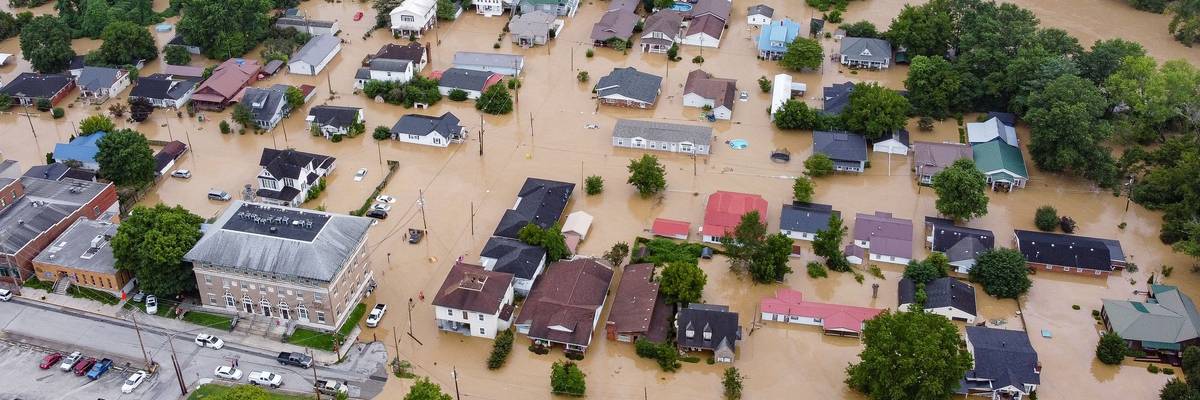
An aerial view shows homes submerged under floodwaters from the North Fork of the Kentucky River in Jackson, Kentucky on July 28, 2022.
Critics Decry Trump HUD's Proposed Rollback of Flood Protections for Low-Income Homes
One group said that the proposal "puts poor and working families that rely on HUD assistance at greater risk of danger, displacement, and homelessness."
Housing and environmental advocates on Tuesday condemned the Trump administration’s planned rollback of flood protections for federally funded housing, warning that the move will leave low-income households exposed to increasingly severe climate-driven flooding while shifting more costs to taxpayers.
In July, the US Department of Housing and Urban Development (HUD) proposed rescinding key portions of the Federal Flood Risk Management Standard (FFRMS), a Biden-era policy that required federally financed projects in areas prone to flooding to account for current and future inundation risks.
Proponents of the move, which would strip a layer of federal flood requirements, argue that local governments know their flood conditions better than Washington bureaucrats.
However, the National Housing Law Project (NHLP), a San Francisco-based advocacy group, warned Tuesday that the proposal "puts poor and working families that rely on HUD assistance at greater risk of danger, displacement, and homelessness by reducing notification and mitigation requirements for homes that are vulnerable to flooding."
NHLP called the move "part of the Trump administration’s attempt to dismantle the government programs that keep people housed, safe, and healthy."
On Tuesday, NHLP submitted a comment to HUD noting that “flooding events have become more frequent and widespread, and put the health, safety, and livelihood of low-income families at risk."
"Tenants displaced from federally subsidized housing face an even more acute crisis, because they often endure temporary or permanent loss of their housing assistance,” the group added. “Due to the personal and societal harm of extreme flooding events, HUD should work toward increasing the resilience of HUD-assisted properties. This proposed rule does the opposite.”
The proposed FFRMS rescission is part of the broader regulatory rollback that began during President Donald Trump's first term. In 2017, Trump repealed Obama-era executive orders that had updated the federal flood standard for the first time since the Carter administration and established regulations meant to ensure that federally funded infrastructure projects were climate-resilient.
In March, Trump issued an executive order directing federal agencies to identify and eliminate regulations deemed unnecessarily costly or burdensome to housing construction.
Responding to HUD's proposed FFRMS rollback, Liz Zepeda, federal regulatory director at the Virginia-based legal advocacy group Southern Environmental Law Center, said in July that “it’s discouraging to see the federal government ignore climate science and put some of our most vulnerable communities at greater risk, especially as we head into hurricane season."
"Reckless deregulation like this is why we need Congress to step up and pass reasonable emergency management policies,” Zepeda added.
In 2021, an NPR investigation revealed that, dating back to at least the Obama administration, the federal government sold homes it had previously purchased after repeated flooding to new buyers—often without adequately informing them about the properties’ flood histories and risks.
Historical data compiled by the National Oceanic and Atmospheric Administration show 45 billion-dollar flooding disasters between 1980-2024 that caused an estimated $215 billion in combined damages, adjusted for inflation. As the climate emergency worsens, the frequency and severity of such flooding have increased dramatically, from an average of 3.3 billion-dollar disasters in the 1980s, to 6.7 in the 2000s, to 23 in the 2020s.
We are at a crossroads
This country and this world are at a monumental crossroads. In a few short weeks, US voters will have an opportunity to beat back the forces of fascism and confront the billionaires who are rigging the economy, our media system, and our democracy, making it increasingly impossible for ordinary people to get by. We’re not just talking about the election. We’re talking about what must be done once these fascist elements are vanquished from power. We need a bolder set of solutions than what either major party has so far been willing to offer and a working-class movement ready to fight like hell for it. Trump didn't emerge from nowhere. The conditions that fueled MAGA authoritarianism were created by decades of radical neoliberal economic policies and a corrupt political system dominated by corporate interests. They slashed taxes on the super-rich, promising that the benefits would trickle down. They said giveaways to the corporate titans would make life more affordable for the rest of us. It was all bullshit. And when a bitter, betrayed populace searches for someone to blame, right-wing demagogues have little trouble finding scapegoats. People know when they're being lied to, but you won't hear any of this from the corporate media. Only independent journalism—powered and funded by people who believe in building a better world—can deliver truly trustworthy daily news. Our Fall Campaign is underway, and we need your help. To power our newsroom through the rest of the year, we need to raise $125,000 by midnight on October 31. So if you share our vision, please contribute whatever you can to sustain our work. |
Housing and environmental advocates on Tuesday condemned the Trump administration’s planned rollback of flood protections for federally funded housing, warning that the move will leave low-income households exposed to increasingly severe climate-driven flooding while shifting more costs to taxpayers.
In July, the US Department of Housing and Urban Development (HUD) proposed rescinding key portions of the Federal Flood Risk Management Standard (FFRMS), a Biden-era policy that required federally financed projects in areas prone to flooding to account for current and future inundation risks.
Proponents of the move, which would strip a layer of federal flood requirements, argue that local governments know their flood conditions better than Washington bureaucrats.
However, the National Housing Law Project (NHLP), a San Francisco-based advocacy group, warned Tuesday that the proposal "puts poor and working families that rely on HUD assistance at greater risk of danger, displacement, and homelessness by reducing notification and mitigation requirements for homes that are vulnerable to flooding."
NHLP called the move "part of the Trump administration’s attempt to dismantle the government programs that keep people housed, safe, and healthy."
On Tuesday, NHLP submitted a comment to HUD noting that “flooding events have become more frequent and widespread, and put the health, safety, and livelihood of low-income families at risk."
"Tenants displaced from federally subsidized housing face an even more acute crisis, because they often endure temporary or permanent loss of their housing assistance,” the group added. “Due to the personal and societal harm of extreme flooding events, HUD should work toward increasing the resilience of HUD-assisted properties. This proposed rule does the opposite.”
The proposed FFRMS rescission is part of the broader regulatory rollback that began during President Donald Trump's first term. In 2017, Trump repealed Obama-era executive orders that had updated the federal flood standard for the first time since the Carter administration and established regulations meant to ensure that federally funded infrastructure projects were climate-resilient.
In March, Trump issued an executive order directing federal agencies to identify and eliminate regulations deemed unnecessarily costly or burdensome to housing construction.
Responding to HUD's proposed FFRMS rollback, Liz Zepeda, federal regulatory director at the Virginia-based legal advocacy group Southern Environmental Law Center, said in July that “it’s discouraging to see the federal government ignore climate science and put some of our most vulnerable communities at greater risk, especially as we head into hurricane season."
"Reckless deregulation like this is why we need Congress to step up and pass reasonable emergency management policies,” Zepeda added.
In 2021, an NPR investigation revealed that, dating back to at least the Obama administration, the federal government sold homes it had previously purchased after repeated flooding to new buyers—often without adequately informing them about the properties’ flood histories and risks.
Historical data compiled by the National Oceanic and Atmospheric Administration show 45 billion-dollar flooding disasters between 1980-2024 that caused an estimated $215 billion in combined damages, adjusted for inflation. As the climate emergency worsens, the frequency and severity of such flooding have increased dramatically, from an average of 3.3 billion-dollar disasters in the 1980s, to 6.7 in the 2000s, to 23 in the 2020s.
Housing and environmental advocates on Tuesday condemned the Trump administration’s planned rollback of flood protections for federally funded housing, warning that the move will leave low-income households exposed to increasingly severe climate-driven flooding while shifting more costs to taxpayers.
In July, the US Department of Housing and Urban Development (HUD) proposed rescinding key portions of the Federal Flood Risk Management Standard (FFRMS), a Biden-era policy that required federally financed projects in areas prone to flooding to account for current and future inundation risks.
Proponents of the move, which would strip a layer of federal flood requirements, argue that local governments know their flood conditions better than Washington bureaucrats.
However, the National Housing Law Project (NHLP), a San Francisco-based advocacy group, warned Tuesday that the proposal "puts poor and working families that rely on HUD assistance at greater risk of danger, displacement, and homelessness by reducing notification and mitigation requirements for homes that are vulnerable to flooding."
NHLP called the move "part of the Trump administration’s attempt to dismantle the government programs that keep people housed, safe, and healthy."
On Tuesday, NHLP submitted a comment to HUD noting that “flooding events have become more frequent and widespread, and put the health, safety, and livelihood of low-income families at risk."
"Tenants displaced from federally subsidized housing face an even more acute crisis, because they often endure temporary or permanent loss of their housing assistance,” the group added. “Due to the personal and societal harm of extreme flooding events, HUD should work toward increasing the resilience of HUD-assisted properties. This proposed rule does the opposite.”
The proposed FFRMS rescission is part of the broader regulatory rollback that began during President Donald Trump's first term. In 2017, Trump repealed Obama-era executive orders that had updated the federal flood standard for the first time since the Carter administration and established regulations meant to ensure that federally funded infrastructure projects were climate-resilient.
In March, Trump issued an executive order directing federal agencies to identify and eliminate regulations deemed unnecessarily costly or burdensome to housing construction.
Responding to HUD's proposed FFRMS rollback, Liz Zepeda, federal regulatory director at the Virginia-based legal advocacy group Southern Environmental Law Center, said in July that “it’s discouraging to see the federal government ignore climate science and put some of our most vulnerable communities at greater risk, especially as we head into hurricane season."
"Reckless deregulation like this is why we need Congress to step up and pass reasonable emergency management policies,” Zepeda added.
In 2021, an NPR investigation revealed that, dating back to at least the Obama administration, the federal government sold homes it had previously purchased after repeated flooding to new buyers—often without adequately informing them about the properties’ flood histories and risks.
Historical data compiled by the National Oceanic and Atmospheric Administration show 45 billion-dollar flooding disasters between 1980-2024 that caused an estimated $215 billion in combined damages, adjusted for inflation. As the climate emergency worsens, the frequency and severity of such flooding have increased dramatically, from an average of 3.3 billion-dollar disasters in the 1980s, to 6.7 in the 2000s, to 23 in the 2020s.