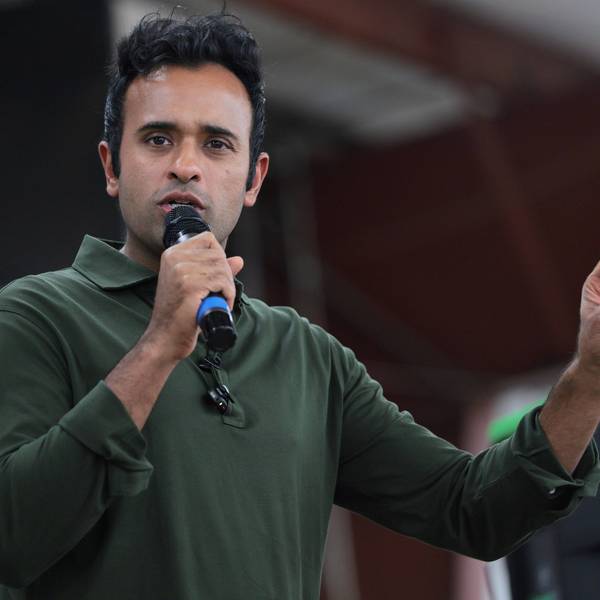


Reps. Mark Amodei (R-Nev.) and Mario Diaz-Balart (R-Fla.) arrive for a committee hearing on June 14, 2023.
Republicans Look to Give Themselves a Pay Raise After Securing Benefit Cuts for the Poor
"This is outrageous," said one critic. "Democrats should raise hell over this."
After taking the global economy hostage to secure painful cuts to aid programs and other federal spending, House Republicans are proposing a pay raise for themselves and other members of Congress for the coming fiscal year.
Roll Call reported Thursday that under spending legislation approved by the Republican-controlled House Appropriations Committee last month, members of Congress "would stand to receive a 4.6%, or $8,000, pay increase" in 2024. Most members of Congress currently make an annual salary of $174,000, putting them in the top 10% of U.S. earners.
"Lawmakers last received a cost-of-living increase in 2009," the outlet noted, "but House Republicans left out the traditional language blocking a cost-of-living increase for members from this year's Legislative Branch bill."
House Legislative Branch Appropriations Chairman Mark Amodei (R-Nev.) told Roll Call that it is "not exactly greedy" to pursue a pay raise for lawmakers after more than a decade of no cost-of-living increase, but he acknowledged the optics are horrible.
"The policy supports, hey, once every twelve years, you can have a cost-of-living increase," Amodei said. "But the politics is—you know how that will go."
"House Republicans are moving to give themselves a raise while taking an ax to education, health, and other essential programs that help grow the economy by growing the middle class."
Colin Seeberger, senior communications adviser at the Center for American Progress Action, urged congressional Democrats to "raise hell over this."
"This is outrageous," Seeberger wrote on Twitter. "House Republicans are moving to give themselves a raise while taking an ax to education, health, and other essential programs that help grow the economy by growing the middle class."
One Democrat, Rep. Angie Craig (D-Minn.), slammed House Republicans for "trying to give themselves a raise while working families struggle to make ends meet."
"That's not what our constituents want—and certainly not what members of Congress need," Craig added.
But Rep. Steny Hoyer (D-Md.), the former House majority leader, expressed support for a raise, telling Roll Call that "precluding members from a COLA adjustment simply decreases their salary every year," which he said "doesn't make any sense."
The Republican-led push for a congressional pay increase comes just weeks after GOP leaders negotiated a debt ceiling agreement with President Joe Biden that imposes new work requirements on older recipients of federal food aid, a change that experts say is likely to strip benefits from around 750,000 low-income people.
Congressional Republicans are also pushing for even steeper cuts to federal spending than were agreed upon in the debt ceiling deal, threatening a government shutdown.
Meanwhile, the House GOP is working to pass legislation that would hand the top 1% of U.S. earners $28 billion in tax cuts next year.
We are at a crossroads
This country and this world are at a monumental crossroads. In a few short weeks, US voters will have an opportunity to beat back the forces of fascism and confront the billionaires who are rigging the economy, our media system, and our democracy, making it increasingly impossible for ordinary people to get by. We’re not just talking about the election. We’re talking about what must be done once these fascist elements are vanquished from power. We need a bolder set of solutions than what either major party has so far been willing to offer and a working-class movement ready to fight like hell for it. Trump didn't emerge from nowhere. The conditions that fueled MAGA authoritarianism were created by decades of radical neoliberal economic policies and a corrupt political system dominated by corporate interests. They slashed taxes on the super-rich, promising that the benefits would trickle down. They said giveaways to the corporate titans would make life more affordable for the rest of us. It was all bullshit. And when a bitter, betrayed populace searches for someone to blame, right-wing demagogues have little trouble finding scapegoats. People know when they're being lied to, but you won't hear any of this from the corporate media. Only independent journalism—powered and funded by people who believe in building a better world—can deliver truly trustworthy daily news. Our Fall Campaign is underway, and we need your help. To power our newsroom through the rest of the year, we need to raise $125,000 by midnight on October 31. So if you share our vision, please contribute whatever you can to sustain our work. |
After taking the global economy hostage to secure painful cuts to aid programs and other federal spending, House Republicans are proposing a pay raise for themselves and other members of Congress for the coming fiscal year.
Roll Call reported Thursday that under spending legislation approved by the Republican-controlled House Appropriations Committee last month, members of Congress "would stand to receive a 4.6%, or $8,000, pay increase" in 2024. Most members of Congress currently make an annual salary of $174,000, putting them in the top 10% of U.S. earners.
"Lawmakers last received a cost-of-living increase in 2009," the outlet noted, "but House Republicans left out the traditional language blocking a cost-of-living increase for members from this year's Legislative Branch bill."
House Legislative Branch Appropriations Chairman Mark Amodei (R-Nev.) told Roll Call that it is "not exactly greedy" to pursue a pay raise for lawmakers after more than a decade of no cost-of-living increase, but he acknowledged the optics are horrible.
"The policy supports, hey, once every twelve years, you can have a cost-of-living increase," Amodei said. "But the politics is—you know how that will go."
"House Republicans are moving to give themselves a raise while taking an ax to education, health, and other essential programs that help grow the economy by growing the middle class."
Colin Seeberger, senior communications adviser at the Center for American Progress Action, urged congressional Democrats to "raise hell over this."
"This is outrageous," Seeberger wrote on Twitter. "House Republicans are moving to give themselves a raise while taking an ax to education, health, and other essential programs that help grow the economy by growing the middle class."
One Democrat, Rep. Angie Craig (D-Minn.), slammed House Republicans for "trying to give themselves a raise while working families struggle to make ends meet."
"That's not what our constituents want—and certainly not what members of Congress need," Craig added.
But Rep. Steny Hoyer (D-Md.), the former House majority leader, expressed support for a raise, telling Roll Call that "precluding members from a COLA adjustment simply decreases their salary every year," which he said "doesn't make any sense."
The Republican-led push for a congressional pay increase comes just weeks after GOP leaders negotiated a debt ceiling agreement with President Joe Biden that imposes new work requirements on older recipients of federal food aid, a change that experts say is likely to strip benefits from around 750,000 low-income people.
Congressional Republicans are also pushing for even steeper cuts to federal spending than were agreed upon in the debt ceiling deal, threatening a government shutdown.
Meanwhile, the House GOP is working to pass legislation that would hand the top 1% of U.S. earners $28 billion in tax cuts next year.