SUBSCRIBE TO OUR FREE NEWSLETTER
Daily news & progressive opinion—funded by the people, not the corporations—delivered straight to your inbox.
5
#000000
#FFFFFF
To donate by check, phone, or other method, see our More Ways to Give page.
Daily news & progressive opinion—funded by the people, not the corporations—delivered straight to your inbox.
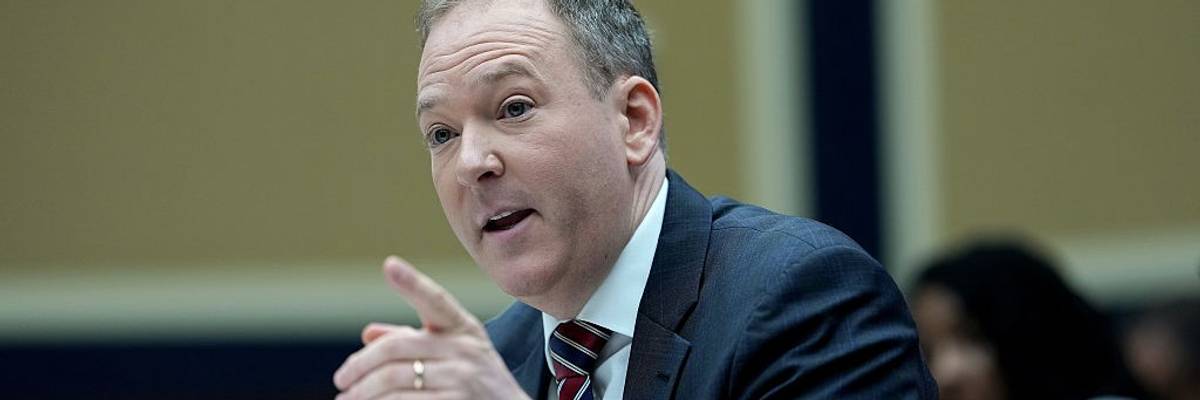
US Environmental Protection Agency (EPA) Administrator Lee Zeldin testifies before Congress on Capitol Hill in Washington, DC on May 20, 2025.
"It’s hard to see how Making America Healthy Again was anything but another broken campaign promise," said one critic.
The US Environmental Protection Agency on Friday announced its anticipated reapproval of dicamba for two key crops, a move which, given the pesticide's proven health risks, places the EPA at apparent odds with President Donald Trump's vow to "Make America Healthy Again."
“The industry cronies at the EPA just approved a pesticide that drifts away from application sites for miles and poisons everything it touches,” Nathan Donley, environmental health science director at the Center for Biological Diversity, said in response to Friday's announcement.
“With the EPA taking aggressive pro-pesticide industry actions like this, it’s hard to see how Making America Healthy Again was anything but another broken campaign promise," Donley added. "When push comes to shove, this administration is willing to bend over backward to appease the pesticide industry, regardless of the consequences to public health or the environment.”
The EPA said in a statement that the agency "established the strongest protections in agency history for over-the-top (OTT) dicamba application on dicamba-tolerant cotton and soybean crops," and that "this decision responds directly to the strong advocacy of America's cotton and soybean farmers."
While scientific studies have linked exposure to high levels of dicamba to increased risk of cancer and hypothyroidism and the European Union has classified dicamba as a category II suspected endocrine disruptor, the EPA said Friday that "when applied according to the new label instructions," it "found no unreasonable risk to human health and the environment from OTT dicamba use."
This is the third time the EPA has approved dicamba for OTT use. On both prior occasions, federal courts blocked the approvals, citing underestimation of the risk of chemical drift that could harm neighboring farms.
The agency highlighted new restrictions on dicamba use it said will reduce risk of drift.
"EPA recognizes that previous drift issues created legitimate concerns, and designed these new label restrictions to directly address them, including cutting the amount of dicamba that can be used annually in half, doubling required safety agents, requiring conservation practices to protect endangered species, and restricting applications during high temperatures when exposure and volatility risks increase," it said.
Critics noted that the EPA during the Biden administration published a report revealing that during Trump’s first term, senior administration officials intentionally excluded scientific evidence of dicamba-related hazards, including the risk of widespread drift damage, prior to a previous reapproval.
Others pointed to the recent appointment of former American Soybean Associate lobbyist and dicamba advocate Kyle Kunkler as the EPA's pesticides chief.
"Kunkler works under two former lobbyists for the American Chemistry Council, Nancy Beck and Lynn Dekleva, who are now overseen by a fourth industry lobbyist, Doug Troutman, who was recently confirmed to lead the chemicals office following endorsement by the chemical council," the Center for Food Safety (CFS) noted Friday.
The Trump EPA has also come under fire for promoting the alleged safety of atrazine, a herbicide that the World Health Organization says probably causes cancer, and for pushing the US Supreme Court to shield Bayer, which makes the likely carcinogenic weedkiller Roundup, from thousands of lawsuits.
CFS science director Bill Freese said that “the Trump administration’s hostility to farmers and rural America knows no bounds."
“Dicamba drift damage threatens farmers’ livelihoods and tears apart rural communities," Freese added. "And these are farmers and communities already reeling from Trump’s [Immigration and Customs Enforcement] raids on farmworkers, the trade war shutdown of soybean exports to China, and Trump’s bailout of Argentina, whose farmers are selling soybeans to the Chinese—soybeans China used to buy from American growers.”
Dear Common Dreams reader, It’s been nearly 30 years since I co-founded Common Dreams with my late wife, Lina Newhouser. We had the radical notion that journalism should serve the public good, not corporate profits. It was clear to us from the outset what it would take to build such a project. No paid advertisements. No corporate sponsors. No millionaire publisher telling us what to think or do. Many people said we wouldn't last a year, but we proved those doubters wrong. Together with a tremendous team of journalists and dedicated staff, we built an independent media outlet free from the constraints of profits and corporate control. Our mission has always been simple: To inform. To inspire. To ignite change for the common good. Building Common Dreams was not easy. Our survival was never guaranteed. When you take on the most powerful forces—Wall Street greed, fossil fuel industry destruction, Big Tech lobbyists, and uber-rich oligarchs who have spent billions upon billions rigging the economy and democracy in their favor—the only bulwark you have is supporters who believe in your work. But here’s the urgent message from me today. It's never been this bad out there. And it's never been this hard to keep us going. At the very moment Common Dreams is most needed, the threats we face are intensifying. We need your support now more than ever. We don't accept corporate advertising and never will. We don't have a paywall because we don't think people should be blocked from critical news based on their ability to pay. Everything we do is funded by the donations of readers like you. When everyone does the little they can afford, we are strong. But if that support retreats or dries up, so do we. Will you donate now to make sure Common Dreams not only survives but thrives? —Craig Brown, Co-founder |
The US Environmental Protection Agency on Friday announced its anticipated reapproval of dicamba for two key crops, a move which, given the pesticide's proven health risks, places the EPA at apparent odds with President Donald Trump's vow to "Make America Healthy Again."
“The industry cronies at the EPA just approved a pesticide that drifts away from application sites for miles and poisons everything it touches,” Nathan Donley, environmental health science director at the Center for Biological Diversity, said in response to Friday's announcement.
“With the EPA taking aggressive pro-pesticide industry actions like this, it’s hard to see how Making America Healthy Again was anything but another broken campaign promise," Donley added. "When push comes to shove, this administration is willing to bend over backward to appease the pesticide industry, regardless of the consequences to public health or the environment.”
The EPA said in a statement that the agency "established the strongest protections in agency history for over-the-top (OTT) dicamba application on dicamba-tolerant cotton and soybean crops," and that "this decision responds directly to the strong advocacy of America's cotton and soybean farmers."
While scientific studies have linked exposure to high levels of dicamba to increased risk of cancer and hypothyroidism and the European Union has classified dicamba as a category II suspected endocrine disruptor, the EPA said Friday that "when applied according to the new label instructions," it "found no unreasonable risk to human health and the environment from OTT dicamba use."
This is the third time the EPA has approved dicamba for OTT use. On both prior occasions, federal courts blocked the approvals, citing underestimation of the risk of chemical drift that could harm neighboring farms.
The agency highlighted new restrictions on dicamba use it said will reduce risk of drift.
"EPA recognizes that previous drift issues created legitimate concerns, and designed these new label restrictions to directly address them, including cutting the amount of dicamba that can be used annually in half, doubling required safety agents, requiring conservation practices to protect endangered species, and restricting applications during high temperatures when exposure and volatility risks increase," it said.
Critics noted that the EPA during the Biden administration published a report revealing that during Trump’s first term, senior administration officials intentionally excluded scientific evidence of dicamba-related hazards, including the risk of widespread drift damage, prior to a previous reapproval.
Others pointed to the recent appointment of former American Soybean Associate lobbyist and dicamba advocate Kyle Kunkler as the EPA's pesticides chief.
"Kunkler works under two former lobbyists for the American Chemistry Council, Nancy Beck and Lynn Dekleva, who are now overseen by a fourth industry lobbyist, Doug Troutman, who was recently confirmed to lead the chemicals office following endorsement by the chemical council," the Center for Food Safety (CFS) noted Friday.
The Trump EPA has also come under fire for promoting the alleged safety of atrazine, a herbicide that the World Health Organization says probably causes cancer, and for pushing the US Supreme Court to shield Bayer, which makes the likely carcinogenic weedkiller Roundup, from thousands of lawsuits.
CFS science director Bill Freese said that “the Trump administration’s hostility to farmers and rural America knows no bounds."
“Dicamba drift damage threatens farmers’ livelihoods and tears apart rural communities," Freese added. "And these are farmers and communities already reeling from Trump’s [Immigration and Customs Enforcement] raids on farmworkers, the trade war shutdown of soybean exports to China, and Trump’s bailout of Argentina, whose farmers are selling soybeans to the Chinese—soybeans China used to buy from American growers.”
The US Environmental Protection Agency on Friday announced its anticipated reapproval of dicamba for two key crops, a move which, given the pesticide's proven health risks, places the EPA at apparent odds with President Donald Trump's vow to "Make America Healthy Again."
“The industry cronies at the EPA just approved a pesticide that drifts away from application sites for miles and poisons everything it touches,” Nathan Donley, environmental health science director at the Center for Biological Diversity, said in response to Friday's announcement.
“With the EPA taking aggressive pro-pesticide industry actions like this, it’s hard to see how Making America Healthy Again was anything but another broken campaign promise," Donley added. "When push comes to shove, this administration is willing to bend over backward to appease the pesticide industry, regardless of the consequences to public health or the environment.”
The EPA said in a statement that the agency "established the strongest protections in agency history for over-the-top (OTT) dicamba application on dicamba-tolerant cotton and soybean crops," and that "this decision responds directly to the strong advocacy of America's cotton and soybean farmers."
While scientific studies have linked exposure to high levels of dicamba to increased risk of cancer and hypothyroidism and the European Union has classified dicamba as a category II suspected endocrine disruptor, the EPA said Friday that "when applied according to the new label instructions," it "found no unreasonable risk to human health and the environment from OTT dicamba use."
This is the third time the EPA has approved dicamba for OTT use. On both prior occasions, federal courts blocked the approvals, citing underestimation of the risk of chemical drift that could harm neighboring farms.
The agency highlighted new restrictions on dicamba use it said will reduce risk of drift.
"EPA recognizes that previous drift issues created legitimate concerns, and designed these new label restrictions to directly address them, including cutting the amount of dicamba that can be used annually in half, doubling required safety agents, requiring conservation practices to protect endangered species, and restricting applications during high temperatures when exposure and volatility risks increase," it said.
Critics noted that the EPA during the Biden administration published a report revealing that during Trump’s first term, senior administration officials intentionally excluded scientific evidence of dicamba-related hazards, including the risk of widespread drift damage, prior to a previous reapproval.
Others pointed to the recent appointment of former American Soybean Associate lobbyist and dicamba advocate Kyle Kunkler as the EPA's pesticides chief.
"Kunkler works under two former lobbyists for the American Chemistry Council, Nancy Beck and Lynn Dekleva, who are now overseen by a fourth industry lobbyist, Doug Troutman, who was recently confirmed to lead the chemicals office following endorsement by the chemical council," the Center for Food Safety (CFS) noted Friday.
The Trump EPA has also come under fire for promoting the alleged safety of atrazine, a herbicide that the World Health Organization says probably causes cancer, and for pushing the US Supreme Court to shield Bayer, which makes the likely carcinogenic weedkiller Roundup, from thousands of lawsuits.
CFS science director Bill Freese said that “the Trump administration’s hostility to farmers and rural America knows no bounds."
“Dicamba drift damage threatens farmers’ livelihoods and tears apart rural communities," Freese added. "And these are farmers and communities already reeling from Trump’s [Immigration and Customs Enforcement] raids on farmworkers, the trade war shutdown of soybean exports to China, and Trump’s bailout of Argentina, whose farmers are selling soybeans to the Chinese—soybeans China used to buy from American growers.”