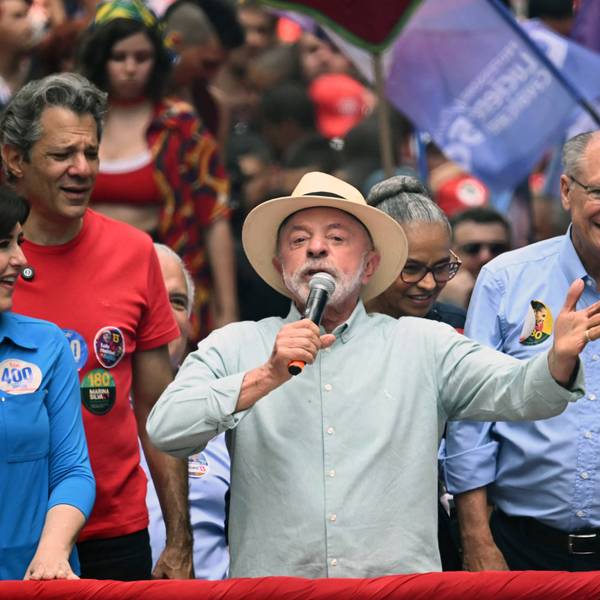
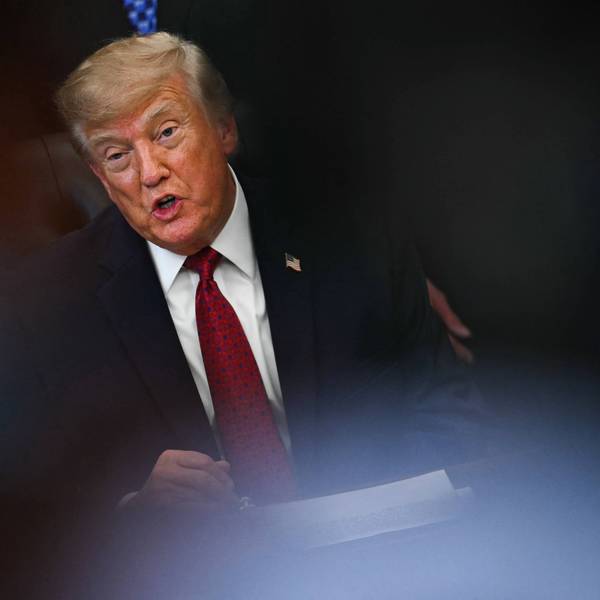
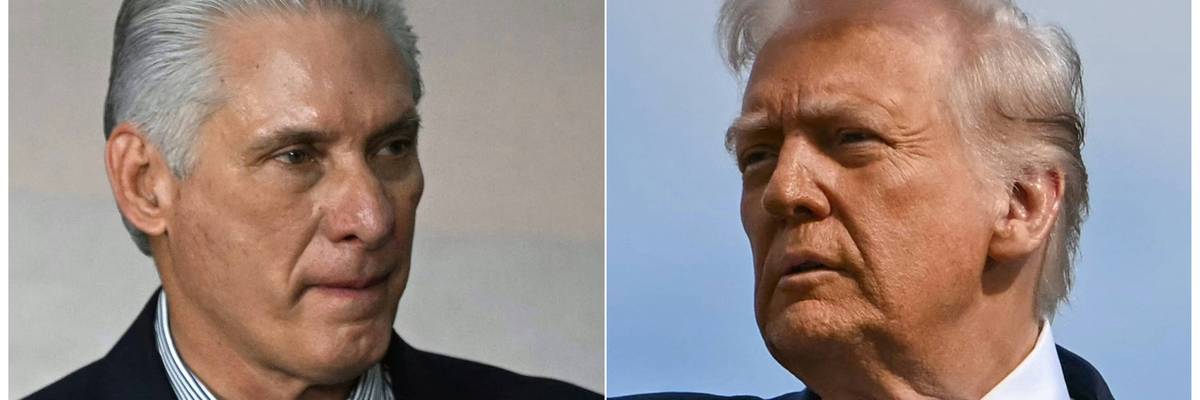
Cuban President and First Secretary Miguel Diaz-Canel is seen in Rio de Janeiro, Brazil, on July 7, 2025, and US President Donald Trump boards Air Force One at Haneda Airport in Tokyo on October 29, 2025.
Cuba Condemns Trump Claim That It Poses ‘Extraordinary Threat’ to US
The White House accused Cuba of supporting terrorist groups as the Trump administration cut off much of the island's energy supply and threatened countries with tariffs if they continue to send Cuba oil.
Cuba's Ministry of Foreign Affairs on Monday said the country is open to expanding "bilateral cooperation" with the US, following President Donald Trump's comments that the White House is "going to make a deal with Cuba"—but diplomatic officials emphasized that they vehemently reject Trump's recent accusations that they harbor terrorists and pose an "unusual and extraordinary threat" to the US.
"Cuba categorically declares that it does not harbor, support, finance, or permit terrorist or extremist organizations," said the ministry.
The statement was released days after the White House issued an executive order to address what it called threats that Cuba poses to the US, threatening to impose new tariffs on countries that sell oil to Cuba.
Trump's invasion of Venezuela—which had been the top energy supplier to Cuba—and his push to take control of the South American country's oil has left Cuba's economy struggling with a virtual energy blockade and rolling blackouts. The US has also been pressuring Mexico to stop supplying energy to the island nation, prompting fears of a potential humanitarian crisis.
White House Deputy Chief of Staff Stephen Miller said last month that the US has the right to take over any country if doing so furthers its interests, and said the Trump administration should "secure our interests unapologetically in our hemisphere."
In the executive order last week, the president made sweeping accusations against Cuba, claiming that it provides support for countries including Russia and China—though the Trump administration has also sought improved relations with Russian President Vladimir Putin and Chinese President Xi Jinping—and offering no evidence for the allegation that it also supports Hamas and Hezbollah.
The Cuban storytelling platform Belly of the Beast called the accusation "laughable, if it weren't so serious," and spoke to some of the hundreds of Palestinian medical students who are studying to be doctors at the Latin American School of Medicine and other institutions.
"The vast majority of Palestinians in Cuba are medical students," said Ihab Masri, who is studying there alongside students from about 100 other countries. "Trump is a person who says he stopped 10 or 12 wars... a person who not only justifies but also denies the genocide in Gaza that they commit and have committed. You can't trust someone like that."
In his attempt to block oil shipments to Cuba, Donald Trump now claims the country is a safe haven for Hamas and Hezbollah, without presenting any evidence. Cubans say it’s complete nonsense. The real story? Hundreds of Palestinian students training to be doctors in Havana. pic.twitter.com/3X24dhF6mN
— Belly of the Beast (@bellybeastcuba) February 1, 2026
Trump's executive order also accused Cuba of spreading "its communist ideas, policies, and practices around the Western Hemisphere, threatening the foreign policy of the United States."
The Ministry of Foreign Affairs on Monday emphasized that "Cuba does not host foreign military or intelligence bases and rejects the characterization that it is a threat to the security of the United States. Nor has it supported any hostile activity against that country, nor will it allow its territory to be used against another nation."
The US has maintained a trade embargo on Cuba for more than six decades and has had hostile relations with the country since the communist revolution gave rise to the late President Fidel Castro and overthrew authoritarian leader Fulgencio Batista, who was backed by the US.
US Rep. Jesús "Chuy" García (D-Ill.) warned that Trump's "latest economic assault against the island is designed to cause a humanitarian collapse, deepening our collective punishment of the Cuban people and forcing more migration."
"Cuba poses no threat to the United States, but that’s not the point. Trump is manufacturing an excuse for cruelty and regime change," added the congressman, while Rep. Rashida Tlaib (D-Mich.) denounced Trump's executive order as "pure cruelty" that could "kill countless innocent Cubans."
Cuban President Miguel Diaz-Canel said last week that Trump's threat against countries that continue to supply energy "reveals the fascist, criminal, and genocidal nature of a clique that has hijacked the interests of the American people for purely personal ends."
On Monday, the global organization Progressive International joined Cuban officials in denouncing Trump's executive order as a "cruel and criminal act of economic warfare that will bring nothing but starvation, deprivation, and despair to [Cuba's] people."
"With this new executive order, the logic of siege has reached its apotheosis: Sanction not only Cuba but every nation that dares show solidarity, effectively demanding that sovereign states choose between the interests of their own people and the dictates of an empire," said the Cabinet of Progressive International.
The group called on the international community to "coordinate diplomatic resistance, demand that governments refuse to enforce secondary tariffs, and amplify Cuban voices against this assault on international law, human dignity, and basic human rights."
"History will judge those who saw this moment and turned away. Cuba stood with oppressed peoples globally—from defeating apartheid in South Africa to sending doctors to the frontlines of epidemics—and now it is our time to act with audacity, moral courage, and collective force," said Progressive International."
"Stand with the Cuban people now," the group added. "Stand against this siege, this economic assault, this unfolding humanitarian disaster; join together in the provision of key supplies to the island, from medicine to food to fuel for its people; and stand for the right of all nations to self-determination and human dignity, or be complicit in its destruction."
We are at a crossroads
This country and this world are at a monumental crossroads. In a few short weeks, US voters will have an opportunity to beat back the forces of fascism and confront the billionaires who are rigging the economy, our media system, and our democracy, making it increasingly impossible for ordinary people to get by. We’re not just talking about the election. We’re talking about what must be done once these fascist elements are vanquished from power. We need a bolder set of solutions than what either major party has so far been willing to offer and a working-class movement ready to fight like hell for it. Trump didn't emerge from nowhere. The conditions that fueled MAGA authoritarianism were created by decades of radical neoliberal economic policies and a corrupt political system dominated by corporate interests. They slashed taxes on the super-rich, promising that the benefits would trickle down. They said giveaways to the corporate titans would make life more affordable for the rest of us. It was all bullshit. And when a bitter, betrayed populace searches for someone to blame, right-wing demagogues have little trouble finding scapegoats. People know when they're being lied to, but you won't hear any of this from the corporate media. Only independent journalism—powered and funded by people who believe in building a better world—can deliver truly trustworthy daily news. Our Fall Campaign is underway, and we need your help. To power our newsroom through the rest of the year, we need to raise $125,000 by midnight on October 31. So if you share our vision, please contribute whatever you can to sustain our work. |
Cuba's Ministry of Foreign Affairs on Monday said the country is open to expanding "bilateral cooperation" with the US, following President Donald Trump's comments that the White House is "going to make a deal with Cuba"—but diplomatic officials emphasized that they vehemently reject Trump's recent accusations that they harbor terrorists and pose an "unusual and extraordinary threat" to the US.
"Cuba categorically declares that it does not harbor, support, finance, or permit terrorist or extremist organizations," said the ministry.
The statement was released days after the White House issued an executive order to address what it called threats that Cuba poses to the US, threatening to impose new tariffs on countries that sell oil to Cuba.
Trump's invasion of Venezuela—which had been the top energy supplier to Cuba—and his push to take control of the South American country's oil has left Cuba's economy struggling with a virtual energy blockade and rolling blackouts. The US has also been pressuring Mexico to stop supplying energy to the island nation, prompting fears of a potential humanitarian crisis.
White House Deputy Chief of Staff Stephen Miller said last month that the US has the right to take over any country if doing so furthers its interests, and said the Trump administration should "secure our interests unapologetically in our hemisphere."
In the executive order last week, the president made sweeping accusations against Cuba, claiming that it provides support for countries including Russia and China—though the Trump administration has also sought improved relations with Russian President Vladimir Putin and Chinese President Xi Jinping—and offering no evidence for the allegation that it also supports Hamas and Hezbollah.
The Cuban storytelling platform Belly of the Beast called the accusation "laughable, if it weren't so serious," and spoke to some of the hundreds of Palestinian medical students who are studying to be doctors at the Latin American School of Medicine and other institutions.
"The vast majority of Palestinians in Cuba are medical students," said Ihab Masri, who is studying there alongside students from about 100 other countries. "Trump is a person who says he stopped 10 or 12 wars... a person who not only justifies but also denies the genocide in Gaza that they commit and have committed. You can't trust someone like that."
In his attempt to block oil shipments to Cuba, Donald Trump now claims the country is a safe haven for Hamas and Hezbollah, without presenting any evidence. Cubans say it’s complete nonsense. The real story? Hundreds of Palestinian students training to be doctors in Havana. pic.twitter.com/3X24dhF6mN
— Belly of the Beast (@bellybeastcuba) February 1, 2026
Trump's executive order also accused Cuba of spreading "its communist ideas, policies, and practices around the Western Hemisphere, threatening the foreign policy of the United States."
The Ministry of Foreign Affairs on Monday emphasized that "Cuba does not host foreign military or intelligence bases and rejects the characterization that it is a threat to the security of the United States. Nor has it supported any hostile activity against that country, nor will it allow its territory to be used against another nation."
The US has maintained a trade embargo on Cuba for more than six decades and has had hostile relations with the country since the communist revolution gave rise to the late President Fidel Castro and overthrew authoritarian leader Fulgencio Batista, who was backed by the US.
US Rep. Jesús "Chuy" García (D-Ill.) warned that Trump's "latest economic assault against the island is designed to cause a humanitarian collapse, deepening our collective punishment of the Cuban people and forcing more migration."
"Cuba poses no threat to the United States, but that’s not the point. Trump is manufacturing an excuse for cruelty and regime change," added the congressman, while Rep. Rashida Tlaib (D-Mich.) denounced Trump's executive order as "pure cruelty" that could "kill countless innocent Cubans."
Cuban President Miguel Diaz-Canel said last week that Trump's threat against countries that continue to supply energy "reveals the fascist, criminal, and genocidal nature of a clique that has hijacked the interests of the American people for purely personal ends."
On Monday, the global organization Progressive International joined Cuban officials in denouncing Trump's executive order as a "cruel and criminal act of economic warfare that will bring nothing but starvation, deprivation, and despair to [Cuba's] people."
"With this new executive order, the logic of siege has reached its apotheosis: Sanction not only Cuba but every nation that dares show solidarity, effectively demanding that sovereign states choose between the interests of their own people and the dictates of an empire," said the Cabinet of Progressive International.
The group called on the international community to "coordinate diplomatic resistance, demand that governments refuse to enforce secondary tariffs, and amplify Cuban voices against this assault on international law, human dignity, and basic human rights."
"History will judge those who saw this moment and turned away. Cuba stood with oppressed peoples globally—from defeating apartheid in South Africa to sending doctors to the frontlines of epidemics—and now it is our time to act with audacity, moral courage, and collective force," said Progressive International."
"Stand with the Cuban people now," the group added. "Stand against this siege, this economic assault, this unfolding humanitarian disaster; join together in the provision of key supplies to the island, from medicine to food to fuel for its people; and stand for the right of all nations to self-determination and human dignity, or be complicit in its destruction."
- More Countries Condemn Trump's 'Imperialist' Saber-Rattling Against Venezuela ›
- 'Pure Evil': Rubio Ripped for Sanctions Against Cuba's Medical Missions ›
- After Venezuela Assault, Trump and Rubio Warn Cuba, Mexico, and Colombia Could Be Next ›
- 'Peace President' Trump Floats 'Friendly Takeover' of Cuba While Preparing to Attack Iran | Common Dreams ›
- 'No Aggressor, No Matter How Powerful, Will Find Surrender in Cuba,' President Warns Trump | Common Dreams ›
- Trump Admin Claims of Cuban Plans for Drone Attacks Denounced as 'Ludicrous Pretext' for War | Common Dreams ›
Cuba's Ministry of Foreign Affairs on Monday said the country is open to expanding "bilateral cooperation" with the US, following President Donald Trump's comments that the White House is "going to make a deal with Cuba"—but diplomatic officials emphasized that they vehemently reject Trump's recent accusations that they harbor terrorists and pose an "unusual and extraordinary threat" to the US.
"Cuba categorically declares that it does not harbor, support, finance, or permit terrorist or extremist organizations," said the ministry.
The statement was released days after the White House issued an executive order to address what it called threats that Cuba poses to the US, threatening to impose new tariffs on countries that sell oil to Cuba.
Trump's invasion of Venezuela—which had been the top energy supplier to Cuba—and his push to take control of the South American country's oil has left Cuba's economy struggling with a virtual energy blockade and rolling blackouts. The US has also been pressuring Mexico to stop supplying energy to the island nation, prompting fears of a potential humanitarian crisis.
White House Deputy Chief of Staff Stephen Miller said last month that the US has the right to take over any country if doing so furthers its interests, and said the Trump administration should "secure our interests unapologetically in our hemisphere."
In the executive order last week, the president made sweeping accusations against Cuba, claiming that it provides support for countries including Russia and China—though the Trump administration has also sought improved relations with Russian President Vladimir Putin and Chinese President Xi Jinping—and offering no evidence for the allegation that it also supports Hamas and Hezbollah.
The Cuban storytelling platform Belly of the Beast called the accusation "laughable, if it weren't so serious," and spoke to some of the hundreds of Palestinian medical students who are studying to be doctors at the Latin American School of Medicine and other institutions.
"The vast majority of Palestinians in Cuba are medical students," said Ihab Masri, who is studying there alongside students from about 100 other countries. "Trump is a person who says he stopped 10 or 12 wars... a person who not only justifies but also denies the genocide in Gaza that they commit and have committed. You can't trust someone like that."
In his attempt to block oil shipments to Cuba, Donald Trump now claims the country is a safe haven for Hamas and Hezbollah, without presenting any evidence. Cubans say it’s complete nonsense. The real story? Hundreds of Palestinian students training to be doctors in Havana. pic.twitter.com/3X24dhF6mN
— Belly of the Beast (@bellybeastcuba) February 1, 2026
Trump's executive order also accused Cuba of spreading "its communist ideas, policies, and practices around the Western Hemisphere, threatening the foreign policy of the United States."
The Ministry of Foreign Affairs on Monday emphasized that "Cuba does not host foreign military or intelligence bases and rejects the characterization that it is a threat to the security of the United States. Nor has it supported any hostile activity against that country, nor will it allow its territory to be used against another nation."
The US has maintained a trade embargo on Cuba for more than six decades and has had hostile relations with the country since the communist revolution gave rise to the late President Fidel Castro and overthrew authoritarian leader Fulgencio Batista, who was backed by the US.
US Rep. Jesús "Chuy" García (D-Ill.) warned that Trump's "latest economic assault against the island is designed to cause a humanitarian collapse, deepening our collective punishment of the Cuban people and forcing more migration."
"Cuba poses no threat to the United States, but that’s not the point. Trump is manufacturing an excuse for cruelty and regime change," added the congressman, while Rep. Rashida Tlaib (D-Mich.) denounced Trump's executive order as "pure cruelty" that could "kill countless innocent Cubans."
Cuban President Miguel Diaz-Canel said last week that Trump's threat against countries that continue to supply energy "reveals the fascist, criminal, and genocidal nature of a clique that has hijacked the interests of the American people for purely personal ends."
On Monday, the global organization Progressive International joined Cuban officials in denouncing Trump's executive order as a "cruel and criminal act of economic warfare that will bring nothing but starvation, deprivation, and despair to [Cuba's] people."
"With this new executive order, the logic of siege has reached its apotheosis: Sanction not only Cuba but every nation that dares show solidarity, effectively demanding that sovereign states choose between the interests of their own people and the dictates of an empire," said the Cabinet of Progressive International.
The group called on the international community to "coordinate diplomatic resistance, demand that governments refuse to enforce secondary tariffs, and amplify Cuban voices against this assault on international law, human dignity, and basic human rights."
"History will judge those who saw this moment and turned away. Cuba stood with oppressed peoples globally—from defeating apartheid in South Africa to sending doctors to the frontlines of epidemics—and now it is our time to act with audacity, moral courage, and collective force," said Progressive International."
"Stand with the Cuban people now," the group added. "Stand against this siege, this economic assault, this unfolding humanitarian disaster; join together in the provision of key supplies to the island, from medicine to food to fuel for its people; and stand for the right of all nations to self-determination and human dignity, or be complicit in its destruction."
- More Countries Condemn Trump's 'Imperialist' Saber-Rattling Against Venezuela ›
- 'Pure Evil': Rubio Ripped for Sanctions Against Cuba's Medical Missions ›
- After Venezuela Assault, Trump and Rubio Warn Cuba, Mexico, and Colombia Could Be Next ›
- 'Peace President' Trump Floats 'Friendly Takeover' of Cuba While Preparing to Attack Iran | Common Dreams ›
- 'No Aggressor, No Matter How Powerful, Will Find Surrender in Cuba,' President Warns Trump | Common Dreams ›
- Trump Admin Claims of Cuban Plans for Drone Attacks Denounced as 'Ludicrous Pretext' for War | Common Dreams ›