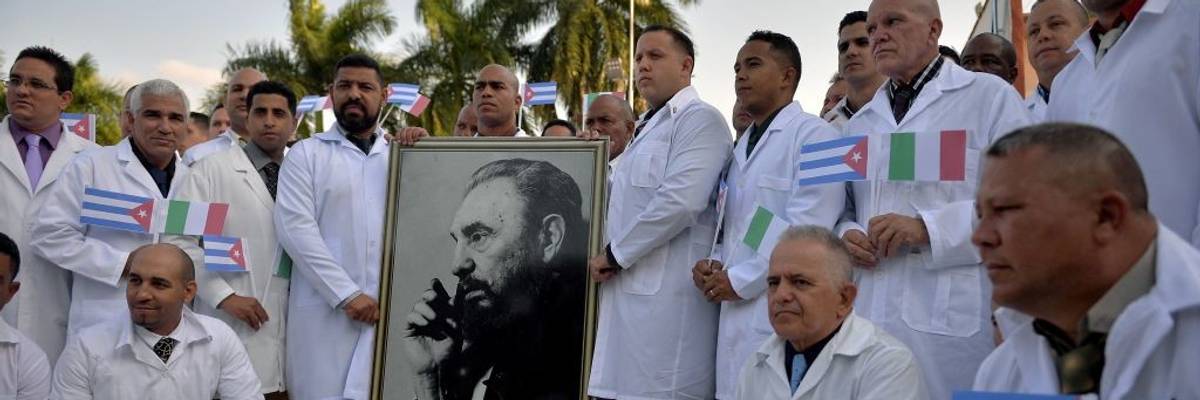
Doctors and nurses of Cuba's Henry Reeve International Medical Brigade pose with a portrait of late Cuban leader Fidel Castro before traveling to Italy to help in the fight against the coronavirus pandemic at the Central Unit of Medical Cooperation in Havana, on March 21, 2020.
'Pure Evil': Rubio Ripped for Sanctions Against Cuba's Medical Missions
"The U.S. State Department should explain to Americans and the international community how the attack on Cuban medical services, on which the health of millions of people in dozens of countries depends, enhances their country," said Cuba's president.
The Trump administration is under fire this week for expanding a visa restriction policy that targets Cuba's medical missions around the world—which U.S. Secretary of State Marco Rubio described as "forced labor," a characterization Cuban officials reject.
"This expanded policy applies to current or former Cuban government officials, and other individuals, including foreign government officials, who are believed to be responsible for, or involved in, the Cuban labor export program, particularly Cuba's overseas medical missions," Rubio, the son of Cuban immigrants, said Tuesday. "This policy also applies to the immediate family of such persons."
Social media users called the Trump administration's move " depraved," "beyond cruel," and "absolutely repulsive," and warned of the impact it could have on patients across the globe.
Medea Benjamin, co-founder of the U.S.-based peace group CodePink, said that "this is PURE EVIL. Punishing people who help provide healthcare to poor people around the world."
As Reuters reported Wednesday:
Since its 1959 leftist revolution, Cuba has dispatched an "army of white coats" to disaster sites and disease outbreaks around the world in the name of solidarity. In the last decade, they have fought cholera in Haiti and Ebola in West Africa.
But Cuba has also exported doctors on more routine missions in exchange for cash or goods in recent decades, an increasingly critical source of hard currency in a nation suffering a deep economic crisis.
Venezueanalysis noted Wednesday that "according to official figures, Cuban doctors in Venezuela numbered as many as 30,000, with approximately 255,000 serving in the country since the start of the program following a deal signed by Venezuelan President Hugo Chávez and Cuban President Fidel Castro in the year 2000, primarily working in low-income barrios. Havana's support was key during the Covid-19 pandemic, supplying vaccines that Caracas found hard to secure due to wide-reaching U.S. sanctions."
Cuba has been targeted by U.S. sanctions for decades—and although former President Joe Biden notified Congress of his intent to remove the island nation from the State Sponsors of Terrorism list shortly before leaving office last month, President Donald Trump swiftly reversed that decision and restored a list of "restricted entities" created during the Republican's first term.
Cuban President Miguel Díaz-Canel and Foreign Minister Bruno Rodriguez denounced those decisions and the visa policy.
Rodriguez took aim at the U.S. secretary of state on Tuesday, saying in English and Spanish social media posts that "once again, Marco Rubio puts his personal agenda before the U.S. interests. The suspension of visas associated to Cuba's international medical cooperation is the seventh unjustified aggressive measure against our population within a month."
"The decision announced today, based on falsehoods and coercion, is intended to affect health services of millions in Cuba and the world, to benefit special groups of interest for which Rubio... guarantees the squandering of the U.S. taxpayers' money," he said.
Díaz-Canel said that "the U.S. State Department should explain to Americans and the international community how the attack on Cuban medical services, on which the health of millions of people in dozens of countries depends, enhances their country."
The new sanctions against Cuba notably come as Republicans in the U.S. Congress work to gut healthcare programs that serve low-income Americans, who have to contend with a for-profit healthcare system dominated by corporate greed.
Every person living in Cuba has access to its universal healthcare system, which is free at the point of service and government-run.
We are at a crossroads
This country and this world are at a monumental crossroads. In a few short weeks, US voters will have an opportunity to beat back the forces of fascism and confront the billionaires who are rigging the economy, our media system, and our democracy, making it increasingly impossible for ordinary people to get by. We’re not just talking about the election. We’re talking about what must be done once these fascist elements are vanquished from power. We need a bolder set of solutions than what either major party has so far been willing to offer and a working-class movement ready to fight like hell for it. Trump didn't emerge from nowhere. The conditions that fueled MAGA authoritarianism were created by decades of radical neoliberal economic policies and a corrupt political system dominated by corporate interests. They slashed taxes on the super-rich, promising that the benefits would trickle down. They said giveaways to the corporate titans would make life more affordable for the rest of us. It was all bullshit. And when a bitter, betrayed populace searches for someone to blame, right-wing demagogues have little trouble finding scapegoats. People know when they're being lied to, but you won't hear any of this from the corporate media. Only independent journalism—powered and funded by people who believe in building a better world—can deliver truly trustworthy daily news. Our Fall Campaign is underway, and we need your help. To power our newsroom through the rest of the year, we need to raise $125,000 by midnight on October 31. So if you share our vision, please contribute whatever you can to sustain our work. |
The Trump administration is under fire this week for expanding a visa restriction policy that targets Cuba's medical missions around the world—which U.S. Secretary of State Marco Rubio described as "forced labor," a characterization Cuban officials reject.
"This expanded policy applies to current or former Cuban government officials, and other individuals, including foreign government officials, who are believed to be responsible for, or involved in, the Cuban labor export program, particularly Cuba's overseas medical missions," Rubio, the son of Cuban immigrants, said Tuesday. "This policy also applies to the immediate family of such persons."
Social media users called the Trump administration's move " depraved," "beyond cruel," and "absolutely repulsive," and warned of the impact it could have on patients across the globe.
Medea Benjamin, co-founder of the U.S.-based peace group CodePink, said that "this is PURE EVIL. Punishing people who help provide healthcare to poor people around the world."
As Reuters reported Wednesday:
Since its 1959 leftist revolution, Cuba has dispatched an "army of white coats" to disaster sites and disease outbreaks around the world in the name of solidarity. In the last decade, they have fought cholera in Haiti and Ebola in West Africa.
But Cuba has also exported doctors on more routine missions in exchange for cash or goods in recent decades, an increasingly critical source of hard currency in a nation suffering a deep economic crisis.
Venezueanalysis noted Wednesday that "according to official figures, Cuban doctors in Venezuela numbered as many as 30,000, with approximately 255,000 serving in the country since the start of the program following a deal signed by Venezuelan President Hugo Chávez and Cuban President Fidel Castro in the year 2000, primarily working in low-income barrios. Havana's support was key during the Covid-19 pandemic, supplying vaccines that Caracas found hard to secure due to wide-reaching U.S. sanctions."
Cuba has been targeted by U.S. sanctions for decades—and although former President Joe Biden notified Congress of his intent to remove the island nation from the State Sponsors of Terrorism list shortly before leaving office last month, President Donald Trump swiftly reversed that decision and restored a list of "restricted entities" created during the Republican's first term.
Cuban President Miguel Díaz-Canel and Foreign Minister Bruno Rodriguez denounced those decisions and the visa policy.
Rodriguez took aim at the U.S. secretary of state on Tuesday, saying in English and Spanish social media posts that "once again, Marco Rubio puts his personal agenda before the U.S. interests. The suspension of visas associated to Cuba's international medical cooperation is the seventh unjustified aggressive measure against our population within a month."
"The decision announced today, based on falsehoods and coercion, is intended to affect health services of millions in Cuba and the world, to benefit special groups of interest for which Rubio... guarantees the squandering of the U.S. taxpayers' money," he said.
Díaz-Canel said that "the U.S. State Department should explain to Americans and the international community how the attack on Cuban medical services, on which the health of millions of people in dozens of countries depends, enhances their country."
The new sanctions against Cuba notably come as Republicans in the U.S. Congress work to gut healthcare programs that serve low-income Americans, who have to contend with a for-profit healthcare system dominated by corporate greed.
Every person living in Cuba has access to its universal healthcare system, which is free at the point of service and government-run.
- As Progressives Call for End to Blockade, Biden Announces More Sanctions Against Cuba ›
- 'Two Genocidaires v. the World': US, Israel Oppose Lifting Cuba Blockade ›
- 'Far Too Little, Far Too Late,' Say Critics as Biden Finally Removes Cuba From Terror List ›
- Ocasio-Cortez Slams Biden Administration for Upholding 'Absurdly Cruel' Cuba Embargo ›
- 'Despicable': Outgoing Trump Administration to Designate Cuba a 'State Sponsor of Terrorism' ›
- Cuba Condemns Trump Claim That It Poses ‘Extraordinary Threat’ to US | Common Dreams ›
- Opinion | The US Must Stop Asphyxiating Cuba Now | Common Dreams ›
- Israel's US-Backed Assault on Gaza Set Stage for Collective Punishment in Cuba, AOC Says | Common Dreams ›
- Reporting Says Rubio 'Deliberately' Lying to Trump About US-Cuba Talks | Common Dreams ›
- Opinion | The US War on Cuba's Doctors | Common Dreams ›
- 'Lethal and Illegal Economic Aggression': Trump, Rubio Rebuked for New Sanctions on Cuba | Common Dreams ›
The Trump administration is under fire this week for expanding a visa restriction policy that targets Cuba's medical missions around the world—which U.S. Secretary of State Marco Rubio described as "forced labor," a characterization Cuban officials reject.
"This expanded policy applies to current or former Cuban government officials, and other individuals, including foreign government officials, who are believed to be responsible for, or involved in, the Cuban labor export program, particularly Cuba's overseas medical missions," Rubio, the son of Cuban immigrants, said Tuesday. "This policy also applies to the immediate family of such persons."
Social media users called the Trump administration's move " depraved," "beyond cruel," and "absolutely repulsive," and warned of the impact it could have on patients across the globe.
Medea Benjamin, co-founder of the U.S.-based peace group CodePink, said that "this is PURE EVIL. Punishing people who help provide healthcare to poor people around the world."
As Reuters reported Wednesday:
Since its 1959 leftist revolution, Cuba has dispatched an "army of white coats" to disaster sites and disease outbreaks around the world in the name of solidarity. In the last decade, they have fought cholera in Haiti and Ebola in West Africa.
But Cuba has also exported doctors on more routine missions in exchange for cash or goods in recent decades, an increasingly critical source of hard currency in a nation suffering a deep economic crisis.
Venezueanalysis noted Wednesday that "according to official figures, Cuban doctors in Venezuela numbered as many as 30,000, with approximately 255,000 serving in the country since the start of the program following a deal signed by Venezuelan President Hugo Chávez and Cuban President Fidel Castro in the year 2000, primarily working in low-income barrios. Havana's support was key during the Covid-19 pandemic, supplying vaccines that Caracas found hard to secure due to wide-reaching U.S. sanctions."
Cuba has been targeted by U.S. sanctions for decades—and although former President Joe Biden notified Congress of his intent to remove the island nation from the State Sponsors of Terrorism list shortly before leaving office last month, President Donald Trump swiftly reversed that decision and restored a list of "restricted entities" created during the Republican's first term.
Cuban President Miguel Díaz-Canel and Foreign Minister Bruno Rodriguez denounced those decisions and the visa policy.
Rodriguez took aim at the U.S. secretary of state on Tuesday, saying in English and Spanish social media posts that "once again, Marco Rubio puts his personal agenda before the U.S. interests. The suspension of visas associated to Cuba's international medical cooperation is the seventh unjustified aggressive measure against our population within a month."
"The decision announced today, based on falsehoods and coercion, is intended to affect health services of millions in Cuba and the world, to benefit special groups of interest for which Rubio... guarantees the squandering of the U.S. taxpayers' money," he said.
Díaz-Canel said that "the U.S. State Department should explain to Americans and the international community how the attack on Cuban medical services, on which the health of millions of people in dozens of countries depends, enhances their country."
The new sanctions against Cuba notably come as Republicans in the U.S. Congress work to gut healthcare programs that serve low-income Americans, who have to contend with a for-profit healthcare system dominated by corporate greed.
Every person living in Cuba has access to its universal healthcare system, which is free at the point of service and government-run.
- As Progressives Call for End to Blockade, Biden Announces More Sanctions Against Cuba ›
- 'Two Genocidaires v. the World': US, Israel Oppose Lifting Cuba Blockade ›
- 'Far Too Little, Far Too Late,' Say Critics as Biden Finally Removes Cuba From Terror List ›
- Ocasio-Cortez Slams Biden Administration for Upholding 'Absurdly Cruel' Cuba Embargo ›
- 'Despicable': Outgoing Trump Administration to Designate Cuba a 'State Sponsor of Terrorism' ›
- Cuba Condemns Trump Claim That It Poses ‘Extraordinary Threat’ to US | Common Dreams ›
- Opinion | The US Must Stop Asphyxiating Cuba Now | Common Dreams ›
- Israel's US-Backed Assault on Gaza Set Stage for Collective Punishment in Cuba, AOC Says | Common Dreams ›
- Reporting Says Rubio 'Deliberately' Lying to Trump About US-Cuba Talks | Common Dreams ›
- Opinion | The US War on Cuba's Doctors | Common Dreams ›
- 'Lethal and Illegal Economic Aggression': Trump, Rubio Rebuked for New Sanctions on Cuba | Common Dreams ›