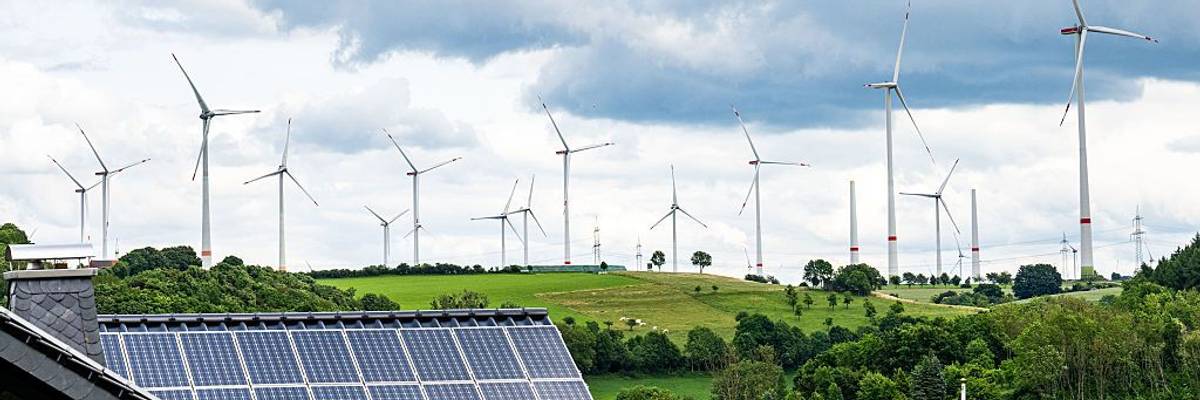
Houses in the so-called 'smart city' of Etteln, Germany, are seen equipped with solar panels on the roofs on June 6, 2025.
UN Report Estimates Bold Climate Action Would Deliver $100 Trillion in Benefits by 2100
"If we choose to stay on the current path—powering our economies with fossil fuels, extracting virgin resources, destroying nature, polluting the environment—the damages would stack up."
A new report from the United Nations Environment Program has found that addressing the global climate emergency would deliver major economic benefits, in addition to creating a cleaner and more habitable planet.
The seventh edition of the Global Environmental Outlook (GEO), released on Tuesday, estimates that making up-front investments in climate action now would begin to yield global macroeconomic benefits starting in 2050, potentially growing to $20 trillion per year by 2070 and $100 trillion by 2100.
The report, which was the product of nearly 300 multi-disciplinary scientists across more than 80 countries, argues that a total of $8 trillion in annual investment from this year until 2050 would be needed to achieve its climate goals. But, the report stresses, the cost of inaction would be far greater.
"If we choose to stay on the current path—powering our economies with fossil fuels, extracting virgin resources, destroying nature, polluting the environment—the damages would stack up," the report warns. "Climate change would cut 4% off annual global GDP by 2050, claim many lives, and increase forced migration."
Other likely consequences of inaction, warns the report, include "Amazon forest dieback and ice-sheet collapse," along with the loss of "hundreds of millions more hectares of natural lands." The report also projects that global food availability will fall if the climate crisis is not addressed, and that increased air pollution will cause an additional 4 million premature deaths per year.
The report recommends a rapid move away from fossil fuels, as well as a drastic rethinking of agricultural subsidies so that they no longer "directly favor activities that have significant harmful effects on the environment, including on biodiversity."
Robert Watson, a co-chair of the GEO assessment, said in an interview with the Guardian that the climate crisis cannot simply be seen as an environmental issue given that it is now "undermining our economy, food security, water security, human health," and also creating national security problems by increasing "conflict in many parts of the world."
In an interview with BBC, Watson also accused US President Donald Trump's administration of sabotaging the report by refusing to even accept its conclusions about the damage being done by human-induced climate change.
"The US decided not to attend the meeting at all," he explained. "At the very end they joined by teleconference and basically made a statement that they could not agree with most of the report, which means they didn't agree with anything we said on climate change, biodiversity, fossil fuels, plastics, and subsidies."
We are at a crossroads
This country and this world are at a monumental crossroads. In a few short weeks, US voters will have an opportunity to beat back the forces of fascism and confront the billionaires who are rigging the economy, our media system, and our democracy, making it increasingly impossible for ordinary people to get by. We’re not just talking about the election. We’re talking about what must be done once these fascist elements are vanquished from power. We need a bolder set of solutions than what either major party has so far been willing to offer and a working-class movement ready to fight like hell for it. Trump didn't emerge from nowhere. The conditions that fueled MAGA authoritarianism were created by decades of radical neoliberal economic policies and a corrupt political system dominated by corporate interests. They slashed taxes on the super-rich, promising that the benefits would trickle down. They said giveaways to the corporate titans would make life more affordable for the rest of us. It was all bullshit. And when a bitter, betrayed populace searches for someone to blame, right-wing demagogues have little trouble finding scapegoats. People know when they're being lied to, but you won't hear any of this from the corporate media. Only independent journalism—powered and funded by people who believe in building a better world—can deliver truly trustworthy daily news. Our Fall Campaign is underway, and we need your help. To power our newsroom through the rest of the year, we need to raise $125,000 by midnight on October 31. So if you share our vision, please contribute whatever you can to sustain our work. |
A new report from the United Nations Environment Program has found that addressing the global climate emergency would deliver major economic benefits, in addition to creating a cleaner and more habitable planet.
The seventh edition of the Global Environmental Outlook (GEO), released on Tuesday, estimates that making up-front investments in climate action now would begin to yield global macroeconomic benefits starting in 2050, potentially growing to $20 trillion per year by 2070 and $100 trillion by 2100.
The report, which was the product of nearly 300 multi-disciplinary scientists across more than 80 countries, argues that a total of $8 trillion in annual investment from this year until 2050 would be needed to achieve its climate goals. But, the report stresses, the cost of inaction would be far greater.
"If we choose to stay on the current path—powering our economies with fossil fuels, extracting virgin resources, destroying nature, polluting the environment—the damages would stack up," the report warns. "Climate change would cut 4% off annual global GDP by 2050, claim many lives, and increase forced migration."
Other likely consequences of inaction, warns the report, include "Amazon forest dieback and ice-sheet collapse," along with the loss of "hundreds of millions more hectares of natural lands." The report also projects that global food availability will fall if the climate crisis is not addressed, and that increased air pollution will cause an additional 4 million premature deaths per year.
The report recommends a rapid move away from fossil fuels, as well as a drastic rethinking of agricultural subsidies so that they no longer "directly favor activities that have significant harmful effects on the environment, including on biodiversity."
Robert Watson, a co-chair of the GEO assessment, said in an interview with the Guardian that the climate crisis cannot simply be seen as an environmental issue given that it is now "undermining our economy, food security, water security, human health," and also creating national security problems by increasing "conflict in many parts of the world."
In an interview with BBC, Watson also accused US President Donald Trump's administration of sabotaging the report by refusing to even accept its conclusions about the damage being done by human-induced climate change.
"The US decided not to attend the meeting at all," he explained. "At the very end they joined by teleconference and basically made a statement that they could not agree with most of the report, which means they didn't agree with anything we said on climate change, biodiversity, fossil fuels, plastics, and subsidies."
- Ahead of COP30, UN Report Shows 1.5°C Will Be Breached as Countries Pledge Just 10% Emissions Cut ›
- Army of 5,000+ Fossil Fuel Lobbyists Has 'Stranglehold on Climate Action' at COP30: Report ›
- All Eyes Are on World Leaders to Do Better at the Climate Ambition Summit ›
- Scientists Warn 'Garbage' Models Underestimate Risk of Economic Collapse From Climate Crisis | Common Dreams ›
- 'Every Key Climate Indicator Is Flashing Red' in New UN Report | Common Dreams ›
- With Planet Set to Overshoot 1.5°C Threshold, Emissions Must Still Be Cut Rapidly to Limit Damage: UN Report | Common Dreams ›
A new report from the United Nations Environment Program has found that addressing the global climate emergency would deliver major economic benefits, in addition to creating a cleaner and more habitable planet.
The seventh edition of the Global Environmental Outlook (GEO), released on Tuesday, estimates that making up-front investments in climate action now would begin to yield global macroeconomic benefits starting in 2050, potentially growing to $20 trillion per year by 2070 and $100 trillion by 2100.
The report, which was the product of nearly 300 multi-disciplinary scientists across more than 80 countries, argues that a total of $8 trillion in annual investment from this year until 2050 would be needed to achieve its climate goals. But, the report stresses, the cost of inaction would be far greater.
"If we choose to stay on the current path—powering our economies with fossil fuels, extracting virgin resources, destroying nature, polluting the environment—the damages would stack up," the report warns. "Climate change would cut 4% off annual global GDP by 2050, claim many lives, and increase forced migration."
Other likely consequences of inaction, warns the report, include "Amazon forest dieback and ice-sheet collapse," along with the loss of "hundreds of millions more hectares of natural lands." The report also projects that global food availability will fall if the climate crisis is not addressed, and that increased air pollution will cause an additional 4 million premature deaths per year.
The report recommends a rapid move away from fossil fuels, as well as a drastic rethinking of agricultural subsidies so that they no longer "directly favor activities that have significant harmful effects on the environment, including on biodiversity."
Robert Watson, a co-chair of the GEO assessment, said in an interview with the Guardian that the climate crisis cannot simply be seen as an environmental issue given that it is now "undermining our economy, food security, water security, human health," and also creating national security problems by increasing "conflict in many parts of the world."
In an interview with BBC, Watson also accused US President Donald Trump's administration of sabotaging the report by refusing to even accept its conclusions about the damage being done by human-induced climate change.
"The US decided not to attend the meeting at all," he explained. "At the very end they joined by teleconference and basically made a statement that they could not agree with most of the report, which means they didn't agree with anything we said on climate change, biodiversity, fossil fuels, plastics, and subsidies."
- Ahead of COP30, UN Report Shows 1.5°C Will Be Breached as Countries Pledge Just 10% Emissions Cut ›
- Army of 5,000+ Fossil Fuel Lobbyists Has 'Stranglehold on Climate Action' at COP30: Report ›
- All Eyes Are on World Leaders to Do Better at the Climate Ambition Summit ›
- Scientists Warn 'Garbage' Models Underestimate Risk of Economic Collapse From Climate Crisis | Common Dreams ›
- 'Every Key Climate Indicator Is Flashing Red' in New UN Report | Common Dreams ›
- With Planet Set to Overshoot 1.5°C Threshold, Emissions Must Still Be Cut Rapidly to Limit Damage: UN Report | Common Dreams ›