SUBSCRIBE TO OUR FREE NEWSLETTER
Daily news & progressive opinion—funded by the people, not the corporations—delivered straight to your inbox.
5
#000000
#FFFFFF
To donate by check, phone, or other method, see our More Ways to Give page.
Daily news & progressive opinion—funded by the people, not the corporations—delivered straight to your inbox.
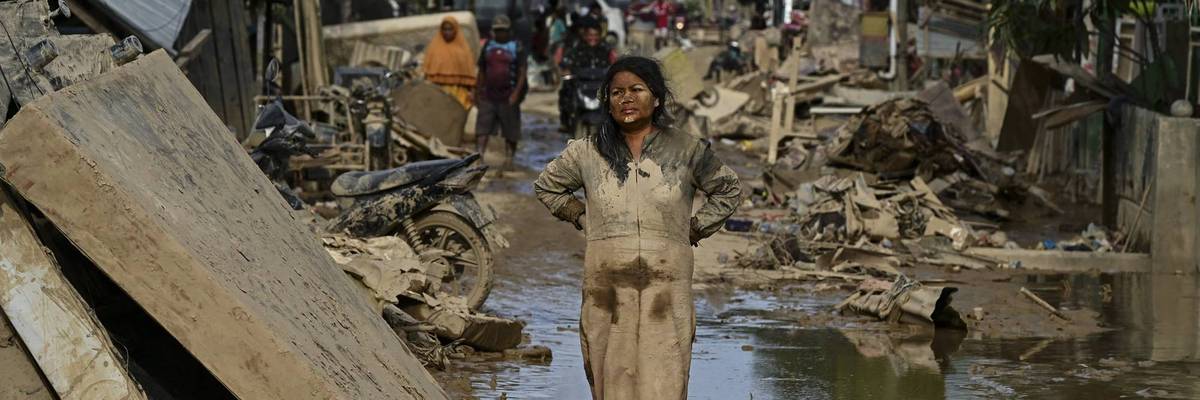
A woman covered in mud stands on a street surrounded by debris after a flash flood hit the area in Aceh Tamiang, Indonesia on December 6, 2025.
“Humanity has just endured the 11 hottest years on record," said the secretary-general of the United Nations. "When history repeats itself 11 times, it is no longer a coincidence. It is a call to act."
The annual State of the Global Climate report by the United Nations' top meteorological agency was released Monday, marking the first time the authors of the report have included the Earth's energy imbalance as a key indicator of the climate emergency.
The World Meteorological Organization's (WMO) inclusion of the imbalance only provides more evidence of what scientists have been warning for decades: The continued extraction of fossil fuels is causing heat-trapping gases like carbon dioxide and methane to build up in the atmosphere and is causing planetary heating, which is leading to extreme weather including wildfires, drought, and severe hurricanes and cyclones.
The State of the Global Climate report explains that in a stable climate, incoming solar energy is roughly equal to the amount of energy leaving the Earth.
But with greenhouse gases at their highest level in the atmosphere in at least 800,000 years, that equilibrium has been thrown off, and the energy imbalance—which has increased steadily over the past two decades—is at its highest since the observational record began in 1960.
Instead of leaving the Earth system, energy is increasingly staying in the planet's surface and deep within the oceans.
Ashkay Deoras, a research scientist at the National Center for Atmospheric Science at the University of Reading in the UK, who was not associated with the report, compared the trapped energy to a hot room.
“If you open the window, naturally, you will allow the hot air to escape,” Deoras told The New York Times. “But now what is happening is that, because of all these greenhouse gases, they are just trapping more and more heat. The planet is just not getting a chance to cool down.”
The report emphasized that the higher temperatures humans feel at the Earth's surface—which have been the hottest in history over the past 11 years—represent just 1% of the excess energy that isn't leaving the planet system.
Five percent of the excess heat is stored in continental land masses, while more than 91% is stored in the ocean.
As fossil fuel emissions have increased and built up, the ocean has been absorbing about 18 times the energy used by humans each year for the past two decades, according to the report.
“Scientific advances have improved our understanding of the Earth’s energy imbalance and of the reality facing our planet and our climate right now,” said WMO Secretary-General Celeste Saulo. “Human activities are increasingly disrupting the natural equilibrium and we will live with these consequences for hundreds and thousands of years.”
UN Secretary-General António Guterres emphasized that in addition to the energy imbalance, "every key climate indicator is flashing red" in the new report.
Last year was the second- or third-hottest year on record, depending on the data set, owing to La Niña conditions that temporarily cooled the planet. Earth was about 1.43°C warmer than the pre-industrial average, and 2024—when hotter El Niño conditions were in effect—remains the hottest year with global temperatures averaging 1.55°C above pre-industrial levels.
About 3% of excess energy warms and melts ice, and ice sheets on Antarctica and Greenland lost significant mass in 2025, while the average Arctic sea-ice extent last year was the lowest or second-lowest on record.
The loss of Arctic and Antarctic ice is driving the long-term rise in the global mean sea level, with was around 11 centimeters higher at the end of 2025 than it was in January 1993, when satellite records began.
“The State of the Global Climate is in a state of emergency. Planet Earth is being pushed beyond its limits," said Guterres. “Humanity has just endured the 11 hottest years on record. When history repeats itself 11 times, it is no longer a coincidence. It is a call to act."
The secretary-general added in a video posted on social media that the world must "accelerate a just transition" to renewable energy to protect "climate security, energy security, and national security."
In this age of war our addiction to fossil fuels is destabilizing the climate, global economy & global security.
Now more than ever, we must accelerate a just transition to renewable energy.
Renewables deliver climate security, energy security & national security. pic.twitter.com/TrphJ2Zwa2
— António Guterres (@antonioguterres) March 23, 2026
Saulo noted that the impact of catastrophic planetary heating grew increasingly evident in 2025, with "heatwaves, wildfires, drought, tropical cyclones, storms, and flooding" causing thousands of deaths and billions of dollars in economic losses.
The World Weather Attribution found that a heatwave across the western US last week would have been "virtually impossible" without the climate emergency. Climate researchers also concluded last summer that devastating floods in central Texas were caused by "very exceptional meteorological conditions," and the climate crisis "supercharged" the conditions that led to the extreme rainfall and flooding that killed 1,750 people in South Asia late last year.
Meanwhile, US President Donald Trump—whose country is the largest historical emitter of greenhouse gases—has taken steps to weaken the world's ability to respond to the climate emergency, withdrawing from dozens of climate- and energy-related international treaties and slashing climate research and emergency response spending.
Trump has also pushed for more fossil fuel emissions—investing in the expensive, pollution-causing coal industry; demanding that the Pentagon obtain energy from coal plants; and mandating oil and gas lease sales.
"The way ahead," said Guterrres, "must be grounded in science, common sense, and the courage to take urgent climate action."
Dear Common Dreams reader, It’s been nearly 30 years since I co-founded Common Dreams with my late wife, Lina Newhouser. We had the radical notion that journalism should serve the public good, not corporate profits. It was clear to us from the outset what it would take to build such a project. No paid advertisements. No corporate sponsors. No millionaire publisher telling us what to think or do. Many people said we wouldn't last a year, but we proved those doubters wrong. Together with a tremendous team of journalists and dedicated staff, we built an independent media outlet free from the constraints of profits and corporate control. Our mission has always been simple: To inform. To inspire. To ignite change for the common good. Building Common Dreams was not easy. Our survival was never guaranteed. When you take on the most powerful forces—Wall Street greed, fossil fuel industry destruction, Big Tech lobbyists, and uber-rich oligarchs who have spent billions upon billions rigging the economy and democracy in their favor—the only bulwark you have is supporters who believe in your work. But here’s the urgent message from me today. It's never been this bad out there. And it's never been this hard to keep us going. At the very moment Common Dreams is most needed, the threats we face are intensifying. We need your support now more than ever. We don't accept corporate advertising and never will. We don't have a paywall because we don't think people should be blocked from critical news based on their ability to pay. Everything we do is funded by the donations of readers like you. When everyone does the little they can afford, we are strong. But if that support retreats or dries up, so do we. Will you donate now to make sure Common Dreams not only survives but thrives? —Craig Brown, Co-founder |
The annual State of the Global Climate report by the United Nations' top meteorological agency was released Monday, marking the first time the authors of the report have included the Earth's energy imbalance as a key indicator of the climate emergency.
The World Meteorological Organization's (WMO) inclusion of the imbalance only provides more evidence of what scientists have been warning for decades: The continued extraction of fossil fuels is causing heat-trapping gases like carbon dioxide and methane to build up in the atmosphere and is causing planetary heating, which is leading to extreme weather including wildfires, drought, and severe hurricanes and cyclones.
The State of the Global Climate report explains that in a stable climate, incoming solar energy is roughly equal to the amount of energy leaving the Earth.
But with greenhouse gases at their highest level in the atmosphere in at least 800,000 years, that equilibrium has been thrown off, and the energy imbalance—which has increased steadily over the past two decades—is at its highest since the observational record began in 1960.
Instead of leaving the Earth system, energy is increasingly staying in the planet's surface and deep within the oceans.
Ashkay Deoras, a research scientist at the National Center for Atmospheric Science at the University of Reading in the UK, who was not associated with the report, compared the trapped energy to a hot room.
“If you open the window, naturally, you will allow the hot air to escape,” Deoras told The New York Times. “But now what is happening is that, because of all these greenhouse gases, they are just trapping more and more heat. The planet is just not getting a chance to cool down.”
The report emphasized that the higher temperatures humans feel at the Earth's surface—which have been the hottest in history over the past 11 years—represent just 1% of the excess energy that isn't leaving the planet system.
Five percent of the excess heat is stored in continental land masses, while more than 91% is stored in the ocean.
As fossil fuel emissions have increased and built up, the ocean has been absorbing about 18 times the energy used by humans each year for the past two decades, according to the report.
“Scientific advances have improved our understanding of the Earth’s energy imbalance and of the reality facing our planet and our climate right now,” said WMO Secretary-General Celeste Saulo. “Human activities are increasingly disrupting the natural equilibrium and we will live with these consequences for hundreds and thousands of years.”
UN Secretary-General António Guterres emphasized that in addition to the energy imbalance, "every key climate indicator is flashing red" in the new report.
Last year was the second- or third-hottest year on record, depending on the data set, owing to La Niña conditions that temporarily cooled the planet. Earth was about 1.43°C warmer than the pre-industrial average, and 2024—when hotter El Niño conditions were in effect—remains the hottest year with global temperatures averaging 1.55°C above pre-industrial levels.
About 3% of excess energy warms and melts ice, and ice sheets on Antarctica and Greenland lost significant mass in 2025, while the average Arctic sea-ice extent last year was the lowest or second-lowest on record.
The loss of Arctic and Antarctic ice is driving the long-term rise in the global mean sea level, with was around 11 centimeters higher at the end of 2025 than it was in January 1993, when satellite records began.
“The State of the Global Climate is in a state of emergency. Planet Earth is being pushed beyond its limits," said Guterres. “Humanity has just endured the 11 hottest years on record. When history repeats itself 11 times, it is no longer a coincidence. It is a call to act."
The secretary-general added in a video posted on social media that the world must "accelerate a just transition" to renewable energy to protect "climate security, energy security, and national security."
In this age of war our addiction to fossil fuels is destabilizing the climate, global economy & global security.
Now more than ever, we must accelerate a just transition to renewable energy.
Renewables deliver climate security, energy security & national security. pic.twitter.com/TrphJ2Zwa2
— António Guterres (@antonioguterres) March 23, 2026
Saulo noted that the impact of catastrophic planetary heating grew increasingly evident in 2025, with "heatwaves, wildfires, drought, tropical cyclones, storms, and flooding" causing thousands of deaths and billions of dollars in economic losses.
The World Weather Attribution found that a heatwave across the western US last week would have been "virtually impossible" without the climate emergency. Climate researchers also concluded last summer that devastating floods in central Texas were caused by "very exceptional meteorological conditions," and the climate crisis "supercharged" the conditions that led to the extreme rainfall and flooding that killed 1,750 people in South Asia late last year.
Meanwhile, US President Donald Trump—whose country is the largest historical emitter of greenhouse gases—has taken steps to weaken the world's ability to respond to the climate emergency, withdrawing from dozens of climate- and energy-related international treaties and slashing climate research and emergency response spending.
Trump has also pushed for more fossil fuel emissions—investing in the expensive, pollution-causing coal industry; demanding that the Pentagon obtain energy from coal plants; and mandating oil and gas lease sales.
"The way ahead," said Guterrres, "must be grounded in science, common sense, and the courage to take urgent climate action."
The annual State of the Global Climate report by the United Nations' top meteorological agency was released Monday, marking the first time the authors of the report have included the Earth's energy imbalance as a key indicator of the climate emergency.
The World Meteorological Organization's (WMO) inclusion of the imbalance only provides more evidence of what scientists have been warning for decades: The continued extraction of fossil fuels is causing heat-trapping gases like carbon dioxide and methane to build up in the atmosphere and is causing planetary heating, which is leading to extreme weather including wildfires, drought, and severe hurricanes and cyclones.
The State of the Global Climate report explains that in a stable climate, incoming solar energy is roughly equal to the amount of energy leaving the Earth.
But with greenhouse gases at their highest level in the atmosphere in at least 800,000 years, that equilibrium has been thrown off, and the energy imbalance—which has increased steadily over the past two decades—is at its highest since the observational record began in 1960.
Instead of leaving the Earth system, energy is increasingly staying in the planet's surface and deep within the oceans.
Ashkay Deoras, a research scientist at the National Center for Atmospheric Science at the University of Reading in the UK, who was not associated with the report, compared the trapped energy to a hot room.
“If you open the window, naturally, you will allow the hot air to escape,” Deoras told The New York Times. “But now what is happening is that, because of all these greenhouse gases, they are just trapping more and more heat. The planet is just not getting a chance to cool down.”
The report emphasized that the higher temperatures humans feel at the Earth's surface—which have been the hottest in history over the past 11 years—represent just 1% of the excess energy that isn't leaving the planet system.
Five percent of the excess heat is stored in continental land masses, while more than 91% is stored in the ocean.
As fossil fuel emissions have increased and built up, the ocean has been absorbing about 18 times the energy used by humans each year for the past two decades, according to the report.
“Scientific advances have improved our understanding of the Earth’s energy imbalance and of the reality facing our planet and our climate right now,” said WMO Secretary-General Celeste Saulo. “Human activities are increasingly disrupting the natural equilibrium and we will live with these consequences for hundreds and thousands of years.”
UN Secretary-General António Guterres emphasized that in addition to the energy imbalance, "every key climate indicator is flashing red" in the new report.
Last year was the second- or third-hottest year on record, depending on the data set, owing to La Niña conditions that temporarily cooled the planet. Earth was about 1.43°C warmer than the pre-industrial average, and 2024—when hotter El Niño conditions were in effect—remains the hottest year with global temperatures averaging 1.55°C above pre-industrial levels.
About 3% of excess energy warms and melts ice, and ice sheets on Antarctica and Greenland lost significant mass in 2025, while the average Arctic sea-ice extent last year was the lowest or second-lowest on record.
The loss of Arctic and Antarctic ice is driving the long-term rise in the global mean sea level, with was around 11 centimeters higher at the end of 2025 than it was in January 1993, when satellite records began.
“The State of the Global Climate is in a state of emergency. Planet Earth is being pushed beyond its limits," said Guterres. “Humanity has just endured the 11 hottest years on record. When history repeats itself 11 times, it is no longer a coincidence. It is a call to act."
The secretary-general added in a video posted on social media that the world must "accelerate a just transition" to renewable energy to protect "climate security, energy security, and national security."
In this age of war our addiction to fossil fuels is destabilizing the climate, global economy & global security.
Now more than ever, we must accelerate a just transition to renewable energy.
Renewables deliver climate security, energy security & national security. pic.twitter.com/TrphJ2Zwa2
— António Guterres (@antonioguterres) March 23, 2026
Saulo noted that the impact of catastrophic planetary heating grew increasingly evident in 2025, with "heatwaves, wildfires, drought, tropical cyclones, storms, and flooding" causing thousands of deaths and billions of dollars in economic losses.
The World Weather Attribution found that a heatwave across the western US last week would have been "virtually impossible" without the climate emergency. Climate researchers also concluded last summer that devastating floods in central Texas were caused by "very exceptional meteorological conditions," and the climate crisis "supercharged" the conditions that led to the extreme rainfall and flooding that killed 1,750 people in South Asia late last year.
Meanwhile, US President Donald Trump—whose country is the largest historical emitter of greenhouse gases—has taken steps to weaken the world's ability to respond to the climate emergency, withdrawing from dozens of climate- and energy-related international treaties and slashing climate research and emergency response spending.
Trump has also pushed for more fossil fuel emissions—investing in the expensive, pollution-causing coal industry; demanding that the Pentagon obtain energy from coal plants; and mandating oil and gas lease sales.
"The way ahead," said Guterrres, "must be grounded in science, common sense, and the courage to take urgent climate action."