SUBSCRIBE TO OUR FREE NEWSLETTER
Daily news & progressive opinion—funded by the people, not the corporations—delivered straight to your inbox.
5
#000000
#FFFFFF
To donate by check, phone, or other method, see our More Ways to Give page.
Daily news & progressive opinion—funded by the people, not the corporations—delivered straight to your inbox.
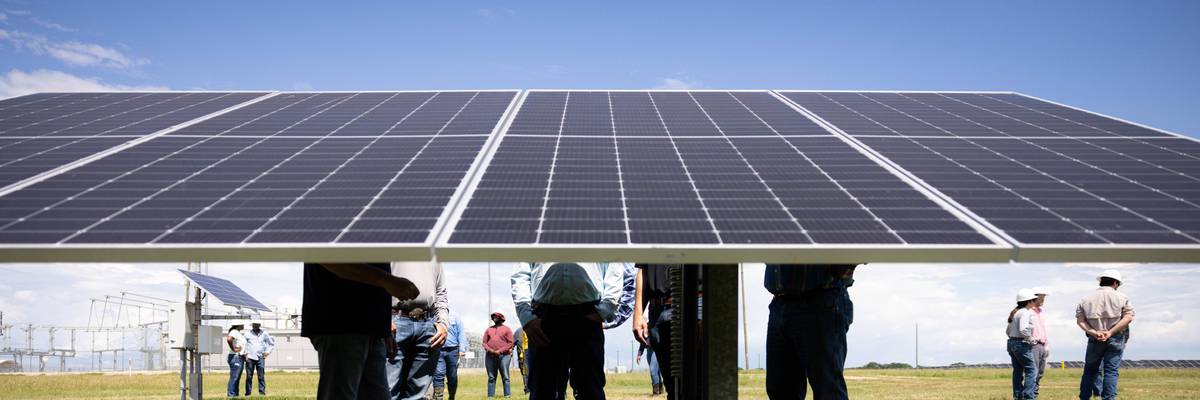
Landowners, educators, and government employees learn about grazing sheep and growing hay under solar panels during a tour of a Solar Stampede site in Saltillo, Texas on May 28, 2026.
“Clearly, the White House has bet on the wrong horse.”
The Trump administration has waged a multi-front war on clean energy during the president's second term. But according to newly published government data, it hasn't worked.
Over the past 18 months, despite the administration’s best efforts, solar, wind, and battery storage added nearly 89 gigawatts of capacity—more than 30 times the growth of fossil fuels and nuclear power combined.
That is according to an analysis of new data from the US Energy Information Administration (EIA) released Monday by the nonprofit SUN DAY Campaign, which tracks federal renewable energy data.
From February 2025 through July 2026, utility solar capacity—large-scale projects that provide electricity to power grids—rose 33% over the previous year compared with the same time during 2025, while wind capacity rose 8%. The storage capacity for batteries, meanwhile, roughly doubled.
By contrast, US coal capacity dropped by 2.4%. Natural gas capacity rose by just 1.5%, while the capacity for fossil fuels and nuclear power combined rose by just 0.3%.
At the start of the second Trump administration, renewables accounted for a combined 22.3% share of US electrical generation. Eighteen months later, they now account for 29%.
“Over the last 18 months, the Trump administration has used every conceivable trick to delay, hinder, or cancel new clean energy projects,” said the SUN DAY Campaign’s executive director, Ken Bossong.
This has included an effective ban on wind development, a repeal of clean-energy tax credits in last year's Republican budget law, a rollback of electric vehicle subsidies, and the cancellation of solar grants, as well as a host of policies meant to ramp up the production of oil, coal, and gas.
The growth of solar and wind reflects an economic reality that Trump has struggled to reverse: Wind and solar are among the cheapest sources of new electricity in much of the country, according to data from the EIA, which expects solar to remain the fastest-growing US source of power generation through 2027.
"Clearly," Bossong said, "the White House has bet on the wrong horse.”
Dear Common Dreams reader, It’s been nearly 30 years since I co-founded Common Dreams with my late wife, Lina Newhouser. We had the radical notion that journalism should serve the public good, not corporate profits. It was clear to us from the outset what it would take to build such a project. No paid advertisements. No corporate sponsors. No millionaire publisher telling us what to think or do. Many people said we wouldn't last a year, but we proved those doubters wrong. Together with a tremendous team of journalists and dedicated staff, we built an independent media outlet free from the constraints of profits and corporate control. Our mission has always been simple: To inform. To inspire. To ignite change for the common good. Building Common Dreams was not easy. Our survival was never guaranteed. When you take on the most powerful forces—Wall Street greed, fossil fuel industry destruction, Big Tech lobbyists, and uber-rich oligarchs who have spent billions upon billions rigging the economy and democracy in their favor—the only bulwark you have is supporters who believe in your work. But here’s the urgent message from me today. It's never been this bad out there. And it's never been this hard to keep us going. At the very moment Common Dreams is most needed, the threats we face are intensifying. We need your support now more than ever. We don't accept corporate advertising and never will. We don't have a paywall because we don't think people should be blocked from critical news based on their ability to pay. Everything we do is funded by the donations of readers like you. When everyone does the little they can afford, we are strong. But if that support retreats or dries up, so do we. Will you donate now to make sure Common Dreams not only survives but thrives? —Craig Brown, Co-founder |
The Trump administration has waged a multi-front war on clean energy during the president's second term. But according to newly published government data, it hasn't worked.
Over the past 18 months, despite the administration’s best efforts, solar, wind, and battery storage added nearly 89 gigawatts of capacity—more than 30 times the growth of fossil fuels and nuclear power combined.
That is according to an analysis of new data from the US Energy Information Administration (EIA) released Monday by the nonprofit SUN DAY Campaign, which tracks federal renewable energy data.
From February 2025 through July 2026, utility solar capacity—large-scale projects that provide electricity to power grids—rose 33% over the previous year compared with the same time during 2025, while wind capacity rose 8%. The storage capacity for batteries, meanwhile, roughly doubled.
By contrast, US coal capacity dropped by 2.4%. Natural gas capacity rose by just 1.5%, while the capacity for fossil fuels and nuclear power combined rose by just 0.3%.
At the start of the second Trump administration, renewables accounted for a combined 22.3% share of US electrical generation. Eighteen months later, they now account for 29%.
“Over the last 18 months, the Trump administration has used every conceivable trick to delay, hinder, or cancel new clean energy projects,” said the SUN DAY Campaign’s executive director, Ken Bossong.
This has included an effective ban on wind development, a repeal of clean-energy tax credits in last year's Republican budget law, a rollback of electric vehicle subsidies, and the cancellation of solar grants, as well as a host of policies meant to ramp up the production of oil, coal, and gas.
The growth of solar and wind reflects an economic reality that Trump has struggled to reverse: Wind and solar are among the cheapest sources of new electricity in much of the country, according to data from the EIA, which expects solar to remain the fastest-growing US source of power generation through 2027.
"Clearly," Bossong said, "the White House has bet on the wrong horse.”
The Trump administration has waged a multi-front war on clean energy during the president's second term. But according to newly published government data, it hasn't worked.
Over the past 18 months, despite the administration’s best efforts, solar, wind, and battery storage added nearly 89 gigawatts of capacity—more than 30 times the growth of fossil fuels and nuclear power combined.
That is according to an analysis of new data from the US Energy Information Administration (EIA) released Monday by the nonprofit SUN DAY Campaign, which tracks federal renewable energy data.
From February 2025 through July 2026, utility solar capacity—large-scale projects that provide electricity to power grids—rose 33% over the previous year compared with the same time during 2025, while wind capacity rose 8%. The storage capacity for batteries, meanwhile, roughly doubled.
By contrast, US coal capacity dropped by 2.4%. Natural gas capacity rose by just 1.5%, while the capacity for fossil fuels and nuclear power combined rose by just 0.3%.
At the start of the second Trump administration, renewables accounted for a combined 22.3% share of US electrical generation. Eighteen months later, they now account for 29%.
“Over the last 18 months, the Trump administration has used every conceivable trick to delay, hinder, or cancel new clean energy projects,” said the SUN DAY Campaign’s executive director, Ken Bossong.
This has included an effective ban on wind development, a repeal of clean-energy tax credits in last year's Republican budget law, a rollback of electric vehicle subsidies, and the cancellation of solar grants, as well as a host of policies meant to ramp up the production of oil, coal, and gas.
The growth of solar and wind reflects an economic reality that Trump has struggled to reverse: Wind and solar are among the cheapest sources of new electricity in much of the country, according to data from the EIA, which expects solar to remain the fastest-growing US source of power generation through 2027.
"Clearly," Bossong said, "the White House has bet on the wrong horse.”