SUBSCRIBE TO OUR FREE NEWSLETTER
Daily news & progressive opinion—funded by the people, not the corporations—delivered straight to your inbox.
5
#000000
#FFFFFF
To donate by check, phone, or other method, see our More Ways to Give page.
Daily news & progressive opinion—funded by the people, not the corporations—delivered straight to your inbox.
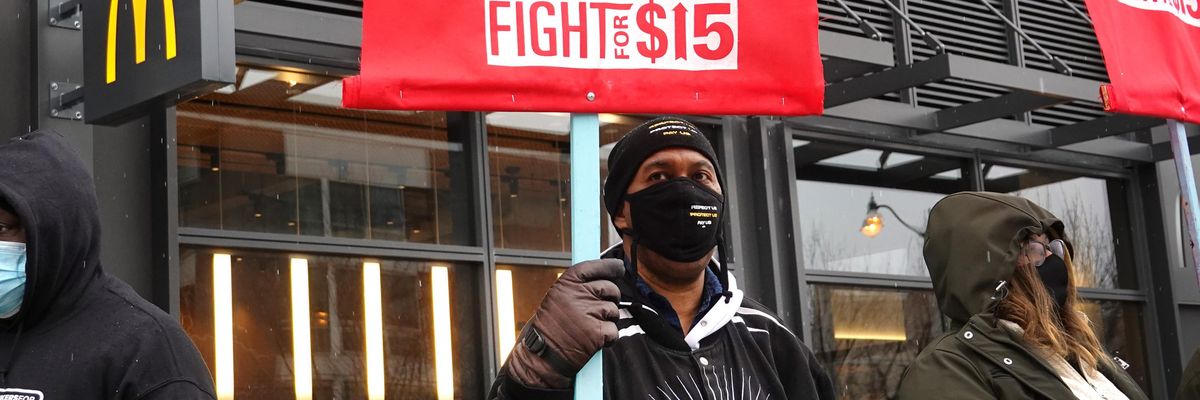
Demonstrators gathered outside of McDonald's corporate headquarters on January 15, 2021 in Chicago. The protest was part of a nationwide effort calling for the minimum wage to be raised to $15-per-hour. (Photo: Scott Olson/Getty Images)
Though McDonald's on Thursday announced pay increases for employees of the 650 company-owned restaurants across the United States, organizers are still planning a strike next week in at least 15 U.S. cities targeting the fast food giant just before its virtual annual shareholder meeting.
"We won't stop fighting until all of them get $15 an hour and a union. When working people stand together, they cannot be defeated."
--Sen. Bernie Sanders
The wage increase--a bid to attract more workers--won't automatically apply to employees at franchise locations, or 95% of McDonald's nearly 14,000 U.S. restaurants.
Over 36,500 employees at company-owned sites will see hourly pay rise by an average of 10% in the coming months, and average wages are expected to hit $15 by 2024, McDonald's said in a statement.
Based on location, the statement said, entry-level workers will make $11 to $17 per hour while shift managers will receive a starting pay of $15 to $20 per hour.
"Together with our franchisees, we face a challenging hiring environment, and staying ahead means we must constantly renew our commitment to offer one of the leading employment packages in the industry," McDonald's USA president Joe Erlinger said in a message to the nation's system, according to CNBC.
The Associated Press reports Erlinger also told employees that "we encourage all our owner/operators to make this same commitment to their restaurant teams in ways that make the most sense for their community, their people, and their long-term growth."
In response to the announcement, the AP noted, "the U.S. National Franchisee Leadership Alliance--which negotiates with the company on behalf of franchisees--expressed support for the wage hikes and encouraged restaurants to stay competitive in their local markets."
Doneshia Babbitt, a McDonald's employee in St. Louis and union leader, confirmed that the Fight for $15 and a Union protests will go on as planned on May 19.
"Clearly, McDonald's understands that in order to hire and retain talented workers, something needs to change," Babbitt said. "Now, they're raising pay for some of us and using fancy math tricks to gloss over the fact that they're selling most of us short."
"We've showed up to work day after day in the middle of a global pandemic, risking our lives without proper PPE or paid time off to keep your stores open and corporate profits flowing," she added. "You've called us essential for over a year, but your announcement today proves that you've seen us as disposable all along."
Emphasizing that the movement is for all workers, not just McDonald's employees, she promised that "we won't stop fighting, striking, and marching in the streets until we win $15 and a union for all."
As the New York Times pointed out Thursday:
In 2019, McDonald's announced it would no longer use its powerful lobbying arm to fight attempts to raise the minimum wage to $15 an hour at the federal, state and local level. In a call with Wall Street analysts in January, the McDonald's chief executive, Chris Kempczinski, said the company was doing "just fine" in the more than two dozen states that had increased minimum wages in a phased-in way.
In fact, despite having many of its dining rooms closed or with limited capacity in parts of the country for much of the pandemic, the strength of McDonald's drive-throughs helped push its profit to more than $4.7 billion in 2020. It paid its shareholders more than $3.7 billion in dividends and spent another $874 million repurchasing shares before suspending the program in early March of last year.
The McDonald's pay announcement--as it attempts to hire 10,000 new employees over the next three months--comes as workers across various industries continue fighting for a $15 federal minimum wage opposed by not only many Republicans in Congress but also some Democrats, despite President Joe Biden's support for it.
"McDonald's is raising wages because thousands of courageous workers marched in the streets and demanded dignity on the job," Sen. Bernie Sanders (I-Vt.) said Thursday. "But make no mistake, we won't stop fighting until all of them get $15 an hour and a union. When working people stand together, they cannot be defeated."
Sanders and Rep. Bobby Scott (D-Va.) introduced the Raise the Wage Act of 2021 in January. The next month, Sanders, the Senate Budget Committee chair, held a hearing to highlight the need for a $15 minimum wage and the dramatic pay disparity between executives and workers on the frontlines of the pandemic.
"You should never have to work multiple jobs in the United States and have nowhere to sleep," said 41-year-old Terrence Wise, a McDonald's worker and Fight for $15 and a Union leader in Kansas City who testified in February about his decades working in the fast food industry. While he was growing up in South Carolina, Wise's family lived in government housing and received food stamps. His mother worked at Hardee's, a fast food chain, and his father was a cook in the military.
"Even with two full-time incomes, my family had to skip meals," Wise shared with senators. At age 16, to help keep the lights on and feed his family, Wise got his first job, at Taco Bell, making $4.25 an hour. He soon got a second job at Wendy's. By 17, the A-student had to leave school and abandon his dreams of college to work full-time.
Although both Wise and his fiancee, a home healthcare provider, are both employed full-time, their family of five has experienced homelessness. He testified about his three daughters struggling to sleep in their purple mini-van in freezing temperatures, even before the pandemic. "Since Covid-19, it's gotten harder," he explained, detailing how his weekly hours were cut from 40 to 28 and his family--which relies on food stamps and Medicaid--was forced to move in with relatives after being evicted.
"During the lockdown, McDonald's gave me a piece of paper to to show the police in case I got pulled over. It said I was an essential employee," Wise said. "But I can tell you they treat us more like second-class citizens than essential workers."
This country and this world are at a monumental crossroads. US voters have an opportunity to beat back the forces of fascism and confront the billionaires who are rigging the economy, our media system, and our democracy, making it increasingly impossible for ordinary people to get by. We’re not just talking about the election. We’re talking about what must be done once these fascist elements are vanquished from power. We need a bolder set of solutions than what either major party has so far been willing to offer and a working-class movement ready to fight like hell for it. Trump didn't emerge from nowhere. The conditions that fueled MAGA authoritarianism were created by decades of radical neoliberal economic policies and a corrupt political system dominated by corporate interests. They slashed taxes on the super-rich, promising that the benefits would trickle down. They said giveaways to the corporate titans would make life more affordable for the rest of us. It was all bullshit. And when a bitter, betrayed populace searches for someone to blame, right-wing demagogues have little trouble finding scapegoats. People know when they're being lied to, but you won't hear any of this from the corporate media. Only independent journalism—powered and funded by people who believe in building a better world—can deliver truly trustworthy daily news. If you share our vision, please contribute whatever you can to sustain our work. |
Though McDonald's on Thursday announced pay increases for employees of the 650 company-owned restaurants across the United States, organizers are still planning a strike next week in at least 15 U.S. cities targeting the fast food giant just before its virtual annual shareholder meeting.
"We won't stop fighting until all of them get $15 an hour and a union. When working people stand together, they cannot be defeated."
--Sen. Bernie Sanders
The wage increase--a bid to attract more workers--won't automatically apply to employees at franchise locations, or 95% of McDonald's nearly 14,000 U.S. restaurants.
Over 36,500 employees at company-owned sites will see hourly pay rise by an average of 10% in the coming months, and average wages are expected to hit $15 by 2024, McDonald's said in a statement.
Based on location, the statement said, entry-level workers will make $11 to $17 per hour while shift managers will receive a starting pay of $15 to $20 per hour.
"Together with our franchisees, we face a challenging hiring environment, and staying ahead means we must constantly renew our commitment to offer one of the leading employment packages in the industry," McDonald's USA president Joe Erlinger said in a message to the nation's system, according to CNBC.
The Associated Press reports Erlinger also told employees that "we encourage all our owner/operators to make this same commitment to their restaurant teams in ways that make the most sense for their community, their people, and their long-term growth."
In response to the announcement, the AP noted, "the U.S. National Franchisee Leadership Alliance--which negotiates with the company on behalf of franchisees--expressed support for the wage hikes and encouraged restaurants to stay competitive in their local markets."
Doneshia Babbitt, a McDonald's employee in St. Louis and union leader, confirmed that the Fight for $15 and a Union protests will go on as planned on May 19.
"Clearly, McDonald's understands that in order to hire and retain talented workers, something needs to change," Babbitt said. "Now, they're raising pay for some of us and using fancy math tricks to gloss over the fact that they're selling most of us short."
"We've showed up to work day after day in the middle of a global pandemic, risking our lives without proper PPE or paid time off to keep your stores open and corporate profits flowing," she added. "You've called us essential for over a year, but your announcement today proves that you've seen us as disposable all along."
Emphasizing that the movement is for all workers, not just McDonald's employees, she promised that "we won't stop fighting, striking, and marching in the streets until we win $15 and a union for all."
As the New York Times pointed out Thursday:
In 2019, McDonald's announced it would no longer use its powerful lobbying arm to fight attempts to raise the minimum wage to $15 an hour at the federal, state and local level. In a call with Wall Street analysts in January, the McDonald's chief executive, Chris Kempczinski, said the company was doing "just fine" in the more than two dozen states that had increased minimum wages in a phased-in way.
In fact, despite having many of its dining rooms closed or with limited capacity in parts of the country for much of the pandemic, the strength of McDonald's drive-throughs helped push its profit to more than $4.7 billion in 2020. It paid its shareholders more than $3.7 billion in dividends and spent another $874 million repurchasing shares before suspending the program in early March of last year.
The McDonald's pay announcement--as it attempts to hire 10,000 new employees over the next three months--comes as workers across various industries continue fighting for a $15 federal minimum wage opposed by not only many Republicans in Congress but also some Democrats, despite President Joe Biden's support for it.
"McDonald's is raising wages because thousands of courageous workers marched in the streets and demanded dignity on the job," Sen. Bernie Sanders (I-Vt.) said Thursday. "But make no mistake, we won't stop fighting until all of them get $15 an hour and a union. When working people stand together, they cannot be defeated."
Sanders and Rep. Bobby Scott (D-Va.) introduced the Raise the Wage Act of 2021 in January. The next month, Sanders, the Senate Budget Committee chair, held a hearing to highlight the need for a $15 minimum wage and the dramatic pay disparity between executives and workers on the frontlines of the pandemic.
"You should never have to work multiple jobs in the United States and have nowhere to sleep," said 41-year-old Terrence Wise, a McDonald's worker and Fight for $15 and a Union leader in Kansas City who testified in February about his decades working in the fast food industry. While he was growing up in South Carolina, Wise's family lived in government housing and received food stamps. His mother worked at Hardee's, a fast food chain, and his father was a cook in the military.
"Even with two full-time incomes, my family had to skip meals," Wise shared with senators. At age 16, to help keep the lights on and feed his family, Wise got his first job, at Taco Bell, making $4.25 an hour. He soon got a second job at Wendy's. By 17, the A-student had to leave school and abandon his dreams of college to work full-time.
Although both Wise and his fiancee, a home healthcare provider, are both employed full-time, their family of five has experienced homelessness. He testified about his three daughters struggling to sleep in their purple mini-van in freezing temperatures, even before the pandemic. "Since Covid-19, it's gotten harder," he explained, detailing how his weekly hours were cut from 40 to 28 and his family--which relies on food stamps and Medicaid--was forced to move in with relatives after being evicted.
"During the lockdown, McDonald's gave me a piece of paper to to show the police in case I got pulled over. It said I was an essential employee," Wise said. "But I can tell you they treat us more like second-class citizens than essential workers."