SUBSCRIBE TO OUR FREE NEWSLETTER
Daily news & progressive opinion—funded by the people, not the corporations—delivered straight to your inbox.
5
#000000
#FFFFFF
To donate by check, phone, or other method, see our More Ways to Give page.
Daily news & progressive opinion—funded by the people, not the corporations—delivered straight to your inbox.
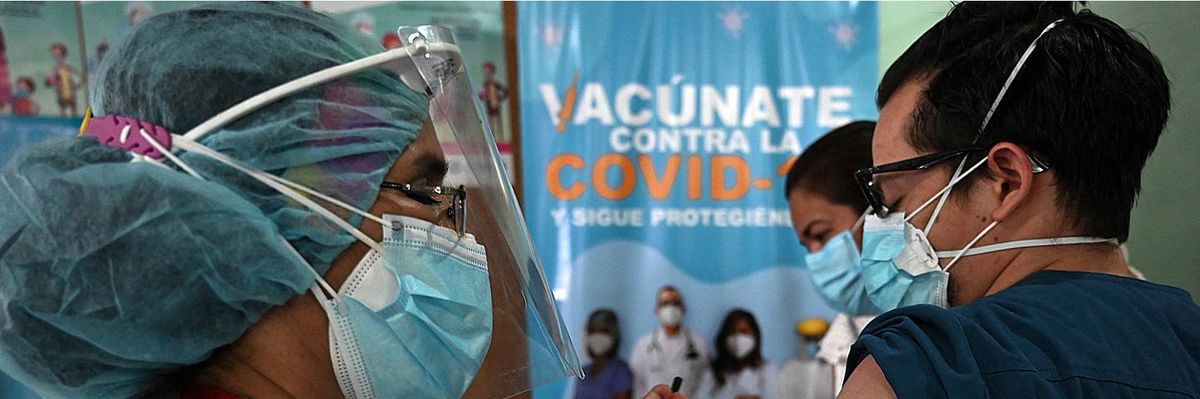
A nurse inoculates a man with an AstraZeneca vaccine against Covid-19 at the Alonso Suazo healthcare center in Tegucigalpa, Honduras on March 15, 2021, as over 48,000 doses donated by COVAX started to be administered to employees of the country's Health Secretariat. (Photo: Orlando Sierra/AFP via Getty Images)
The global death toll from Covid-19 surpassed three million on Saturday, a milestone that spotlighted issues of unequal access to inoculation amid calls for waiving patents on vaccines to urgently boost production and distribution worldwide.
"The need for a rapid, global vaccination rollout is clear and urgent."
--Gabriel Scally, University of Bristol
"The relentless pace of death" from the coronavirus pandemic "is now being increasingly borne by the poorest places in the world," Bloomberg reported Saturday, noting that the latest one million deaths documented by Johns Hopkins University came even faster than the first two.
"The grim milestone underscores a widening disparity in combating the pandemic, which parallels the gap in vaccine access," Bloomberg added. "While mortality rates have largely slowed in the U.S. and parts of Europe thanks to vaccine rollouts that promise a return to some semblance of a normal life, the developing world--Brazil in particular--is shouldering a rising death toll."
While the United States still led the world in recorded deaths as of Sunday, the pandemic had killed more than 371,600 people in Brazil, 212,200 in Mexico, and 177,100 people in India. Meanwhile, more than 884 million vaccine doses have been administered across 155 countries.
So far, the vast majority of vaccine doses have been hoarded by rich countries, provoking charges of "vaccine apartheid." Over 100 World Trade Organization (WTO) member nations, led by South Africa and India, have proposed temporarily waiving coronavirus-related patent protections to increase the global supply of doses--but powerful governments including the U.S. and the U.K. have blocked that effort.
Leaders of the countries standing in the way of the waiver face rising pressure to change course. U.S. Sen. Bernie Sanders (I-Vt.) and a group of Democrats sent a letter to President Joe Biden on Friday, writing that "allowing countries to manufacture locally will expedite access to vaccines and treatment, prevent unnecessary deaths, expedite global vaccination efforts, and facilitate a stronger, faster economic recovery."
That came after more than 170 Nobel laureates and former heads of state and government sent a similar letter to the White House on Wednesday. Recent polling from Data for Progress shows that 60% of U.S. voters--including 72% of Democrats and 50% of Republicans--also want Biden to support the effort by the majority of WTO member nations pushing to waive patents during the pandemic.
Biden isn't the only world leader facing such pressure. In an opinion piece for The Guardian on Sunday, Gabriel Scally, a visiting professor of public health at the University of Bristol and a member of Independent SAGE, argued that "by helping block a patent waiver, the U.K. government is stifling vaccine production, which means many countries will wait years for sufficient doses." As Scally wrote:
Because coronavirus cases continue to rise worldwide, the risk of vaccine-resistant variants is increasing. Public health voices have already warned that if we don't rapidly vaccinate the world's population, our current generation of Covid-19 vaccines could be rendered ineffective within a year. The need for a rapid, global vaccination rollout is clear and urgent.
Pandemics are, by definition, global health crises. No matter how high our vaccination rate may be, no matter what restrictions we place on travel, we will not be safe from Covid-19 until we have suppressed the virus across the globe. As things stand, many countries in the southern hemisphere may not manage to achieve widespread vaccination until 2024. This long delay puts us all at risk.
"The British government should urgently review its opposition" he said of the WTO effort. "We, across the U.K., are cautiously moving towards reducing coronavirus restrictions and assisting the economy to recover. All of that could be lost if highly infectious, vaccine-resistant variants emerge--a 'people's vaccine' is the surest, fastest way to avoid the risk of what might be a devastating development."
Campaigners are also targeting Big Pharma directly. With pharmaceutical firms set to hold their annual general meetings in the coming weeks, the People's Vaccine Alliance has invited CEOs to attend a public event on Wednesday with healthcare workers, vaccine volunteers, and patients from across the globe.
The alliance says that "we want the pharmaceutical companies to hear the testimonies of those who are directly affected by lack of access to the vaccines--and answer our questions on how they intend to improve global access."
Dear Common Dreams reader, It’s been nearly 30 years since I co-founded Common Dreams with my late wife, Lina Newhouser. We had the radical notion that journalism should serve the public good, not corporate profits. It was clear to us from the outset what it would take to build such a project. No paid advertisements. No corporate sponsors. No millionaire publisher telling us what to think or do. Many people said we wouldn't last a year, but we proved those doubters wrong. Together with a tremendous team of journalists and dedicated staff, we built an independent media outlet free from the constraints of profits and corporate control. Our mission has always been simple: To inform. To inspire. To ignite change for the common good. Building Common Dreams was not easy. Our survival was never guaranteed. When you take on the most powerful forces—Wall Street greed, fossil fuel industry destruction, Big Tech lobbyists, and uber-rich oligarchs who have spent billions upon billions rigging the economy and democracy in their favor—the only bulwark you have is supporters who believe in your work. But here’s the urgent message from me today. It's never been this bad out there. And it's never been this hard to keep us going. At the very moment Common Dreams is most needed, the threats we face are intensifying. We need your support now more than ever. We don't accept corporate advertising and never will. We don't have a paywall because we don't think people should be blocked from critical news based on their ability to pay. Everything we do is funded by the donations of readers like you. When everyone does the little they can afford, we are strong. But if that support retreats or dries up, so do we. Will you donate now to make sure Common Dreams not only survives but thrives? —Craig Brown, Co-founder |
The global death toll from Covid-19 surpassed three million on Saturday, a milestone that spotlighted issues of unequal access to inoculation amid calls for waiving patents on vaccines to urgently boost production and distribution worldwide.
"The need for a rapid, global vaccination rollout is clear and urgent."
--Gabriel Scally, University of Bristol
"The relentless pace of death" from the coronavirus pandemic "is now being increasingly borne by the poorest places in the world," Bloomberg reported Saturday, noting that the latest one million deaths documented by Johns Hopkins University came even faster than the first two.
"The grim milestone underscores a widening disparity in combating the pandemic, which parallels the gap in vaccine access," Bloomberg added. "While mortality rates have largely slowed in the U.S. and parts of Europe thanks to vaccine rollouts that promise a return to some semblance of a normal life, the developing world--Brazil in particular--is shouldering a rising death toll."
While the United States still led the world in recorded deaths as of Sunday, the pandemic had killed more than 371,600 people in Brazil, 212,200 in Mexico, and 177,100 people in India. Meanwhile, more than 884 million vaccine doses have been administered across 155 countries.
So far, the vast majority of vaccine doses have been hoarded by rich countries, provoking charges of "vaccine apartheid." Over 100 World Trade Organization (WTO) member nations, led by South Africa and India, have proposed temporarily waiving coronavirus-related patent protections to increase the global supply of doses--but powerful governments including the U.S. and the U.K. have blocked that effort.
Leaders of the countries standing in the way of the waiver face rising pressure to change course. U.S. Sen. Bernie Sanders (I-Vt.) and a group of Democrats sent a letter to President Joe Biden on Friday, writing that "allowing countries to manufacture locally will expedite access to vaccines and treatment, prevent unnecessary deaths, expedite global vaccination efforts, and facilitate a stronger, faster economic recovery."
That came after more than 170 Nobel laureates and former heads of state and government sent a similar letter to the White House on Wednesday. Recent polling from Data for Progress shows that 60% of U.S. voters--including 72% of Democrats and 50% of Republicans--also want Biden to support the effort by the majority of WTO member nations pushing to waive patents during the pandemic.
Biden isn't the only world leader facing such pressure. In an opinion piece for The Guardian on Sunday, Gabriel Scally, a visiting professor of public health at the University of Bristol and a member of Independent SAGE, argued that "by helping block a patent waiver, the U.K. government is stifling vaccine production, which means many countries will wait years for sufficient doses." As Scally wrote:
Because coronavirus cases continue to rise worldwide, the risk of vaccine-resistant variants is increasing. Public health voices have already warned that if we don't rapidly vaccinate the world's population, our current generation of Covid-19 vaccines could be rendered ineffective within a year. The need for a rapid, global vaccination rollout is clear and urgent.
Pandemics are, by definition, global health crises. No matter how high our vaccination rate may be, no matter what restrictions we place on travel, we will not be safe from Covid-19 until we have suppressed the virus across the globe. As things stand, many countries in the southern hemisphere may not manage to achieve widespread vaccination until 2024. This long delay puts us all at risk.
"The British government should urgently review its opposition" he said of the WTO effort. "We, across the U.K., are cautiously moving towards reducing coronavirus restrictions and assisting the economy to recover. All of that could be lost if highly infectious, vaccine-resistant variants emerge--a 'people's vaccine' is the surest, fastest way to avoid the risk of what might be a devastating development."
Campaigners are also targeting Big Pharma directly. With pharmaceutical firms set to hold their annual general meetings in the coming weeks, the People's Vaccine Alliance has invited CEOs to attend a public event on Wednesday with healthcare workers, vaccine volunteers, and patients from across the globe.
The alliance says that "we want the pharmaceutical companies to hear the testimonies of those who are directly affected by lack of access to the vaccines--and answer our questions on how they intend to improve global access."
The global death toll from Covid-19 surpassed three million on Saturday, a milestone that spotlighted issues of unequal access to inoculation amid calls for waiving patents on vaccines to urgently boost production and distribution worldwide.
"The need for a rapid, global vaccination rollout is clear and urgent."
--Gabriel Scally, University of Bristol
"The relentless pace of death" from the coronavirus pandemic "is now being increasingly borne by the poorest places in the world," Bloomberg reported Saturday, noting that the latest one million deaths documented by Johns Hopkins University came even faster than the first two.
"The grim milestone underscores a widening disparity in combating the pandemic, which parallels the gap in vaccine access," Bloomberg added. "While mortality rates have largely slowed in the U.S. and parts of Europe thanks to vaccine rollouts that promise a return to some semblance of a normal life, the developing world--Brazil in particular--is shouldering a rising death toll."
While the United States still led the world in recorded deaths as of Sunday, the pandemic had killed more than 371,600 people in Brazil, 212,200 in Mexico, and 177,100 people in India. Meanwhile, more than 884 million vaccine doses have been administered across 155 countries.
So far, the vast majority of vaccine doses have been hoarded by rich countries, provoking charges of "vaccine apartheid." Over 100 World Trade Organization (WTO) member nations, led by South Africa and India, have proposed temporarily waiving coronavirus-related patent protections to increase the global supply of doses--but powerful governments including the U.S. and the U.K. have blocked that effort.
Leaders of the countries standing in the way of the waiver face rising pressure to change course. U.S. Sen. Bernie Sanders (I-Vt.) and a group of Democrats sent a letter to President Joe Biden on Friday, writing that "allowing countries to manufacture locally will expedite access to vaccines and treatment, prevent unnecessary deaths, expedite global vaccination efforts, and facilitate a stronger, faster economic recovery."
That came after more than 170 Nobel laureates and former heads of state and government sent a similar letter to the White House on Wednesday. Recent polling from Data for Progress shows that 60% of U.S. voters--including 72% of Democrats and 50% of Republicans--also want Biden to support the effort by the majority of WTO member nations pushing to waive patents during the pandemic.
Biden isn't the only world leader facing such pressure. In an opinion piece for The Guardian on Sunday, Gabriel Scally, a visiting professor of public health at the University of Bristol and a member of Independent SAGE, argued that "by helping block a patent waiver, the U.K. government is stifling vaccine production, which means many countries will wait years for sufficient doses." As Scally wrote:
Because coronavirus cases continue to rise worldwide, the risk of vaccine-resistant variants is increasing. Public health voices have already warned that if we don't rapidly vaccinate the world's population, our current generation of Covid-19 vaccines could be rendered ineffective within a year. The need for a rapid, global vaccination rollout is clear and urgent.
Pandemics are, by definition, global health crises. No matter how high our vaccination rate may be, no matter what restrictions we place on travel, we will not be safe from Covid-19 until we have suppressed the virus across the globe. As things stand, many countries in the southern hemisphere may not manage to achieve widespread vaccination until 2024. This long delay puts us all at risk.
"The British government should urgently review its opposition" he said of the WTO effort. "We, across the U.K., are cautiously moving towards reducing coronavirus restrictions and assisting the economy to recover. All of that could be lost if highly infectious, vaccine-resistant variants emerge--a 'people's vaccine' is the surest, fastest way to avoid the risk of what might be a devastating development."
Campaigners are also targeting Big Pharma directly. With pharmaceutical firms set to hold their annual general meetings in the coming weeks, the People's Vaccine Alliance has invited CEOs to attend a public event on Wednesday with healthcare workers, vaccine volunteers, and patients from across the globe.
The alliance says that "we want the pharmaceutical companies to hear the testimonies of those who are directly affected by lack of access to the vaccines--and answer our questions on how they intend to improve global access."