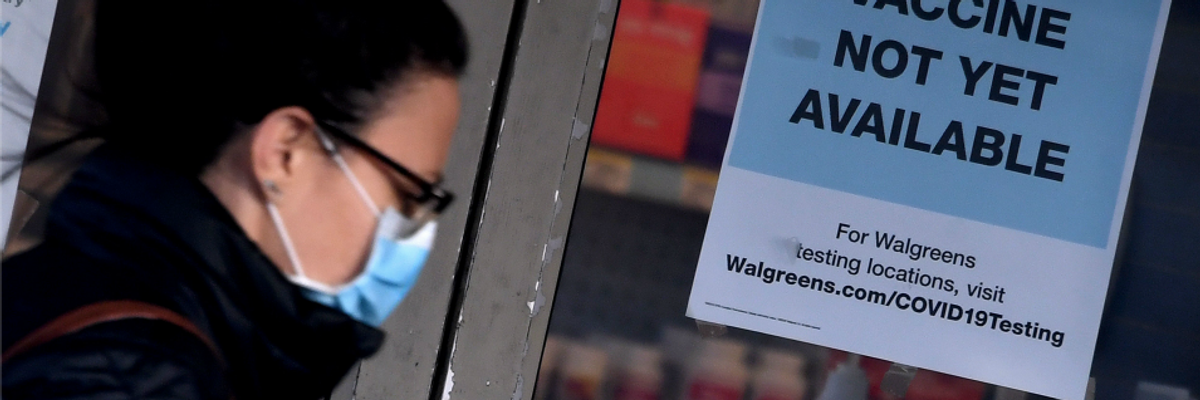
A woman walks past a "Covid-19 vaccine not yet available" sign outside a store in Arlington, Virginia on December 1, 2020. (Photo: Olivier Douliery/AFP via Getty Images)
'This Is Warp Speed?' At Current Pace, US Will Take 10 Years to Adequately Vaccinate the Public Against Covid-19, Analysis Warns
"We should have been prepared to start inoculating millions of people the day a vaccine was approved. This is a massive policy failure."
If the Trump administration's coronavirus vaccine distribution effort continues at its current sluggish pace, it would take nearly a decade for the United States to inoculate an adequate number of Americans to rein in the deadly pandemic.
That's according to an analysis released Tuesday by NBC News, which found that the U.S. is nowhere near on track to meet the Trump administration's stated goal of vaccinating around 80% of the population by late June of 2021.
"To meet that goal, a little more than three million people would have to get the shots each day," NBC noted. "But so far, only about two million people--most of them frontline healthcare workers and some nursing home residents--have gotten their first shots of the 11.5 million doses that were delivered in the last two weeks."
"States are stretched. Feds are supposed to help. But the same folks who blamed states for the testing mess now ready to blame states for the vaccine slowdown."
--Ashish Jha, Brown University School of Public Health
President-elect Joe Biden took aim at the Trump administration's slow and chaotic vaccine rollout in a speech Tuesday, declaring that the "plan to distribute vaccines is falling behind, far behind." Warning it will "take years, not months, to vaccinate the American people" if significant changes aren't made, Biden promised "a much more aggressive effort, with more federal involvement and leadership, to get things back on track."
"We'll find ways to boost the pace of vaccinations," said Biden, who vowed to invoke the Defense Production Act to speed up the manufacture of necessary materials.
In response to Biden's remarks, outgoing President Donald Trump characteristically refused to take responsibility for the lagging distribution effort, instead placing the blame on crisis-ravaged states.
"It is up to the states to distribute the vaccines once brought to the designated areas by the federal government," Trump tweeted. "We have not only developed the vaccines, including putting up money to move the process along quickly, but gotten them to the states."
While there is plenty of evidence indicating that state officials are moving too slowly--Texas' health commissioner, for instance, warned last week that a "significant portion" of the state's vaccine supply is sitting on shelves--critics have argued that the Trump administration failed to lay the groundwork for a speedy and effective distribution effort, effectively guaranteeing that states would struggle getting vaccine doses out the door.
"This is warp speed?" Dean Baker, co-director of the Center for Economic and Policy Research (CEPR), asked in a blog post Monday, pointing to the relatively small number of people in the U.S. who have received shots since the Food and Drug Administration (FDA) authorized the Pfizer and Moderna vaccines for emergency use earlier this month.
"We should have had major warehouses located around the country so that as soon as the FDA green-lighted a vaccine, it could quickly be delivered to hospitals and clinics in every corner of the country," Baker argued. "We should have been prepared to start inoculating millions of people the day a vaccine was approved. This is a massive policy failure."
Ashish Jha, a physician and dean of the Brown University School of Public Health, echoed Baker's criticism of the Trump administration in a series of tweets on Monday.
"The worst part is no real planning on what happens when vaccines arrive in states. No plan, no money, just hope that states will figure this out," Jha wrote. "[State health departments] are trying to stand up a vaccination infrastructure. Congress had given them no money. States are out of money, so many are passing it on to hospitals, nursing homes."
"Public health has always been a state/federal partnership," Jha added. "States are stretched. Feds are supposed to help. But the same folks who blamed states for the testing mess now ready to blame states for the vaccine slowdown. They are again setting states up to fail."
Growing fears about the lagging pace of vaccinations come as Colorado on Tuesday reported the first U.S. case of a more contagious coronavirus variant that was first detected in the United Kingdom. Experts said it is possible that the variant has spread in the Colorado patient's community and possibly elsewhere in the U.S., which has the highest Covid-19 death toll in the world.
As the New York Times reported, "Scientists are worried about variants but not surprised by them. It is normal for viruses to mutate, and most of the mutations of the coronavirus have proved minor. There's no evidence that an infection with the variant--known as B.1.1.7--is more likely to lead to a severe case of Covid-19, increase the risk of death or evade the new vaccines."
"But the speed at which the variant seems to spread," the Times added, "could lead to more infections--and therefore more hospitalizations," heightening the urgency of the vaccine rollout.
Leana Wen, visiting professor of health policy and management at the George Washington University's Milken School of Public Health, wrote in a column for the Washington Post on Tuesday that the speed of vaccinations thus far "should set off alarms."
"Remember, the first group of vaccinations was supposed to be the easiest: It's hospitals and nursing homes inoculating their own workers and residents," Wen wrote. "If we can't get this right, it doesn't bode well for the rest of the country."
Wen proceeded to take the Trump administration to task for repeatedly shifting the goal posts as it failed to meet its initial targets for the mass inoculation campaign.
"When states learned they would receive fewer doses than they had been told, the administration said its end-of-year goal was not for vaccinations but vaccine distribution," Wen noted. "It also halved the number of doses that would be available to people, from 40 million to 20 million. (Perhaps they hoped no one would notice that their initial pledge was to vaccinate 20 million people, which is 40 million doses, or that President Trump had at one point vowed to have 100 million doses by the end of the year.)"
"Instead of muddying the waters, the federal government needs to take three urgent steps. First, set up a real-time public dashboard to track vaccine distribution," Wen wrote. "Second, publicize the plan for how vaccination will scale up so dramatically... Third, acknowledge the challenges and end the defensiveness. The public will understand if initial goals need to be revised, but there must be willingness to learn from missteps and immediately course-correct."
We are at a crossroads
This country and this world are at a monumental crossroads. In a few short weeks, US voters will have an opportunity to beat back the forces of fascism and confront the billionaires who are rigging the economy, our media system, and our democracy, making it increasingly impossible for ordinary people to get by. We’re not just talking about the election. We’re talking about what must be done once these fascist elements are vanquished from power. We need a bolder set of solutions than what either major party has so far been willing to offer and a working-class movement ready to fight like hell for it. Trump didn't emerge from nowhere. The conditions that fueled MAGA authoritarianism were created by decades of radical neoliberal economic policies and a corrupt political system dominated by corporate interests. They slashed taxes on the super-rich, promising that the benefits would trickle down. They said giveaways to the corporate titans would make life more affordable for the rest of us. It was all bullshit. And when a bitter, betrayed populace searches for someone to blame, right-wing demagogues have little trouble finding scapegoats. People know when they're being lied to, but you won't hear any of this from the corporate media. Only independent journalism—powered and funded by people who believe in building a better world—can deliver truly trustworthy daily news. Our Fall Campaign is underway, and we need your help. To power our newsroom through the rest of the year, we need to raise $125,000 by midnight on October 31. So if you share our vision, please contribute whatever you can to sustain our work. |
If the Trump administration's coronavirus vaccine distribution effort continues at its current sluggish pace, it would take nearly a decade for the United States to inoculate an adequate number of Americans to rein in the deadly pandemic.
That's according to an analysis released Tuesday by NBC News, which found that the U.S. is nowhere near on track to meet the Trump administration's stated goal of vaccinating around 80% of the population by late June of 2021.
"To meet that goal, a little more than three million people would have to get the shots each day," NBC noted. "But so far, only about two million people--most of them frontline healthcare workers and some nursing home residents--have gotten their first shots of the 11.5 million doses that were delivered in the last two weeks."
"States are stretched. Feds are supposed to help. But the same folks who blamed states for the testing mess now ready to blame states for the vaccine slowdown."
--Ashish Jha, Brown University School of Public Health
President-elect Joe Biden took aim at the Trump administration's slow and chaotic vaccine rollout in a speech Tuesday, declaring that the "plan to distribute vaccines is falling behind, far behind." Warning it will "take years, not months, to vaccinate the American people" if significant changes aren't made, Biden promised "a much more aggressive effort, with more federal involvement and leadership, to get things back on track."
"We'll find ways to boost the pace of vaccinations," said Biden, who vowed to invoke the Defense Production Act to speed up the manufacture of necessary materials.
In response to Biden's remarks, outgoing President Donald Trump characteristically refused to take responsibility for the lagging distribution effort, instead placing the blame on crisis-ravaged states.
"It is up to the states to distribute the vaccines once brought to the designated areas by the federal government," Trump tweeted. "We have not only developed the vaccines, including putting up money to move the process along quickly, but gotten them to the states."
While there is plenty of evidence indicating that state officials are moving too slowly--Texas' health commissioner, for instance, warned last week that a "significant portion" of the state's vaccine supply is sitting on shelves--critics have argued that the Trump administration failed to lay the groundwork for a speedy and effective distribution effort, effectively guaranteeing that states would struggle getting vaccine doses out the door.
"This is warp speed?" Dean Baker, co-director of the Center for Economic and Policy Research (CEPR), asked in a blog post Monday, pointing to the relatively small number of people in the U.S. who have received shots since the Food and Drug Administration (FDA) authorized the Pfizer and Moderna vaccines for emergency use earlier this month.
"We should have had major warehouses located around the country so that as soon as the FDA green-lighted a vaccine, it could quickly be delivered to hospitals and clinics in every corner of the country," Baker argued. "We should have been prepared to start inoculating millions of people the day a vaccine was approved. This is a massive policy failure."
Ashish Jha, a physician and dean of the Brown University School of Public Health, echoed Baker's criticism of the Trump administration in a series of tweets on Monday.
"The worst part is no real planning on what happens when vaccines arrive in states. No plan, no money, just hope that states will figure this out," Jha wrote. "[State health departments] are trying to stand up a vaccination infrastructure. Congress had given them no money. States are out of money, so many are passing it on to hospitals, nursing homes."
"Public health has always been a state/federal partnership," Jha added. "States are stretched. Feds are supposed to help. But the same folks who blamed states for the testing mess now ready to blame states for the vaccine slowdown. They are again setting states up to fail."
Growing fears about the lagging pace of vaccinations come as Colorado on Tuesday reported the first U.S. case of a more contagious coronavirus variant that was first detected in the United Kingdom. Experts said it is possible that the variant has spread in the Colorado patient's community and possibly elsewhere in the U.S., which has the highest Covid-19 death toll in the world.
As the New York Times reported, "Scientists are worried about variants but not surprised by them. It is normal for viruses to mutate, and most of the mutations of the coronavirus have proved minor. There's no evidence that an infection with the variant--known as B.1.1.7--is more likely to lead to a severe case of Covid-19, increase the risk of death or evade the new vaccines."
"But the speed at which the variant seems to spread," the Times added, "could lead to more infections--and therefore more hospitalizations," heightening the urgency of the vaccine rollout.
Leana Wen, visiting professor of health policy and management at the George Washington University's Milken School of Public Health, wrote in a column for the Washington Post on Tuesday that the speed of vaccinations thus far "should set off alarms."
"Remember, the first group of vaccinations was supposed to be the easiest: It's hospitals and nursing homes inoculating their own workers and residents," Wen wrote. "If we can't get this right, it doesn't bode well for the rest of the country."
Wen proceeded to take the Trump administration to task for repeatedly shifting the goal posts as it failed to meet its initial targets for the mass inoculation campaign.
"When states learned they would receive fewer doses than they had been told, the administration said its end-of-year goal was not for vaccinations but vaccine distribution," Wen noted. "It also halved the number of doses that would be available to people, from 40 million to 20 million. (Perhaps they hoped no one would notice that their initial pledge was to vaccinate 20 million people, which is 40 million doses, or that President Trump had at one point vowed to have 100 million doses by the end of the year.)"
"Instead of muddying the waters, the federal government needs to take three urgent steps. First, set up a real-time public dashboard to track vaccine distribution," Wen wrote. "Second, publicize the plan for how vaccination will scale up so dramatically... Third, acknowledge the challenges and end the defensiveness. The public will understand if initial goals need to be revised, but there must be willingness to learn from missteps and immediately course-correct."