
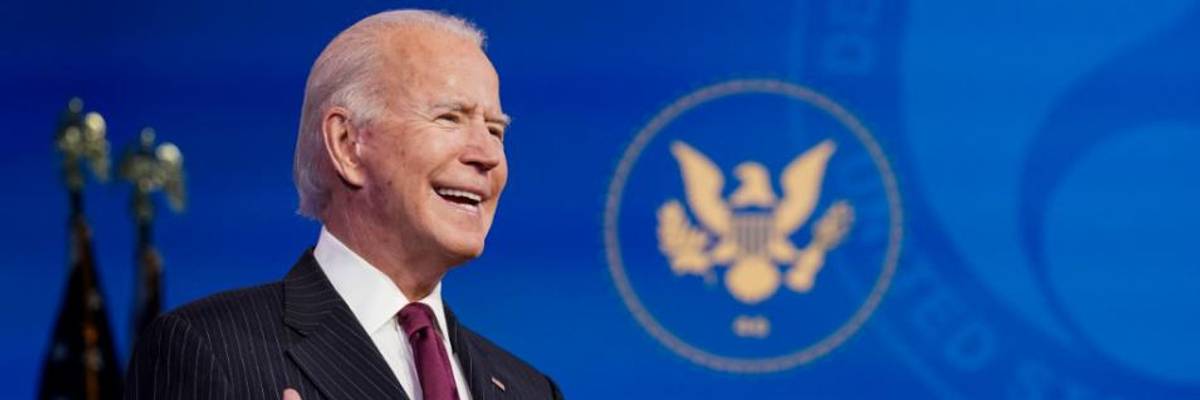
U.S. President-elect Joe Biden speaks during a news conference at his transition headquarters on December 16, 2020 in Wilmington, Delaware. (Photo: Kevin Lamarque-Pool/Getty Images)
To Help 'Reshape How America Engages a Changed World,' Biden Given Slate of Progressive Foreign Policy Picks
"There are, in fact, an impressive number of people who could legitimately fill those jobs and question the dominant perspective on foreign policy and national security."
While President-elect Joe Biden has faced criticism from the left for nominating war hawks and weapons industry insiders to the upper ranks of his foreign policy team, a coalition of progressive organizations hoping to influence staffing decisions at the lower echelons of the national security apparatus on Friday delivered a dossier containing the profiles of 100 left-leaning experts accompanied by recommendations for roles they could assume in the incoming administration.
"This is quite unprecedented," Gordon Adams, a fellow at the Quincy Institute, said in an interview with Politico, which first broke the news Friday.
"It says there are, in fact, an impressive number of people who could legitimately fill those jobs and question the dominant perspective on foreign policy and national security," he added.
Stressing the need for a new approach to national security, Alexander Main, the director of international policy at the Center for Economic and Policy Research, told The Hill that "for far too long, U.S. foreign policy has contributed to global insecurity and has been out of step with much of the rest of the world in addressing climate change, nuclear proliferation, and other major challenges."
Main emphasized that Biden has "an opportunity to change course and deploy a fresh, innovative policy playbook to engage with the international community in promoting peace, equitable development, and a sustainable future for our planet."
"To do this," Main added, the president-elect will "need a team of smart, creative people with bold ideas, a deep understanding of and respect for other cultures, and a record of thinking outside of the box. And that's exactly the kind of candidates that are being proposed in this book."
Yasmine Taeb, a senior fellow at the Center for International Policy, called compiling the dossier full of dozens of candidates who have ties to human rights and antiwar groups "the first comprehensive and coordinated effort by the left to influence the transition to appoint progressives to national security and foreign policy positions."
"The candidates being recommended," she said, "are not only qualified but are forward-looking, with no corporate ties or revolving door issues which has been a concern with respect to many of the national security appointments being made by the incoming Biden administration."
Some individuals "are being recommended for specific roles in the Biden administration," Politico reported.
For example, Matt Duss, the top foreign policy adviser to Sen. Bernie Sanders (I-Vt.), is being put forward as deputy national security adviser or special adviser to the secretary of State. Trita Parsi, co-founder of the Quincy Institute and a former United Nations official, is being recommended to oversee Middle East affairs on the National Security Council. Kate Gould, a national security adviser to Rep. Ro Khanna (D-Calif.), is being put up for senior policy adviser for the U.S. Mission to the United Nations.
There are dozens of additional "unconventional thinkers" with scholarly expertise and/or government experience whom the coalition wants to see serving in--and ideally transforming the foreign policy agenda of--the Biden administration.
Some, like Oxfam America senior policy adviser Noah Gottschalk--recommended by the coalition for deputy assistant secretary of state overseeing the bureau of population, refugees, and migration--would be entering the White House for the first time in an attempt to reorient national security in a more humane direction.
Others, like Bruce Riedel, a fellow at the Brookings Institution and a former deputy assistant secretary of defense for the Near East and South Asia, "are well-known in defense and foreign policy circles," Politico reported.
Along with many on the list, Alison Friedman, executive director of the International Corporate Accountability Roundtable and an expert on human trafficking who did a prior stint in the state department, has both veteran credentials and progressive bona fides.
The effort was organized by Taeb and Alex McCoy, political director at Common Defense. Dozens of groups supported the project, including: the Progressive Change Institute; Common Defense; the Revolving Door Project; Friends of the Earth U.S., Progressive Democrats of America; the Project on Government Oversight; EarthRights International, the Center for Economic and Policy Research; the Quincy Institute for Responsible Statecraft; Win Without War; Peace Action; Women's Action for New Directions; National Iranian American Council Action; the American Economic Liberties Project; and the Arab American Institute.
According to Adams, "There is a seriousness with which the progressive wing of the Democratic Party is trying to shape alternative ways for the United States to engage in the world."
"These perspectives are real and they have begun to acquire a legitimacy because the world has changed," he noted. "This is a serious, deep bench of progressive practitioners who ought to be serious participants in a Biden effort to reshape how America engages a changed world."
We are at a crossroads
This country and this world are at a monumental crossroads. In a few short weeks, US voters will have an opportunity to beat back the forces of fascism and confront the billionaires who are rigging the economy, our media system, and our democracy, making it increasingly impossible for ordinary people to get by. We’re not just talking about the election. We’re talking about what must be done once these fascist elements are vanquished from power. We need a bolder set of solutions than what either major party has so far been willing to offer and a working-class movement ready to fight like hell for it. Trump didn't emerge from nowhere. The conditions that fueled MAGA authoritarianism were created by decades of radical neoliberal economic policies and a corrupt political system dominated by corporate interests. They slashed taxes on the super-rich, promising that the benefits would trickle down. They said giveaways to the corporate titans would make life more affordable for the rest of us. It was all bullshit. And when a bitter, betrayed populace searches for someone to blame, right-wing demagogues have little trouble finding scapegoats. People know when they're being lied to, but you won't hear any of this from the corporate media. Only independent journalism—powered and funded by people who believe in building a better world—can deliver truly trustworthy daily news. Our Fall Campaign is underway, and we need your help. To power our newsroom through the rest of the year, we need to raise $125,000 by midnight on October 31. So if you share our vision, please contribute whatever you can to sustain our work. |
While President-elect Joe Biden has faced criticism from the left for nominating war hawks and weapons industry insiders to the upper ranks of his foreign policy team, a coalition of progressive organizations hoping to influence staffing decisions at the lower echelons of the national security apparatus on Friday delivered a dossier containing the profiles of 100 left-leaning experts accompanied by recommendations for roles they could assume in the incoming administration.
"This is quite unprecedented," Gordon Adams, a fellow at the Quincy Institute, said in an interview with Politico, which first broke the news Friday.
"It says there are, in fact, an impressive number of people who could legitimately fill those jobs and question the dominant perspective on foreign policy and national security," he added.
Stressing the need for a new approach to national security, Alexander Main, the director of international policy at the Center for Economic and Policy Research, told The Hill that "for far too long, U.S. foreign policy has contributed to global insecurity and has been out of step with much of the rest of the world in addressing climate change, nuclear proliferation, and other major challenges."
Main emphasized that Biden has "an opportunity to change course and deploy a fresh, innovative policy playbook to engage with the international community in promoting peace, equitable development, and a sustainable future for our planet."
"To do this," Main added, the president-elect will "need a team of smart, creative people with bold ideas, a deep understanding of and respect for other cultures, and a record of thinking outside of the box. And that's exactly the kind of candidates that are being proposed in this book."
Yasmine Taeb, a senior fellow at the Center for International Policy, called compiling the dossier full of dozens of candidates who have ties to human rights and antiwar groups "the first comprehensive and coordinated effort by the left to influence the transition to appoint progressives to national security and foreign policy positions."
"The candidates being recommended," she said, "are not only qualified but are forward-looking, with no corporate ties or revolving door issues which has been a concern with respect to many of the national security appointments being made by the incoming Biden administration."
Some individuals "are being recommended for specific roles in the Biden administration," Politico reported.
For example, Matt Duss, the top foreign policy adviser to Sen. Bernie Sanders (I-Vt.), is being put forward as deputy national security adviser or special adviser to the secretary of State. Trita Parsi, co-founder of the Quincy Institute and a former United Nations official, is being recommended to oversee Middle East affairs on the National Security Council. Kate Gould, a national security adviser to Rep. Ro Khanna (D-Calif.), is being put up for senior policy adviser for the U.S. Mission to the United Nations.
There are dozens of additional "unconventional thinkers" with scholarly expertise and/or government experience whom the coalition wants to see serving in--and ideally transforming the foreign policy agenda of--the Biden administration.
Some, like Oxfam America senior policy adviser Noah Gottschalk--recommended by the coalition for deputy assistant secretary of state overseeing the bureau of population, refugees, and migration--would be entering the White House for the first time in an attempt to reorient national security in a more humane direction.
Others, like Bruce Riedel, a fellow at the Brookings Institution and a former deputy assistant secretary of defense for the Near East and South Asia, "are well-known in defense and foreign policy circles," Politico reported.
Along with many on the list, Alison Friedman, executive director of the International Corporate Accountability Roundtable and an expert on human trafficking who did a prior stint in the state department, has both veteran credentials and progressive bona fides.
The effort was organized by Taeb and Alex McCoy, political director at Common Defense. Dozens of groups supported the project, including: the Progressive Change Institute; Common Defense; the Revolving Door Project; Friends of the Earth U.S., Progressive Democrats of America; the Project on Government Oversight; EarthRights International, the Center for Economic and Policy Research; the Quincy Institute for Responsible Statecraft; Win Without War; Peace Action; Women's Action for New Directions; National Iranian American Council Action; the American Economic Liberties Project; and the Arab American Institute.
According to Adams, "There is a seriousness with which the progressive wing of the Democratic Party is trying to shape alternative ways for the United States to engage in the world."
"These perspectives are real and they have begun to acquire a legitimacy because the world has changed," he noted. "This is a serious, deep bench of progressive practitioners who ought to be serious participants in a Biden effort to reshape how America engages a changed world."