SUBSCRIBE TO OUR FREE NEWSLETTER
Daily news & progressive opinion—funded by the people, not the corporations—delivered straight to your inbox.
5
#000000
#FFFFFF
To donate by check, phone, or other method, see our More Ways to Give page.
Daily news & progressive opinion—funded by the people, not the corporations—delivered straight to your inbox.
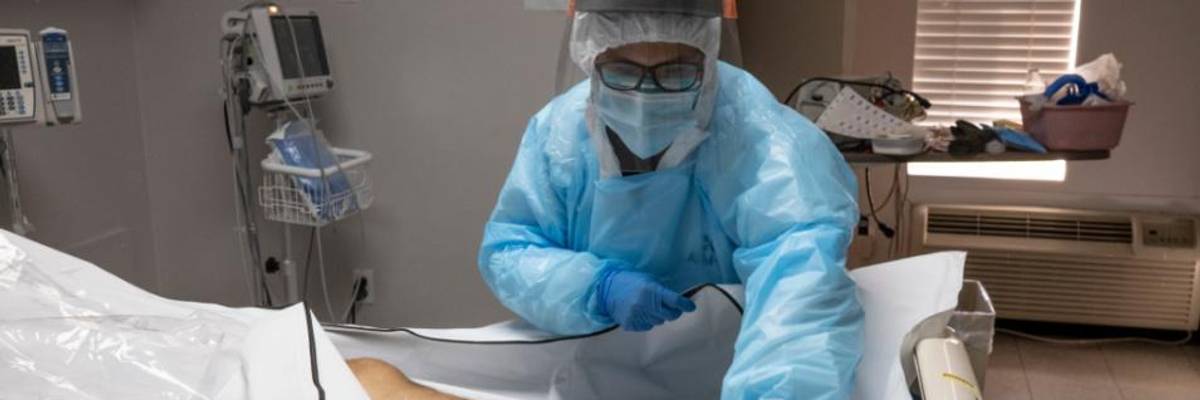
A medical staff member closes the zipper of a body bag that contains a deceased Covid-19 patient in the intensive care unit at the United Memorial Medical Center on November 25, 2020 in Houston. (Photo: Go Nakamura/Getty Images)
On the same day the first American received a coronavirus vaccine, the U.S. pandemic death toll surpassed 300,000 on Monday, another grim milestone that comes less than four weeks after the number of Covid-19 deaths in the country reached 250,000.
The Associated Press put the staggering statistics into context: "The number of dead rivals the population of St. Louis or Pittsburgh. It is equivalent to repeating a tragedy on the scale of Hurricane Katrina every day for 5 1/2 months. It is more than five times the number of Americans killed in the Vietnam War. It is equal to a 9/11 attack every day for more than 100 days."
At the same time, Brian Walter, who lost his 80-year old father to the disease, told NPR that "the numbers do not reflect that these were people. Everyone lost was a father or a mother, they had kids, they had family, they left people behind."
According to the Covid-19 Tracking Project, the U.S. is now averaging nearly 2,430 deaths per day.
Jennifer Nuzzo, a public health researcher at Johns Hopkins University, told AP that "to think now we can just absorb in our country 3,000 deaths a day as though it were just business as usual, it just represents a moral failing."
Despite constituting just over 4% of the global population, the U.S. is home to nearly 19% of the more than 1.6 million Covid-19 deaths that have occurred worldwide. The disproportionate impact of the pandemic on the American population was called "a catastrophic failure" of leadership to be blamed on President Donald Trump, who baselessly claimed in February that the virus was on the verge of disappearing.
"There's no need for that many to have died," David Hayes-Bautista, a professor of medicine at the University of California, Los Angeles, told the New York Times. "We chose, as a country, to take our foot off the gas pedal. We chose to, and that's the tragedy."
As Common Dreams reported earlier this month, progressives have argued that the catastrophic handling of the coronavirus crisis in the U.S.--while made worse by Trump and non-cooperative individuals--is better understood as the product of several decades of "free-market" ideology and associated policies that exacerbated inequalities and hampered an effective governmental response to the disaster as it unfolded.
Although Monday's coronavirus vaccine rollout represents good news in the fight against the pandemic, physician and public health expert Ashish Jha of Brown University lamented that the worst is yet to come. As a result of "infections that have already happened or will this week... we will pass 400,000 deaths... in January."
He said that "vaccines will help," but if we are serious about meeting the challenge of preventing the Covid-19 death toll from reaching 500,000, "we can [and] must do more" to stop the spread of the coronavirus.
"Actions taken collectively can really change the course of what is happening," Nicholas Reich, a biostatistician at the University of Massachusetts, told the Times. "One reason this is hard to predict is to some extent the power is in our hands."
Dear Common Dreams reader, It’s been nearly 30 years since I co-founded Common Dreams with my late wife, Lina Newhouser. We had the radical notion that journalism should serve the public good, not corporate profits. It was clear to us from the outset what it would take to build such a project. No paid advertisements. No corporate sponsors. No millionaire publisher telling us what to think or do. Many people said we wouldn't last a year, but we proved those doubters wrong. Together with a tremendous team of journalists and dedicated staff, we built an independent media outlet free from the constraints of profits and corporate control. Our mission has always been simple: To inform. To inspire. To ignite change for the common good. Building Common Dreams was not easy. Our survival was never guaranteed. When you take on the most powerful forces—Wall Street greed, fossil fuel industry destruction, Big Tech lobbyists, and uber-rich oligarchs who have spent billions upon billions rigging the economy and democracy in their favor—the only bulwark you have is supporters who believe in your work. But here’s the urgent message from me today. It's never been this bad out there. And it's never been this hard to keep us going. At the very moment Common Dreams is most needed, the threats we face are intensifying. We need your support now more than ever. We don't accept corporate advertising and never will. We don't have a paywall because we don't think people should be blocked from critical news based on their ability to pay. Everything we do is funded by the donations of readers like you. When everyone does the little they can afford, we are strong. But if that support retreats or dries up, so do we. Will you donate now to make sure Common Dreams not only survives but thrives? —Craig Brown, Co-founder |
On the same day the first American received a coronavirus vaccine, the U.S. pandemic death toll surpassed 300,000 on Monday, another grim milestone that comes less than four weeks after the number of Covid-19 deaths in the country reached 250,000.
The Associated Press put the staggering statistics into context: "The number of dead rivals the population of St. Louis or Pittsburgh. It is equivalent to repeating a tragedy on the scale of Hurricane Katrina every day for 5 1/2 months. It is more than five times the number of Americans killed in the Vietnam War. It is equal to a 9/11 attack every day for more than 100 days."
At the same time, Brian Walter, who lost his 80-year old father to the disease, told NPR that "the numbers do not reflect that these were people. Everyone lost was a father or a mother, they had kids, they had family, they left people behind."
According to the Covid-19 Tracking Project, the U.S. is now averaging nearly 2,430 deaths per day.
Jennifer Nuzzo, a public health researcher at Johns Hopkins University, told AP that "to think now we can just absorb in our country 3,000 deaths a day as though it were just business as usual, it just represents a moral failing."
Despite constituting just over 4% of the global population, the U.S. is home to nearly 19% of the more than 1.6 million Covid-19 deaths that have occurred worldwide. The disproportionate impact of the pandemic on the American population was called "a catastrophic failure" of leadership to be blamed on President Donald Trump, who baselessly claimed in February that the virus was on the verge of disappearing.
"There's no need for that many to have died," David Hayes-Bautista, a professor of medicine at the University of California, Los Angeles, told the New York Times. "We chose, as a country, to take our foot off the gas pedal. We chose to, and that's the tragedy."
As Common Dreams reported earlier this month, progressives have argued that the catastrophic handling of the coronavirus crisis in the U.S.--while made worse by Trump and non-cooperative individuals--is better understood as the product of several decades of "free-market" ideology and associated policies that exacerbated inequalities and hampered an effective governmental response to the disaster as it unfolded.
Although Monday's coronavirus vaccine rollout represents good news in the fight against the pandemic, physician and public health expert Ashish Jha of Brown University lamented that the worst is yet to come. As a result of "infections that have already happened or will this week... we will pass 400,000 deaths... in January."
He said that "vaccines will help," but if we are serious about meeting the challenge of preventing the Covid-19 death toll from reaching 500,000, "we can [and] must do more" to stop the spread of the coronavirus.
"Actions taken collectively can really change the course of what is happening," Nicholas Reich, a biostatistician at the University of Massachusetts, told the Times. "One reason this is hard to predict is to some extent the power is in our hands."
On the same day the first American received a coronavirus vaccine, the U.S. pandemic death toll surpassed 300,000 on Monday, another grim milestone that comes less than four weeks after the number of Covid-19 deaths in the country reached 250,000.
The Associated Press put the staggering statistics into context: "The number of dead rivals the population of St. Louis or Pittsburgh. It is equivalent to repeating a tragedy on the scale of Hurricane Katrina every day for 5 1/2 months. It is more than five times the number of Americans killed in the Vietnam War. It is equal to a 9/11 attack every day for more than 100 days."
At the same time, Brian Walter, who lost his 80-year old father to the disease, told NPR that "the numbers do not reflect that these were people. Everyone lost was a father or a mother, they had kids, they had family, they left people behind."
According to the Covid-19 Tracking Project, the U.S. is now averaging nearly 2,430 deaths per day.
Jennifer Nuzzo, a public health researcher at Johns Hopkins University, told AP that "to think now we can just absorb in our country 3,000 deaths a day as though it were just business as usual, it just represents a moral failing."
Despite constituting just over 4% of the global population, the U.S. is home to nearly 19% of the more than 1.6 million Covid-19 deaths that have occurred worldwide. The disproportionate impact of the pandemic on the American population was called "a catastrophic failure" of leadership to be blamed on President Donald Trump, who baselessly claimed in February that the virus was on the verge of disappearing.
"There's no need for that many to have died," David Hayes-Bautista, a professor of medicine at the University of California, Los Angeles, told the New York Times. "We chose, as a country, to take our foot off the gas pedal. We chose to, and that's the tragedy."
As Common Dreams reported earlier this month, progressives have argued that the catastrophic handling of the coronavirus crisis in the U.S.--while made worse by Trump and non-cooperative individuals--is better understood as the product of several decades of "free-market" ideology and associated policies that exacerbated inequalities and hampered an effective governmental response to the disaster as it unfolded.
Although Monday's coronavirus vaccine rollout represents good news in the fight against the pandemic, physician and public health expert Ashish Jha of Brown University lamented that the worst is yet to come. As a result of "infections that have already happened or will this week... we will pass 400,000 deaths... in January."
He said that "vaccines will help," but if we are serious about meeting the challenge of preventing the Covid-19 death toll from reaching 500,000, "we can [and] must do more" to stop the spread of the coronavirus.
"Actions taken collectively can really change the course of what is happening," Nicholas Reich, a biostatistician at the University of Massachusetts, told the Times. "One reason this is hard to predict is to some extent the power is in our hands."