
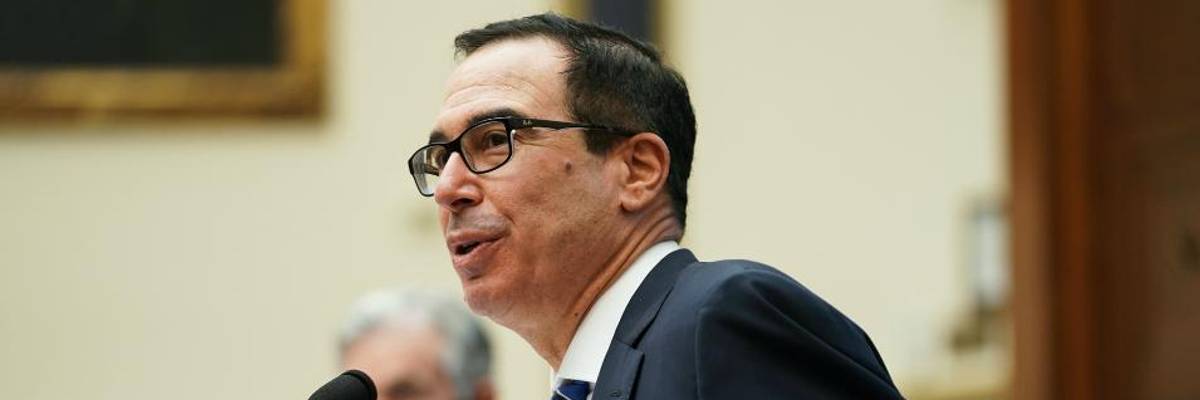
Treasury Secretary Steven Mnuchin testifies during a House Financial Services Committee hearing in the Rayburn House Office Building in Washington, D.C. on December 2, 2020. (Photo: Greg Nash/Pool/AFP via Getty Images)
'This Is Atrocious': Trump White House Proposes Covid Relief Plan With $0 Weekly Unemployment Boost
"The president's proposal starts by cutting the unemployment insurance proposal being discussed by bipartisan members of the House and Senate. That is unacceptable."
The Trump White House late Tuesday tossed into the middle of ongoing coronavirus relief negotiations a $916 billion proposal that includes one-time $600 stimulus payments in the place of a weekly boost to federal unemployment benefits, a trade-off that Democratic lawmakers and economic analysts immediately rejected as unconscionable.
Offered as Democratic and Republican negotiators are racing to strike a relief deal before year's end, the White House plan would provide $40 billion for an extension of federal unemployment programs set to expire on December 26--but no increase in weekly benefits, despite the dire state of the economy.
"We gave the biggest help to those who needed it. The Republicans would send one $600 check and that's it. This is atrocious."
--Rep. Don Beyer
The Trump administration's unemployment insurance plan, put forth by Treasury Secretary Steve Mnuchin, falls well short of a bipartisan framework that calls for $180 billion in funding to boost unemployment benefits by $300 per week through March.
"The president's proposal starts by cutting the unemployment insurance proposal being discussed by bipartisan members of the House and Senate from $180 billion to $40 billion," House Speaker Nancy Pelosi (D-Calif.) and Senate Minority Leader Chuck Schumer (D-N.Y.) said in a joint statement. "That is unacceptable."
As a substitute for the lack of a weekly unemployment boost, the White House proposed a round of direct stimulus payments amounting to $600 per adult and $600 per child.
By contrast, the $2.2 trillion CARES Act that Congress approved in March sent one-time payments of $1,200 per adult and $500 per child to most U.S. households, on top of a $600-per-week unemployment supplement that proved remarkably successful until Republicans allowed it to lapse at the end of July.
"We gave the biggest help to those who needed it," Rep. Don Beyer (D-Va.) said of the CARES Act. "The Republicans would send one $600 check and that's it. This is atrocious."
Andrew Stettner, a senior fellow at The Century Foundation, noted that "unemployed workers are going thousands in dollars in debt on paltry benefits."
"Stimulus checks are not a substitute," said Stettner, a sentiment echoed by other analysts.
With hiring slowing sharply as coronavirus infections rise nationwide, economists have warned that failure to approve a weekly unemployment boost would heighten the misery already being felt by tens of millions of people across the U.S. According to recent data, around 20 million Americans are currently receiving some form of unemployment insurance, 26 million are struggling to afford enough food, and 40 million could face eviction in the near future.
"The expiration of vital pandemic unemployment insurance (UI) benefits on December 26 will leave 12 million workers without a safety net, and over four million others will have already exhausted their benefits by this cutoff," Elise Gould, senior economist at the Economic Policy Institute, wrote in a blog post last week. "This spells trouble not only for workers and their families who are desperately trying to keep a roof over their heads and put food on the table--especially with the eviction moratorium also set to expire on December 31--but also for the recovery itself."
"The longer Congress waits to act, the more permanent damage will be done to American families and the overall economy."
--Dr. Mark Paul, Dr. Adam Hersh
In addition to being dramatically less ambitious than the CARES Act, the White House's new proposal and the bipartisan plan embraced as a starting point by Democratic leaders are both a far cry from the kind of bold stimulus that experts say is needed to prevent a prolonged recession and ensure a just recovery.
A paper (pdf) authored by economists Dr. Mark Paul and Dr. Adam Hersh and released Tuesday by the Groundwork Collaborative estimates that "Congress needs to provide economic relief of between $3-4.5 trillion in the short-term in order to get American families and businesses working at their full potential."
"This would include continuing to expand eligibility for unemployment insurance benefits, renewing the $600 weekly supplemental benefits, providing fiscal aid to offset budgetary pressures on state, local, and tribal governments, renewal and better management of the Paycheck Protection Program for small businesses, and resources to expand Covid testing and tracing and health insurance subsidies, among other measures," the economists wrote.
"The longer Congress waits to act," they warned, "the more permanent damage will be done to American families and the overall economy, and the harder it will be for the U.S. economy to regain prosperity."
We are at a crossroads
This country and this world are at a monumental crossroads. In a few short weeks, US voters will have an opportunity to beat back the forces of fascism and confront the billionaires who are rigging the economy, our media system, and our democracy, making it increasingly impossible for ordinary people to get by. We’re not just talking about the election. We’re talking about what must be done once these fascist elements are vanquished from power. We need a bolder set of solutions than what either major party has so far been willing to offer and a working-class movement ready to fight like hell for it. Trump didn't emerge from nowhere. The conditions that fueled MAGA authoritarianism were created by decades of radical neoliberal economic policies and a corrupt political system dominated by corporate interests. They slashed taxes on the super-rich, promising that the benefits would trickle down. They said giveaways to the corporate titans would make life more affordable for the rest of us. It was all bullshit. And when a bitter, betrayed populace searches for someone to blame, right-wing demagogues have little trouble finding scapegoats. People know when they're being lied to, but you won't hear any of this from the corporate media. Only independent journalism—powered and funded by people who believe in building a better world—can deliver truly trustworthy daily news. Our Fall Campaign is underway, and we need your help. To power our newsroom through the rest of the year, we need to raise $125,000 by midnight on October 31. So if you share our vision, please contribute whatever you can to sustain our work. |
The Trump White House late Tuesday tossed into the middle of ongoing coronavirus relief negotiations a $916 billion proposal that includes one-time $600 stimulus payments in the place of a weekly boost to federal unemployment benefits, a trade-off that Democratic lawmakers and economic analysts immediately rejected as unconscionable.
Offered as Democratic and Republican negotiators are racing to strike a relief deal before year's end, the White House plan would provide $40 billion for an extension of federal unemployment programs set to expire on December 26--but no increase in weekly benefits, despite the dire state of the economy.
"We gave the biggest help to those who needed it. The Republicans would send one $600 check and that's it. This is atrocious."
--Rep. Don Beyer
The Trump administration's unemployment insurance plan, put forth by Treasury Secretary Steve Mnuchin, falls well short of a bipartisan framework that calls for $180 billion in funding to boost unemployment benefits by $300 per week through March.
"The president's proposal starts by cutting the unemployment insurance proposal being discussed by bipartisan members of the House and Senate from $180 billion to $40 billion," House Speaker Nancy Pelosi (D-Calif.) and Senate Minority Leader Chuck Schumer (D-N.Y.) said in a joint statement. "That is unacceptable."
As a substitute for the lack of a weekly unemployment boost, the White House proposed a round of direct stimulus payments amounting to $600 per adult and $600 per child.
By contrast, the $2.2 trillion CARES Act that Congress approved in March sent one-time payments of $1,200 per adult and $500 per child to most U.S. households, on top of a $600-per-week unemployment supplement that proved remarkably successful until Republicans allowed it to lapse at the end of July.
"We gave the biggest help to those who needed it," Rep. Don Beyer (D-Va.) said of the CARES Act. "The Republicans would send one $600 check and that's it. This is atrocious."
Andrew Stettner, a senior fellow at The Century Foundation, noted that "unemployed workers are going thousands in dollars in debt on paltry benefits."
"Stimulus checks are not a substitute," said Stettner, a sentiment echoed by other analysts.
With hiring slowing sharply as coronavirus infections rise nationwide, economists have warned that failure to approve a weekly unemployment boost would heighten the misery already being felt by tens of millions of people across the U.S. According to recent data, around 20 million Americans are currently receiving some form of unemployment insurance, 26 million are struggling to afford enough food, and 40 million could face eviction in the near future.
"The expiration of vital pandemic unemployment insurance (UI) benefits on December 26 will leave 12 million workers without a safety net, and over four million others will have already exhausted their benefits by this cutoff," Elise Gould, senior economist at the Economic Policy Institute, wrote in a blog post last week. "This spells trouble not only for workers and their families who are desperately trying to keep a roof over their heads and put food on the table--especially with the eviction moratorium also set to expire on December 31--but also for the recovery itself."
"The longer Congress waits to act, the more permanent damage will be done to American families and the overall economy."
--Dr. Mark Paul, Dr. Adam Hersh
In addition to being dramatically less ambitious than the CARES Act, the White House's new proposal and the bipartisan plan embraced as a starting point by Democratic leaders are both a far cry from the kind of bold stimulus that experts say is needed to prevent a prolonged recession and ensure a just recovery.
A paper (pdf) authored by economists Dr. Mark Paul and Dr. Adam Hersh and released Tuesday by the Groundwork Collaborative estimates that "Congress needs to provide economic relief of between $3-4.5 trillion in the short-term in order to get American families and businesses working at their full potential."
"This would include continuing to expand eligibility for unemployment insurance benefits, renewing the $600 weekly supplemental benefits, providing fiscal aid to offset budgetary pressures on state, local, and tribal governments, renewal and better management of the Paycheck Protection Program for small businesses, and resources to expand Covid testing and tracing and health insurance subsidies, among other measures," the economists wrote.
"The longer Congress waits to act," they warned, "the more permanent damage will be done to American families and the overall economy, and the harder it will be for the U.S. economy to regain prosperity."
The Trump White House late Tuesday tossed into the middle of ongoing coronavirus relief negotiations a $916 billion proposal that includes one-time $600 stimulus payments in the place of a weekly boost to federal unemployment benefits, a trade-off that Democratic lawmakers and economic analysts immediately rejected as unconscionable.
Offered as Democratic and Republican negotiators are racing to strike a relief deal before year's end, the White House plan would provide $40 billion for an extension of federal unemployment programs set to expire on December 26--but no increase in weekly benefits, despite the dire state of the economy.
"We gave the biggest help to those who needed it. The Republicans would send one $600 check and that's it. This is atrocious."
--Rep. Don Beyer
The Trump administration's unemployment insurance plan, put forth by Treasury Secretary Steve Mnuchin, falls well short of a bipartisan framework that calls for $180 billion in funding to boost unemployment benefits by $300 per week through March.
"The president's proposal starts by cutting the unemployment insurance proposal being discussed by bipartisan members of the House and Senate from $180 billion to $40 billion," House Speaker Nancy Pelosi (D-Calif.) and Senate Minority Leader Chuck Schumer (D-N.Y.) said in a joint statement. "That is unacceptable."
As a substitute for the lack of a weekly unemployment boost, the White House proposed a round of direct stimulus payments amounting to $600 per adult and $600 per child.
By contrast, the $2.2 trillion CARES Act that Congress approved in March sent one-time payments of $1,200 per adult and $500 per child to most U.S. households, on top of a $600-per-week unemployment supplement that proved remarkably successful until Republicans allowed it to lapse at the end of July.
"We gave the biggest help to those who needed it," Rep. Don Beyer (D-Va.) said of the CARES Act. "The Republicans would send one $600 check and that's it. This is atrocious."
Andrew Stettner, a senior fellow at The Century Foundation, noted that "unemployed workers are going thousands in dollars in debt on paltry benefits."
"Stimulus checks are not a substitute," said Stettner, a sentiment echoed by other analysts.
With hiring slowing sharply as coronavirus infections rise nationwide, economists have warned that failure to approve a weekly unemployment boost would heighten the misery already being felt by tens of millions of people across the U.S. According to recent data, around 20 million Americans are currently receiving some form of unemployment insurance, 26 million are struggling to afford enough food, and 40 million could face eviction in the near future.
"The expiration of vital pandemic unemployment insurance (UI) benefits on December 26 will leave 12 million workers without a safety net, and over four million others will have already exhausted their benefits by this cutoff," Elise Gould, senior economist at the Economic Policy Institute, wrote in a blog post last week. "This spells trouble not only for workers and their families who are desperately trying to keep a roof over their heads and put food on the table--especially with the eviction moratorium also set to expire on December 31--but also for the recovery itself."
"The longer Congress waits to act, the more permanent damage will be done to American families and the overall economy."
--Dr. Mark Paul, Dr. Adam Hersh
In addition to being dramatically less ambitious than the CARES Act, the White House's new proposal and the bipartisan plan embraced as a starting point by Democratic leaders are both a far cry from the kind of bold stimulus that experts say is needed to prevent a prolonged recession and ensure a just recovery.
A paper (pdf) authored by economists Dr. Mark Paul and Dr. Adam Hersh and released Tuesday by the Groundwork Collaborative estimates that "Congress needs to provide economic relief of between $3-4.5 trillion in the short-term in order to get American families and businesses working at their full potential."
"This would include continuing to expand eligibility for unemployment insurance benefits, renewing the $600 weekly supplemental benefits, providing fiscal aid to offset budgetary pressures on state, local, and tribal governments, renewal and better management of the Paycheck Protection Program for small businesses, and resources to expand Covid testing and tracing and health insurance subsidies, among other measures," the economists wrote.
"The longer Congress waits to act," they warned, "the more permanent damage will be done to American families and the overall economy, and the harder it will be for the U.S. economy to regain prosperity."