SUBSCRIBE TO OUR FREE NEWSLETTER
Daily news & progressive opinion—funded by the people, not the corporations—delivered straight to your inbox.
5
#000000
#FFFFFF
To donate by check, phone, or other method, see our More Ways to Give page.
Daily news & progressive opinion—funded by the people, not the corporations—delivered straight to your inbox.
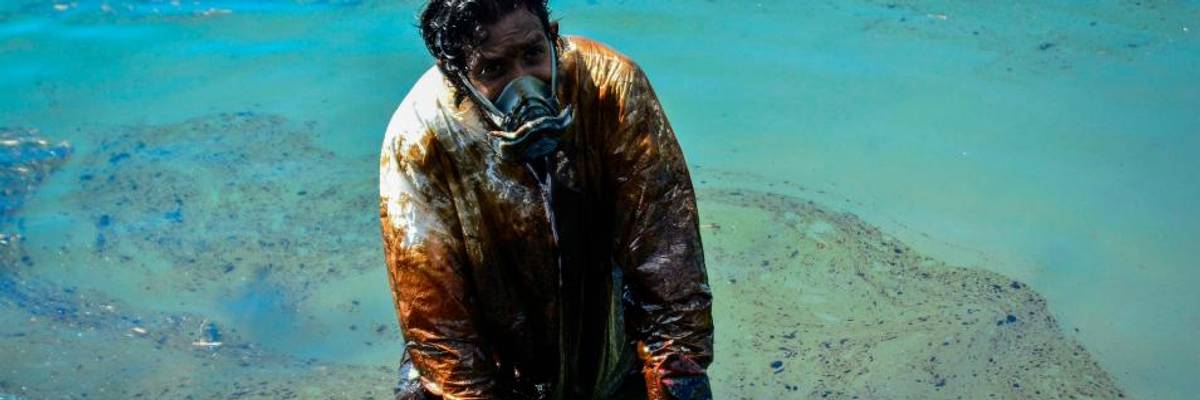
A man scoops leaked oil from MV Wakashio, a vessel that is owned by a Japanese company but Panamanian-flagged, which ran aground near Blue Bay Marine Park off the coast of southeast Mauritius on August 8, 2020. (Photo: Jean Aurelio Prudence/L'Express Maurice/AFP via Getty Images)
After Mauritius Prime Minister Pravind Jugnauth and local environmentalists confirmed that most of the remaining fuel on a cracked ship stranded about a mile off the island nation's coast had been removed, wildlife experts on Thursday reiterated warnings that significant damage has already been done by the vessel spilling over 1,000 tonnes of oil into Indian Ocean.
"Make no mistake, the damage that has been done already is substantial."
--Jean Hugue Gardenne, Mauritian Wildlife Foundation
"Today we can confirm that there is just a small amount of oil left on the ship. We are not threatened with an even worse disaster," Jean Hugue Gardenne, communications manager for the Mauritian Wildlife Foundation, a local nonprofit, told the Associated Press on Thursday.
"However, make no mistake, the damage that has been done already is substantial. There is considerable clean-up work that must be done urgently," Gardenne said. "The damage to the coral reefs may be irreversible."
"The amount of oil that was spilled in the area may seem relatively small, but it hit at a very sensitive part of our island," he explained. "Our coral reefs, the mangrove areas, a marine protected area, four small islands. All these have been contaminated by the oil."
Mauritius, located east of the African continent, is a "biodiverisity hotspot" and its surrounding waters are home to 1,700 species. The oil spill occurred "near two environmentally protected marine ecosystems and the Blue Bay Marine Park reserve, which is a wetland of international importance," BBC News reported Thursday.
"There are very few such marine areas with such rich biodiversity left on the planet. An oil spill like this will impact almost everything there," Corina Ciocan, a senior lecturer in marine biology at the United Kingdom's University of Brighton, told the BBC.
"It is not just about the light oil slick you see on the surface of the water caused by the spill," Ciocan said. "There will also be soluble compounds from the oil that will dissolve in the water, a mousse-like layer underneath the surface of the water, and then very heavy residues on the bed--so the entire marine ecosystem will be affected."
The MV Wakashio--a vessel owned by Nagashiki Shipping and operated by Mitsui OSK Lines, both based in Japan--ran aground on a coral reef near Mauritius on July 25 while carrying an estimated 4,000 tonnes of oil.
The ship started leaking oil last week, and efforts to remove the fuel that remained onboard ramped up Monday amid fears that the MV Wakashio may break in two.
In addition to telling reporters Wednesday that "almost all the oil has been removed from the ship," Jugnauth said that his government will seek compensation from the ship's owner for the environmental damage.
The company, Nagashiki Shipping, said Thursday that "it felt its responsibility acutely and intends to take steps towards assessing compensation," according to Reuters.
Environmental advocacy groups across the globe, including Greenpeace and 350.org, have responded to the spill by demanding not only international aid for the clean-up efforts but also an end to fossil fuels.
Greenpeace Africa's communications director, Tal Harris, told the AP on Thursday that "we know this disaster will have significant effects on biodiversity in Mauritius."
"There needs to be a detailed and urgent survey of the damage done and a monitoring program to see what can recover and how quickly, and how much residual oil sticks around in the long term," Harris said.
Along with the environmental impact, the oil spill is taking an economic toll on Mauritius--which is notably dependent on tourism and was already facing difficulties on that front due to the coronavirus pandemic.
"It is really going to affect the communities down there, especially for the fisherman, the local guys that live there, you know that's how they make money from tourists," Willow River-Tonkin, who owns a kite-surfing business, told Reuters of the area around the spill.
"Taking them out to go diving, to go snorkeling, to go wakeboarding, to go see dolphins, and all that sort of thing you know, and all of that is going to affect it, if we don't get it under control very soon," River-Tonkin warned.
Dear Common Dreams reader, It’s been nearly 30 years since I co-founded Common Dreams with my late wife, Lina Newhouser. We had the radical notion that journalism should serve the public good, not corporate profits. It was clear to us from the outset what it would take to build such a project. No paid advertisements. No corporate sponsors. No millionaire publisher telling us what to think or do. Many people said we wouldn't last a year, but we proved those doubters wrong. Together with a tremendous team of journalists and dedicated staff, we built an independent media outlet free from the constraints of profits and corporate control. Our mission has always been simple: To inform. To inspire. To ignite change for the common good. Building Common Dreams was not easy. Our survival was never guaranteed. When you take on the most powerful forces—Wall Street greed, fossil fuel industry destruction, Big Tech lobbyists, and uber-rich oligarchs who have spent billions upon billions rigging the economy and democracy in their favor—the only bulwark you have is supporters who believe in your work. But here’s the urgent message from me today. It's never been this bad out there. And it's never been this hard to keep us going. At the very moment Common Dreams is most needed, the threats we face are intensifying. We need your support now more than ever. We don't accept corporate advertising and never will. We don't have a paywall because we don't think people should be blocked from critical news based on their ability to pay. Everything we do is funded by the donations of readers like you. When everyone does the little they can afford, we are strong. But if that support retreats or dries up, so do we. Will you donate now to make sure Common Dreams not only survives but thrives? —Craig Brown, Co-founder |
After Mauritius Prime Minister Pravind Jugnauth and local environmentalists confirmed that most of the remaining fuel on a cracked ship stranded about a mile off the island nation's coast had been removed, wildlife experts on Thursday reiterated warnings that significant damage has already been done by the vessel spilling over 1,000 tonnes of oil into Indian Ocean.
"Make no mistake, the damage that has been done already is substantial."
--Jean Hugue Gardenne, Mauritian Wildlife Foundation
"Today we can confirm that there is just a small amount of oil left on the ship. We are not threatened with an even worse disaster," Jean Hugue Gardenne, communications manager for the Mauritian Wildlife Foundation, a local nonprofit, told the Associated Press on Thursday.
"However, make no mistake, the damage that has been done already is substantial. There is considerable clean-up work that must be done urgently," Gardenne said. "The damage to the coral reefs may be irreversible."
"The amount of oil that was spilled in the area may seem relatively small, but it hit at a very sensitive part of our island," he explained. "Our coral reefs, the mangrove areas, a marine protected area, four small islands. All these have been contaminated by the oil."
Mauritius, located east of the African continent, is a "biodiverisity hotspot" and its surrounding waters are home to 1,700 species. The oil spill occurred "near two environmentally protected marine ecosystems and the Blue Bay Marine Park reserve, which is a wetland of international importance," BBC News reported Thursday.
"There are very few such marine areas with such rich biodiversity left on the planet. An oil spill like this will impact almost everything there," Corina Ciocan, a senior lecturer in marine biology at the United Kingdom's University of Brighton, told the BBC.
"It is not just about the light oil slick you see on the surface of the water caused by the spill," Ciocan said. "There will also be soluble compounds from the oil that will dissolve in the water, a mousse-like layer underneath the surface of the water, and then very heavy residues on the bed--so the entire marine ecosystem will be affected."
The MV Wakashio--a vessel owned by Nagashiki Shipping and operated by Mitsui OSK Lines, both based in Japan--ran aground on a coral reef near Mauritius on July 25 while carrying an estimated 4,000 tonnes of oil.
The ship started leaking oil last week, and efforts to remove the fuel that remained onboard ramped up Monday amid fears that the MV Wakashio may break in two.
In addition to telling reporters Wednesday that "almost all the oil has been removed from the ship," Jugnauth said that his government will seek compensation from the ship's owner for the environmental damage.
The company, Nagashiki Shipping, said Thursday that "it felt its responsibility acutely and intends to take steps towards assessing compensation," according to Reuters.
Environmental advocacy groups across the globe, including Greenpeace and 350.org, have responded to the spill by demanding not only international aid for the clean-up efforts but also an end to fossil fuels.
Greenpeace Africa's communications director, Tal Harris, told the AP on Thursday that "we know this disaster will have significant effects on biodiversity in Mauritius."
"There needs to be a detailed and urgent survey of the damage done and a monitoring program to see what can recover and how quickly, and how much residual oil sticks around in the long term," Harris said.
Along with the environmental impact, the oil spill is taking an economic toll on Mauritius--which is notably dependent on tourism and was already facing difficulties on that front due to the coronavirus pandemic.
"It is really going to affect the communities down there, especially for the fisherman, the local guys that live there, you know that's how they make money from tourists," Willow River-Tonkin, who owns a kite-surfing business, told Reuters of the area around the spill.
"Taking them out to go diving, to go snorkeling, to go wakeboarding, to go see dolphins, and all that sort of thing you know, and all of that is going to affect it, if we don't get it under control very soon," River-Tonkin warned.
After Mauritius Prime Minister Pravind Jugnauth and local environmentalists confirmed that most of the remaining fuel on a cracked ship stranded about a mile off the island nation's coast had been removed, wildlife experts on Thursday reiterated warnings that significant damage has already been done by the vessel spilling over 1,000 tonnes of oil into Indian Ocean.
"Make no mistake, the damage that has been done already is substantial."
--Jean Hugue Gardenne, Mauritian Wildlife Foundation
"Today we can confirm that there is just a small amount of oil left on the ship. We are not threatened with an even worse disaster," Jean Hugue Gardenne, communications manager for the Mauritian Wildlife Foundation, a local nonprofit, told the Associated Press on Thursday.
"However, make no mistake, the damage that has been done already is substantial. There is considerable clean-up work that must be done urgently," Gardenne said. "The damage to the coral reefs may be irreversible."
"The amount of oil that was spilled in the area may seem relatively small, but it hit at a very sensitive part of our island," he explained. "Our coral reefs, the mangrove areas, a marine protected area, four small islands. All these have been contaminated by the oil."
Mauritius, located east of the African continent, is a "biodiverisity hotspot" and its surrounding waters are home to 1,700 species. The oil spill occurred "near two environmentally protected marine ecosystems and the Blue Bay Marine Park reserve, which is a wetland of international importance," BBC News reported Thursday.
"There are very few such marine areas with such rich biodiversity left on the planet. An oil spill like this will impact almost everything there," Corina Ciocan, a senior lecturer in marine biology at the United Kingdom's University of Brighton, told the BBC.
"It is not just about the light oil slick you see on the surface of the water caused by the spill," Ciocan said. "There will also be soluble compounds from the oil that will dissolve in the water, a mousse-like layer underneath the surface of the water, and then very heavy residues on the bed--so the entire marine ecosystem will be affected."
The MV Wakashio--a vessel owned by Nagashiki Shipping and operated by Mitsui OSK Lines, both based in Japan--ran aground on a coral reef near Mauritius on July 25 while carrying an estimated 4,000 tonnes of oil.
The ship started leaking oil last week, and efforts to remove the fuel that remained onboard ramped up Monday amid fears that the MV Wakashio may break in two.
In addition to telling reporters Wednesday that "almost all the oil has been removed from the ship," Jugnauth said that his government will seek compensation from the ship's owner for the environmental damage.
The company, Nagashiki Shipping, said Thursday that "it felt its responsibility acutely and intends to take steps towards assessing compensation," according to Reuters.
Environmental advocacy groups across the globe, including Greenpeace and 350.org, have responded to the spill by demanding not only international aid for the clean-up efforts but also an end to fossil fuels.
Greenpeace Africa's communications director, Tal Harris, told the AP on Thursday that "we know this disaster will have significant effects on biodiversity in Mauritius."
"There needs to be a detailed and urgent survey of the damage done and a monitoring program to see what can recover and how quickly, and how much residual oil sticks around in the long term," Harris said.
Along with the environmental impact, the oil spill is taking an economic toll on Mauritius--which is notably dependent on tourism and was already facing difficulties on that front due to the coronavirus pandemic.
"It is really going to affect the communities down there, especially for the fisherman, the local guys that live there, you know that's how they make money from tourists," Willow River-Tonkin, who owns a kite-surfing business, told Reuters of the area around the spill.
"Taking them out to go diving, to go snorkeling, to go wakeboarding, to go see dolphins, and all that sort of thing you know, and all of that is going to affect it, if we don't get it under control very soon," River-Tonkin warned.