
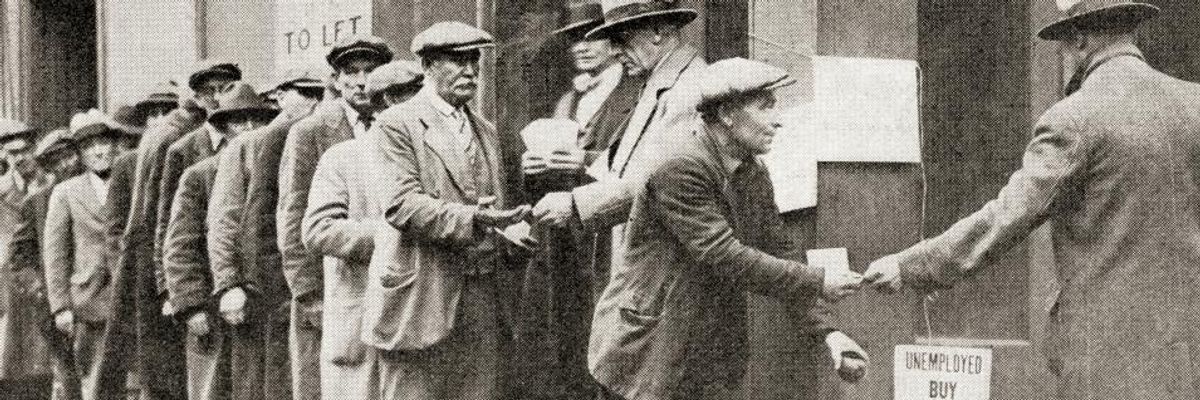
A line of unemployed men buy apples for 5 cents during the Great Depression.
Stiglitz Warns US Barreling Toward Second 'Great Depression' Thanks to Trump-GOP Failed Covid-19 Response
"If you leave it to Donald Trump and Mitch McConnell we will have a Great Depression. If we had the right policy structure in place we could avoid it easily."
Nobel Prize-winning economist Joseph Stiglitz on Wednesday offered a scathing assessment of President Donald Trump's response to the deadly Covid-19 pandemic and warned that the U.S. economy could rapidly descend into a second Great Depression without sweeping and urgent legislative action from Congress.
"It is like a third world country," Stiglitz said in an interview with The Guardian, pointing to the number of people in the U.S. who have been forced to rely on food banks to survive amid the ongoing coronavirus outbreak.
"We were unprepared but, even given the degree of unpreparedness, Trump's decision to make this about politics rather than about science has meant we have responded far more poorly."
--Joseph Stiglitz, Columbia University
Stiglitz, a professor at Columbia University, said America's existing inequities and fragmented social safety net made it far more difficult for the nation to respond quickly and effectively to the coronavirus outbreak, which has infected more than 800,000 people in the U.S.
"The inequality in the U.S. is so large," said Stiglitz. "This disease has targeted those with the poorest health. In the advanced world, the U.S. is one of the countries with the poorest health overall and the greatest health inequality... The safety net is not adequate and is propagating the disease."
Stiglitz warned that if Trump and Senate Majority Leader Mitch McConnell (R-Ky.) are allowed to continue dictating the federal government's response to the coronavirus outbreak, "we will have a Great Depression."
"If we had the right policy structure in place we could avoid it easily," said Stiglitz. "We were unprepared but, even given the degree of unpreparedness, Trump's decision to make this about politics rather than about science has meant we have responded far more poorly."
Congress has thus far passed three relief packages in response to the coronavirus crisis. An additional interim measure passed the Senate Tuesday and is expected to be approved by the House as early as Thursday.
Stiglitz was an outspoken critic of the $2.2 trillion CARES Act that Trump signed into law last month, warning the package would not be enough to stem massive job losses and stave off a recession. According to the U.S. Department of Labor latest data, 22 million Americans have filed jobless claims since the middle of March.
"So much wealth has been destroyed on people's balance sheet," Stiglitz said in an interview on Democratic Now! last month. "When the economy recovers, when the disease gets under control, people may be not in position to spend in the way that they were before. And so, it could help prolong the economic downturn, unless we take appropriate measures."
We are at a crossroads
This country and this world are at a monumental crossroads. In a few short weeks, US voters will have an opportunity to beat back the forces of fascism and confront the billionaires who are rigging the economy, our media system, and our democracy, making it increasingly impossible for ordinary people to get by. We’re not just talking about the election. We’re talking about what must be done once these fascist elements are vanquished from power. We need a bolder set of solutions than what either major party has so far been willing to offer and a working-class movement ready to fight like hell for it. Trump didn't emerge from nowhere. The conditions that fueled MAGA authoritarianism were created by decades of radical neoliberal economic policies and a corrupt political system dominated by corporate interests. They slashed taxes on the super-rich, promising that the benefits would trickle down. They said giveaways to the corporate titans would make life more affordable for the rest of us. It was all bullshit. And when a bitter, betrayed populace searches for someone to blame, right-wing demagogues have little trouble finding scapegoats. People know when they're being lied to, but you won't hear any of this from the corporate media. Only independent journalism—powered and funded by people who believe in building a better world—can deliver truly trustworthy daily news. Our Fall Campaign is underway, and we need your help. To power our newsroom through the rest of the year, we need to raise $125,000 by midnight on October 31. So if you share our vision, please contribute whatever you can to sustain our work. |
Nobel Prize-winning economist Joseph Stiglitz on Wednesday offered a scathing assessment of President Donald Trump's response to the deadly Covid-19 pandemic and warned that the U.S. economy could rapidly descend into a second Great Depression without sweeping and urgent legislative action from Congress.
"It is like a third world country," Stiglitz said in an interview with The Guardian, pointing to the number of people in the U.S. who have been forced to rely on food banks to survive amid the ongoing coronavirus outbreak.
"We were unprepared but, even given the degree of unpreparedness, Trump's decision to make this about politics rather than about science has meant we have responded far more poorly."
--Joseph Stiglitz, Columbia University
Stiglitz, a professor at Columbia University, said America's existing inequities and fragmented social safety net made it far more difficult for the nation to respond quickly and effectively to the coronavirus outbreak, which has infected more than 800,000 people in the U.S.
"The inequality in the U.S. is so large," said Stiglitz. "This disease has targeted those with the poorest health. In the advanced world, the U.S. is one of the countries with the poorest health overall and the greatest health inequality... The safety net is not adequate and is propagating the disease."
Stiglitz warned that if Trump and Senate Majority Leader Mitch McConnell (R-Ky.) are allowed to continue dictating the federal government's response to the coronavirus outbreak, "we will have a Great Depression."
"If we had the right policy structure in place we could avoid it easily," said Stiglitz. "We were unprepared but, even given the degree of unpreparedness, Trump's decision to make this about politics rather than about science has meant we have responded far more poorly."
Congress has thus far passed three relief packages in response to the coronavirus crisis. An additional interim measure passed the Senate Tuesday and is expected to be approved by the House as early as Thursday.
Stiglitz was an outspoken critic of the $2.2 trillion CARES Act that Trump signed into law last month, warning the package would not be enough to stem massive job losses and stave off a recession. According to the U.S. Department of Labor latest data, 22 million Americans have filed jobless claims since the middle of March.
"So much wealth has been destroyed on people's balance sheet," Stiglitz said in an interview on Democratic Now! last month. "When the economy recovers, when the disease gets under control, people may be not in position to spend in the way that they were before. And so, it could help prolong the economic downturn, unless we take appropriate measures."