SUBSCRIBE TO OUR FREE NEWSLETTER
Daily news & progressive opinion—funded by the people, not the corporations—delivered straight to your inbox.
5
#000000
#FFFFFF
To donate by check, phone, or other method, see our More Ways to Give page.
Daily news & progressive opinion—funded by the people, not the corporations—delivered straight to your inbox.
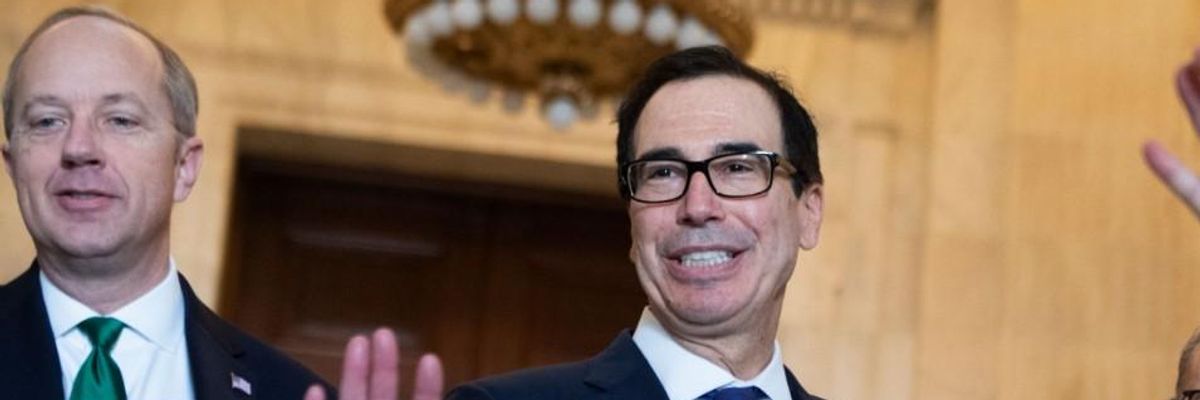
Treasury Secretary Steven Mnuchin asks the media for social distancing before delivering remarks on the coronavirus relief package after the Senate Republican Policy luncheon in Russell Building on Tuesday, March 17, 2020. (Photo: Tom Williams/CQ-Roll Call, Inc via Getty Images)
President Donald Trump's Treasury Department has given U.S. banks a green light to seize a portion or all of the one-time $1,200 coronavirus relief payments meant to help Americans cope with financial hardship and instead use the money to pay off individuals' outstanding debts--a move consumer advocates decried as cruel and unacceptable.
"These payments are supposed to help individuals and families put food on the table during this crisis, not enrich debt collectors."
--Maura Healey, Massachusetts Attorney General
"The Treasury Department effectively blessed this activity on a webinar with banking officials last Friday," The American Prospect's David Dayen reported Tuesday.
In an audio recording from the webinar obtained exclusively by the Prospect, Ronda Kent, chief disbursing officer at the Treasury Department's Bureau of the Fiscal Service, told bankers that "there's nothing in the law that precludes" financial institutions from seizing a person's payment and using it to pay off the individual's debts.
"After a third of U.S. renters couldn't make rent this month, the Treasury Department is pointing out opportunities for banks and debt collectors to steal Americans' relief checks out from under them," Jeremy Funk, spokesperson for consumer advocacy group Allied Progress, said in a statement responding to Kent's comments.
"It's the middle of a pandemic," said Funk. "This money should be going toward food, rent, and medicine--it's not the time to hand out favors to debt collection industry donors or pad some big bank's bottom line," said Funk. "Secretary Mnuchin needs to ensure that these $1,200 checks go straight into Americans pockets where they belong."
Listen to the recording:
Americans with direct deposit information on file with the Internal Revenue Service are expected to begin receiving the $1,200 payments in their bank accounts this week, provided that their banks do not opt to seize the money.
Those for whom the government does not have direct deposit information--a group that is disproportionately low-income--could be forced to wait up to five months to receive paper checks in the mail.
The direct payments were authorized under the CARES Act, a massive coronavirus stimulus package President Donald Trump signed into law last month.
As Dayen explained, Congress explicitly exempted the one-time stimulus payments from collection under the CARES Act "if the debt is owed to federal or state agencies, unless the debt involves a child support payment."
"But Congress did not extend this exemption to private debt collection," Dayen wrote. "The payments are defined as tax credits and not federal benefits, making them subject to 'garnishment,' in which a debt collector that wins a judgment in court can seize anything of value held by the debtor."
"Congress did give Treasury the authority under Section 2201(h) of the CARES Act to write rules exempting the payments from private debt collectors," Dayen noted, but the Treasury Department--headed by former Goldman Sachs executive Steve Mnuchin--has thus far refused to exercise that authority despite pressure from Democratic members of Congress and state attorneys general.
On Monday, Massachusetts Attorney General Maura Healey issued guidance stating that the $1,200 payments "are exempt from seizure or garnishment by creditors under Massachusetts law."
"These payments are supposed to help individuals and families put food on the table during this crisis, not enrich debt collectors," Healey said in a statement. "With this guidance... my office is putting the debt collection industry on notice that these payments are off limits."
Healey on Monday also signed onto a letter (pdf) led by New York Attorney General Letitia James urging Mnuchin to issue "a regulation or guidance designating CARES Act payments as 'benefit payments' exempt from garnishment." The letter was signed by 25 state attorneys general.
"During this public health and economic crisis, the states do not believe that the billions of dollars appropriated by Congress to help keep hard-working Americans afloat should be subject to garnishment," the letter states.
"Absolutely obscene. This money is for food, medicine, housing. The essentials of life."
--Mike Siegel, Texas congressional candidate
Dayen noted that "legally speaking, banks have the right to 'offset' any deposits to pay off delinquent loans, overdraft fees, or other charges."
"Banks have more immediate access to the coronavirus checks by virtue of having them deposited into accounts at their institutions," Dayen wrote. "They're also in front of the line for repayment of debts ahead of other private debt collectors."
The possibility that banks could seize individuals' relief payments as millions of people across the U.S. face layoffs, pay cuts, and reductions in work hours sparked outrage on social media.
"This is beyond predatory," tweeted finance expert and investigative journalist Nomi Prins.
Jess Scarane, a progressive running to unseat Sen. Chris Coons (D-Del.), tweeted that "this 'stimulus' gets worse and worse for working people every day."
"Even the meager help we thought individuals would get can end up in the hands of banks," said Scarane, "while people continue to struggle to put food on their tables and survive."
Dear Common Dreams reader, It’s been nearly 30 years since I co-founded Common Dreams with my late wife, Lina Newhouser. We had the radical notion that journalism should serve the public good, not corporate profits. It was clear to us from the outset what it would take to build such a project. No paid advertisements. No corporate sponsors. No millionaire publisher telling us what to think or do. Many people said we wouldn't last a year, but we proved those doubters wrong. Together with a tremendous team of journalists and dedicated staff, we built an independent media outlet free from the constraints of profits and corporate control. Our mission has always been simple: To inform. To inspire. To ignite change for the common good. Building Common Dreams was not easy. Our survival was never guaranteed. When you take on the most powerful forces—Wall Street greed, fossil fuel industry destruction, Big Tech lobbyists, and uber-rich oligarchs who have spent billions upon billions rigging the economy and democracy in their favor—the only bulwark you have is supporters who believe in your work. But here’s the urgent message from me today. It's never been this bad out there. And it's never been this hard to keep us going. At the very moment Common Dreams is most needed, the threats we face are intensifying. We need your support now more than ever. We don't accept corporate advertising and never will. We don't have a paywall because we don't think people should be blocked from critical news based on their ability to pay. Everything we do is funded by the donations of readers like you. When everyone does the little they can afford, we are strong. But if that support retreats or dries up, so do we. Will you donate now to make sure Common Dreams not only survives but thrives? —Craig Brown, Co-founder |
President Donald Trump's Treasury Department has given U.S. banks a green light to seize a portion or all of the one-time $1,200 coronavirus relief payments meant to help Americans cope with financial hardship and instead use the money to pay off individuals' outstanding debts--a move consumer advocates decried as cruel and unacceptable.
"These payments are supposed to help individuals and families put food on the table during this crisis, not enrich debt collectors."
--Maura Healey, Massachusetts Attorney General
"The Treasury Department effectively blessed this activity on a webinar with banking officials last Friday," The American Prospect's David Dayen reported Tuesday.
In an audio recording from the webinar obtained exclusively by the Prospect, Ronda Kent, chief disbursing officer at the Treasury Department's Bureau of the Fiscal Service, told bankers that "there's nothing in the law that precludes" financial institutions from seizing a person's payment and using it to pay off the individual's debts.
"After a third of U.S. renters couldn't make rent this month, the Treasury Department is pointing out opportunities for banks and debt collectors to steal Americans' relief checks out from under them," Jeremy Funk, spokesperson for consumer advocacy group Allied Progress, said in a statement responding to Kent's comments.
"It's the middle of a pandemic," said Funk. "This money should be going toward food, rent, and medicine--it's not the time to hand out favors to debt collection industry donors or pad some big bank's bottom line," said Funk. "Secretary Mnuchin needs to ensure that these $1,200 checks go straight into Americans pockets where they belong."
Listen to the recording:
Americans with direct deposit information on file with the Internal Revenue Service are expected to begin receiving the $1,200 payments in their bank accounts this week, provided that their banks do not opt to seize the money.
Those for whom the government does not have direct deposit information--a group that is disproportionately low-income--could be forced to wait up to five months to receive paper checks in the mail.
The direct payments were authorized under the CARES Act, a massive coronavirus stimulus package President Donald Trump signed into law last month.
As Dayen explained, Congress explicitly exempted the one-time stimulus payments from collection under the CARES Act "if the debt is owed to federal or state agencies, unless the debt involves a child support payment."
"But Congress did not extend this exemption to private debt collection," Dayen wrote. "The payments are defined as tax credits and not federal benefits, making them subject to 'garnishment,' in which a debt collector that wins a judgment in court can seize anything of value held by the debtor."
"Congress did give Treasury the authority under Section 2201(h) of the CARES Act to write rules exempting the payments from private debt collectors," Dayen noted, but the Treasury Department--headed by former Goldman Sachs executive Steve Mnuchin--has thus far refused to exercise that authority despite pressure from Democratic members of Congress and state attorneys general.
On Monday, Massachusetts Attorney General Maura Healey issued guidance stating that the $1,200 payments "are exempt from seizure or garnishment by creditors under Massachusetts law."
"These payments are supposed to help individuals and families put food on the table during this crisis, not enrich debt collectors," Healey said in a statement. "With this guidance... my office is putting the debt collection industry on notice that these payments are off limits."
Healey on Monday also signed onto a letter (pdf) led by New York Attorney General Letitia James urging Mnuchin to issue "a regulation or guidance designating CARES Act payments as 'benefit payments' exempt from garnishment." The letter was signed by 25 state attorneys general.
"During this public health and economic crisis, the states do not believe that the billions of dollars appropriated by Congress to help keep hard-working Americans afloat should be subject to garnishment," the letter states.
"Absolutely obscene. This money is for food, medicine, housing. The essentials of life."
--Mike Siegel, Texas congressional candidate
Dayen noted that "legally speaking, banks have the right to 'offset' any deposits to pay off delinquent loans, overdraft fees, or other charges."
"Banks have more immediate access to the coronavirus checks by virtue of having them deposited into accounts at their institutions," Dayen wrote. "They're also in front of the line for repayment of debts ahead of other private debt collectors."
The possibility that banks could seize individuals' relief payments as millions of people across the U.S. face layoffs, pay cuts, and reductions in work hours sparked outrage on social media.
"This is beyond predatory," tweeted finance expert and investigative journalist Nomi Prins.
Jess Scarane, a progressive running to unseat Sen. Chris Coons (D-Del.), tweeted that "this 'stimulus' gets worse and worse for working people every day."
"Even the meager help we thought individuals would get can end up in the hands of banks," said Scarane, "while people continue to struggle to put food on their tables and survive."
President Donald Trump's Treasury Department has given U.S. banks a green light to seize a portion or all of the one-time $1,200 coronavirus relief payments meant to help Americans cope with financial hardship and instead use the money to pay off individuals' outstanding debts--a move consumer advocates decried as cruel and unacceptable.
"These payments are supposed to help individuals and families put food on the table during this crisis, not enrich debt collectors."
--Maura Healey, Massachusetts Attorney General
"The Treasury Department effectively blessed this activity on a webinar with banking officials last Friday," The American Prospect's David Dayen reported Tuesday.
In an audio recording from the webinar obtained exclusively by the Prospect, Ronda Kent, chief disbursing officer at the Treasury Department's Bureau of the Fiscal Service, told bankers that "there's nothing in the law that precludes" financial institutions from seizing a person's payment and using it to pay off the individual's debts.
"After a third of U.S. renters couldn't make rent this month, the Treasury Department is pointing out opportunities for banks and debt collectors to steal Americans' relief checks out from under them," Jeremy Funk, spokesperson for consumer advocacy group Allied Progress, said in a statement responding to Kent's comments.
"It's the middle of a pandemic," said Funk. "This money should be going toward food, rent, and medicine--it's not the time to hand out favors to debt collection industry donors or pad some big bank's bottom line," said Funk. "Secretary Mnuchin needs to ensure that these $1,200 checks go straight into Americans pockets where they belong."
Listen to the recording:
Americans with direct deposit information on file with the Internal Revenue Service are expected to begin receiving the $1,200 payments in their bank accounts this week, provided that their banks do not opt to seize the money.
Those for whom the government does not have direct deposit information--a group that is disproportionately low-income--could be forced to wait up to five months to receive paper checks in the mail.
The direct payments were authorized under the CARES Act, a massive coronavirus stimulus package President Donald Trump signed into law last month.
As Dayen explained, Congress explicitly exempted the one-time stimulus payments from collection under the CARES Act "if the debt is owed to federal or state agencies, unless the debt involves a child support payment."
"But Congress did not extend this exemption to private debt collection," Dayen wrote. "The payments are defined as tax credits and not federal benefits, making them subject to 'garnishment,' in which a debt collector that wins a judgment in court can seize anything of value held by the debtor."
"Congress did give Treasury the authority under Section 2201(h) of the CARES Act to write rules exempting the payments from private debt collectors," Dayen noted, but the Treasury Department--headed by former Goldman Sachs executive Steve Mnuchin--has thus far refused to exercise that authority despite pressure from Democratic members of Congress and state attorneys general.
On Monday, Massachusetts Attorney General Maura Healey issued guidance stating that the $1,200 payments "are exempt from seizure or garnishment by creditors under Massachusetts law."
"These payments are supposed to help individuals and families put food on the table during this crisis, not enrich debt collectors," Healey said in a statement. "With this guidance... my office is putting the debt collection industry on notice that these payments are off limits."
Healey on Monday also signed onto a letter (pdf) led by New York Attorney General Letitia James urging Mnuchin to issue "a regulation or guidance designating CARES Act payments as 'benefit payments' exempt from garnishment." The letter was signed by 25 state attorneys general.
"During this public health and economic crisis, the states do not believe that the billions of dollars appropriated by Congress to help keep hard-working Americans afloat should be subject to garnishment," the letter states.
"Absolutely obscene. This money is for food, medicine, housing. The essentials of life."
--Mike Siegel, Texas congressional candidate
Dayen noted that "legally speaking, banks have the right to 'offset' any deposits to pay off delinquent loans, overdraft fees, or other charges."
"Banks have more immediate access to the coronavirus checks by virtue of having them deposited into accounts at their institutions," Dayen wrote. "They're also in front of the line for repayment of debts ahead of other private debt collectors."
The possibility that banks could seize individuals' relief payments as millions of people across the U.S. face layoffs, pay cuts, and reductions in work hours sparked outrage on social media.
"This is beyond predatory," tweeted finance expert and investigative journalist Nomi Prins.
Jess Scarane, a progressive running to unseat Sen. Chris Coons (D-Del.), tweeted that "this 'stimulus' gets worse and worse for working people every day."
"Even the meager help we thought individuals would get can end up in the hands of banks," said Scarane, "while people continue to struggle to put food on their tables and survive."