SUBSCRIBE TO OUR FREE NEWSLETTER
Daily news & progressive opinion—funded by the people, not the corporations—delivered straight to your inbox.
5
#000000
#FFFFFF
To donate by check, phone, or other method, see our More Ways to Give page.
Daily news & progressive opinion—funded by the people, not the corporations—delivered straight to your inbox.
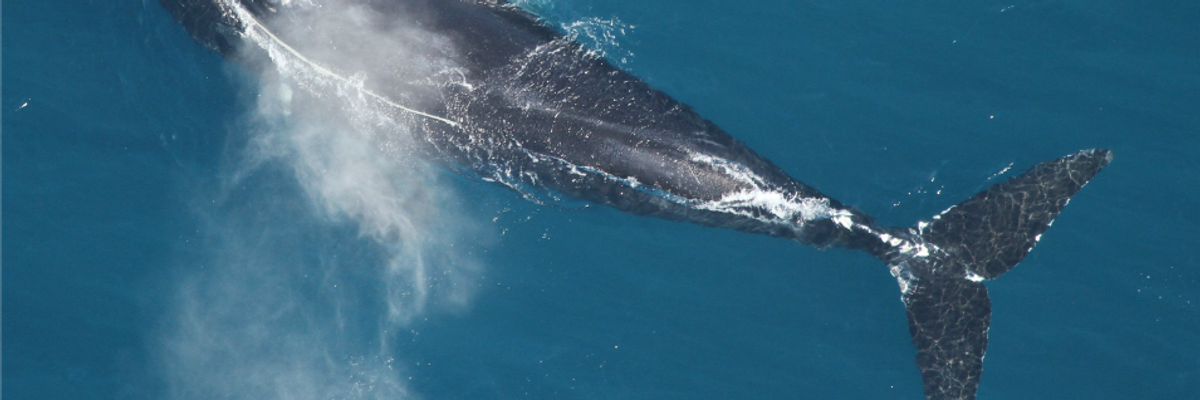
The North Atlantic right whale was among the 458 endangered species which the U.S. federal government is currently failing to protect from the effects of the climate crisis. (Photo: FWC Fish and Wildlife Research Institute/Flickr/cc)
A new study exposes serious gaps in the U.S. government's commitment to fighting the effects of the climate crisis on endangered species, which federal agencies are required by law to protect.
"While climate change is a pressing threat to imperiled species, agencies that manage federally protected species have not given enough attention to this threat," said Aimee Delach, study co-author and a researcher at Defenders of Wildlife.
Researchers at the Union of Concerned Scientists (UCS) and Defenders of Wildlife examined the sensitivities of the country's 459 endangered species to a number of global changes brought about by the climate crisis, and found all but one of them--the Hawaiian goose--have traits that make it challenging for them to adapt to those effects.
"The biggest roadblock is likely the repeated denial of the latest science by the current administration, members of Congress, and those who stand to gain from the continued use of damaging fossil fuels. Since 2016, agencies have given scant attention to the climate crisis more broadly."
--Astrid Caldas, Union of Concerned Scientists
While the authors of the study, which was published in Nature Climate Change on Monday, found that 99.8 percent of the country's endangered species are threatened by the climate crisis, government agencies consider the rapidly changing climate to be a risk for only 64 percent of them. Just 18 percent of the species are currently protected under specific plans, but the federal government is bound to protect all of them under the Endangered Species Act.
"The current administration produced only one species' document in 2017-18 that included management actions to address climate impacts," said Delach.
Dr. Gretchen Goldman, a research director at UCS, tweeted that the report identified "a big gap in our endangered species protections."
Astrid Caldas, a climate scientist at UCS who co-authored the report, suggested that the Trump administration has in less than three years greatly reduced the government's efforts to protect endangered species from melting ice, habitat destruction, and other climate changes.
"While underfunding and the lack of tools to plan and implement needed actions could be partially to blame for the lack of action, the biggest roadblock is likely the repeated denial of the latest science by the current administration, members of Congress, and those who stand to gain from the continued use of damaging fossil fuels," Caldas said in a statement. "Since 2016, agencies have given scant attention to the climate crisis more broadly."
The report comes days after documents revealed that President Donald Trump's Interior Secretary, David Bernhardt, is gutting endangered species protections to help the same companies Bernhardt was a lobbyist for before entering government.
Nearly three-quarters of the species were shown to be sensitive to three or more factors of the changing climate, increasing the danger of extinction.
A number of amphibians, mollusks, and arthropods were the most sensitive to climate changes, including the Sonoran tiger salamander and the Florida leafwing butterfly.
"We still have time to safeguard many of the endangered species we treasure, but the window to act is narrowing," Caldas said.
Dear Common Dreams reader, It’s been nearly 30 years since I co-founded Common Dreams with my late wife, Lina Newhouser. We had the radical notion that journalism should serve the public good, not corporate profits. It was clear to us from the outset what it would take to build such a project. No paid advertisements. No corporate sponsors. No millionaire publisher telling us what to think or do. Many people said we wouldn't last a year, but we proved those doubters wrong. Together with a tremendous team of journalists and dedicated staff, we built an independent media outlet free from the constraints of profits and corporate control. Our mission has always been simple: To inform. To inspire. To ignite change for the common good. Building Common Dreams was not easy. Our survival was never guaranteed. When you take on the most powerful forces—Wall Street greed, fossil fuel industry destruction, Big Tech lobbyists, and uber-rich oligarchs who have spent billions upon billions rigging the economy and democracy in their favor—the only bulwark you have is supporters who believe in your work. But here’s the urgent message from me today. It's never been this bad out there. And it's never been this hard to keep us going. At the very moment Common Dreams is most needed, the threats we face are intensifying. We need your support now more than ever. We don't accept corporate advertising and never will. We don't have a paywall because we don't think people should be blocked from critical news based on their ability to pay. Everything we do is funded by the donations of readers like you. When everyone does the little they can afford, we are strong. But if that support retreats or dries up, so do we. Will you donate now to make sure Common Dreams not only survives but thrives? —Craig Brown, Co-founder |
A new study exposes serious gaps in the U.S. government's commitment to fighting the effects of the climate crisis on endangered species, which federal agencies are required by law to protect.
"While climate change is a pressing threat to imperiled species, agencies that manage federally protected species have not given enough attention to this threat," said Aimee Delach, study co-author and a researcher at Defenders of Wildlife.
Researchers at the Union of Concerned Scientists (UCS) and Defenders of Wildlife examined the sensitivities of the country's 459 endangered species to a number of global changes brought about by the climate crisis, and found all but one of them--the Hawaiian goose--have traits that make it challenging for them to adapt to those effects.
"The biggest roadblock is likely the repeated denial of the latest science by the current administration, members of Congress, and those who stand to gain from the continued use of damaging fossil fuels. Since 2016, agencies have given scant attention to the climate crisis more broadly."
--Astrid Caldas, Union of Concerned Scientists
While the authors of the study, which was published in Nature Climate Change on Monday, found that 99.8 percent of the country's endangered species are threatened by the climate crisis, government agencies consider the rapidly changing climate to be a risk for only 64 percent of them. Just 18 percent of the species are currently protected under specific plans, but the federal government is bound to protect all of them under the Endangered Species Act.
"The current administration produced only one species' document in 2017-18 that included management actions to address climate impacts," said Delach.
Dr. Gretchen Goldman, a research director at UCS, tweeted that the report identified "a big gap in our endangered species protections."
Astrid Caldas, a climate scientist at UCS who co-authored the report, suggested that the Trump administration has in less than three years greatly reduced the government's efforts to protect endangered species from melting ice, habitat destruction, and other climate changes.
"While underfunding and the lack of tools to plan and implement needed actions could be partially to blame for the lack of action, the biggest roadblock is likely the repeated denial of the latest science by the current administration, members of Congress, and those who stand to gain from the continued use of damaging fossil fuels," Caldas said in a statement. "Since 2016, agencies have given scant attention to the climate crisis more broadly."
The report comes days after documents revealed that President Donald Trump's Interior Secretary, David Bernhardt, is gutting endangered species protections to help the same companies Bernhardt was a lobbyist for before entering government.
Nearly three-quarters of the species were shown to be sensitive to three or more factors of the changing climate, increasing the danger of extinction.
A number of amphibians, mollusks, and arthropods were the most sensitive to climate changes, including the Sonoran tiger salamander and the Florida leafwing butterfly.
"We still have time to safeguard many of the endangered species we treasure, but the window to act is narrowing," Caldas said.
A new study exposes serious gaps in the U.S. government's commitment to fighting the effects of the climate crisis on endangered species, which federal agencies are required by law to protect.
"While climate change is a pressing threat to imperiled species, agencies that manage federally protected species have not given enough attention to this threat," said Aimee Delach, study co-author and a researcher at Defenders of Wildlife.
Researchers at the Union of Concerned Scientists (UCS) and Defenders of Wildlife examined the sensitivities of the country's 459 endangered species to a number of global changes brought about by the climate crisis, and found all but one of them--the Hawaiian goose--have traits that make it challenging for them to adapt to those effects.
"The biggest roadblock is likely the repeated denial of the latest science by the current administration, members of Congress, and those who stand to gain from the continued use of damaging fossil fuels. Since 2016, agencies have given scant attention to the climate crisis more broadly."
--Astrid Caldas, Union of Concerned Scientists
While the authors of the study, which was published in Nature Climate Change on Monday, found that 99.8 percent of the country's endangered species are threatened by the climate crisis, government agencies consider the rapidly changing climate to be a risk for only 64 percent of them. Just 18 percent of the species are currently protected under specific plans, but the federal government is bound to protect all of them under the Endangered Species Act.
"The current administration produced only one species' document in 2017-18 that included management actions to address climate impacts," said Delach.
Dr. Gretchen Goldman, a research director at UCS, tweeted that the report identified "a big gap in our endangered species protections."
Astrid Caldas, a climate scientist at UCS who co-authored the report, suggested that the Trump administration has in less than three years greatly reduced the government's efforts to protect endangered species from melting ice, habitat destruction, and other climate changes.
"While underfunding and the lack of tools to plan and implement needed actions could be partially to blame for the lack of action, the biggest roadblock is likely the repeated denial of the latest science by the current administration, members of Congress, and those who stand to gain from the continued use of damaging fossil fuels," Caldas said in a statement. "Since 2016, agencies have given scant attention to the climate crisis more broadly."
The report comes days after documents revealed that President Donald Trump's Interior Secretary, David Bernhardt, is gutting endangered species protections to help the same companies Bernhardt was a lobbyist for before entering government.
Nearly three-quarters of the species were shown to be sensitive to three or more factors of the changing climate, increasing the danger of extinction.
A number of amphibians, mollusks, and arthropods were the most sensitive to climate changes, including the Sonoran tiger salamander and the Florida leafwing butterfly.
"We still have time to safeguard many of the endangered species we treasure, but the window to act is narrowing," Caldas said.