
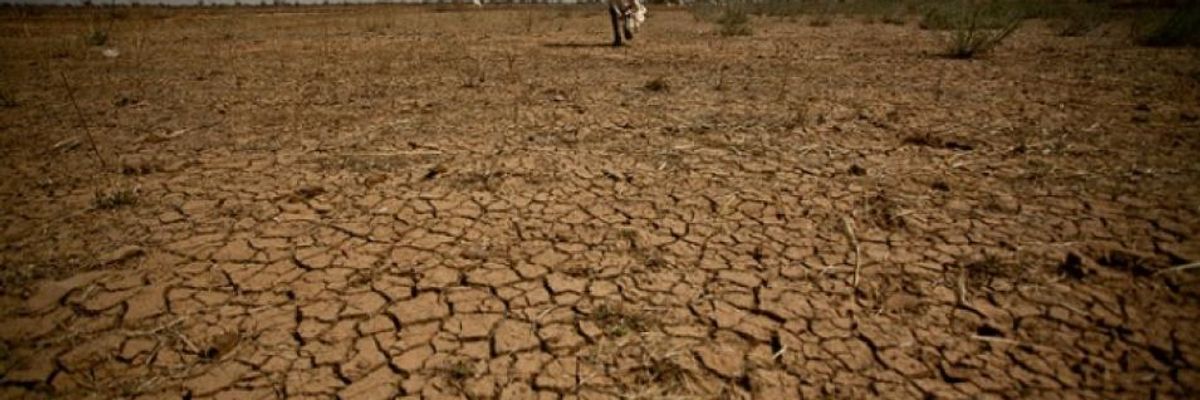
Arid soils are shown in Mauritania in 2012, when crops failed because of a severe drought which led to a food crisis that impacted millions of people across West Africa. (Photo: Oxfam International/Flickr/cc)
Citing $69 Trillion Price Tag by 2100, Moody's Warns Central Banks of Far-Reaching Economic Damage of Climate Crisis
"There is no denying it: The longer we wait to take bold action to curb emissions, the higher the costs will be for all of us."
Noting previous warnings that the human-caused climate crisis could cause trillions of dollars in damage to the global economy by the end of the century, a new report from Moody's Analytics explores the economic implications of the international community's failure to curb planet-warming emissions.
Moody's Analytics chief economist Mark Zandi told The Washington Post--which first reported on the new analysis--that this is "the first stab at trying to quantify what the macroeconomic consequences might be" of the global climate crisis, and it comes in response to European commercial banks and central banks. The climate emergency is "not a cliff event. It's not a shock to the economy. It's more like a corrosive," Zandi added. But it is "getting weightier with each passing year."
The financial research and consulting firm's analysis (pdf) highlights a few key projections from a report published last October by the U.N. Intergovernmental Panel on Climate Change (IPCC): if the average global temperature soars to 1.5degC above pre-industrial levels--the lower limit of the Paris climate agreement--the cost to the global economy is estimated to be $54 trillion in 2100, and under a warming scenario of 2degC, the cost could reach $69 trillion.
Moody's--whose clients include multinational corporations, governments, central banks, financial regulators and institutions, retailers, mutual funds, utilities, real estate firms, insurance companies, and investors--notes researchers have found that "warming beyond the 2degC threshold could hit tipping points for even larger and irreversible warming feedback loops, such as permanent summer ice melt in the Arctic Ocean."
One of the key takeaways, the report emphasizes, is that economically, "the more draconian effects of climate change are not felt until 2030 and beyond. And they do not become especially pronounced until the second part of the century."
"That's why it is so hard to get people focused on this issue and get a comprehensive policy response," Zandi told the Post. "Business is focused on the next year, or five years out."
"Most of the models go out 30 years," he said, "but, really, the damage to the economy is in the next half-century, and we haven't developed the tools to look out that far."
Responding to the Post report, which emphasized Moody's warning of the anticipated damage to the global economy, some advocates of ambitious global action to slash human-generated greenhouse gas emissions pointed to recent findings from climate experts that the world's temperature could rise 3degC or higher by 2100, implying that the economic costs could exceed the IPCC's upper estimate.
Linking to the Post report, Defend Our Future--a project of the Environmental Defense Fund that aims to empower young people interested in advancing climate and clean energy solutions--tweeted: "There is no denying it: The longer we wait to take bold action to curb emissions, the higher the costs will be for all of us."
Moody's analysts examined the climate emergency's expected economic damage across six impact channels--sea-level rise, human health effects, heat effect of labor productivity, agricultural productivity, tourism, and energy demand--and created forecasts through 2048.
"This analysis reveals that some countries are significantly exposed to rising temperatures while others, particularly in Northern Hemisphere climates, are well insulated," the report says. Those at the greatest risk, analysts found, are "countries in hot climates, particularly those that are emerging economies such as Malaysia, Algeria, the Philippines, and Thailand, and oil producers such as Saudi Arabia, Qatar, and Oman."
On the agricultural front, rising temperatures are expected to impact both the health of farmworkers and crop yields, which particularly threatens less-developed nations that are economically dependent on farming. Echoing a U.N. report published this week, Moody's notes that "heat stress, determined by high temperature and humidity, lowers working speed, necessitates more frequent breaks, and increases the probability of injury."
The report says that in terms of human health, the number of heat-related deaths worldwide is expected to increase as the global temperature does, and a hotter world "can lengthen the season and increase the geographic range of disease-carrying insects such as mosquitoes, ticks, and fleas, allowing them to move into higher altitudes and new regions."
Recognizing some limitations of its analysis, Moody's acknowledges that "there are a number of factors that were not considered in this work. The foremost of these is the increasing frequency and severity of natural disasters." The report points to a U.S. government calculation that in the United States alone, disasters caused more than $300 billion in damage in 2017.
As the environmental legal organization Earthjustice concluded in response to the report, "We literally cannot afford inaction on this crisis."
We are at a crossroads
This country and this world are at a monumental crossroads. US voters have an opportunity to beat back the forces of fascism and confront the billionaires who are rigging the economy, our media system, and our democracy, making it increasingly impossible for ordinary people to get by. We’re not just talking about the election. We’re talking about what must be done once these fascist elements are vanquished from power. We need a bolder set of solutions than what either major party has so far been willing to offer and a working-class movement ready to fight like hell for it. Trump didn't emerge from nowhere. The conditions that fueled MAGA authoritarianism were created by decades of radical neoliberal economic policies and a corrupt political system dominated by corporate interests. They slashed taxes on the super-rich, promising that the benefits would trickle down. They said giveaways to the corporate titans would make life more affordable for the rest of us. It was all bullshit. And when a bitter, betrayed populace searches for someone to blame, right-wing demagogues have little trouble finding scapegoats. People know when they're being lied to, but you won't hear any of this from the corporate media. Only independent journalism—powered and funded by people who believe in building a better world—can deliver truly trustworthy daily news. Our Fall Campaign is underway, and we need your help. To power our newsroom through the rest of the year, we need to raise $125,000 by midnight on October 31. So if you share our vision, please contribute whatever you can to sustain our work. |
Noting previous warnings that the human-caused climate crisis could cause trillions of dollars in damage to the global economy by the end of the century, a new report from Moody's Analytics explores the economic implications of the international community's failure to curb planet-warming emissions.
Moody's Analytics chief economist Mark Zandi told The Washington Post--which first reported on the new analysis--that this is "the first stab at trying to quantify what the macroeconomic consequences might be" of the global climate crisis, and it comes in response to European commercial banks and central banks. The climate emergency is "not a cliff event. It's not a shock to the economy. It's more like a corrosive," Zandi added. But it is "getting weightier with each passing year."
The financial research and consulting firm's analysis (pdf) highlights a few key projections from a report published last October by the U.N. Intergovernmental Panel on Climate Change (IPCC): if the average global temperature soars to 1.5degC above pre-industrial levels--the lower limit of the Paris climate agreement--the cost to the global economy is estimated to be $54 trillion in 2100, and under a warming scenario of 2degC, the cost could reach $69 trillion.
Moody's--whose clients include multinational corporations, governments, central banks, financial regulators and institutions, retailers, mutual funds, utilities, real estate firms, insurance companies, and investors--notes researchers have found that "warming beyond the 2degC threshold could hit tipping points for even larger and irreversible warming feedback loops, such as permanent summer ice melt in the Arctic Ocean."
One of the key takeaways, the report emphasizes, is that economically, "the more draconian effects of climate change are not felt until 2030 and beyond. And they do not become especially pronounced until the second part of the century."
"That's why it is so hard to get people focused on this issue and get a comprehensive policy response," Zandi told the Post. "Business is focused on the next year, or five years out."
"Most of the models go out 30 years," he said, "but, really, the damage to the economy is in the next half-century, and we haven't developed the tools to look out that far."
Responding to the Post report, which emphasized Moody's warning of the anticipated damage to the global economy, some advocates of ambitious global action to slash human-generated greenhouse gas emissions pointed to recent findings from climate experts that the world's temperature could rise 3degC or higher by 2100, implying that the economic costs could exceed the IPCC's upper estimate.
Linking to the Post report, Defend Our Future--a project of the Environmental Defense Fund that aims to empower young people interested in advancing climate and clean energy solutions--tweeted: "There is no denying it: The longer we wait to take bold action to curb emissions, the higher the costs will be for all of us."
Moody's analysts examined the climate emergency's expected economic damage across six impact channels--sea-level rise, human health effects, heat effect of labor productivity, agricultural productivity, tourism, and energy demand--and created forecasts through 2048.
"This analysis reveals that some countries are significantly exposed to rising temperatures while others, particularly in Northern Hemisphere climates, are well insulated," the report says. Those at the greatest risk, analysts found, are "countries in hot climates, particularly those that are emerging economies such as Malaysia, Algeria, the Philippines, and Thailand, and oil producers such as Saudi Arabia, Qatar, and Oman."
On the agricultural front, rising temperatures are expected to impact both the health of farmworkers and crop yields, which particularly threatens less-developed nations that are economically dependent on farming. Echoing a U.N. report published this week, Moody's notes that "heat stress, determined by high temperature and humidity, lowers working speed, necessitates more frequent breaks, and increases the probability of injury."
The report says that in terms of human health, the number of heat-related deaths worldwide is expected to increase as the global temperature does, and a hotter world "can lengthen the season and increase the geographic range of disease-carrying insects such as mosquitoes, ticks, and fleas, allowing them to move into higher altitudes and new regions."
Recognizing some limitations of its analysis, Moody's acknowledges that "there are a number of factors that were not considered in this work. The foremost of these is the increasing frequency and severity of natural disasters." The report points to a U.S. government calculation that in the United States alone, disasters caused more than $300 billion in damage in 2017.
As the environmental legal organization Earthjustice concluded in response to the report, "We literally cannot afford inaction on this crisis."