

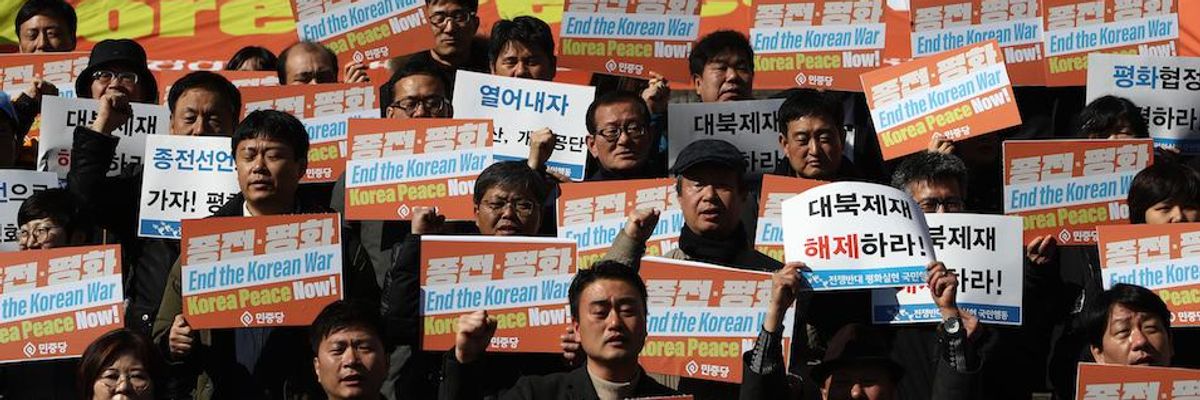
Photo: South Koreans activists participate in a rally to support a summit between North Korean leader Kim Jong Un and U.S. President Donald Trump, on February 26, 2019 in Seoul, South Korea (PHOTO: Chung Sung-Jun/Getty Images)
Progressives Endorse House Resolution Calling for Formal End to Korean War
After nearly 70 years of conflict, former president Jimmy Carter called ending the war "the only way to ensure true security for both the Korean and American people."
Rep. Ro Khanna (D-Ca.) introduced a House resolution to end the Korean War on Tuesday after 69 years of conflict. The resolution comes as President Donald Trump is in Hanoi, Vietnam, in advance of a historic meeting with North Korean President Kim Jong Un to discuss North Korean denuclearization.
"Historic engagement between South and North Korea has created a once-in-a-generation opportunity to formally end this war," Khanna said in a statement. "President Trump must not squander this rare chance for peace."
Khanna's resolution (pdf) was cosponsored by 18 House progressives, including Rep. Pramila Jayapal (D-Wa.), Rep. Barbara Lee (D-Ca.), and Rep. Deb Haaland (D-N.M.).
Kim's openness to dialogue with the American president comes after a thawing of relations with South Korean President Moon Jae-in. Moon and Kim met at the DMZ, or demilitarized zone, on April 26, 2018, as a show of unity in friendship. Since that meeting, Kim and Moon have pushed to end hostilities, but the push is complicated by the U.S. presence in South Korea and decades of tension.
A number of U.S. commentators and experts have treated the coming summit with suspicion and fear, claiming that simply by meeting with Kim, Trump is giving the North Korean leader an aura of legitimacy that's undeserved and damaging American standing in the world.
Kim Jong Un has murdered at least 340 people, runs a network of prison gulags where prisoners "are starved, forced to work, tortured and raped," and spends much of his country's resources creating a personality cult.
Trump thinks he's a good kid. https://t.co/BshM8RlyAG https://t.co/J0PnnwuUkx
In the resolution, however, Khanna and his cosponsors pointed to statements from Moon that assert U.S. military personnel will remain in the peninsula irrespective of the war, thereby assumedly negating a threat to national security. The resolution also states that ending hostilities should not be confused with an acceptance of a nuclear North Korea. "An end to the state of war would not legally imply recognition of North Korea as a nuclear weapons state," reads the resolution.
The resolution was met with support in progressive circles.
In a statement, Kevin Martin, president of the anti-war group Peace Action and the coordinator of the Korea Peace Network, said that he was hopeful the diplomatic process would win out this time.
Khanna's legislation, Martin said, "offers a common sense vision for achieving peace and advancing nuclear disarmament on the Korean Peninsula that all members of Congress should be able to get behind."
The timely introduction of the bill, he added, "offers a blueprint for diplomacy that rightly acknowledges that real progress cannot be made in negotiations without reciprocal steps and confidence-building measures by all parties at the table."
The resolution also received public backing from former President Jimmy Carter.
"Ending the threat of war is the only way to ensure true security for both the Korean and American people," Carter said in a statement, "and will create the conditions to alleviate the suffering of the ordinary North Koreans who are most harmed by ongoing tensions."
We are at a crossroads
This country and this world are at a monumental crossroads. In a few short weeks, US voters will have an opportunity to beat back the forces of fascism and confront the billionaires who are rigging the economy, our media system, and our democracy, making it increasingly impossible for ordinary people to get by. We’re not just talking about the election. We’re talking about what must be done once these fascist elements are vanquished from power. We need a bolder set of solutions than what either major party has so far been willing to offer and a working-class movement ready to fight like hell for it. Trump didn't emerge from nowhere. The conditions that fueled MAGA authoritarianism were created by decades of radical neoliberal economic policies and a corrupt political system dominated by corporate interests. They slashed taxes on the super-rich, promising that the benefits would trickle down. They said giveaways to the corporate titans would make life more affordable for the rest of us. It was all bullshit. And when a bitter, betrayed populace searches for someone to blame, right-wing demagogues have little trouble finding scapegoats. People know when they're being lied to, but you won't hear any of this from the corporate media. Only independent journalism—powered and funded by people who believe in building a better world—can deliver truly trustworthy daily news. Our Fall Campaign is underway, and we need your help. To power our newsroom through the rest of the year, we need to raise $125,000 by midnight on October 31. So if you share our vision, please contribute whatever you can to sustain our work. |
Rep. Ro Khanna (D-Ca.) introduced a House resolution to end the Korean War on Tuesday after 69 years of conflict. The resolution comes as President Donald Trump is in Hanoi, Vietnam, in advance of a historic meeting with North Korean President Kim Jong Un to discuss North Korean denuclearization.
"Historic engagement between South and North Korea has created a once-in-a-generation opportunity to formally end this war," Khanna said in a statement. "President Trump must not squander this rare chance for peace."
Khanna's resolution (pdf) was cosponsored by 18 House progressives, including Rep. Pramila Jayapal (D-Wa.), Rep. Barbara Lee (D-Ca.), and Rep. Deb Haaland (D-N.M.).
Kim's openness to dialogue with the American president comes after a thawing of relations with South Korean President Moon Jae-in. Moon and Kim met at the DMZ, or demilitarized zone, on April 26, 2018, as a show of unity in friendship. Since that meeting, Kim and Moon have pushed to end hostilities, but the push is complicated by the U.S. presence in South Korea and decades of tension.
A number of U.S. commentators and experts have treated the coming summit with suspicion and fear, claiming that simply by meeting with Kim, Trump is giving the North Korean leader an aura of legitimacy that's undeserved and damaging American standing in the world.
Kim Jong Un has murdered at least 340 people, runs a network of prison gulags where prisoners "are starved, forced to work, tortured and raped," and spends much of his country's resources creating a personality cult.
Trump thinks he's a good kid. https://t.co/BshM8RlyAG https://t.co/J0PnnwuUkx
In the resolution, however, Khanna and his cosponsors pointed to statements from Moon that assert U.S. military personnel will remain in the peninsula irrespective of the war, thereby assumedly negating a threat to national security. The resolution also states that ending hostilities should not be confused with an acceptance of a nuclear North Korea. "An end to the state of war would not legally imply recognition of North Korea as a nuclear weapons state," reads the resolution.
The resolution was met with support in progressive circles.
In a statement, Kevin Martin, president of the anti-war group Peace Action and the coordinator of the Korea Peace Network, said that he was hopeful the diplomatic process would win out this time.
Khanna's legislation, Martin said, "offers a common sense vision for achieving peace and advancing nuclear disarmament on the Korean Peninsula that all members of Congress should be able to get behind."
The timely introduction of the bill, he added, "offers a blueprint for diplomacy that rightly acknowledges that real progress cannot be made in negotiations without reciprocal steps and confidence-building measures by all parties at the table."
The resolution also received public backing from former President Jimmy Carter.
"Ending the threat of war is the only way to ensure true security for both the Korean and American people," Carter said in a statement, "and will create the conditions to alleviate the suffering of the ordinary North Koreans who are most harmed by ongoing tensions."