Report Shows How War Profiteers Are Now Refugee Profiteers, Too
Arms dealers flood war-torn Middle East with weapons and then lobby EU to militarize borders against refugees—profiting from both ends of conflict
As Europe comes to terms with a Brexit vote fueled in large part by anti-immigrant hate-mongering, a new report exposes how war profiteers are influencing EU policy to make money from unending Middle East conflicts as well as the wave of refugees created by that same instability and violence.

The report (pdf), Border Wars: The Arms Dealers Profiting from Europe's Refugee Tragedy, released jointly by the European Stop Wapenhandel and Transnational Institute (TNI) on Monday, outlines arms traders' pursuit of profit in the 21st century's endless conflicts.
"There is one group of interests that have only benefited from the refugee crisis, and in particular from the European Union's investment in 'securing' its borders,'" the report finds. "They are the military and security companies that provide the equipment to border guards, the surveillance technology to monitor frontiers, and the IT infrastructure to track population movements."
The report shows that "far from being passive beneficiaries of EU largesse, these corporations are actively encouraging a growing securitization of Europe's borders, and willing to provide ever more draconian technologies to do this."
In the past decade, the report says, corporate players have viewed intractable Middle East warfare as a windfall: "Several large international arms companies cited instability in the Middle East to assure investors about future prospects for their business. The arms companies are assisted by European governments, which actively promote European arms in the region and are very reluctant, to say the least, to impose stricter arms export policies."
"The human rights of refugees play no real role in this thinking, except for promotional purposes."
--Mark Akkerman, Stop Wapenhandel
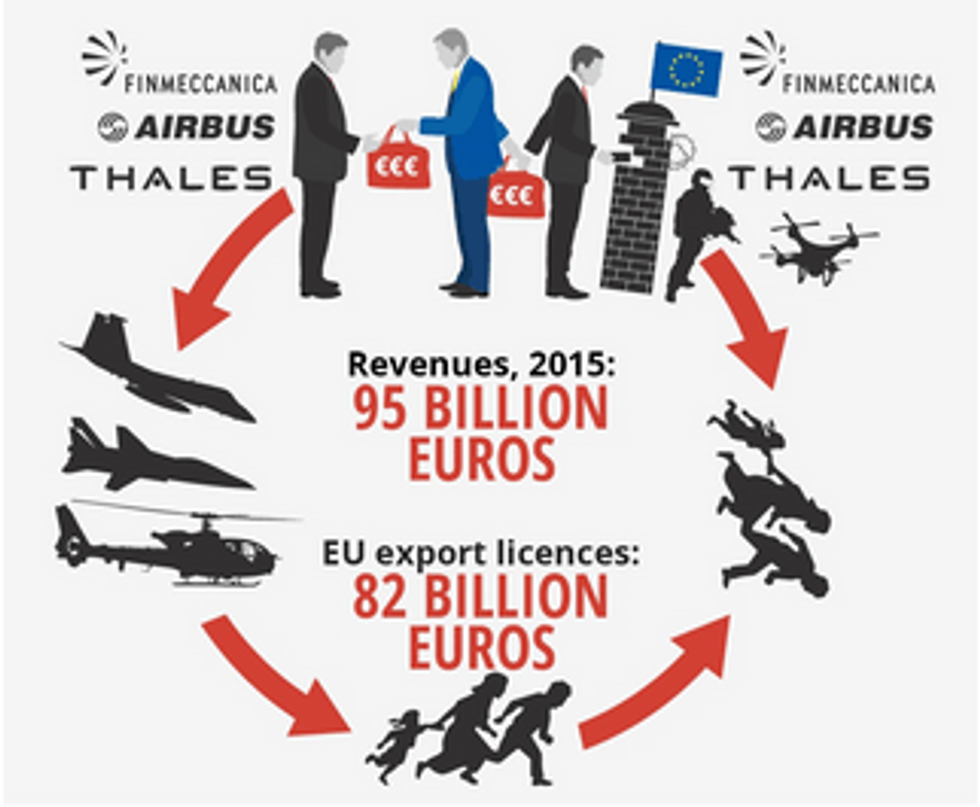
Indeed, "from 2005 to 2014, EU member states granted arms exports license to the Middle East and North Africa worth over 82 billion euros," according to the report.
The report details how a steady flow of arms from outside the Middle East supplies all players in multi-part conflicts, such as Syria's civil war, with an endless supply of high-tech weaponry--thus ensuring that those conflicts endure.
And as these wars create more and more refugees who seek asylum in Europe, the very same corporations are lobbying the EU to 'securitize' its borders against them--thus creating additional profit for those in the business of militarization.
Moreover, Stop Wapenhandel and TNI found "industry representatives, government officials and military and security personnel meet around the year at conferences, fairs and round tables."
The report quotes Nick Vaughan-Williams, international security professor at the University of Warwick, saying: "At these events it is possible to identify a cyclical culture whereby the presentation of new technologies not only responds to, but also enables and drives the formulation of new policies and practices in the field of border security and migration management."
And these "special fairs and congresses on border security are relatively new," the report notes. "They all started within the last decade."
"I believe the influence of the military and security industry on the shaping of the [EU's] border security policy is quite big, especially on the securitization and militarization of these and on the expanding use of surveillance technology and data exchange," Stop Wapenhandel's Mark Akkerman told Common Dreams. "Industry efforts include regular interactions with EU's border institutions (including high ranking officials and politicians), where ideas are discussed that later turn up in new EU policy documents."
"For example, the industry has been pushing for years to upgrade [EU border agency] Frontex to a cross-European border security agency," Akkerman added. "The new European Border and Coast Guard Agency the European Commission has proposed, which has a lot more powers (has its own equipment, direct interventions in member states, binding decisions forcing member states to strengthen border security capacities) than Frontex has now, is exactly that."
"If the establishment of the European Border and Coast Guard Agency proceeds," the report notes, "this would mean a fundamental shift to an EU-controlled system of border security, with the possibility of bypassing the member states and forcing them to strengthen controls and purchase or upgrade equipment."
"It is not hard to predict that this will lead refugees to use increasingly dangerous routes, strengthening the business case for traffickers. For the military and security industry, however it means the prospect of more orders from the agency itself and from member states," the report continues.
Akkerman pointed out the EU's stunning dismissal of human rights in this profit-motivated process:
The human rights of refugees play no real role in this thinking, except for promotional purposes. Both the policy makers and the industry sometimes try to sell the increase in and militarization of border security as a humanitarian effort, in terms of strengthening search and rescue capacities. The EU has repeatedly tried to put all the blame for refugee deaths on traffickers. This has resulted in narrowing its response to 'taking away the business model of smugglers', with even more military means to try to accomplish this.
This creates a downward spiral: the greater the controls and the more the repression, the greater the risks refugees are forced to take resulting in more deaths. Experts (academics) and human rights organizations have been warning about this for years, but they have been ignored.
As death tolls rise and a record number of people are displaced by conflict, it seems that the fear-mongering and profiteering--and devastating human rights abuses--will only continue.
Urgent. It's never been this bad.
Dear Common Dreams reader, It’s been nearly 30 years since I co-founded Common Dreams with my late wife, Lina Newhouser. We had the radical notion that journalism should serve the public good, not corporate profits. It was clear to us from the outset what it would take to build such a project. No paid advertisements. No corporate sponsors. No millionaire publisher telling us what to think or do. Many people said we wouldn't last a year, but we proved those doubters wrong. Together with a tremendous team of journalists and dedicated staff, we built an independent media outlet free from the constraints of profits and corporate control. Our mission from the outset was simple. To inform. To inspire. To ignite change for the common good. Building Common Dreams was not easy. Our survival was never guaranteed. When you take on the most powerful forces—Wall Street greed, fossil fuel industry destruction, Big Tech lobbyists, and uber-rich oligarchs who have spent billions upon billions rigging the economy and democracy in their favor—the only bulwark you have is supporters who believe in your work. But here’s the urgent message from me today. It’s never been this bad out there. And it’s never been this hard to keep us going. At the very moment Common Dreams is most needed and doing some of its best and most important work, the threats we face are intensifying. Right now, with just three days to go in our Spring Campaign, we're falling short of our make-or-break goal. When everyone does the little they can afford, we are strong. But if that support retreats or dries up, so do we. Can you make a gift right now to make sure Common Dreams not only survives but thrives? There is no backup plan or rainy day fund. There is only you. —Craig Brown, Co-founder |
As Europe comes to terms with a Brexit vote fueled in large part by anti-immigrant hate-mongering, a new report exposes how war profiteers are influencing EU policy to make money from unending Middle East conflicts as well as the wave of refugees created by that same instability and violence.

The report (pdf), Border Wars: The Arms Dealers Profiting from Europe's Refugee Tragedy, released jointly by the European Stop Wapenhandel and Transnational Institute (TNI) on Monday, outlines arms traders' pursuit of profit in the 21st century's endless conflicts.
"There is one group of interests that have only benefited from the refugee crisis, and in particular from the European Union's investment in 'securing' its borders,'" the report finds. "They are the military and security companies that provide the equipment to border guards, the surveillance technology to monitor frontiers, and the IT infrastructure to track population movements."
The report shows that "far from being passive beneficiaries of EU largesse, these corporations are actively encouraging a growing securitization of Europe's borders, and willing to provide ever more draconian technologies to do this."
In the past decade, the report says, corporate players have viewed intractable Middle East warfare as a windfall: "Several large international arms companies cited instability in the Middle East to assure investors about future prospects for their business. The arms companies are assisted by European governments, which actively promote European arms in the region and are very reluctant, to say the least, to impose stricter arms export policies."
"The human rights of refugees play no real role in this thinking, except for promotional purposes."
--Mark Akkerman, Stop Wapenhandel
Indeed, "from 2005 to 2014, EU member states granted arms exports license to the Middle East and North Africa worth over 82 billion euros," according to the report.
The report details how a steady flow of arms from outside the Middle East supplies all players in multi-part conflicts, such as Syria's civil war, with an endless supply of high-tech weaponry--thus ensuring that those conflicts endure.
And as these wars create more and more refugees who seek asylum in Europe, the very same corporations are lobbying the EU to 'securitize' its borders against them--thus creating additional profit for those in the business of militarization.
Moreover, Stop Wapenhandel and TNI found "industry representatives, government officials and military and security personnel meet around the year at conferences, fairs and round tables."
The report quotes Nick Vaughan-Williams, international security professor at the University of Warwick, saying: "At these events it is possible to identify a cyclical culture whereby the presentation of new technologies not only responds to, but also enables and drives the formulation of new policies and practices in the field of border security and migration management."
And these "special fairs and congresses on border security are relatively new," the report notes. "They all started within the last decade."
"I believe the influence of the military and security industry on the shaping of the [EU's] border security policy is quite big, especially on the securitization and militarization of these and on the expanding use of surveillance technology and data exchange," Stop Wapenhandel's Mark Akkerman told Common Dreams. "Industry efforts include regular interactions with EU's border institutions (including high ranking officials and politicians), where ideas are discussed that later turn up in new EU policy documents."
"For example, the industry has been pushing for years to upgrade [EU border agency] Frontex to a cross-European border security agency," Akkerman added. "The new European Border and Coast Guard Agency the European Commission has proposed, which has a lot more powers (has its own equipment, direct interventions in member states, binding decisions forcing member states to strengthen border security capacities) than Frontex has now, is exactly that."
"If the establishment of the European Border and Coast Guard Agency proceeds," the report notes, "this would mean a fundamental shift to an EU-controlled system of border security, with the possibility of bypassing the member states and forcing them to strengthen controls and purchase or upgrade equipment."
"It is not hard to predict that this will lead refugees to use increasingly dangerous routes, strengthening the business case for traffickers. For the military and security industry, however it means the prospect of more orders from the agency itself and from member states," the report continues.
Akkerman pointed out the EU's stunning dismissal of human rights in this profit-motivated process:
The human rights of refugees play no real role in this thinking, except for promotional purposes. Both the policy makers and the industry sometimes try to sell the increase in and militarization of border security as a humanitarian effort, in terms of strengthening search and rescue capacities. The EU has repeatedly tried to put all the blame for refugee deaths on traffickers. This has resulted in narrowing its response to 'taking away the business model of smugglers', with even more military means to try to accomplish this.
This creates a downward spiral: the greater the controls and the more the repression, the greater the risks refugees are forced to take resulting in more deaths. Experts (academics) and human rights organizations have been warning about this for years, but they have been ignored.
As death tolls rise and a record number of people are displaced by conflict, it seems that the fear-mongering and profiteering--and devastating human rights abuses--will only continue.
As Europe comes to terms with a Brexit vote fueled in large part by anti-immigrant hate-mongering, a new report exposes how war profiteers are influencing EU policy to make money from unending Middle East conflicts as well as the wave of refugees created by that same instability and violence.

The report (pdf), Border Wars: The Arms Dealers Profiting from Europe's Refugee Tragedy, released jointly by the European Stop Wapenhandel and Transnational Institute (TNI) on Monday, outlines arms traders' pursuit of profit in the 21st century's endless conflicts.
"There is one group of interests that have only benefited from the refugee crisis, and in particular from the European Union's investment in 'securing' its borders,'" the report finds. "They are the military and security companies that provide the equipment to border guards, the surveillance technology to monitor frontiers, and the IT infrastructure to track population movements."
The report shows that "far from being passive beneficiaries of EU largesse, these corporations are actively encouraging a growing securitization of Europe's borders, and willing to provide ever more draconian technologies to do this."
In the past decade, the report says, corporate players have viewed intractable Middle East warfare as a windfall: "Several large international arms companies cited instability in the Middle East to assure investors about future prospects for their business. The arms companies are assisted by European governments, which actively promote European arms in the region and are very reluctant, to say the least, to impose stricter arms export policies."
"The human rights of refugees play no real role in this thinking, except for promotional purposes."
--Mark Akkerman, Stop Wapenhandel
Indeed, "from 2005 to 2014, EU member states granted arms exports license to the Middle East and North Africa worth over 82 billion euros," according to the report.
The report details how a steady flow of arms from outside the Middle East supplies all players in multi-part conflicts, such as Syria's civil war, with an endless supply of high-tech weaponry--thus ensuring that those conflicts endure.
And as these wars create more and more refugees who seek asylum in Europe, the very same corporations are lobbying the EU to 'securitize' its borders against them--thus creating additional profit for those in the business of militarization.
Moreover, Stop Wapenhandel and TNI found "industry representatives, government officials and military and security personnel meet around the year at conferences, fairs and round tables."
The report quotes Nick Vaughan-Williams, international security professor at the University of Warwick, saying: "At these events it is possible to identify a cyclical culture whereby the presentation of new technologies not only responds to, but also enables and drives the formulation of new policies and practices in the field of border security and migration management."
And these "special fairs and congresses on border security are relatively new," the report notes. "They all started within the last decade."
"I believe the influence of the military and security industry on the shaping of the [EU's] border security policy is quite big, especially on the securitization and militarization of these and on the expanding use of surveillance technology and data exchange," Stop Wapenhandel's Mark Akkerman told Common Dreams. "Industry efforts include regular interactions with EU's border institutions (including high ranking officials and politicians), where ideas are discussed that later turn up in new EU policy documents."
"For example, the industry has been pushing for years to upgrade [EU border agency] Frontex to a cross-European border security agency," Akkerman added. "The new European Border and Coast Guard Agency the European Commission has proposed, which has a lot more powers (has its own equipment, direct interventions in member states, binding decisions forcing member states to strengthen border security capacities) than Frontex has now, is exactly that."
"If the establishment of the European Border and Coast Guard Agency proceeds," the report notes, "this would mean a fundamental shift to an EU-controlled system of border security, with the possibility of bypassing the member states and forcing them to strengthen controls and purchase or upgrade equipment."
"It is not hard to predict that this will lead refugees to use increasingly dangerous routes, strengthening the business case for traffickers. For the military and security industry, however it means the prospect of more orders from the agency itself and from member states," the report continues.
Akkerman pointed out the EU's stunning dismissal of human rights in this profit-motivated process:
The human rights of refugees play no real role in this thinking, except for promotional purposes. Both the policy makers and the industry sometimes try to sell the increase in and militarization of border security as a humanitarian effort, in terms of strengthening search and rescue capacities. The EU has repeatedly tried to put all the blame for refugee deaths on traffickers. This has resulted in narrowing its response to 'taking away the business model of smugglers', with even more military means to try to accomplish this.
This creates a downward spiral: the greater the controls and the more the repression, the greater the risks refugees are forced to take resulting in more deaths. Experts (academics) and human rights organizations have been warning about this for years, but they have been ignored.
As death tolls rise and a record number of people are displaced by conflict, it seems that the fear-mongering and profiteering--and devastating human rights abuses--will only continue.