SUBSCRIBE TO OUR FREE NEWSLETTER
Daily news & progressive opinion—funded by the people, not the corporations—delivered straight to your inbox.
5
#000000
#FFFFFF
To donate by check, phone, or other method, see our More Ways to Give page.
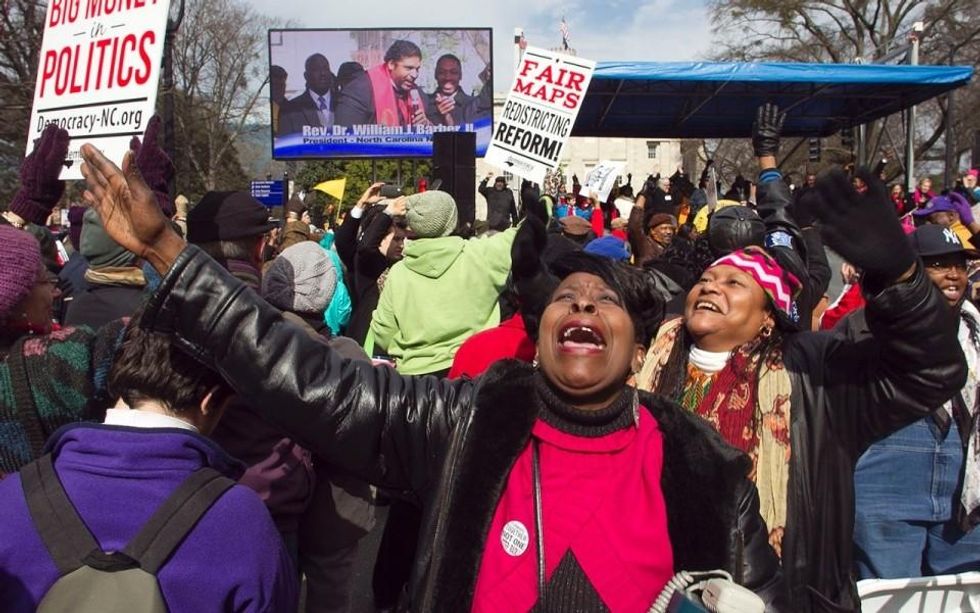
Under the banner of the Forward Together Moral Movement, this patchwork group is what leader Rev. Dr. William J. Barber refers to as an "agenda-based coalition: anti-racism, anti-poverty, pro-justice."
The agenda covers a wide swath of issues that include equitable and well-funded public education; universal health care; environmental protection; voting rights; poverty reduction; fairness for minorities and the poor in criminal sentencing; and equality for women, immigrants, and LGBTQ people.
But, according to Barber, they are united by the overarching principle of morality. "We are deeply committed to a society where people love one another and don't kick people when they are down," he said in an interview with Common Dreams.
The movement, led by the state chapter of the NAACP, with Barber as the "Convener," hopes to bring together some of the other disparate fights currently being waged across the country, including the Fast Food Workers' strikes.
"The same people attacking voting rights are attacking labor rights are attacking health care," he said, adding that under the Forward Together Moral Movement, women's rights advocates stand on the picket line with the fast food workers.
"That is the point," Barber said, "to begin to see ourselves as existing in society not as isolated selves but as part of the whole."
What began seven years ago as an annual march known as the "Historic Thousands on Jones Street People's Assembly" was jump-started last spring into weekly civil disobedience actions at the North Carolina General Assembly, over the course of which over 900 people were arrested.
And, according to the group, the momentum from Saturday's march--to which tens of thousands of people traveled from 32 states and more than 70 counties within North Carolina--will continue to build.
The movement has organized a long-term strategy which includes litigation, voter registration, outreach, civil disobedience and a watchdog group, which ensures that any legislation put forth in the state has the interest of the people at heart. They are also planning a "Freedom Summer"--referencing the 1964 voter registration drive in Mississippi--to energize the state's youth vote.
The target of the protests, Barber says, is not Republicans but 'extremists.' The demonstrations began as an effort to call attention to the policies of GOP Governor Pat McCrory and the conservative-run General Assembly which, they say, are an "assault" on the state's poor and unemployed.
But the ultimate goal, he says, is to change the national conversation.
"Ultimately, we believe that there is a need for new discourse for how we talk about public policy that needs to be rooted in our moral values. How we treat the poor, women, children," which, he says, extends beyond party lines or religious affiliations.
Reports following Saturday's march speculated that predominantly secular progressives might be alienated by all of the biblical language.
"Where there is no moral imagination there can be no political implementation. Something has to move people to believe that they don't have to accept the myths of domination, they don't have to believe they are powerless." -Rev. William Barber
Barber argues that, alternately, having political conversation based on morality is critical because it undercuts the "extreme ultra right's" claim to the moral high ground in their arguments regarding "abortion, prayer in school and homosexuality." Those issues, he says, are "private."
"The greater moral considerations have to do with shaping public policy in a way that benefits the least of these and those made to feel as outcasts," he adds. "In the deepest way, budgets are moral issues, taxes are moral issues, education, voting rights..."
The Moral Movement has begun to spread across the South with a spinoff demonstration in Georgia last month and upcoming actions in Florida and Alabama. Like the lunch-counter sit-ins of the 1960s, organizers elsewhere are replicating what those in North Carolina have begun.
"I certainly hope this is impacting the national conversation," Barber said. "If you want to change America you've got to think states, and if you think states you think southern states," he added, noting that is where a lot of the "extremism" is.
"What we're having here is a portrait of this rise, this renewal," he continued.
"Clearly in this country, clearly in the history of the world, where there is no moral imagination there can be no political implementation. Something has to move people to believe that they don't have to accept the myths of domination, they don't have to believe they are powerless."
The North Carolina Justice Center uploaded these images from Saturday's march:
Under the banner of the Forward Together Moral Movement, this patchwork group is what leader Rev. Dr. William J. Barber refers to as an "agenda-based coalition: anti-racism, anti-poverty, pro-justice."
The agenda covers a wide swath of issues that include equitable and well-funded public education; universal health care; environmental protection; voting rights; poverty reduction; fairness for minorities and the poor in criminal sentencing; and equality for women, immigrants, and LGBTQ people.
But, according to Barber, they are united by the overarching principle of morality. "We are deeply committed to a society where people love one another and don't kick people when they are down," he said in an interview with Common Dreams.
The movement, led by the state chapter of the NAACP, with Barber as the "Convener," hopes to bring together some of the other disparate fights currently being waged across the country, including the Fast Food Workers' strikes.
"The same people attacking voting rights are attacking labor rights are attacking health care," he said, adding that under the Forward Together Moral Movement, women's rights advocates stand on the picket line with the fast food workers.
"That is the point," Barber said, "to begin to see ourselves as existing in society not as isolated selves but as part of the whole."
What began seven years ago as an annual march known as the "Historic Thousands on Jones Street People's Assembly" was jump-started last spring into weekly civil disobedience actions at the North Carolina General Assembly, over the course of which over 900 people were arrested.
And, according to the group, the momentum from Saturday's march--to which tens of thousands of people traveled from 32 states and more than 70 counties within North Carolina--will continue to build.
The movement has organized a long-term strategy which includes litigation, voter registration, outreach, civil disobedience and a watchdog group, which ensures that any legislation put forth in the state has the interest of the people at heart. They are also planning a "Freedom Summer"--referencing the 1964 voter registration drive in Mississippi--to energize the state's youth vote.
The target of the protests, Barber says, is not Republicans but 'extremists.' The demonstrations began as an effort to call attention to the policies of GOP Governor Pat McCrory and the conservative-run General Assembly which, they say, are an "assault" on the state's poor and unemployed.
But the ultimate goal, he says, is to change the national conversation.
"Ultimately, we believe that there is a need for new discourse for how we talk about public policy that needs to be rooted in our moral values. How we treat the poor, women, children," which, he says, extends beyond party lines or religious affiliations.
Reports following Saturday's march speculated that predominantly secular progressives might be alienated by all of the biblical language.
"Where there is no moral imagination there can be no political implementation. Something has to move people to believe that they don't have to accept the myths of domination, they don't have to believe they are powerless." -Rev. William Barber
Barber argues that, alternately, having political conversation based on morality is critical because it undercuts the "extreme ultra right's" claim to the moral high ground in their arguments regarding "abortion, prayer in school and homosexuality." Those issues, he says, are "private."
"The greater moral considerations have to do with shaping public policy in a way that benefits the least of these and those made to feel as outcasts," he adds. "In the deepest way, budgets are moral issues, taxes are moral issues, education, voting rights..."
The Moral Movement has begun to spread across the South with a spinoff demonstration in Georgia last month and upcoming actions in Florida and Alabama. Like the lunch-counter sit-ins of the 1960s, organizers elsewhere are replicating what those in North Carolina have begun.
"I certainly hope this is impacting the national conversation," Barber said. "If you want to change America you've got to think states, and if you think states you think southern states," he added, noting that is where a lot of the "extremism" is.
"What we're having here is a portrait of this rise, this renewal," he continued.
"Clearly in this country, clearly in the history of the world, where there is no moral imagination there can be no political implementation. Something has to move people to believe that they don't have to accept the myths of domination, they don't have to believe they are powerless."
The North Carolina Justice Center uploaded these images from Saturday's march:
Under the banner of the Forward Together Moral Movement, this patchwork group is what leader Rev. Dr. William J. Barber refers to as an "agenda-based coalition: anti-racism, anti-poverty, pro-justice."
The agenda covers a wide swath of issues that include equitable and well-funded public education; universal health care; environmental protection; voting rights; poverty reduction; fairness for minorities and the poor in criminal sentencing; and equality for women, immigrants, and LGBTQ people.
But, according to Barber, they are united by the overarching principle of morality. "We are deeply committed to a society where people love one another and don't kick people when they are down," he said in an interview with Common Dreams.
The movement, led by the state chapter of the NAACP, with Barber as the "Convener," hopes to bring together some of the other disparate fights currently being waged across the country, including the Fast Food Workers' strikes.
"The same people attacking voting rights are attacking labor rights are attacking health care," he said, adding that under the Forward Together Moral Movement, women's rights advocates stand on the picket line with the fast food workers.
"That is the point," Barber said, "to begin to see ourselves as existing in society not as isolated selves but as part of the whole."
What began seven years ago as an annual march known as the "Historic Thousands on Jones Street People's Assembly" was jump-started last spring into weekly civil disobedience actions at the North Carolina General Assembly, over the course of which over 900 people were arrested.
And, according to the group, the momentum from Saturday's march--to which tens of thousands of people traveled from 32 states and more than 70 counties within North Carolina--will continue to build.
The movement has organized a long-term strategy which includes litigation, voter registration, outreach, civil disobedience and a watchdog group, which ensures that any legislation put forth in the state has the interest of the people at heart. They are also planning a "Freedom Summer"--referencing the 1964 voter registration drive in Mississippi--to energize the state's youth vote.
The target of the protests, Barber says, is not Republicans but 'extremists.' The demonstrations began as an effort to call attention to the policies of GOP Governor Pat McCrory and the conservative-run General Assembly which, they say, are an "assault" on the state's poor and unemployed.
But the ultimate goal, he says, is to change the national conversation.
"Ultimately, we believe that there is a need for new discourse for how we talk about public policy that needs to be rooted in our moral values. How we treat the poor, women, children," which, he says, extends beyond party lines or religious affiliations.
Reports following Saturday's march speculated that predominantly secular progressives might be alienated by all of the biblical language.
"Where there is no moral imagination there can be no political implementation. Something has to move people to believe that they don't have to accept the myths of domination, they don't have to believe they are powerless." -Rev. William Barber
Barber argues that, alternately, having political conversation based on morality is critical because it undercuts the "extreme ultra right's" claim to the moral high ground in their arguments regarding "abortion, prayer in school and homosexuality." Those issues, he says, are "private."
"The greater moral considerations have to do with shaping public policy in a way that benefits the least of these and those made to feel as outcasts," he adds. "In the deepest way, budgets are moral issues, taxes are moral issues, education, voting rights..."
The Moral Movement has begun to spread across the South with a spinoff demonstration in Georgia last month and upcoming actions in Florida and Alabama. Like the lunch-counter sit-ins of the 1960s, organizers elsewhere are replicating what those in North Carolina have begun.
"I certainly hope this is impacting the national conversation," Barber said. "If you want to change America you've got to think states, and if you think states you think southern states," he added, noting that is where a lot of the "extremism" is.
"What we're having here is a portrait of this rise, this renewal," he continued.
"Clearly in this country, clearly in the history of the world, where there is no moral imagination there can be no political implementation. Something has to move people to believe that they don't have to accept the myths of domination, they don't have to believe they are powerless."
The North Carolina Justice Center uploaded these images from Saturday's march: