SUBSCRIBE TO OUR FREE NEWSLETTER
Daily news & progressive opinion—funded by the people, not the corporations—delivered straight to your inbox.
5
#000000
#FFFFFF
To donate by check, phone, or other method, see our More Ways to Give page.
Daily news & progressive opinion—funded by the people, not the corporations—delivered straight to your inbox.
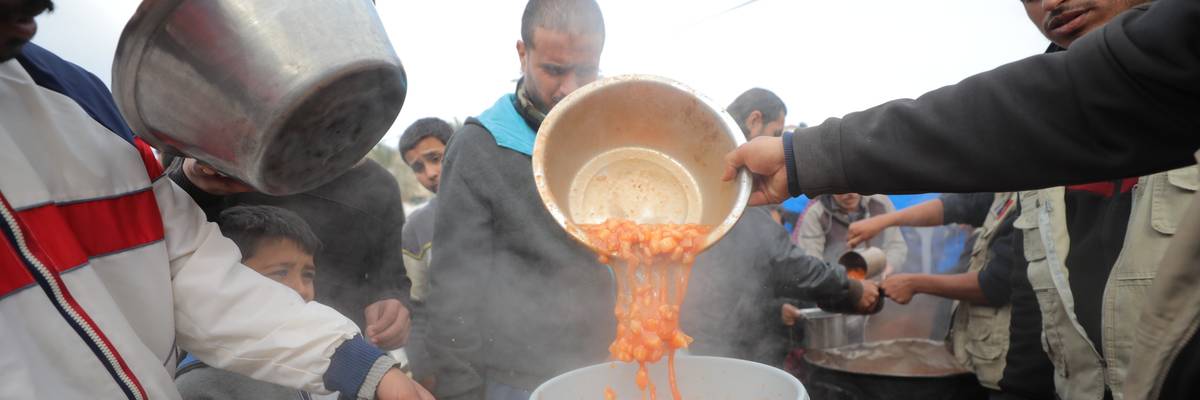
Palestinians fleeing Israeli airstrikes seek refuge in the Nuseirat refugee camp, receive hot meals distributed by humanitarian organizations as they face hunger due to the ongoing embargo in the Gaza Strip on January 04, 2025.
"Today's challenges of access to food will be exacerbated by production challenges tomorrow. We are not on track to meet future food needs. Not even close," according to a letter published Tuesday.
A group of some of the world's foremost thinkers is sounding the alarm on the globe's looming "hunger catastrophe" and are calling for "moonshot" efforts to stave off the crisis, according to an open letter published Tuesday that was signed by 153 winners of the Nobel Prize and World Food Prize.
The luminaries who signed the letter include the economist Joseph Stiglitz; the spiritual leader the 14th Dalai Lama; the Nigerian playwright and political activist Wole Soyinka; and Emmanuelle Charpentier and Jennifer Doudna, who discovered the CRISPR/Cas9 genetic scissors.
The letter notes that there are 700 million people worldwide who are currently food insecure and "desperately poor"—and about 50% of them don't know where they can expect their next meal. Some 60 million children under five are cognitively and physically impaired for life from nutritional deficiencies.
As hard as those numbers are to fathom, it's about to get worse, according to the letter. Due to climate change, the world is expected to experience a decrease in the productivity of most major food staples, even though the planet is projected to add another 1.5 billion people to its population by 2050. "For maize, the major staple for much of Africa, the picture is particularly dire with decreasing yields projected for virtually its entire growing area," according to the letter.
Extreme weather and weather events linked to climate change will threaten crop productions, as will additional factors like "soil erosion and land degradation, biodiversity loss, water shortages, conflict, and policies that restrict innovation."
In sum, according to the letter, "today's challenges of access to food will be exacerbated by production challenges tomorrow. We are not on track to meet future food needs. Not even close. While much can and needs to be done to improve the flow of food to those in need, food production and accessibility must rise sharply and sustainably by mid-century, particularly where hunger and malnutrition are most severe."
The appeal was coordinated by Cary Fowler, joint 2024 World Food Prize Laureate, who is also the outgoing U.S. special envoy for global food security at the State Department. He is also known as the "father" of the Svalbard Global Seed Vault.
"We know that agricultural research and innovation can be a powerful lever, not only for food and nutrition security, but also improved health, livelihoods and economic development. We need to channel our best scientific efforts into reversing our current trajectory, or today's crisis will become tomorrow's catastrophe," Fowler said in a statement Tuesday.
The efforts the group is calling for include investment and prioritization in agricultural research and development, as well as other potential moonshot initiatives such as enhancing photosynthesis in crops such as wheat and rice, transforming annual to perennial crops, creating nutrient-rich food from microorganisms and fungi, and more.
Mashal Hussain, the incoming president of the World Food Prize Foundation, said in a statement: "If we can put a man on the moon, we can surely rally the funding, resources, and collaboration needed to put enough food on plates here on Earth. With the right support, the scientific community can deliver the breakthroughs to prevent catastrophic food insecurity in the next 25 years."
The letter will be discussed during a Senate Committee event in Washington, D.C. on Tuesday.
Dear Common Dreams reader, It’s been nearly 30 years since I co-founded Common Dreams with my late wife, Lina Newhouser. We had the radical notion that journalism should serve the public good, not corporate profits. It was clear to us from the outset what it would take to build such a project. No paid advertisements. No corporate sponsors. No millionaire publisher telling us what to think or do. Many people said we wouldn't last a year, but we proved those doubters wrong. Together with a tremendous team of journalists and dedicated staff, we built an independent media outlet free from the constraints of profits and corporate control. Our mission has always been simple: To inform. To inspire. To ignite change for the common good. Building Common Dreams was not easy. Our survival was never guaranteed. When you take on the most powerful forces—Wall Street greed, fossil fuel industry destruction, Big Tech lobbyists, and uber-rich oligarchs who have spent billions upon billions rigging the economy and democracy in their favor—the only bulwark you have is supporters who believe in your work. But here’s the urgent message from me today. It's never been this bad out there. And it's never been this hard to keep us going. At the very moment Common Dreams is most needed, the threats we face are intensifying. We need your support now more than ever. We don't accept corporate advertising and never will. We don't have a paywall because we don't think people should be blocked from critical news based on their ability to pay. Everything we do is funded by the donations of readers like you. When everyone does the little they can afford, we are strong. But if that support retreats or dries up, so do we. Will you donate now to make sure Common Dreams not only survives but thrives? —Craig Brown, Co-founder |
A group of some of the world's foremost thinkers is sounding the alarm on the globe's looming "hunger catastrophe" and are calling for "moonshot" efforts to stave off the crisis, according to an open letter published Tuesday that was signed by 153 winners of the Nobel Prize and World Food Prize.
The luminaries who signed the letter include the economist Joseph Stiglitz; the spiritual leader the 14th Dalai Lama; the Nigerian playwright and political activist Wole Soyinka; and Emmanuelle Charpentier and Jennifer Doudna, who discovered the CRISPR/Cas9 genetic scissors.
The letter notes that there are 700 million people worldwide who are currently food insecure and "desperately poor"—and about 50% of them don't know where they can expect their next meal. Some 60 million children under five are cognitively and physically impaired for life from nutritional deficiencies.
As hard as those numbers are to fathom, it's about to get worse, according to the letter. Due to climate change, the world is expected to experience a decrease in the productivity of most major food staples, even though the planet is projected to add another 1.5 billion people to its population by 2050. "For maize, the major staple for much of Africa, the picture is particularly dire with decreasing yields projected for virtually its entire growing area," according to the letter.
Extreme weather and weather events linked to climate change will threaten crop productions, as will additional factors like "soil erosion and land degradation, biodiversity loss, water shortages, conflict, and policies that restrict innovation."
In sum, according to the letter, "today's challenges of access to food will be exacerbated by production challenges tomorrow. We are not on track to meet future food needs. Not even close. While much can and needs to be done to improve the flow of food to those in need, food production and accessibility must rise sharply and sustainably by mid-century, particularly where hunger and malnutrition are most severe."
The appeal was coordinated by Cary Fowler, joint 2024 World Food Prize Laureate, who is also the outgoing U.S. special envoy for global food security at the State Department. He is also known as the "father" of the Svalbard Global Seed Vault.
"We know that agricultural research and innovation can be a powerful lever, not only for food and nutrition security, but also improved health, livelihoods and economic development. We need to channel our best scientific efforts into reversing our current trajectory, or today's crisis will become tomorrow's catastrophe," Fowler said in a statement Tuesday.
The efforts the group is calling for include investment and prioritization in agricultural research and development, as well as other potential moonshot initiatives such as enhancing photosynthesis in crops such as wheat and rice, transforming annual to perennial crops, creating nutrient-rich food from microorganisms and fungi, and more.
Mashal Hussain, the incoming president of the World Food Prize Foundation, said in a statement: "If we can put a man on the moon, we can surely rally the funding, resources, and collaboration needed to put enough food on plates here on Earth. With the right support, the scientific community can deliver the breakthroughs to prevent catastrophic food insecurity in the next 25 years."
The letter will be discussed during a Senate Committee event in Washington, D.C. on Tuesday.
A group of some of the world's foremost thinkers is sounding the alarm on the globe's looming "hunger catastrophe" and are calling for "moonshot" efforts to stave off the crisis, according to an open letter published Tuesday that was signed by 153 winners of the Nobel Prize and World Food Prize.
The luminaries who signed the letter include the economist Joseph Stiglitz; the spiritual leader the 14th Dalai Lama; the Nigerian playwright and political activist Wole Soyinka; and Emmanuelle Charpentier and Jennifer Doudna, who discovered the CRISPR/Cas9 genetic scissors.
The letter notes that there are 700 million people worldwide who are currently food insecure and "desperately poor"—and about 50% of them don't know where they can expect their next meal. Some 60 million children under five are cognitively and physically impaired for life from nutritional deficiencies.
As hard as those numbers are to fathom, it's about to get worse, according to the letter. Due to climate change, the world is expected to experience a decrease in the productivity of most major food staples, even though the planet is projected to add another 1.5 billion people to its population by 2050. "For maize, the major staple for much of Africa, the picture is particularly dire with decreasing yields projected for virtually its entire growing area," according to the letter.
Extreme weather and weather events linked to climate change will threaten crop productions, as will additional factors like "soil erosion and land degradation, biodiversity loss, water shortages, conflict, and policies that restrict innovation."
In sum, according to the letter, "today's challenges of access to food will be exacerbated by production challenges tomorrow. We are not on track to meet future food needs. Not even close. While much can and needs to be done to improve the flow of food to those in need, food production and accessibility must rise sharply and sustainably by mid-century, particularly where hunger and malnutrition are most severe."
The appeal was coordinated by Cary Fowler, joint 2024 World Food Prize Laureate, who is also the outgoing U.S. special envoy for global food security at the State Department. He is also known as the "father" of the Svalbard Global Seed Vault.
"We know that agricultural research and innovation can be a powerful lever, not only for food and nutrition security, but also improved health, livelihoods and economic development. We need to channel our best scientific efforts into reversing our current trajectory, or today's crisis will become tomorrow's catastrophe," Fowler said in a statement Tuesday.
The efforts the group is calling for include investment and prioritization in agricultural research and development, as well as other potential moonshot initiatives such as enhancing photosynthesis in crops such as wheat and rice, transforming annual to perennial crops, creating nutrient-rich food from microorganisms and fungi, and more.
Mashal Hussain, the incoming president of the World Food Prize Foundation, said in a statement: "If we can put a man on the moon, we can surely rally the funding, resources, and collaboration needed to put enough food on plates here on Earth. With the right support, the scientific community can deliver the breakthroughs to prevent catastrophic food insecurity in the next 25 years."
The letter will be discussed during a Senate Committee event in Washington, D.C. on Tuesday.