

SUBSCRIBE TO OUR FREE NEWSLETTER
Daily news & progressive opinion—funded by the people, not the corporations—delivered straight to your inbox.
5
#000000
#FFFFFF
To donate by check, phone, or other method, see our More Ways to Give page.
Daily news & progressive opinion—funded by the people, not the corporations—delivered straight to your inbox.

The international medical humanitarian organization Doctors Without Borders/Medecins Sans Frontieres (MSF) today announced that it will no longer accept funds from the European Union and its member states, in opposition to their damaging migration deterrence policies and intensifying attempts to push people and their suffering away from European shores. This decision will take effect immediately and will apply to MSF's projects worldwide.
Three months into an agreement struck between the EU and Turkey, which European governments are claiming as a success, people in need of protection are paying the true cost of the deal. On the Greek islands, more than 8,000 people, including hundreds of unaccompanied minors, have been stranded as a direct consequence of the EU-Turkey deal. They have been living in dire conditions in overcrowded camps, sometimes for months. While they fear a forced return to Turkey, they are deprived of essential legal aid, their one defense against collective expulsion. The majority of these families, whom Europe has legislated out of sight, have fled conflict in Syria, Iraq, and Afghanistan.
"For months MSF has spoken out about a shameful European response focused on deterrence rather than on providing people with the assistance and protection they need," said Jerome Oberreit, MSF international secretary general. "The EU-Turkey deal goes one step further, placing the very concept of 'refugee' and the protection it offers in danger."
Last week the European Commission unveiled a new proposal to replicate the EU-Turkey logic across more than 16 countries in Africa and the Middle East. These deals would impose trade and development aid cuts on countries that do not stem migration to Europe or facilitate forcible returns, and reward those that do. Among these potential partners are Somalia, Eritrea, Sudan, and Afghanistan, four of the top 10 refugee generating countries, according to the United Nations.
"Is Europe's only offer to refugees that they stay in countries they are desperate to flee? Once again, Europe's main focus is not on how well people will be protected, but on how efficiently they are kept away," said Oberreit.
The EU-Turkey deal sets a dangerous precedent for other countries hosting refugees, sending a message that caring for people forced from their homes is optional and that they can purchase their way out of providing asylum. Last month, the Kenyan government cited European migration policy to justify its decision to close the world's largest refugee camp, Dadaab, and send its residents back to Somalia. Likewise, the deal does nothing to encourage countries surrounding Syria, already hosting millions of refugees, to open their borders to those in need.
"Europe's attempt to outsource migration control is having a domino effect, with closed borders stretching all the way back to Syria," said Oberreit. "People increasingly have nowhere to turn. Will the situation in Azaz, Syria, where 100,000 people are blocked between closed borders and front lines, become the rule, rather than the deadly exception?"
The EU-Turkey deal's financial package includes one billion euros in humanitarian aid. While there are undoubtedly needs in Turkey, which currently hosts close to three million Syrian refugees, this aid has been negotiated as a reward for border control promises, rather than being based solely on needs. This instrumentalization of humanitarian aid is unacceptable, MSF said.
"Deterrence policies sold to the public as humanitarian solutions have only exacerbated the suffering of people in need," said Oberreit. "There is nothing remotely humanitarian about these policies, which cannot become the norm and must be challenged. MSF will not receive funding from institutions and governments whose policies do so much harm. We are calling on European governments to shift priorities. Rather than maximize the number of people they can push back, they must maximize the number they welcome and protect."
MSF has been providing assistance to people crossing the Mediterranean Sea to Europe since 2002. In the last 18 months alone, MSF medics have treated an estimated 200,000 men, women, and children in Europe and on the Mediterranean Sea. The organization currently cares for refugees and migrants in Greece, Serbia, France, and Italy and on the Mediterranean, as well as in countries across Africa, Asia, and the Middle East.
MSF's activities are mainly (92 percent) privately funded. Nevertheless, the organization is also involved in some financial partnerships with institutional donors for specific programs. In 2015, funding from EU institutions represented 19 million euros, while funding from EU member states represented 37 million euros. MSF also used 6.8 millions euros received from the Norwegian Government. In 2016, in addition to ECHO, MSF is involved in partnerships with nine European Union member states: Belgium, Denmark, Germany, Ireland, Luxembourg, Netherlands, Spain, Sweden, and the United Kingdom.
Doctors Without Borders/Medecins Sans Frontieres (MSF) is an international medical humanitarian organization created by doctors and journalists in France in 1971. MSF's work is based on the humanitarian principles of medical ethics and impartiality. The organization is committed to bringing quality medical care to people caught in crisis regardless of race, religion, or political affiliation. MSF operates independently of any political, military, or religious agendas.
![People gathered for a traditional Somali wedding in the banquet room at the Safari Restaurant and Banquet Center at 4th Ave. and Lake Street, Minneapolis, Friday afternoon, July 29th, 2011.] Bruce Bisping/Star Tribune.](https://www.commondreams.org/media-library/people-gathered-for-a-traditional-somali-wedding-in-the-banquet-room-at-the-safari-restaurant-and-banquet-center-at-4th-ave-and.jpg?id=62230790&width=1245&height=700&quality=80&coordinates=0%2C175%2C0%2C176)
"This decision, fueled by harmful misinformation campaigns that we believe have external political motives, will tear families apart and send individuals to a country they have not known for over 20 years," one campaigner said.
President Donald Trump's Friday announcement that he was ending Temporary Protected Status for Somali immigrants in Minnesota prompted outrage and fear from Minnesota Somalis and their allies over the weekend.
In a Truth Social Post, Trump said that he was terminating the TPS program for Somalis in Minnesota "effective immediately," citing concerns about money laundering and gang activity.
“We are deeply disappointed that the administration has chosen to end the Somali TPS program in Minnesota, a legal lifeline for families who have built their lives here for decades," Jaylani Hussein, executive director of the Council on American-Islamic Relations-Minnesota, said in response. "This decision, fueled by harmful misinformation campaigns that we believe have external political motives, will tear families apart and send individuals to a country they have not known for over 20 years."
"This is not just a bureaucratic change; it is a political attack on the Somali and Muslim community driven by Islamophobic and hateful rhetoric. We strongly urge President Trump to reverse this misguided decision," Hussein continued.
"In a typical move, Donald Trump attacks our Somali community because he can’t think of anything else to do on a Friday night."
Minnesota has the nation's largest Somali population at over 26,000. Many have become citizens or are permanent residents, and only around 430 are in the Minnesota TPS program. Further, immigration law experts say that it would be difficult legally to revoke protections before they are already set to expire in March of next year.
"There is literally no legal means by which he can do this. It’s not a presidential power," wrote Aaron Reichlin-Melnick, a senior fellow with the American Immigration Council advocacy group, on social media. "TPS by law cannot be terminated early. Somali TPS is not set to expire until March 17, 2026."
He added that while the Department of Homeland Security "may make an attempt to do this... it would be immediately struck down."
Further, TPS would have to be revoked nationally, and not for a single state.
“There’s no legal mechanism that allows the president to terminate protected status for a particular community or state that he has beef with,” Heidi Altman, policy director at the National Immigrant Justice Center, told the Associated Press.
“This is Trump doing what he always does: demagoguing immigrants without justification or evidence and using that demagoguery in an attempt to take away important life-saving protections,” she said.
Despite this, the remarks sent many in the community into a "panic," local immigration attorney Abdiqani Jabane told the Minnesota Star Tribune.
People “are afraid that ICE [Immigration and Customs Enforcement] agents may start rounding up Somalis. These are people who have lived and worked in the community for more than 20 years," Jabane said.
Somalis were first granted TPS status in the US in 1991 when civil war broke out following the removal of leader Said Barre. Since then, it has been renewed 27 times. Today, the militant group al-Shabab still controls parts of the country.
“Sending anyone back to Somalia today is unsafe because al-Shabab remains active, terrorist attacks continue, and the [Somali] government today is unable to protect anyone,” Jabane said.
Minnesota leaders took to social media to speak out against Trump's edict and stand up for the state's Somali community.
"It’s not surprising that the President has chosen to broadly target an entire community. This is what he does to change the subject, wrote Minnesota Gov. Tim Walz.
Sen. Tina Smith (D-Minn.) wrote: "In a typical move, Donald Trump attacks our Somali community because he can’t think of anything else to do on a Friday night. That’s who he is, but it’s not who we are."
Rep. Ilhan Omar (D-Minn.), who is Somali herself, pushed back against people who used Trump's announcement to call for her deportation.
"I am a citizen and so are [a] majority of Somalis in America. Good luck celebrating a policy change that really doesn’t have much impact on the Somalis you love to hate. We are here to stay," she wrote.
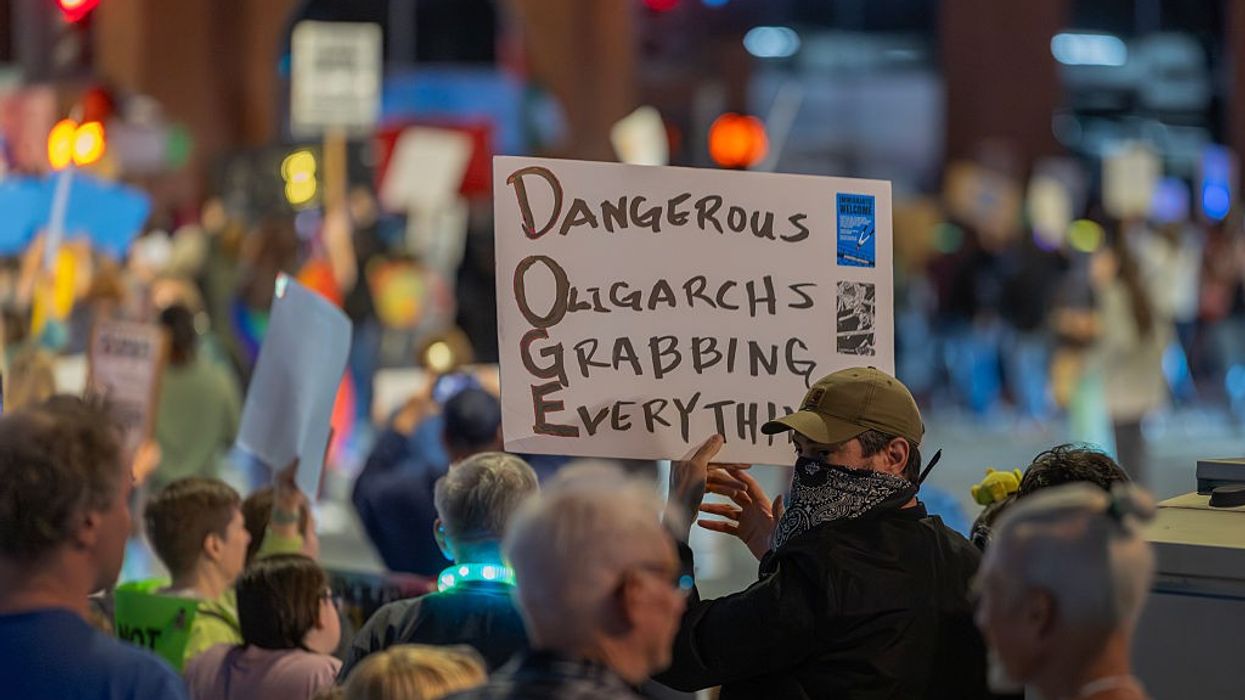
"The little bit of spending DOGE cut has already killed hundreds of thousands and will eventually lead to millions of deaths," one expert said.
The Department of Government Efficiency—Elon Musk's much-heralded attempt to take a chainsaw to the federal bureaucracy—has quietly disbanded eight months before its official expiration date, Reuters reported on Sunday.
The news agency received confirmation of DOGE's demise from Office of Personnel Management Director Scott Kupor earlier this month.
"That doesn't exist," Kupor told Reuters, adding that it was "no longer a centralized agency."
Kupor also said that a government hiring freeze implemented by DOGE had ended.
" DOGE is fading away like bank robbery gangs fade away after the robberies are done."
When President Donald Trump first signed the executive order creating DOGE, he said that it would last until July 4, 2026. However, following a public feud with Musk in late spring, Trump and his team had indicated the department was no longer active, often speaking of DOGE in the past tense.
Musk originally set out to save $1 trillion in federal expenditures by cutting what he claimed to be waste. According to the DOGE website, the department has only saved $214 billion of that aim. However, even that number is in dispute, with one Senate report finding the agency wasted over $21 billion.
At the same time, DOGE sowed chaos in the federal government by mass firing workers, hobbling consumer watchdog agencies, and gutting the US Agency for International Development (USAID)—a move that could lead to more than 14 million deaths worldwide by 2030. At the same time, DOGE employees' attempts to gain access to sensitive government data have made the data of millions of Americans less secure. One whistleblower report said the department uploaded Social Security data to a cloud server at risk from hacking.
Several experts reacted to Reuters' report by reflecting on DOGE's destructive legacy.
"Difficult to overstate how profound a failure DOGE was," Bobby Kogan, the senior director of federal budget policy at the Center for American Progress, wrote on social media. "Spending in FY2025 was not only than in FY2024—but higher than it was projected to be when Trump first took office.* The little bit of spending DOGE cut has already killed hundreds of thousands and will eventually lead to millions of deaths."
Rachel Khan wrote for the New Republic:
DOGE’s legacy is both very stupid and very sad: It decimated the federal workforce, including Social Security personnel at local offices, and made it easier for hackers to access your data. The agency tore apart USAID, which resulted in hundreds of thousands of lives lost globally. And all this for projected savings—numbers which grew smaller and less ambitious every time Musk mentioned them.
While DOGE may fade away into a fever dream of Trump’s first 100 days, its effects—and the suffering it inflicted—will be felt for a long time.
Dean Baker, senior economist at the Center for Economic and Policy Research, joked, "DOGE seems to be out of business, I guess Elon put our $5k dividend checks in the mail," referring to a promise Musk had made to redistribute DOGE's savings to taxpayers.
However, other commenters argued that DOGE had not failed, but had rather succeeded at its unstated aims.
Georgia State University political scientist Jeff Lazarus wrote that Musk "donated $277 million to Trump so he could steal the federal government’s data, dismantle the nation’s infrastructure, and stop foreign aid from going to nonwhite people. It’s a quid pro quo breathtaking in scope, corruption, and damage, & completely unprecedented in American history."
Bluesky user En Buen Ora wrote: "DOGE did not fail in any way to accomplish its goals. Its goals were never efficiency or saving money. Its goals were to destroy as much of government as possible forever, and to steal data for the Space Nazi. DOGE is fading away like bank robbery gangs fade away after the robberies are done."
While DOGE as an entity may not longer be working, Reuters noted that several of its employees had moved on to other government positions:
ProPublica has compiled a running list of every DOGE staffer it could verify, which now totals 114.
Author Tyler King wrote on social media that “‘DOGE doesn’t exist anymore' is a misleading premise because more than 100 former DOGErs have become deeply embedded in federal agencies to generally fuck around with our data and arbitrarily disrupt budgets."
Trump ally Jair Bolsonaro was taken into custody over concerns he might attempt to flee the country after he tampered with his ankle monitor.
Former Brazilian President Jair Bolsonaro, a right-wing ally of US President Donald Trump, was arrested in Brazil early Saturday morning following concerns he might flee the country.
Bolsonaro was under house arrest awaiting the result of his appeal after he was tried and sentenced to 27 years in prison for plotting a coup and the assassination of current Brazilian President Luiz Inácio Lula da Silva and other officials.
“Brazil just succeeded where America failed. Bringing a former president who assaulted democracy to justice,” filmmaker Petra Costa wrote on social media, as The Guardian reported.
Brazilian Supreme Court Justice Alexandre de Moraes ordered the arrest after discovering Bolsonaro's ankle monitor had been tampered with at 12:08 am local time Saturday. Bolsonaro's lawyers said that this was not the case, but Bolsonaro later admitted to taking a soldering iron to the device "out of curiosity" in a video released by the Supreme Court.
"This isn't curiosity, it's a crime," said State Deputy to the Legislative Assembly of Rio de Janeiro Renata da Silva Souza, on social media. "Bolsonaro is not a victim: He is convicted, ineligible, and is IMPRISONED. Turning this absurdity into a justification is a mockery of Brazilian democracy."
The ex-president's arrest also came the same day that his son Flávio Bolsonaro had planned a protest outside the Brasilia condo where Bolsonaro has been living.
De Moraes said Bolsonaro's tampering with his monitor fed his suspicions that he would attempt to flee the country in “the confusion that would be caused by a demonstration organized by his son," according to The Associated Press.
“He is located about 13 kilometers (8 miles) away from where the United States of America embassy lies, in a distance that can be covered in a 15-minute drive," de Moraes added.
Trump, who has sanctioned de Moraes and supports Bolsonaro, reacted to news of the arrest by saying it was "too bad."
Bolsonaro was arrested around 6:00 am local time and is now detained in an approximately 130-square-foot room in the federal police headquarters in Brasilia, according to Reuters. The entire five-judge panel that originally sentenced Bolsonaro will review his detention on Monday.
Institutional Relations Minister Gleisi Hoffmann was the highest-ranking member of the current government to comment on the detention, according to Reuters.
Hoffmann wrote on social media:
The pretrial detention of Jair Bolsonaro strictly follows the rites of due process of law, overseen by the Federal Supreme Court and the Attorney General's Office in each stage of the criminal action against the attempted coup d'état in Brazil. The decision by Minister Alexandre de Moraes is grounded in the real risks of flight by the leader of the coup organization, as well as the imminent finality of his conviction for the serving of his sentence. It also rightly takes into account the background of a process marked by violent attempts to coerce the Judiciary, such as the tarifaço and the Magnitsky sanctions. In a democracy, justice must be upheld.
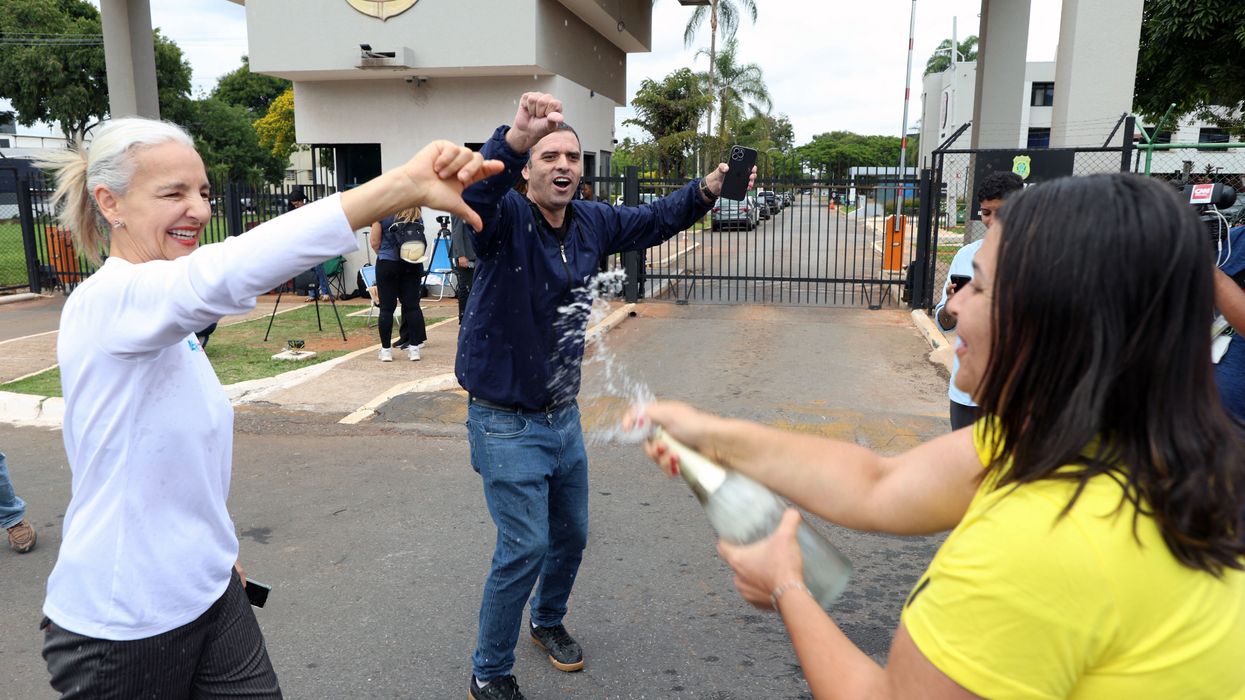
Ordinary Brazilians also celebrated the news of Bolsonaro's arrest, with some uncorking champagne bottles outside police headquarters.
"The message to Brazil, and to the world, is that crime doesn’t pay," Reimont Otoni, a Workers’ Party congressman, said.