SUBSCRIBE TO OUR FREE NEWSLETTER
Daily news & progressive opinion—funded by the people, not the corporations—delivered straight to your inbox.
5
#000000
#FFFFFF
To donate by check, phone, or other method, see our More Ways to Give page.
Daily news & progressive opinion—funded by the people, not the corporations—delivered straight to your inbox.
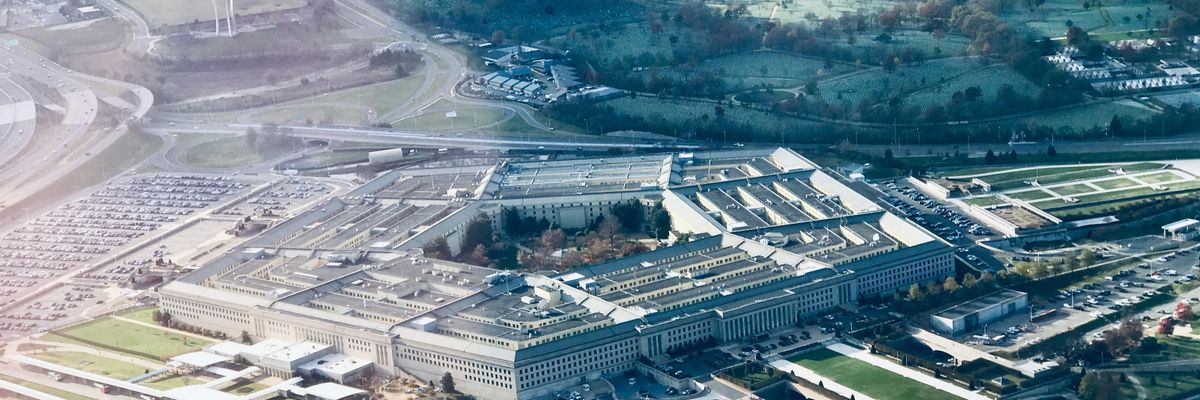
Aerial view of the Department of Defense, the cornerstone of United States defense. (Photo: Getty Images)
New outcries for gun control have followed the horrible tragedies of mass shootings in Uvalde and Buffalo. "Evil came to that elementary school classroom in Texas, to that grocery store in New York, to far too many places where innocents have died," President Biden declared over the weekend during a university commencement address. As he has said, a badly needed step is gun control--which, it's clear from evidence in many countries, would sharply reduce gun-related deaths.
But what about "gun control" at the Pentagon?
How is it that countless anguished commentators and concerned individuals across the USA can express justified fury at gun marketers and gun-related murders when a mass shooting occurs inside U.S. borders, while remaining silent about the need for meaningful gun control at the Pentagon?
The concept of curtailing the U.S. military's arsenal is such a nonstarter that it doesn't even get mentioned. Yet the annual number of deadly shootings in the United--19,384 at last count--is comparable to the average yearly number of documented civilian deaths directly caused by the Pentagon's warfare in the last two decades. And such figures on war deaths are underestimates.
From high-tech rifles and automatic weapons to drones, long-range missiles and gravity bombs, the U.S. military's weaponry has inflicted carnage in numerous countries. How many people have been directly killed by the "War on Terror" violence? An average of 45,000 human beings each year--more than two-fifths of them innocent civilians--since the terror war began, as documented by the Costs of War project at Brown University.
The mindset of U.S. mass media and mainstream politics is so militarized that such realities are routinely not accorded a second thought, or even any thought. Meanwhile, the Pentagon budget keeps ballooning year after year, with President Biden now proposing $813 billion for fiscal year 2023. Liberals and others frequently denounce how gun manufacturers are making a killing from sales of handguns and semiautomatic rifles in the United States, while weapons sales to the Pentagon continue to spike upward for corporate war mega-profiteers.
As William Hartung showed in his Profits of War report last fall, "Pentagon spending has totaled over $14 trillion since the start of the war in Afghanistan, with one-third to one-half of the total going to military contractors. A large portion of these contracts--one-quarter to one-third of all Pentagon contracts in recent years--have gone to just five major corporations: Lockheed Martin, Boeing, General Dynamics, Raytheon and Northrop Grumman."
What's more, the United States is the world's leading arms exporter, accounting for 35 percent of total weapons sales--more than Russia and China combined. The U.S. arms exports have huge consequences.
Pointing out that the Saudi-led war and blockade on Yemen "has helped cause the deaths of nearly half a million people," a letter to Congress from 60 organizations in late April said that "the United States must cease supplying weapons, spare parts, maintenance services, and logistical support to Saudi Arabia."
How is it that countless anguished commentators and concerned individuals across the USA can express justified fury at gun marketers and gun-related murders when a mass shooting occurs inside U.S. borders, while remaining silent about the need for meaningful gun control at the Pentagon?
The civilians who have died--and are continuing to die--from use of U.S. military weapons don't appear on American TV screens. Many lose their lives due to military operations that are unreported by U.S. news media, either because mainline journalists don't bother to cover the story or because those operations are kept secret by the U.S. government. As a practical matter, the actual system treats certain war victims as "unworthy" of notice.
Whatever the causal mix might be--in whatever proportions of conscious or unconscious nationalism, jingoism, chauvinism, racism and flat-out eagerness to believe whatever comforting fairy tale is repeatedly told by media and government officials--the resulting concoction is a dire refusal to acknowledge key realities of U.S. society and foreign policy.
To heighten the routine deception, we've been drilled into calling the nation's military budget a "defense" budget--while Congress devotes half of all discretionary spending to the military, the USA spends more on its military than the next 10 countries combined (most of them allies), the Pentagon operates 750 military bases overseas, and the United States is now conducting military operations in 85 countries.
Yes, gun control is a great idea. For the small guns. And the big ones.
Dear Common Dreams reader, It’s been nearly 30 years since I co-founded Common Dreams with my late wife, Lina Newhouser. We had the radical notion that journalism should serve the public good, not corporate profits. It was clear to us from the outset what it would take to build such a project. No paid advertisements. No corporate sponsors. No millionaire publisher telling us what to think or do. Many people said we wouldn't last a year, but we proved those doubters wrong. Together with a tremendous team of journalists and dedicated staff, we built an independent media outlet free from the constraints of profits and corporate control. Our mission has always been simple: To inform. To inspire. To ignite change for the common good. Building Common Dreams was not easy. Our survival was never guaranteed. When you take on the most powerful forces—Wall Street greed, fossil fuel industry destruction, Big Tech lobbyists, and uber-rich oligarchs who have spent billions upon billions rigging the economy and democracy in their favor—the only bulwark you have is supporters who believe in your work. But here’s the urgent message from me today. It's never been this bad out there. And it's never been this hard to keep us going. At the very moment Common Dreams is most needed, the threats we face are intensifying. We need your support now more than ever. We don't accept corporate advertising and never will. We don't have a paywall because we don't think people should be blocked from critical news based on their ability to pay. Everything we do is funded by the donations of readers like you. When everyone does the little they can afford, we are strong. But if that support retreats or dries up, so do we. Will you donate now to make sure Common Dreams not only survives but thrives? —Craig Brown, Co-founder |
Norman Solomon is the national director of RootsAction.org and executive director of the Institute for Public Accuracy. The paperback edition of his latest book, War Made Invisible: How America Hides the Human Toll of Its Military Machine, includes an afterword about the Gaza war.
New outcries for gun control have followed the horrible tragedies of mass shootings in Uvalde and Buffalo. "Evil came to that elementary school classroom in Texas, to that grocery store in New York, to far too many places where innocents have died," President Biden declared over the weekend during a university commencement address. As he has said, a badly needed step is gun control--which, it's clear from evidence in many countries, would sharply reduce gun-related deaths.
But what about "gun control" at the Pentagon?
How is it that countless anguished commentators and concerned individuals across the USA can express justified fury at gun marketers and gun-related murders when a mass shooting occurs inside U.S. borders, while remaining silent about the need for meaningful gun control at the Pentagon?
The concept of curtailing the U.S. military's arsenal is such a nonstarter that it doesn't even get mentioned. Yet the annual number of deadly shootings in the United--19,384 at last count--is comparable to the average yearly number of documented civilian deaths directly caused by the Pentagon's warfare in the last two decades. And such figures on war deaths are underestimates.
From high-tech rifles and automatic weapons to drones, long-range missiles and gravity bombs, the U.S. military's weaponry has inflicted carnage in numerous countries. How many people have been directly killed by the "War on Terror" violence? An average of 45,000 human beings each year--more than two-fifths of them innocent civilians--since the terror war began, as documented by the Costs of War project at Brown University.
The mindset of U.S. mass media and mainstream politics is so militarized that such realities are routinely not accorded a second thought, or even any thought. Meanwhile, the Pentagon budget keeps ballooning year after year, with President Biden now proposing $813 billion for fiscal year 2023. Liberals and others frequently denounce how gun manufacturers are making a killing from sales of handguns and semiautomatic rifles in the United States, while weapons sales to the Pentagon continue to spike upward for corporate war mega-profiteers.
As William Hartung showed in his Profits of War report last fall, "Pentagon spending has totaled over $14 trillion since the start of the war in Afghanistan, with one-third to one-half of the total going to military contractors. A large portion of these contracts--one-quarter to one-third of all Pentagon contracts in recent years--have gone to just five major corporations: Lockheed Martin, Boeing, General Dynamics, Raytheon and Northrop Grumman."
What's more, the United States is the world's leading arms exporter, accounting for 35 percent of total weapons sales--more than Russia and China combined. The U.S. arms exports have huge consequences.
Pointing out that the Saudi-led war and blockade on Yemen "has helped cause the deaths of nearly half a million people," a letter to Congress from 60 organizations in late April said that "the United States must cease supplying weapons, spare parts, maintenance services, and logistical support to Saudi Arabia."
How is it that countless anguished commentators and concerned individuals across the USA can express justified fury at gun marketers and gun-related murders when a mass shooting occurs inside U.S. borders, while remaining silent about the need for meaningful gun control at the Pentagon?
The civilians who have died--and are continuing to die--from use of U.S. military weapons don't appear on American TV screens. Many lose their lives due to military operations that are unreported by U.S. news media, either because mainline journalists don't bother to cover the story or because those operations are kept secret by the U.S. government. As a practical matter, the actual system treats certain war victims as "unworthy" of notice.
Whatever the causal mix might be--in whatever proportions of conscious or unconscious nationalism, jingoism, chauvinism, racism and flat-out eagerness to believe whatever comforting fairy tale is repeatedly told by media and government officials--the resulting concoction is a dire refusal to acknowledge key realities of U.S. society and foreign policy.
To heighten the routine deception, we've been drilled into calling the nation's military budget a "defense" budget--while Congress devotes half of all discretionary spending to the military, the USA spends more on its military than the next 10 countries combined (most of them allies), the Pentagon operates 750 military bases overseas, and the United States is now conducting military operations in 85 countries.
Yes, gun control is a great idea. For the small guns. And the big ones.
Norman Solomon is the national director of RootsAction.org and executive director of the Institute for Public Accuracy. The paperback edition of his latest book, War Made Invisible: How America Hides the Human Toll of Its Military Machine, includes an afterword about the Gaza war.
New outcries for gun control have followed the horrible tragedies of mass shootings in Uvalde and Buffalo. "Evil came to that elementary school classroom in Texas, to that grocery store in New York, to far too many places where innocents have died," President Biden declared over the weekend during a university commencement address. As he has said, a badly needed step is gun control--which, it's clear from evidence in many countries, would sharply reduce gun-related deaths.
But what about "gun control" at the Pentagon?
How is it that countless anguished commentators and concerned individuals across the USA can express justified fury at gun marketers and gun-related murders when a mass shooting occurs inside U.S. borders, while remaining silent about the need for meaningful gun control at the Pentagon?
The concept of curtailing the U.S. military's arsenal is such a nonstarter that it doesn't even get mentioned. Yet the annual number of deadly shootings in the United--19,384 at last count--is comparable to the average yearly number of documented civilian deaths directly caused by the Pentagon's warfare in the last two decades. And such figures on war deaths are underestimates.
From high-tech rifles and automatic weapons to drones, long-range missiles and gravity bombs, the U.S. military's weaponry has inflicted carnage in numerous countries. How many people have been directly killed by the "War on Terror" violence? An average of 45,000 human beings each year--more than two-fifths of them innocent civilians--since the terror war began, as documented by the Costs of War project at Brown University.
The mindset of U.S. mass media and mainstream politics is so militarized that such realities are routinely not accorded a second thought, or even any thought. Meanwhile, the Pentagon budget keeps ballooning year after year, with President Biden now proposing $813 billion for fiscal year 2023. Liberals and others frequently denounce how gun manufacturers are making a killing from sales of handguns and semiautomatic rifles in the United States, while weapons sales to the Pentagon continue to spike upward for corporate war mega-profiteers.
As William Hartung showed in his Profits of War report last fall, "Pentagon spending has totaled over $14 trillion since the start of the war in Afghanistan, with one-third to one-half of the total going to military contractors. A large portion of these contracts--one-quarter to one-third of all Pentagon contracts in recent years--have gone to just five major corporations: Lockheed Martin, Boeing, General Dynamics, Raytheon and Northrop Grumman."
What's more, the United States is the world's leading arms exporter, accounting for 35 percent of total weapons sales--more than Russia and China combined. The U.S. arms exports have huge consequences.
Pointing out that the Saudi-led war and blockade on Yemen "has helped cause the deaths of nearly half a million people," a letter to Congress from 60 organizations in late April said that "the United States must cease supplying weapons, spare parts, maintenance services, and logistical support to Saudi Arabia."
How is it that countless anguished commentators and concerned individuals across the USA can express justified fury at gun marketers and gun-related murders when a mass shooting occurs inside U.S. borders, while remaining silent about the need for meaningful gun control at the Pentagon?
The civilians who have died--and are continuing to die--from use of U.S. military weapons don't appear on American TV screens. Many lose their lives due to military operations that are unreported by U.S. news media, either because mainline journalists don't bother to cover the story or because those operations are kept secret by the U.S. government. As a practical matter, the actual system treats certain war victims as "unworthy" of notice.
Whatever the causal mix might be--in whatever proportions of conscious or unconscious nationalism, jingoism, chauvinism, racism and flat-out eagerness to believe whatever comforting fairy tale is repeatedly told by media and government officials--the resulting concoction is a dire refusal to acknowledge key realities of U.S. society and foreign policy.
To heighten the routine deception, we've been drilled into calling the nation's military budget a "defense" budget--while Congress devotes half of all discretionary spending to the military, the USA spends more on its military than the next 10 countries combined (most of them allies), the Pentagon operates 750 military bases overseas, and the United States is now conducting military operations in 85 countries.
Yes, gun control is a great idea. For the small guns. And the big ones.