SUBSCRIBE TO OUR FREE NEWSLETTER
Daily news & progressive opinion—funded by the people, not the corporations—delivered straight to your inbox.
5
#000000
#FFFFFF
To donate by check, phone, or other method, see our More Ways to Give page.
Daily news & progressive opinion—funded by the people, not the corporations—delivered straight to your inbox.
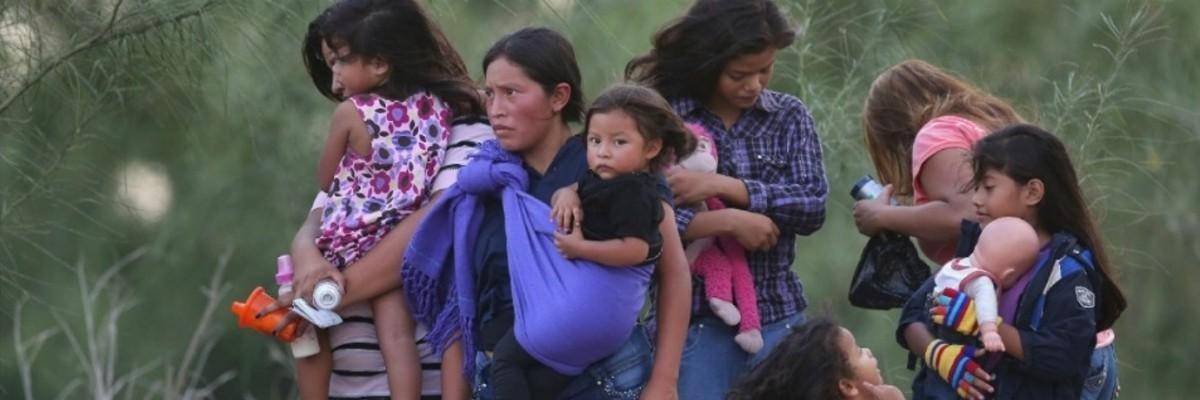
The IPCC report recognizes that migration is a form of climate adaptation--and that it is already occurring. (Photo: Getty)
Going beyond the headline figures of rising temperatures and sea levels, the latest report from the Intergovernmental Panel on Climate Change (IPCC) captures the full scale of the threat to human life in a heating world. It explains how extreme weather, drought, habitat and species loss, urban heat islands, and the destruction of food sources and livelihoods are all intensifying. And the scientific community is now more certain that climate change is having a direct influence on migration.
Climate-related displacement disproportionately affects people who have contributed least to the problem. Thanks to the repeated failure of the world's major powers to address climate change, extreme weather in Central America, fires and storms in North America, flooding across Europe and Asia, and drought in Africa are forcing people to move. Last year, the Red Cross confirmed that it was already dealing with the consequences of climate change in all 192 countries where it operates.
The solutions to displacement already exist, as do the legal and moral bases for establishing practical agreements between governments.
The IPCC report recognizes that migration is a form of climate adaptation--and that it is already occurring. This is an important correction to the widespread narrative of climate-linked displacement as a problem to be managed at some point in the future.
That view is often accompanied by fearmongering in wealthy countries about swarms of climate refugees. Across the Global North, ever more public money is being funneled into a growing border-security and surveillance industry that promises to tackle the "threat" with a "Global Climate Wall." The industry's lobbyists and political allies claim that advanced networks of weapons, walls, drones, surveillance technology, and lawfare will be needed to protect powerful countries against future waves of climate displacement.
But climate walls provide no such protection, even as they threaten civil liberties (in wealthier countries as much as anywhere else) and divert resources from meaningful climate action to the hands of crisis profiteers. Worse, these operators are closely linked to the fossil-fuel sector, global finance, and the arms industry, which profits from the conflicts that generate refugee flows (and that climate change will make more likely).
These false solutions are already costing lives and livelihoods. In 2020-21, 2,000 people were killed in the Mediterranean due to illegal "pushback" policies in the European Union. People being turned away at the US-Mexico border are also fleeing extreme weather conditions, as are many now languishing in indefinite detention in countries from Britain to Australia.
The IPCC report is right to stress the urgency of decarbonization to prevent further displacement. But we must not stop there. The governments of major emitters of greenhouse gases must be pressured to support countries that face irreversible loss and damage from climate change. The global climate movement will fail if it focuses only on renewable energy and not also on ameliorating the suffering caused by the climate emergency that is already here.
What more should be done? First, we must safeguard both the right to move and the right to stay. Climate finance to help at-risk communities build resilience and limit migration is essential, as are improvements to disaster warning and relief systems. But we also need financing to facilitate the safe movement of people when it is necessary. Most displacement happens within countries, not across borders, so we must ensure that poorer countries have the resources to manage both short- and long-term resettlement.
Second, in cases where climate-linked displacement does cross borders, we should respond with pragmatism and compassion, not paranoia and profiteering. The money being thrown at dystopian military and surveillance infrastructure should instead go toward supporting safe and legal routes and procedures for people who need to move. The dominant political impulse today is to try to divide people by the circumstances of their birth. But with more resources and a different political vision, we could ensure that both newcomers and host communities alike benefit from immigration.
Third, we need to broaden our understanding of what counts as climate-linked displacement. Those who are directly fleeing storms, fires, and floods obviously need policy support. But climate change is also a growing factor in resource shortages, income loss, political instability, and violent conflicts. We must resist efforts to limit the definition of who counts as a climate-displaced person. We cannot wait for disaster to strike before acting. We should already be considering processes to achieve planned migration with dignity, allowing people in vulnerable locales to move before the worst effects materialize.
Despite its shortcomings, the IPCC report does acknowledge that human migration is an important part of the solution to the broader crisis of climate change. Displaced, indigenous, and vulnerable communities in both the Global North and South have already had their lives changed for the worse by pollution, fossil-fuel extraction, and climate change. They have much to teach us about preserving life in a heating world, if we seize the opportunity to bring people together, to foster cross-border problem-solving, and to push back against the petty nationalism that has hamstrung the world's pandemic response.
The solutions to displacement already exist, as do the legal and moral bases for establishing practical agreements between governments. What we need is international action to provide systems that can ensure a safe and dignified future for everyone. A climate movement that has learned to protect human life to the fullest must be at the forefront of that effort.
This country and this world are at a monumental crossroads. US voters have an opportunity to beat back the forces of fascism and confront the billionaires who are rigging the economy, our media system, and our democracy, making it increasingly impossible for ordinary people to get by. We’re not just talking about the election. We’re talking about what must be done once these fascist elements are vanquished from power. We need a bolder set of solutions than what either major party has so far been willing to offer and a working-class movement ready to fight like hell for it. Trump didn't emerge from nowhere. The conditions that fueled MAGA authoritarianism were created by decades of radical neoliberal economic policies and a corrupt political system dominated by corporate interests. They slashed taxes on the super-rich, promising that the benefits would trickle down. They said giveaways to the corporate titans would make life more affordable for the rest of us. It was all bullshit. And when a bitter, betrayed populace searches for someone to blame, right-wing demagogues have little trouble finding scapegoats. People know when they're being lied to, but you won't hear any of this from the corporate media. Only independent journalism—powered and funded by people who believe in building a better world—can deliver truly trustworthy daily news. If you share our vision, please contribute whatever you can to sustain our work. |
Going beyond the headline figures of rising temperatures and sea levels, the latest report from the Intergovernmental Panel on Climate Change (IPCC) captures the full scale of the threat to human life in a heating world. It explains how extreme weather, drought, habitat and species loss, urban heat islands, and the destruction of food sources and livelihoods are all intensifying. And the scientific community is now more certain that climate change is having a direct influence on migration.
Climate-related displacement disproportionately affects people who have contributed least to the problem. Thanks to the repeated failure of the world's major powers to address climate change, extreme weather in Central America, fires and storms in North America, flooding across Europe and Asia, and drought in Africa are forcing people to move. Last year, the Red Cross confirmed that it was already dealing with the consequences of climate change in all 192 countries where it operates.
The solutions to displacement already exist, as do the legal and moral bases for establishing practical agreements between governments.
The IPCC report recognizes that migration is a form of climate adaptation--and that it is already occurring. This is an important correction to the widespread narrative of climate-linked displacement as a problem to be managed at some point in the future.
That view is often accompanied by fearmongering in wealthy countries about swarms of climate refugees. Across the Global North, ever more public money is being funneled into a growing border-security and surveillance industry that promises to tackle the "threat" with a "Global Climate Wall." The industry's lobbyists and political allies claim that advanced networks of weapons, walls, drones, surveillance technology, and lawfare will be needed to protect powerful countries against future waves of climate displacement.
But climate walls provide no such protection, even as they threaten civil liberties (in wealthier countries as much as anywhere else) and divert resources from meaningful climate action to the hands of crisis profiteers. Worse, these operators are closely linked to the fossil-fuel sector, global finance, and the arms industry, which profits from the conflicts that generate refugee flows (and that climate change will make more likely).
These false solutions are already costing lives and livelihoods. In 2020-21, 2,000 people were killed in the Mediterranean due to illegal "pushback" policies in the European Union. People being turned away at the US-Mexico border are also fleeing extreme weather conditions, as are many now languishing in indefinite detention in countries from Britain to Australia.
The IPCC report is right to stress the urgency of decarbonization to prevent further displacement. But we must not stop there. The governments of major emitters of greenhouse gases must be pressured to support countries that face irreversible loss and damage from climate change. The global climate movement will fail if it focuses only on renewable energy and not also on ameliorating the suffering caused by the climate emergency that is already here.
What more should be done? First, we must safeguard both the right to move and the right to stay. Climate finance to help at-risk communities build resilience and limit migration is essential, as are improvements to disaster warning and relief systems. But we also need financing to facilitate the safe movement of people when it is necessary. Most displacement happens within countries, not across borders, so we must ensure that poorer countries have the resources to manage both short- and long-term resettlement.
Second, in cases where climate-linked displacement does cross borders, we should respond with pragmatism and compassion, not paranoia and profiteering. The money being thrown at dystopian military and surveillance infrastructure should instead go toward supporting safe and legal routes and procedures for people who need to move. The dominant political impulse today is to try to divide people by the circumstances of their birth. But with more resources and a different political vision, we could ensure that both newcomers and host communities alike benefit from immigration.
Third, we need to broaden our understanding of what counts as climate-linked displacement. Those who are directly fleeing storms, fires, and floods obviously need policy support. But climate change is also a growing factor in resource shortages, income loss, political instability, and violent conflicts. We must resist efforts to limit the definition of who counts as a climate-displaced person. We cannot wait for disaster to strike before acting. We should already be considering processes to achieve planned migration with dignity, allowing people in vulnerable locales to move before the worst effects materialize.
Despite its shortcomings, the IPCC report does acknowledge that human migration is an important part of the solution to the broader crisis of climate change. Displaced, indigenous, and vulnerable communities in both the Global North and South have already had their lives changed for the worse by pollution, fossil-fuel extraction, and climate change. They have much to teach us about preserving life in a heating world, if we seize the opportunity to bring people together, to foster cross-border problem-solving, and to push back against the petty nationalism that has hamstrung the world's pandemic response.
The solutions to displacement already exist, as do the legal and moral bases for establishing practical agreements between governments. What we need is international action to provide systems that can ensure a safe and dignified future for everyone. A climate movement that has learned to protect human life to the fullest must be at the forefront of that effort.