SUBSCRIBE TO OUR FREE NEWSLETTER
Daily news & progressive opinion—funded by the people, not the corporations—delivered straight to your inbox.
5
#000000
#FFFFFF
To donate by check, phone, or other method, see our More Ways to Give page.
Daily news & progressive opinion—funded by the people, not the corporations—delivered straight to your inbox.
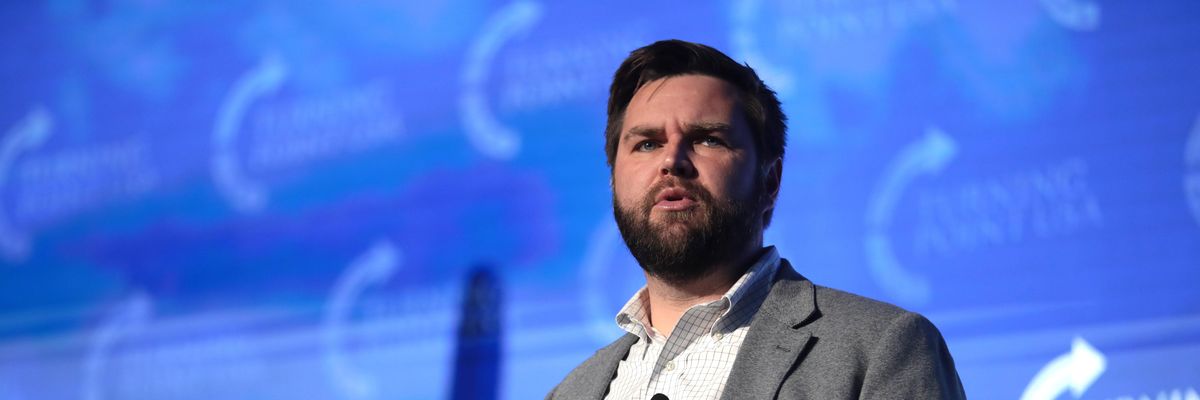
J. D. Vance, a U.S. Senate candidate from Ohio, speaks at the Southwest Regional Conference hosted by Turning Point USA on April 17, 2021 at the Arizona Biltmore in Phoenix. (Photo: Gage Skidmore/Flickr)
On Tuesday, J.D. Vance, author of the bestselling Hillbilly Elegy and now candidate for the U.S. Senate from Ohio, gave a keynote speech at the National Conservatism Conference titled "The Universities Are the Enemy."
Hitler said he regretted that his regime still had some need for its "intellectual classes," otherwise, "one day we could, I don't know, exterminate them or something."
In the speech, he told his audience: "I think in this movement of national conservatism, what we need more than inspiration is wisdom. And there is a wisdom in what Richard Nixon said approximately 40, 50 years ago. He said, and I quote: 'The professors are the enemy.'"
Nixon actually said these words to his then-national security advisor, the Harvard professor Henry Kissinger. He added, in a professorial flourish, "write that on a blackboard 100 times and never forget it."
This hatred of professors and their universities seems to be a big deal for Vance. On his campaign website, under the heading "Protect Conservative Values," he complains that "hundreds of billions of American tax dollars" get sent to universities that "teach that America is an evil, racist nation." These universities "then train teachers who bring that indoctrination into our elementary and high schools." He doesn't want any tax dollars going to institutions that teach "critical race theory or radical gender ideology." Instead, he wants them to deliver "an honest, patriotic account of American history." Other sections of the website extol the glories of the 2nd Amendment, while ranting about immigrants and Covid-19 regulations.
Vance's complaint is at least as old as the trial of Socrates in the Athens of 399 BCE. Socrates was sentenced to death for teachings that supposedly corrupted the youth of Athens and mocked the city's gods. Vilifying professors has been the theme of a certain kind of politics ever since.
Ironically, the same Henry Kissinger who heard Nixon's 1972 rant about professors made his own academic reputation writing about Prince Klemens von Metternich, the top minister of the Austrian Empire from 1809 to 1848. Metternich was a conservative strongman, perhaps the Vladimir Putin of his day. He didn't like professors either.
In 1820, Metternich wrote that the main evil of his time was "presumption," his word for the habit of educated people to question authority. "Experience has no value for the presumptuous man; faith is nothing to him," he said. Ordinary working people, he said, did not fall prey to these illusions because they were too busy with the hard labor of their own lives. Not so the professors who were his target: the "real cosmopolitans...men of letters, lawyers, and the individuals charged with public education."
Just like Vance, Metternich thought the only counterweight to such errors was to be found in "wisdom"--which meant accepting Metternich's authority and all conservative values with it.
Authoritarians... claim that academic activity is subversive, unpatriotic, and immoral--and thus a serious threat to society.
The fascist movements of the 20th century were notoriously anti-intellectual and anti-professor. In a relatively unscripted moment in a 1938 speech, Adolf Hitler said he regretted that his regime still had some need for its "intellectual classes," otherwise, "one day we could, I don't know, exterminate them or something."
Hitler's propaganda minister, Joseph Goebbels, was irritated by academics' tendency to examine political statements for their truth value. But he concluded that "I do not believe that university professors make history."
Why is it that professors have always drawn the anger of authoritarians? Authoritarians themselves will always claim that academic activity is subversive, unpatriotic, and immoral--and thus a serious threat to society. But let's be real for a moment. Goebbels actually had a point.
The great majority of scholarly publications are read by only a tiny handful of professional colleagues. Academics who somehow reach a broader public audience are usually highly untypical of their profession. As for our nefarious activity in the classroom: I can assure Vance that I could never indoctrinate any student into anything, even if I wanted to. I keep a file of amusing exam answers. To put it gently, students don't always listen. Any indoctrination I tried would surely backfire.
If Vance were to be honest about who he thinks his enemies really are, he would have to say minorities, immigrants, and others who don't fit into his vision of American values. These are the people hurt by the kind of politics he advances. But it doesn't sound quite so good to say this out loud.
Professors, on the other hand, are a perfect target, and perfect scapegoats. The work they do is often obscure and mysterious for people outside the academy. They are easy to caricature as out of touch, or worse. Most importantly, they do not have the power or media reach to fight back.
Vance is right about one thing, though. So long as he pursues a politics of division, fear, hatred, and mass death from Covid and guns, I will oppose him. I will probably be an ineffective enemy. But I will do my best.
Dear Common Dreams reader, It’s been nearly 30 years since I co-founded Common Dreams with my late wife, Lina Newhouser. We had the radical notion that journalism should serve the public good, not corporate profits. It was clear to us from the outset what it would take to build such a project. No paid advertisements. No corporate sponsors. No millionaire publisher telling us what to think or do. Many people said we wouldn't last a year, but we proved those doubters wrong. Together with a tremendous team of journalists and dedicated staff, we built an independent media outlet free from the constraints of profits and corporate control. Our mission has always been simple: To inform. To inspire. To ignite change for the common good. Building Common Dreams was not easy. Our survival was never guaranteed. When you take on the most powerful forces—Wall Street greed, fossil fuel industry destruction, Big Tech lobbyists, and uber-rich oligarchs who have spent billions upon billions rigging the economy and democracy in their favor—the only bulwark you have is supporters who believe in your work. But here’s the urgent message from me today. It's never been this bad out there. And it's never been this hard to keep us going. At the very moment Common Dreams is most needed, the threats we face are intensifying. We need your support now more than ever. We don't accept corporate advertising and never will. We don't have a paywall because we don't think people should be blocked from critical news based on their ability to pay. Everything we do is funded by the donations of readers like you. When everyone does the little they can afford, we are strong. But if that support retreats or dries up, so do we. Will you donate now to make sure Common Dreams not only survives but thrives? —Craig Brown, Co-founder |
On Tuesday, J.D. Vance, author of the bestselling Hillbilly Elegy and now candidate for the U.S. Senate from Ohio, gave a keynote speech at the National Conservatism Conference titled "The Universities Are the Enemy."
Hitler said he regretted that his regime still had some need for its "intellectual classes," otherwise, "one day we could, I don't know, exterminate them or something."
In the speech, he told his audience: "I think in this movement of national conservatism, what we need more than inspiration is wisdom. And there is a wisdom in what Richard Nixon said approximately 40, 50 years ago. He said, and I quote: 'The professors are the enemy.'"
Nixon actually said these words to his then-national security advisor, the Harvard professor Henry Kissinger. He added, in a professorial flourish, "write that on a blackboard 100 times and never forget it."
This hatred of professors and their universities seems to be a big deal for Vance. On his campaign website, under the heading "Protect Conservative Values," he complains that "hundreds of billions of American tax dollars" get sent to universities that "teach that America is an evil, racist nation." These universities "then train teachers who bring that indoctrination into our elementary and high schools." He doesn't want any tax dollars going to institutions that teach "critical race theory or radical gender ideology." Instead, he wants them to deliver "an honest, patriotic account of American history." Other sections of the website extol the glories of the 2nd Amendment, while ranting about immigrants and Covid-19 regulations.
Vance's complaint is at least as old as the trial of Socrates in the Athens of 399 BCE. Socrates was sentenced to death for teachings that supposedly corrupted the youth of Athens and mocked the city's gods. Vilifying professors has been the theme of a certain kind of politics ever since.
Ironically, the same Henry Kissinger who heard Nixon's 1972 rant about professors made his own academic reputation writing about Prince Klemens von Metternich, the top minister of the Austrian Empire from 1809 to 1848. Metternich was a conservative strongman, perhaps the Vladimir Putin of his day. He didn't like professors either.
In 1820, Metternich wrote that the main evil of his time was "presumption," his word for the habit of educated people to question authority. "Experience has no value for the presumptuous man; faith is nothing to him," he said. Ordinary working people, he said, did not fall prey to these illusions because they were too busy with the hard labor of their own lives. Not so the professors who were his target: the "real cosmopolitans...men of letters, lawyers, and the individuals charged with public education."
Just like Vance, Metternich thought the only counterweight to such errors was to be found in "wisdom"--which meant accepting Metternich's authority and all conservative values with it.
Authoritarians... claim that academic activity is subversive, unpatriotic, and immoral--and thus a serious threat to society.
The fascist movements of the 20th century were notoriously anti-intellectual and anti-professor. In a relatively unscripted moment in a 1938 speech, Adolf Hitler said he regretted that his regime still had some need for its "intellectual classes," otherwise, "one day we could, I don't know, exterminate them or something."
Hitler's propaganda minister, Joseph Goebbels, was irritated by academics' tendency to examine political statements for their truth value. But he concluded that "I do not believe that university professors make history."
Why is it that professors have always drawn the anger of authoritarians? Authoritarians themselves will always claim that academic activity is subversive, unpatriotic, and immoral--and thus a serious threat to society. But let's be real for a moment. Goebbels actually had a point.
The great majority of scholarly publications are read by only a tiny handful of professional colleagues. Academics who somehow reach a broader public audience are usually highly untypical of their profession. As for our nefarious activity in the classroom: I can assure Vance that I could never indoctrinate any student into anything, even if I wanted to. I keep a file of amusing exam answers. To put it gently, students don't always listen. Any indoctrination I tried would surely backfire.
If Vance were to be honest about who he thinks his enemies really are, he would have to say minorities, immigrants, and others who don't fit into his vision of American values. These are the people hurt by the kind of politics he advances. But it doesn't sound quite so good to say this out loud.
Professors, on the other hand, are a perfect target, and perfect scapegoats. The work they do is often obscure and mysterious for people outside the academy. They are easy to caricature as out of touch, or worse. Most importantly, they do not have the power or media reach to fight back.
Vance is right about one thing, though. So long as he pursues a politics of division, fear, hatred, and mass death from Covid and guns, I will oppose him. I will probably be an ineffective enemy. But I will do my best.
On Tuesday, J.D. Vance, author of the bestselling Hillbilly Elegy and now candidate for the U.S. Senate from Ohio, gave a keynote speech at the National Conservatism Conference titled "The Universities Are the Enemy."
Hitler said he regretted that his regime still had some need for its "intellectual classes," otherwise, "one day we could, I don't know, exterminate them or something."
In the speech, he told his audience: "I think in this movement of national conservatism, what we need more than inspiration is wisdom. And there is a wisdom in what Richard Nixon said approximately 40, 50 years ago. He said, and I quote: 'The professors are the enemy.'"
Nixon actually said these words to his then-national security advisor, the Harvard professor Henry Kissinger. He added, in a professorial flourish, "write that on a blackboard 100 times and never forget it."
This hatred of professors and their universities seems to be a big deal for Vance. On his campaign website, under the heading "Protect Conservative Values," he complains that "hundreds of billions of American tax dollars" get sent to universities that "teach that America is an evil, racist nation." These universities "then train teachers who bring that indoctrination into our elementary and high schools." He doesn't want any tax dollars going to institutions that teach "critical race theory or radical gender ideology." Instead, he wants them to deliver "an honest, patriotic account of American history." Other sections of the website extol the glories of the 2nd Amendment, while ranting about immigrants and Covid-19 regulations.
Vance's complaint is at least as old as the trial of Socrates in the Athens of 399 BCE. Socrates was sentenced to death for teachings that supposedly corrupted the youth of Athens and mocked the city's gods. Vilifying professors has been the theme of a certain kind of politics ever since.
Ironically, the same Henry Kissinger who heard Nixon's 1972 rant about professors made his own academic reputation writing about Prince Klemens von Metternich, the top minister of the Austrian Empire from 1809 to 1848. Metternich was a conservative strongman, perhaps the Vladimir Putin of his day. He didn't like professors either.
In 1820, Metternich wrote that the main evil of his time was "presumption," his word for the habit of educated people to question authority. "Experience has no value for the presumptuous man; faith is nothing to him," he said. Ordinary working people, he said, did not fall prey to these illusions because they were too busy with the hard labor of their own lives. Not so the professors who were his target: the "real cosmopolitans...men of letters, lawyers, and the individuals charged with public education."
Just like Vance, Metternich thought the only counterweight to such errors was to be found in "wisdom"--which meant accepting Metternich's authority and all conservative values with it.
Authoritarians... claim that academic activity is subversive, unpatriotic, and immoral--and thus a serious threat to society.
The fascist movements of the 20th century were notoriously anti-intellectual and anti-professor. In a relatively unscripted moment in a 1938 speech, Adolf Hitler said he regretted that his regime still had some need for its "intellectual classes," otherwise, "one day we could, I don't know, exterminate them or something."
Hitler's propaganda minister, Joseph Goebbels, was irritated by academics' tendency to examine political statements for their truth value. But he concluded that "I do not believe that university professors make history."
Why is it that professors have always drawn the anger of authoritarians? Authoritarians themselves will always claim that academic activity is subversive, unpatriotic, and immoral--and thus a serious threat to society. But let's be real for a moment. Goebbels actually had a point.
The great majority of scholarly publications are read by only a tiny handful of professional colleagues. Academics who somehow reach a broader public audience are usually highly untypical of their profession. As for our nefarious activity in the classroom: I can assure Vance that I could never indoctrinate any student into anything, even if I wanted to. I keep a file of amusing exam answers. To put it gently, students don't always listen. Any indoctrination I tried would surely backfire.
If Vance were to be honest about who he thinks his enemies really are, he would have to say minorities, immigrants, and others who don't fit into his vision of American values. These are the people hurt by the kind of politics he advances. But it doesn't sound quite so good to say this out loud.
Professors, on the other hand, are a perfect target, and perfect scapegoats. The work they do is often obscure and mysterious for people outside the academy. They are easy to caricature as out of touch, or worse. Most importantly, they do not have the power or media reach to fight back.
Vance is right about one thing, though. So long as he pursues a politics of division, fear, hatred, and mass death from Covid and guns, I will oppose him. I will probably be an ineffective enemy. But I will do my best.