
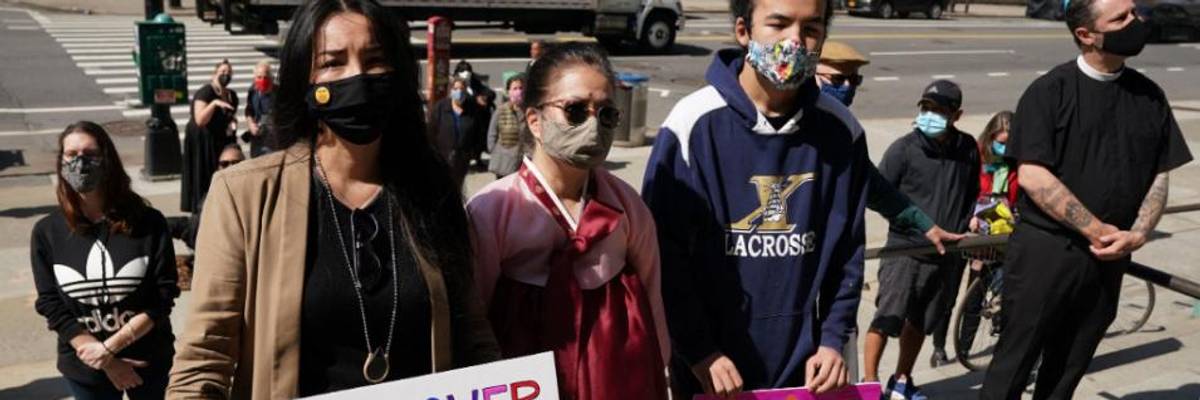
People stand on the steps of the Cathedral of St. John the Divine in New York City for a demonstration against anti-Asian violence on March 23, 2021. (Photo: Timothy A. Clary/AFP via Getty Images)
On a Quilt of Oppressions and Injustices
Last Tuesday's mass shooting targeting Asian American women working at massage parlors in Atlanta was a horrific manifestation of historically rooted and systematically sustained racism, xenophobia, anti-Asian rhetoric, hypersexualization of Asian women, and misogyny.
Last Tuesday's deadly mass shooting targeting Asian American women working at massage parlors in Atlanta, Georgia is neither a tragic happenstance, nor an isolated case of a (sexually) frustrated white man having "a really bad day"--as in the words of openly racist Cherokee County Sheriff Jay Baker. Last Tuesday's shooting is the latest and horrific demonstration of what historically rooted and systematically sustained racism, xenophobia, anti-Asian rhetoric, hypersexualization of Asian women, and misogyny look like when they have been diligently interweaved over generations and across borders to form one titanic, timeless, and gruesome patchwork quilt.
In our society, poor and low-income women of color--many of whom have been compelled to work in poorly-paid, dangerous, and often exploitative trades across the globe--are bound to face multi-layered oppressions and injustices, especially in wartime but also in peacetime.
A particularly ugly segment of that patchwork quilt can be found in none other than this country's own war in Indochina more than five decades ago. In that war, racism, sexism, and neo-colonialism coalesced into a monstrous war machine that systematically dehumanized and sexually exploited indigenous women.
While prostitution, or "sex work," was first brought to Vietnam by the French colonial conquest in the mid-19th century, it was the arrival of American ground troops in 1965 that compelled this so-called "profession" to mushroom and flourish. By 1966, hundreds of brothels--dubbed "recreation centers," "Disneylands," or "boom-boom parlors"--had been established around the newly-formed American military bases across South Vietnam.
Plunged into poverty and hunger by a merciless war machine created in the name of "democracy," droves of women and girls were forced to become prostitutes, bargirls, and "hootchmaids" whose livelihoods depended entirely on the American military presence. Their commodified bodies became the very sites of the violence perpetrated against them, both by their patrons and by the venereal diseases that plagued wherever Western colonialism touched. The failure to contain the spreading of diseases was so conspicuous that military brothels hung signs that read "Girls with Tags Are Clean. Girls without Tags Are Diseased."
As such, prostitutes and bargirls were tragically subjected to at once brutal violence stemming from war, poverty, and misogyny, and debilitating social degradation in a Confucian society that prized above all women's chastity and sexual abstinence. Many were hurt and killed by their husbands out of jealousy, their fathers out of shame, and, most of all, by patrons out of anger or mere hatred. By the war's end in 1975, over 500,000 prostitutes had been generated among South Vietnam's population of 18 million. This explosion of prostitution and other forms of sexual violence and exploitation during the American war would forever transform the dynamics of Vietnamese gender relations and diminish women's positions in an already prejudiced society.
In short, one needs not be reminded that violence against women is only the most extreme manifestation and an inevitable result of a world built around male supremacy--just as racial/colonial violence is a product of white supremacy, and poverty a revolting fruit of unhindered greed. In our patchwork society, then, poor and low-income women of color--many of whom have been compelled to work in poorly-paid, dangerous, and often exploitative trades across the globe--are bound to face multi-layered oppressions and injustices, especially in wartime but also in peacetime.
Dismantling, or at least radically changing, the problematic ways we currently view the world and our relationships with one another might just be the only way to move forward without leaving so many behind.
As many advocates and progressive lawmakers have cautioned us, the question concerning supporters of women's rights, in light of what happened last week, should not be about how to better police hate crimes, because ample evidence exists to show that over-policing has only hurt women and people of color more.
The question, instead, should be about recognizing and conscientiously tackling the structural predicaments of our current system, and to inquire among and within ourselves: How might we reposition our perspectives and discourses in order to fully hear and give space to these women's voices? What fundamental changes must we individually and collectively undertake to ensure their voices are answered, their dignity preserved, their lives safeguarded? What steps must be taken so that women and girls --especially minorities and those living in poverty and insecurity--are no longer under-heard and overlooked, no longer trying to over-perform only to remain under-appreciated?
It will take time and a concerted effort to figure all of these out. One thing remains certain: there is no disentangling the ugly patterns without destroying the entire quilt. And dismantling, or at least radically changing, the problematic ways we currently view the world and our relationships with one another might just be the only way to move forward without leaving so many behind.
Last Tuesday was many things, but it was NOT a white man's "bad day." It was, surely, another day of being a woman and an Asian person struggling to leave their marks on a blemished patchwork quilt.
We are at a crossroads
This country and this world are at a monumental crossroads. In a few short weeks, US voters will have an opportunity to beat back the forces of fascism and confront the billionaires who are rigging the economy, our media system, and our democracy, making it increasingly impossible for ordinary people to get by. We’re not just talking about the election. We’re talking about what must be done once these fascist elements are vanquished from power. We need a bolder set of solutions than what either major party has so far been willing to offer and a working-class movement ready to fight like hell for it. Trump didn't emerge from nowhere. The conditions that fueled MAGA authoritarianism were created by decades of radical neoliberal economic policies and a corrupt political system dominated by corporate interests. They slashed taxes on the super-rich, promising that the benefits would trickle down. They said giveaways to the corporate titans would make life more affordable for the rest of us. It was all bullshit. And when a bitter, betrayed populace searches for someone to blame, right-wing demagogues have little trouble finding scapegoats. People know when they're being lied to, but you won't hear any of this from the corporate media. Only independent journalism—powered and funded by people who believe in building a better world—can deliver truly trustworthy daily news. Our Fall Campaign is underway, and we need your help. To power our newsroom through the rest of the year, we need to raise $125,000 by midnight on October 31. So if you share our vision, please contribute whatever you can to sustain our work. |
Last Tuesday's deadly mass shooting targeting Asian American women working at massage parlors in Atlanta, Georgia is neither a tragic happenstance, nor an isolated case of a (sexually) frustrated white man having "a really bad day"--as in the words of openly racist Cherokee County Sheriff Jay Baker. Last Tuesday's shooting is the latest and horrific demonstration of what historically rooted and systematically sustained racism, xenophobia, anti-Asian rhetoric, hypersexualization of Asian women, and misogyny look like when they have been diligently interweaved over generations and across borders to form one titanic, timeless, and gruesome patchwork quilt.
In our society, poor and low-income women of color--many of whom have been compelled to work in poorly-paid, dangerous, and often exploitative trades across the globe--are bound to face multi-layered oppressions and injustices, especially in wartime but also in peacetime.
A particularly ugly segment of that patchwork quilt can be found in none other than this country's own war in Indochina more than five decades ago. In that war, racism, sexism, and neo-colonialism coalesced into a monstrous war machine that systematically dehumanized and sexually exploited indigenous women.
While prostitution, or "sex work," was first brought to Vietnam by the French colonial conquest in the mid-19th century, it was the arrival of American ground troops in 1965 that compelled this so-called "profession" to mushroom and flourish. By 1966, hundreds of brothels--dubbed "recreation centers," "Disneylands," or "boom-boom parlors"--had been established around the newly-formed American military bases across South Vietnam.
Plunged into poverty and hunger by a merciless war machine created in the name of "democracy," droves of women and girls were forced to become prostitutes, bargirls, and "hootchmaids" whose livelihoods depended entirely on the American military presence. Their commodified bodies became the very sites of the violence perpetrated against them, both by their patrons and by the venereal diseases that plagued wherever Western colonialism touched. The failure to contain the spreading of diseases was so conspicuous that military brothels hung signs that read "Girls with Tags Are Clean. Girls without Tags Are Diseased."
As such, prostitutes and bargirls were tragically subjected to at once brutal violence stemming from war, poverty, and misogyny, and debilitating social degradation in a Confucian society that prized above all women's chastity and sexual abstinence. Many were hurt and killed by their husbands out of jealousy, their fathers out of shame, and, most of all, by patrons out of anger or mere hatred. By the war's end in 1975, over 500,000 prostitutes had been generated among South Vietnam's population of 18 million. This explosion of prostitution and other forms of sexual violence and exploitation during the American war would forever transform the dynamics of Vietnamese gender relations and diminish women's positions in an already prejudiced society.
In short, one needs not be reminded that violence against women is only the most extreme manifestation and an inevitable result of a world built around male supremacy--just as racial/colonial violence is a product of white supremacy, and poverty a revolting fruit of unhindered greed. In our patchwork society, then, poor and low-income women of color--many of whom have been compelled to work in poorly-paid, dangerous, and often exploitative trades across the globe--are bound to face multi-layered oppressions and injustices, especially in wartime but also in peacetime.
Dismantling, or at least radically changing, the problematic ways we currently view the world and our relationships with one another might just be the only way to move forward without leaving so many behind.
As many advocates and progressive lawmakers have cautioned us, the question concerning supporters of women's rights, in light of what happened last week, should not be about how to better police hate crimes, because ample evidence exists to show that over-policing has only hurt women and people of color more.
The question, instead, should be about recognizing and conscientiously tackling the structural predicaments of our current system, and to inquire among and within ourselves: How might we reposition our perspectives and discourses in order to fully hear and give space to these women's voices? What fundamental changes must we individually and collectively undertake to ensure their voices are answered, their dignity preserved, their lives safeguarded? What steps must be taken so that women and girls --especially minorities and those living in poverty and insecurity--are no longer under-heard and overlooked, no longer trying to over-perform only to remain under-appreciated?
It will take time and a concerted effort to figure all of these out. One thing remains certain: there is no disentangling the ugly patterns without destroying the entire quilt. And dismantling, or at least radically changing, the problematic ways we currently view the world and our relationships with one another might just be the only way to move forward without leaving so many behind.
Last Tuesday was many things, but it was NOT a white man's "bad day." It was, surely, another day of being a woman and an Asian person struggling to leave their marks on a blemished patchwork quilt.
Last Tuesday's deadly mass shooting targeting Asian American women working at massage parlors in Atlanta, Georgia is neither a tragic happenstance, nor an isolated case of a (sexually) frustrated white man having "a really bad day"--as in the words of openly racist Cherokee County Sheriff Jay Baker. Last Tuesday's shooting is the latest and horrific demonstration of what historically rooted and systematically sustained racism, xenophobia, anti-Asian rhetoric, hypersexualization of Asian women, and misogyny look like when they have been diligently interweaved over generations and across borders to form one titanic, timeless, and gruesome patchwork quilt.
In our society, poor and low-income women of color--many of whom have been compelled to work in poorly-paid, dangerous, and often exploitative trades across the globe--are bound to face multi-layered oppressions and injustices, especially in wartime but also in peacetime.
A particularly ugly segment of that patchwork quilt can be found in none other than this country's own war in Indochina more than five decades ago. In that war, racism, sexism, and neo-colonialism coalesced into a monstrous war machine that systematically dehumanized and sexually exploited indigenous women.
While prostitution, or "sex work," was first brought to Vietnam by the French colonial conquest in the mid-19th century, it was the arrival of American ground troops in 1965 that compelled this so-called "profession" to mushroom and flourish. By 1966, hundreds of brothels--dubbed "recreation centers," "Disneylands," or "boom-boom parlors"--had been established around the newly-formed American military bases across South Vietnam.
Plunged into poverty and hunger by a merciless war machine created in the name of "democracy," droves of women and girls were forced to become prostitutes, bargirls, and "hootchmaids" whose livelihoods depended entirely on the American military presence. Their commodified bodies became the very sites of the violence perpetrated against them, both by their patrons and by the venereal diseases that plagued wherever Western colonialism touched. The failure to contain the spreading of diseases was so conspicuous that military brothels hung signs that read "Girls with Tags Are Clean. Girls without Tags Are Diseased."
As such, prostitutes and bargirls were tragically subjected to at once brutal violence stemming from war, poverty, and misogyny, and debilitating social degradation in a Confucian society that prized above all women's chastity and sexual abstinence. Many were hurt and killed by their husbands out of jealousy, their fathers out of shame, and, most of all, by patrons out of anger or mere hatred. By the war's end in 1975, over 500,000 prostitutes had been generated among South Vietnam's population of 18 million. This explosion of prostitution and other forms of sexual violence and exploitation during the American war would forever transform the dynamics of Vietnamese gender relations and diminish women's positions in an already prejudiced society.
In short, one needs not be reminded that violence against women is only the most extreme manifestation and an inevitable result of a world built around male supremacy--just as racial/colonial violence is a product of white supremacy, and poverty a revolting fruit of unhindered greed. In our patchwork society, then, poor and low-income women of color--many of whom have been compelled to work in poorly-paid, dangerous, and often exploitative trades across the globe--are bound to face multi-layered oppressions and injustices, especially in wartime but also in peacetime.
Dismantling, or at least radically changing, the problematic ways we currently view the world and our relationships with one another might just be the only way to move forward without leaving so many behind.
As many advocates and progressive lawmakers have cautioned us, the question concerning supporters of women's rights, in light of what happened last week, should not be about how to better police hate crimes, because ample evidence exists to show that over-policing has only hurt women and people of color more.
The question, instead, should be about recognizing and conscientiously tackling the structural predicaments of our current system, and to inquire among and within ourselves: How might we reposition our perspectives and discourses in order to fully hear and give space to these women's voices? What fundamental changes must we individually and collectively undertake to ensure their voices are answered, their dignity preserved, their lives safeguarded? What steps must be taken so that women and girls --especially minorities and those living in poverty and insecurity--are no longer under-heard and overlooked, no longer trying to over-perform only to remain under-appreciated?
It will take time and a concerted effort to figure all of these out. One thing remains certain: there is no disentangling the ugly patterns without destroying the entire quilt. And dismantling, or at least radically changing, the problematic ways we currently view the world and our relationships with one another might just be the only way to move forward without leaving so many behind.
Last Tuesday was many things, but it was NOT a white man's "bad day." It was, surely, another day of being a woman and an Asian person struggling to leave their marks on a blemished patchwork quilt.