SUBSCRIBE TO OUR FREE NEWSLETTER
Daily news & progressive opinion—funded by the people, not the corporations—delivered straight to your inbox.
5
#000000
#FFFFFF
To donate by check, phone, or other method, see our More Ways to Give page.
Daily news & progressive opinion—funded by the people, not the corporations—delivered straight to your inbox.
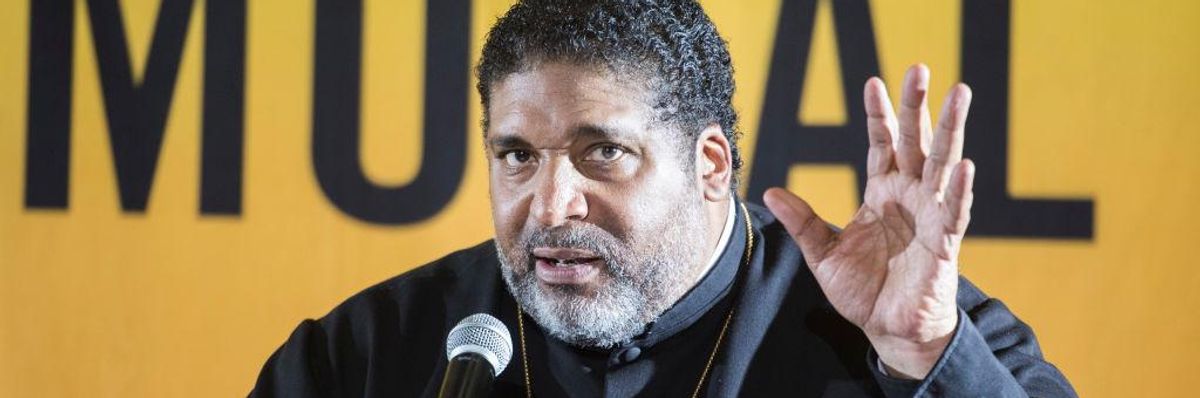
Rev. Dr. William J. Barber II is seen during the Poor Peoples Moral Action Congress forum for presidential candidates at Trinity Washington University on Monday, June 17, 2019. (Photo By Tom Williams/CQ Roll Call)
At the end of a year we will never forget, it is time to take a hard look at the budget priorities we will fund with the taxes we pay on April 15. The Pandemic is acting like a searchlight, shining a light on matters of life and death that we must address with our federal budgets. It has shown us that our past budget priorities were completely out of whack with our real needs. While we spent trillions chasing demons abroad and "bad hombres" at our borders, a tiny virus was able to bring us to our knees in a way no "enemy" ever could. Our missiles could not shoot it down. Our billion-dollar battleships could not sink it. Our most sophisticated jets could not bomb it away.
The pandemic's searchlight certainly helps us see some things about ourselves of which we can be proud: the courage of our health care workers--from the most skilled doctors and nurses to those who swept the hospital floors--who go to battle against the virus every day, many losing their lives to keep us safe. The generosity of many of our compatriots who rose to the occasion to feed the growing armies of the hungry jobless. The nobility of so many frontline workers--many of them undocumented immigrants--who stocked our grocery shelves, and drove the ambulances, and harvested or delivered our food so the rest of us could shelter in place and work at home.
But that searchlight also brings the light of day to some realities about our country that we must face if we are to be a fair society that will be able to avoid future disasters, whether new pandemics, or climate catastrophe or the growing danger of nuclear war.
The recently passed American Rescue Plan will send critical relief to millions of struggling workers and families and small businesses, to schools, to state and local government social services, and to those facing homelessness and hunger. But now the work begins for the long haul as Congress starts to craft its annual budgets paid for by those taxes due on the 15th.
To be adequate to the task, our federal budget must center the voices, experiences and needs of everyone.
This is a time to develop support for budget priorities built on those lessons we have learned over the past year.
Clearly, we must fund and build a competent and coordinated public health system that is ready and able to confront new health threats effectively. We must never again run around like chickens with our heads cut off trying to figure out which end is up and where we can find masks, PPE and ventilators, how to set up testing, what protective measures were needed, and how to schedule vaccinations. It is absurd that what we spend on protecting ourselves from infectious diseases is less than 3/10 of one percent of what we spend on war and preparation for war.
Beyond investments in public health, The Poor Peoples Campaign's "Moral Budget" advocated by a large and growing multi-racial movement throughout the country provides us with a guide to new budget priorities based on reality and our common humanity:
But where could all that money come from to pay for these life-enhancing programs? The Poor Peoples Budget has a simple answer:
Clearly here in the Pentagon budget is a source of money that can be much better used to defend our country from the very real threats--and to seize the wonderful opportunities for a safe and just society--that are on the horizon.
So this upcoming period, as the Congress begins a long and complex debate on the budget, offers us the opportunity and the responsibility to advocate for just and sane priorities in whatever forums are available: tax day rallies, meetings with our congressional representatives, webinars, articles and letters to the editor, calls to elected officials, nonviolent civil disobedience, joining or donating to advocacy organizations that reflect our values, collaboration among groups working on different issues. As complex as the budget process is, these upcoming months will be a period when much will be determined about our future. We must not allow a repeat of this past year and all the grief and hardship and mental crisis it has brought to so many. More people than ever are aware of what needs to be done. So, with a new spring and a new baseball season beckoning us, it's time to grab a glove and get in the game.
Dear Common Dreams reader, It’s been nearly 30 years since I co-founded Common Dreams with my late wife, Lina Newhouser. We had the radical notion that journalism should serve the public good, not corporate profits. It was clear to us from the outset what it would take to build such a project. No paid advertisements. No corporate sponsors. No millionaire publisher telling us what to think or do. Many people said we wouldn't last a year, but we proved those doubters wrong. Together with a tremendous team of journalists and dedicated staff, we built an independent media outlet free from the constraints of profits and corporate control. Our mission has always been simple: To inform. To inspire. To ignite change for the common good. Building Common Dreams was not easy. Our survival was never guaranteed. When you take on the most powerful forces—Wall Street greed, fossil fuel industry destruction, Big Tech lobbyists, and uber-rich oligarchs who have spent billions upon billions rigging the economy and democracy in their favor—the only bulwark you have is supporters who believe in your work. But here’s the urgent message from me today. It's never been this bad out there. And it's never been this hard to keep us going. At the very moment Common Dreams is most needed, the threats we face are intensifying. We need your support now more than ever. We don't accept corporate advertising and never will. We don't have a paywall because we don't think people should be blocked from critical news based on their ability to pay. Everything we do is funded by the donations of readers like you. When everyone does the little they can afford, we are strong. But if that support retreats or dries up, so do we. Will you donate now to make sure Common Dreams not only survives but thrives? —Craig Brown, Co-founder |
At the end of a year we will never forget, it is time to take a hard look at the budget priorities we will fund with the taxes we pay on April 15. The Pandemic is acting like a searchlight, shining a light on matters of life and death that we must address with our federal budgets. It has shown us that our past budget priorities were completely out of whack with our real needs. While we spent trillions chasing demons abroad and "bad hombres" at our borders, a tiny virus was able to bring us to our knees in a way no "enemy" ever could. Our missiles could not shoot it down. Our billion-dollar battleships could not sink it. Our most sophisticated jets could not bomb it away.
The pandemic's searchlight certainly helps us see some things about ourselves of which we can be proud: the courage of our health care workers--from the most skilled doctors and nurses to those who swept the hospital floors--who go to battle against the virus every day, many losing their lives to keep us safe. The generosity of many of our compatriots who rose to the occasion to feed the growing armies of the hungry jobless. The nobility of so many frontline workers--many of them undocumented immigrants--who stocked our grocery shelves, and drove the ambulances, and harvested or delivered our food so the rest of us could shelter in place and work at home.
But that searchlight also brings the light of day to some realities about our country that we must face if we are to be a fair society that will be able to avoid future disasters, whether new pandemics, or climate catastrophe or the growing danger of nuclear war.
The recently passed American Rescue Plan will send critical relief to millions of struggling workers and families and small businesses, to schools, to state and local government social services, and to those facing homelessness and hunger. But now the work begins for the long haul as Congress starts to craft its annual budgets paid for by those taxes due on the 15th.
To be adequate to the task, our federal budget must center the voices, experiences and needs of everyone.
This is a time to develop support for budget priorities built on those lessons we have learned over the past year.
Clearly, we must fund and build a competent and coordinated public health system that is ready and able to confront new health threats effectively. We must never again run around like chickens with our heads cut off trying to figure out which end is up and where we can find masks, PPE and ventilators, how to set up testing, what protective measures were needed, and how to schedule vaccinations. It is absurd that what we spend on protecting ourselves from infectious diseases is less than 3/10 of one percent of what we spend on war and preparation for war.
Beyond investments in public health, The Poor Peoples Campaign's "Moral Budget" advocated by a large and growing multi-racial movement throughout the country provides us with a guide to new budget priorities based on reality and our common humanity:
But where could all that money come from to pay for these life-enhancing programs? The Poor Peoples Budget has a simple answer:
Clearly here in the Pentagon budget is a source of money that can be much better used to defend our country from the very real threats--and to seize the wonderful opportunities for a safe and just society--that are on the horizon.
So this upcoming period, as the Congress begins a long and complex debate on the budget, offers us the opportunity and the responsibility to advocate for just and sane priorities in whatever forums are available: tax day rallies, meetings with our congressional representatives, webinars, articles and letters to the editor, calls to elected officials, nonviolent civil disobedience, joining or donating to advocacy organizations that reflect our values, collaboration among groups working on different issues. As complex as the budget process is, these upcoming months will be a period when much will be determined about our future. We must not allow a repeat of this past year and all the grief and hardship and mental crisis it has brought to so many. More people than ever are aware of what needs to be done. So, with a new spring and a new baseball season beckoning us, it's time to grab a glove and get in the game.
At the end of a year we will never forget, it is time to take a hard look at the budget priorities we will fund with the taxes we pay on April 15. The Pandemic is acting like a searchlight, shining a light on matters of life and death that we must address with our federal budgets. It has shown us that our past budget priorities were completely out of whack with our real needs. While we spent trillions chasing demons abroad and "bad hombres" at our borders, a tiny virus was able to bring us to our knees in a way no "enemy" ever could. Our missiles could not shoot it down. Our billion-dollar battleships could not sink it. Our most sophisticated jets could not bomb it away.
The pandemic's searchlight certainly helps us see some things about ourselves of which we can be proud: the courage of our health care workers--from the most skilled doctors and nurses to those who swept the hospital floors--who go to battle against the virus every day, many losing their lives to keep us safe. The generosity of many of our compatriots who rose to the occasion to feed the growing armies of the hungry jobless. The nobility of so many frontline workers--many of them undocumented immigrants--who stocked our grocery shelves, and drove the ambulances, and harvested or delivered our food so the rest of us could shelter in place and work at home.
But that searchlight also brings the light of day to some realities about our country that we must face if we are to be a fair society that will be able to avoid future disasters, whether new pandemics, or climate catastrophe or the growing danger of nuclear war.
The recently passed American Rescue Plan will send critical relief to millions of struggling workers and families and small businesses, to schools, to state and local government social services, and to those facing homelessness and hunger. But now the work begins for the long haul as Congress starts to craft its annual budgets paid for by those taxes due on the 15th.
To be adequate to the task, our federal budget must center the voices, experiences and needs of everyone.
This is a time to develop support for budget priorities built on those lessons we have learned over the past year.
Clearly, we must fund and build a competent and coordinated public health system that is ready and able to confront new health threats effectively. We must never again run around like chickens with our heads cut off trying to figure out which end is up and where we can find masks, PPE and ventilators, how to set up testing, what protective measures were needed, and how to schedule vaccinations. It is absurd that what we spend on protecting ourselves from infectious diseases is less than 3/10 of one percent of what we spend on war and preparation for war.
Beyond investments in public health, The Poor Peoples Campaign's "Moral Budget" advocated by a large and growing multi-racial movement throughout the country provides us with a guide to new budget priorities based on reality and our common humanity:
But where could all that money come from to pay for these life-enhancing programs? The Poor Peoples Budget has a simple answer:
Clearly here in the Pentagon budget is a source of money that can be much better used to defend our country from the very real threats--and to seize the wonderful opportunities for a safe and just society--that are on the horizon.
So this upcoming period, as the Congress begins a long and complex debate on the budget, offers us the opportunity and the responsibility to advocate for just and sane priorities in whatever forums are available: tax day rallies, meetings with our congressional representatives, webinars, articles and letters to the editor, calls to elected officials, nonviolent civil disobedience, joining or donating to advocacy organizations that reflect our values, collaboration among groups working on different issues. As complex as the budget process is, these upcoming months will be a period when much will be determined about our future. We must not allow a repeat of this past year and all the grief and hardship and mental crisis it has brought to so many. More people than ever are aware of what needs to be done. So, with a new spring and a new baseball season beckoning us, it's time to grab a glove and get in the game.