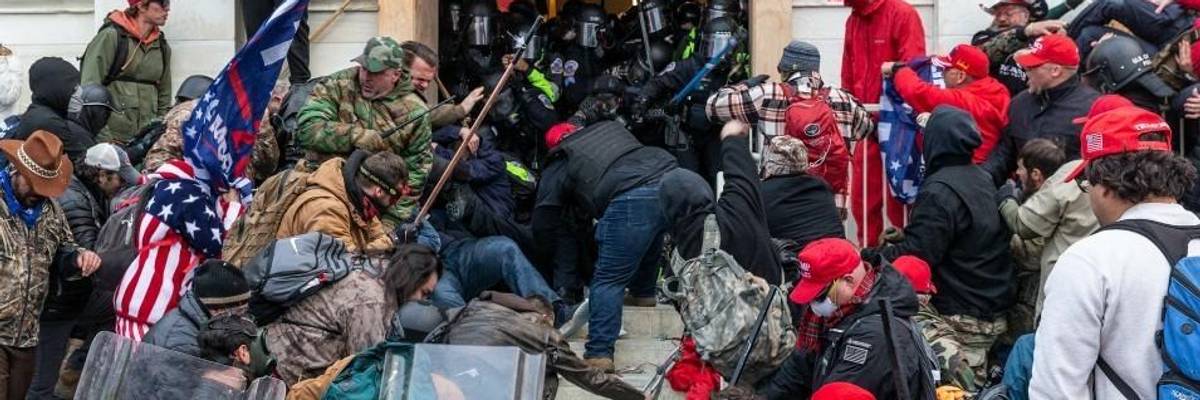
Trump's insurrectionists attack police while trying to storm the Capitol building on January 6, 2021. The rioters broke windows and used metal bars, flag poles and bear spray as well against the police. (Photo: Lev Radin/Pacific Press/LightRocket via Getty Images)
We Must Expose the Insurrection Financiers
The January 6 assault on our democracy should lead to greater accountability for future political leaders—and their wealthy financial backers.
Throughout his scorching indictment of President Trump, lead impeachment manager Jamie Raskin wove in quotes from eminent historic minds, including this one from his late father, Institute for Policy Studies Co-founder Marcus Raskin:
" Democracy needs a ground to stand on and that ground is the truth."
Raskin's trial team exposed a great deal of truth as they methodically made the case that Trump was "singularly responsible" for inciting the riot at the Capitol. At the same time, they laid out ample evidence that the assault was entirely predictable based on the former president's track record of publicly egging on violent supporters.
If plans for the insurrection were no great secret, then the wealthy enablers who financed the "Stop the Steal" convergence should also bear some responsibility.
As Raskin pointed out in Day 3 of the trial, Trump had "road tested" his tactics for inflaming mobs at his campaign rallies and through Twitter. Social media traffic leading up to January 6 made clear that dangerous extremist groups were planning a violent attack in the nation's capital.
In her widely viewed Instagram video, Rep. Alexandria Ocasio Cortez also recounted that the threat of violence seemed to be widely known, as she started receiving warnings from other members of Congress, including Republicans, a week before the actual attack.
If plans for the insurrection were no great secret, then the wealthy enablers who financed the "Stop the Steal" convergence should also bear some responsibility.
The impeachment trial shed no new light on who these financiers might be. And as journalist Casey Michel explained in NBCNews.com, they may forever remain anonymous:
"Thanks to a lattice of financial secrecy vehicles--all of which are perfectly legal--we may never have a complete financial picture of those who provided the money to organize a rally that descended into chaos and that shook the underpinnings of American democracy."
We do know, thanks to OpenSecrets, that the Trump 2020 campaign and its joint fundraising committees made more than $3.5 million in direct payments to people and firms involved in the demonstration. But as the transparency group pointed out, "the campaign used an opaque payment scheme that concealed details of hundreds of millions of dollars in spending by routing payments through shell companies where the ultimate payee is hidden."
In December 2020, Congress passed a landmark bipartisan bill, the Corporate Transparency Act, which will take a meaningful step toward eliminating such anonymous shell corporations.
Chuck Collins, director of the Program on Inequality and the Common Good at the Institute for Policy Studies, heralded that passage as a victory for transparency activists who have "spent years documenting the ways that rogue nations, terrorists, dictators, and kleptocrats have deployed anonymous companies to launder illicit funds, dodge taxes, avoid sanctions, and game the U.S. financial system." Collins might've added finance insurrection to that list.
Because the Corporate Transparency Act won't take effect for two years, Rep. Carolyn Maloney (D-NY) has introduced the Insurrection Financing Transparency Act, which would give U.S. authorities immediate access to the identities of those who financed the Capitol assault.
Another proposed bill, the For the People Act, would also curb dangerous financial secrecy by requiring super PACs and other "dark money" political campaign organizations to disclose their donors.
The events of January 6 have also prompted pro-democracy advocates to step up their demands on corporations to end their political spending. More than 50 organizations, investment firms, and religious organizations called on large U.S. corporations to take a number of steps to signal their support for democracy. These included ending all super PAC and dark money contributions and pledging to never again provide financial backing for the 147 members of Congress who refused to certify the presidential election.
The groups pointed out that these members have received more than $170 million from corporate and trade group PACs and nearly $2 million from Big Tech companies. In the wake of the insurrection, a number of corporate PACs have pulled back their corporate donations to these officials.
The full impact of the January 6 insurrection and the impeachment trial on our democracy will not be known for many years, if not centuries. We can only hope that this national trauma will lead to greater accountability for future political leaders--and their wealthy financial enablers.
We are at a crossroads
This country and this world are at a monumental crossroads. In a few short weeks, US voters will have an opportunity to beat back the forces of fascism and confront the billionaires who are rigging the economy, our media system, and our democracy, making it increasingly impossible for ordinary people to get by. We’re not just talking about the election. We’re talking about what must be done once these fascist elements are vanquished from power. We need a bolder set of solutions than what either major party has so far been willing to offer and a working-class movement ready to fight like hell for it. Trump didn't emerge from nowhere. The conditions that fueled MAGA authoritarianism were created by decades of radical neoliberal economic policies and a corrupt political system dominated by corporate interests. They slashed taxes on the super-rich, promising that the benefits would trickle down. They said giveaways to the corporate titans would make life more affordable for the rest of us. It was all bullshit. And when a bitter, betrayed populace searches for someone to blame, right-wing demagogues have little trouble finding scapegoats. People know when they're being lied to, but you won't hear any of this from the corporate media. Only independent journalism—powered and funded by people who believe in building a better world—can deliver truly trustworthy daily news. Our Fall Campaign is underway, and we need your help. To power our newsroom through the rest of the year, we need to raise $125,000 by midnight on October 31. So if you share our vision, please contribute whatever you can to sustain our work. |
Throughout his scorching indictment of President Trump, lead impeachment manager Jamie Raskin wove in quotes from eminent historic minds, including this one from his late father, Institute for Policy Studies Co-founder Marcus Raskin:
" Democracy needs a ground to stand on and that ground is the truth."
Raskin's trial team exposed a great deal of truth as they methodically made the case that Trump was "singularly responsible" for inciting the riot at the Capitol. At the same time, they laid out ample evidence that the assault was entirely predictable based on the former president's track record of publicly egging on violent supporters.
If plans for the insurrection were no great secret, then the wealthy enablers who financed the "Stop the Steal" convergence should also bear some responsibility.
As Raskin pointed out in Day 3 of the trial, Trump had "road tested" his tactics for inflaming mobs at his campaign rallies and through Twitter. Social media traffic leading up to January 6 made clear that dangerous extremist groups were planning a violent attack in the nation's capital.
In her widely viewed Instagram video, Rep. Alexandria Ocasio Cortez also recounted that the threat of violence seemed to be widely known, as she started receiving warnings from other members of Congress, including Republicans, a week before the actual attack.
If plans for the insurrection were no great secret, then the wealthy enablers who financed the "Stop the Steal" convergence should also bear some responsibility.
The impeachment trial shed no new light on who these financiers might be. And as journalist Casey Michel explained in NBCNews.com, they may forever remain anonymous:
"Thanks to a lattice of financial secrecy vehicles--all of which are perfectly legal--we may never have a complete financial picture of those who provided the money to organize a rally that descended into chaos and that shook the underpinnings of American democracy."
We do know, thanks to OpenSecrets, that the Trump 2020 campaign and its joint fundraising committees made more than $3.5 million in direct payments to people and firms involved in the demonstration. But as the transparency group pointed out, "the campaign used an opaque payment scheme that concealed details of hundreds of millions of dollars in spending by routing payments through shell companies where the ultimate payee is hidden."
In December 2020, Congress passed a landmark bipartisan bill, the Corporate Transparency Act, which will take a meaningful step toward eliminating such anonymous shell corporations.
Chuck Collins, director of the Program on Inequality and the Common Good at the Institute for Policy Studies, heralded that passage as a victory for transparency activists who have "spent years documenting the ways that rogue nations, terrorists, dictators, and kleptocrats have deployed anonymous companies to launder illicit funds, dodge taxes, avoid sanctions, and game the U.S. financial system." Collins might've added finance insurrection to that list.
Because the Corporate Transparency Act won't take effect for two years, Rep. Carolyn Maloney (D-NY) has introduced the Insurrection Financing Transparency Act, which would give U.S. authorities immediate access to the identities of those who financed the Capitol assault.
Another proposed bill, the For the People Act, would also curb dangerous financial secrecy by requiring super PACs and other "dark money" political campaign organizations to disclose their donors.
The events of January 6 have also prompted pro-democracy advocates to step up their demands on corporations to end their political spending. More than 50 organizations, investment firms, and religious organizations called on large U.S. corporations to take a number of steps to signal their support for democracy. These included ending all super PAC and dark money contributions and pledging to never again provide financial backing for the 147 members of Congress who refused to certify the presidential election.
The groups pointed out that these members have received more than $170 million from corporate and trade group PACs and nearly $2 million from Big Tech companies. In the wake of the insurrection, a number of corporate PACs have pulled back their corporate donations to these officials.
The full impact of the January 6 insurrection and the impeachment trial on our democracy will not be known for many years, if not centuries. We can only hope that this national trauma will lead to greater accountability for future political leaders--and their wealthy financial enablers.