

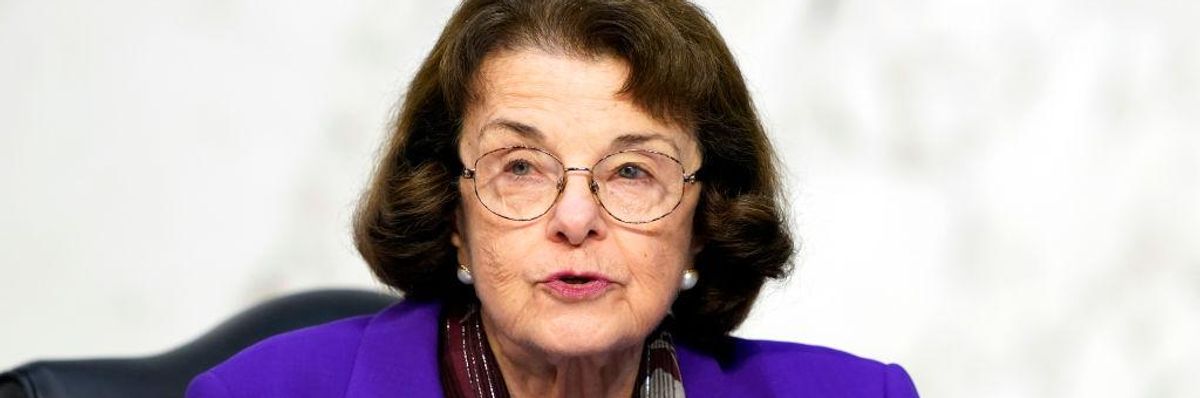
Sen. Dianne Feinstein, D-Calif., speaks as the Senate Judiciary Committee hears from legal experts on the final day of the confirmation hearing for Supreme Court nominee Amy Coney Barrett, on October 15, 2020 in Washington, DC. (Photo by Susan Walsh-Pool/Getty Images)
Dianne Feinstein Was Harder on Preteen Climate Activists Than She Was on Amy Coney Barrett
The contrast makes it clear that Feinstein prioritizes an outdated model of bipartisanship over engaging a passionate, young, left-leaning voter base.
When Senate Majority Leader Mitch McConnell (R-Ky.) eroded political norms by refusing to hold a vote on Merrick Garland's nomination to the Supreme Court in March of 2016, he set a precedent. The precedent was not, "A Supreme Court justice shouldn't be appointed in the last year of a president's term." The precedent was, "Republicans can do whatever they want."
That fact was made obvious by the GOP's rush to fill the seat left empty by Justice Ruth Bader Ginsburg's death a mere 46 days before the 2020 election. The hypocrisy was clear, but that hardly mattered. Republicans control the Senate now, just as they did when President Obama nominated Garland. Few of them are likely to defect. Judge Amy Coney Barrett, President Trump's nominee to replace Ginsburg, will almost certainly be confirmed.
But did Democrats -- and Sen. Dianne Feinstein in particular -- really need to give in so easily?
Feinstein, California's senior senator and the highest-ranking Democrat on the Judiciary Committee, questioned Barrett on abortion access, the Affordable Care Act and gun control during this week's Senate hearings. But her questions weren't particularly tough, and she didn't say anything that invoked the single biggest issue with Barrett's nomination: that it's a blatant Republican power grab threatening to hopelessly politicize and destabilize the Supreme Court, and it shouldn't be happening in the first place.
There's bipartisanship, and then there's bringing a pillow to a gun fight. The Republican Party has gotten very good at playing constitutional hardball. If Democrats can't or won't match that energy, there won't be a prize for maintaining the moral high ground. There will just be a lot of predictable political impotence.
Adding insult to injury for progressives is the fact that Feinstein can be ferocious with political opponents. She just saves it for the real threats to our democracy -- like, say, 11-year-old climate activists.
A video of Feinstein speaking dismissively to a group of tweenaged Sunrise Movement activists who asked her to support the Green New Deal went viral in February 2019, and it resurfaced this week as many liberals heavily criticized the senator. The contrast between the Feinstein of the Barrett hearings and the Feinstein of the Sunrise Movement encounter is jarring.
Of course Feinstein's (very, very, very) long political career can't be adequately summed up by a handful of quotes from two events. But for young progressives, it's deeply disappointing for one of the most senior Democrats in Congress to treat the Republicans rushing Barrett's confirmation with kid gloves -- after treating young Californians concerned about climate change with open contempt.
The contrast makes it clear that Feinstein prioritizes an outdated model of bipartisanship over engaging a passionate, young, left-leaning voter base. Reaching across the aisle might once have been a noble impulse. But when the Republican Party has more or less unanimously sworn fealty to a demagogic Republican president and the entire West Coast has caught fire, it's past time for long-serving senators like Feinstein to either adjust their sense of what's important or step aside.
We are at a crossroads
This country and this world are at a monumental crossroads. In a few short weeks, US voters will have an opportunity to beat back the forces of fascism and confront the billionaires who are rigging the economy, our media system, and our democracy, making it increasingly impossible for ordinary people to get by. We’re not just talking about the election. We’re talking about what must be done once these fascist elements are vanquished from power. We need a bolder set of solutions than what either major party has so far been willing to offer and a working-class movement ready to fight like hell for it. Trump didn't emerge from nowhere. The conditions that fueled MAGA authoritarianism were created by decades of radical neoliberal economic policies and a corrupt political system dominated by corporate interests. They slashed taxes on the super-rich, promising that the benefits would trickle down. They said giveaways to the corporate titans would make life more affordable for the rest of us. It was all bullshit. And when a bitter, betrayed populace searches for someone to blame, right-wing demagogues have little trouble finding scapegoats. People know when they're being lied to, but you won't hear any of this from the corporate media. Only independent journalism—powered and funded by people who believe in building a better world—can deliver truly trustworthy daily news. Our Fall Campaign is underway, and we need your help. To power our newsroom through the rest of the year, we need to raise $125,000 by midnight on October 31. So if you share our vision, please contribute whatever you can to sustain our work. |
When Senate Majority Leader Mitch McConnell (R-Ky.) eroded political norms by refusing to hold a vote on Merrick Garland's nomination to the Supreme Court in March of 2016, he set a precedent. The precedent was not, "A Supreme Court justice shouldn't be appointed in the last year of a president's term." The precedent was, "Republicans can do whatever they want."
That fact was made obvious by the GOP's rush to fill the seat left empty by Justice Ruth Bader Ginsburg's death a mere 46 days before the 2020 election. The hypocrisy was clear, but that hardly mattered. Republicans control the Senate now, just as they did when President Obama nominated Garland. Few of them are likely to defect. Judge Amy Coney Barrett, President Trump's nominee to replace Ginsburg, will almost certainly be confirmed.
But did Democrats -- and Sen. Dianne Feinstein in particular -- really need to give in so easily?
Feinstein, California's senior senator and the highest-ranking Democrat on the Judiciary Committee, questioned Barrett on abortion access, the Affordable Care Act and gun control during this week's Senate hearings. But her questions weren't particularly tough, and she didn't say anything that invoked the single biggest issue with Barrett's nomination: that it's a blatant Republican power grab threatening to hopelessly politicize and destabilize the Supreme Court, and it shouldn't be happening in the first place.
There's bipartisanship, and then there's bringing a pillow to a gun fight. The Republican Party has gotten very good at playing constitutional hardball. If Democrats can't or won't match that energy, there won't be a prize for maintaining the moral high ground. There will just be a lot of predictable political impotence.
Adding insult to injury for progressives is the fact that Feinstein can be ferocious with political opponents. She just saves it for the real threats to our democracy -- like, say, 11-year-old climate activists.
A video of Feinstein speaking dismissively to a group of tweenaged Sunrise Movement activists who asked her to support the Green New Deal went viral in February 2019, and it resurfaced this week as many liberals heavily criticized the senator. The contrast between the Feinstein of the Barrett hearings and the Feinstein of the Sunrise Movement encounter is jarring.
Of course Feinstein's (very, very, very) long political career can't be adequately summed up by a handful of quotes from two events. But for young progressives, it's deeply disappointing for one of the most senior Democrats in Congress to treat the Republicans rushing Barrett's confirmation with kid gloves -- after treating young Californians concerned about climate change with open contempt.
The contrast makes it clear that Feinstein prioritizes an outdated model of bipartisanship over engaging a passionate, young, left-leaning voter base. Reaching across the aisle might once have been a noble impulse. But when the Republican Party has more or less unanimously sworn fealty to a demagogic Republican president and the entire West Coast has caught fire, it's past time for long-serving senators like Feinstein to either adjust their sense of what's important or step aside.