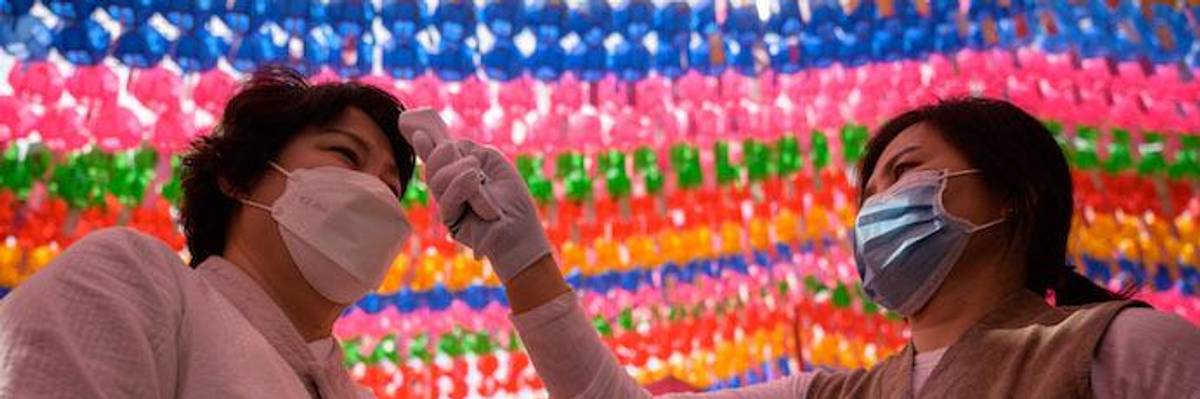
Worshippers wearing face masks have their temperature taken as they attend a prayer ceremony entitled 'overcoming and healing the COVID-19 coronavirus', while marking Buhha's birthday at the Jogye buddhist temple in Seoul on April 30, 2020. (Photo: Ed Jones/AFP via Getty Images)
What Asian Nations Know About Squashing Covid
We can save ourselves and our economy, if we look to and learn from the achievements of other nations.
May 03, 2020
The number of Americans who have died from Covid-19 now significantly exceeds the total US troop fatalities during the Vietnam War.
While the coronavirus continues to ravage the country, with confirmed cases exceeding 1 million and deaths rising by the day, some states are lifting stay at home orders in hopes of salvaging the economy. With so many lives at stake, it's time the United States looked to those countries in the Asia Pacific region that have successfully controlled the pandemic to figure out how to save ourselves and the economy.
Several places in the Asia-Pacific, including Australia, China, New Zealand, South Korea, Taiwan and Vietnam, have reported suppressing the reproduction number -- the average number of people who will catch the disease from a single infected person -- to below 1, without the need for continued, widespread lockdowns.
They are now rapidly and successfully suppressing outbreaks of the disease by isolating those who are infected and their contacts who are likely to be infected.
It's as if there are two worlds.
The United States has had more than 66,000 deaths, or about 20 deaths per 100,000 people. The number of deaths per 100,000 people reported in Western European countries is also very high: Belgium, 67; France, 37; Italy, 47; Germany, 8; Spain, 53; and Sweden, 26.
Meanwhile, the reported rates in Asia and Oceania are considerably lower: Australia, 0.4; China, 0.3; New Zealand, 0.4; South Korea, 0.5; Taiwan, 0.03.
Despite the stark disparities, America seems blind to the strategies other countries have used to control the virus. How is it that one part of the world is succeeding, while the other part refuses to learn the lessons of success?
On Tuesday, the The Wall Street Journal extolled the virtues of Germany's efforts in comparison with the United States, France, Italy, and Spain, without even a mention that Germany's mortality rate per million is itself more than 100 times higher than Taiwan and Hong Kong, and more than 10 times higher than in Australia, Japan, New Zealand and South Korea.
How have these countries succeeded to date?
Many have adopted nationwide public-health standards, using mobile technologies, professionalism of government, widespread use of face masks and hand sanitizers, and intensive public health services to isolate infected individuals or those likely to be infected.
Testing has played an important role, but has not been the be-all-and-end-all as is sometimes believed in the United States.
Vietnam has succeeded, for example, with contact tracing and an aggressive quarantine regime. When one person is confirmed positive, many of his or her close contacts -- even those without symptoms -- are isolated. As a result, Vietnam tested only a moderate number of people as a share of the population because it managed to contain outbreaks so effectively. Vietnam, with about 95 million people, has not reported a single Covid-19 death so far.
In New Zealand, the government is starting to ease lockdown restrictions as officials say they are now in a position to test and trace any new clusters of infection.
Here are the careful and precise words of New Zealand Prime Minister Jacinda Ardern. "There is no widespread undetected community transmission in New Zealand. We have won that battle. But we must remain vigilant if we are to keep it that way."
There are similar success stories across much of the region.
South Korea, which has dramatically broken the epidemic with aggressive testing, contact tracing and basic public health measures such as thermal monitoring, has also employed digital technology in the fight against Covid-19, according to a new report. South Korea uses a text alert system to keep the public informed, while various apps allow people to track new Covid-19 cases, make doctor's appointments or monitor hotspots to avoid.
The government also uses apps to monitor people in quarantine, through self-reported symptoms and location tracking. Despite the fact that these apps may raise privacy issues in the United States, the upshot is an economy that is open, albeit cautiously so, together with a suppression of new infections.
The US government has been utterly incapable of learning from these cases of success.
President Donald Trump is incompetent and his appointees at Health and Human Services, the US Centers for Disease Control and Prevention, and Transport Security Administration have failed to provide leadership. America First has put us first in deaths in the world, with tens of thousands of lives squandered as a result.
We can save ourselves and our economy, if we look to and learn from the achievements of other nations. And if the federal government continues to fail, as seems likely, our governors and mayors must step forward to do the job.
An Urgent Message From Our Co-Founder
Dear Common Dreams reader, It’s been nearly 30 years since I co-founded Common Dreams with my late wife, Lina Newhouser. We had the radical notion that journalism should serve the public good, not corporate profits. It was clear to us from the outset what it would take to build such a project. No paid advertisements. No corporate sponsors. No millionaire publisher telling us what to think or do. Many people said we wouldn't last a year, but we proved those doubters wrong. Together with a tremendous team of journalists and dedicated staff, we built an independent media outlet free from the constraints of profits and corporate control. Our mission has always been simple: To inform. To inspire. To ignite change for the common good. Building Common Dreams was not easy. Our survival was never guaranteed. When you take on the most powerful forces—Wall Street greed, fossil fuel industry destruction, Big Tech lobbyists, and uber-rich oligarchs who have spent billions upon billions rigging the economy and democracy in their favor—the only bulwark you have is supporters who believe in your work. But here’s the urgent message from me today. It's never been this bad out there. And it's never been this hard to keep us going. At the very moment Common Dreams is most needed, the threats we face are intensifying. We need your support now more than ever. We don't accept corporate advertising and never will. We don't have a paywall because we don't think people should be blocked from critical news based on their ability to pay. Everything we do is funded by the donations of readers like you. When everyone does the little they can afford, we are strong. But if that support retreats or dries up, so do we. Will you donate now to make sure Common Dreams not only survives but thrives? —Craig Brown, Co-founder |
© 2023 Cable News Network
Jeffrey D. Sachs
Jeffrey D. Sachs is a University Professor and Director of the Center for Sustainable Development at Columbia University, where he directed The Earth Institute from 2002 until 2016. He is also President of the UN Sustainable Development Solutions Network and a commissioner of the UN Broadband Commission for Development. He has been advisor to three United Nations Secretaries-General, and currently serves as an SDG Advocate under Secretary-General Antonio Guterres. Sachs is the author, most recently, of "A New Foreign Policy: Beyond American Exceptionalism" (2020). Other books include: "Building the New American Economy: Smart, Fair, and Sustainable" (2017) and "The Age of Sustainable Development," (2015) with Ban Ki-moon.
The number of Americans who have died from Covid-19 now significantly exceeds the total US troop fatalities during the Vietnam War.
While the coronavirus continues to ravage the country, with confirmed cases exceeding 1 million and deaths rising by the day, some states are lifting stay at home orders in hopes of salvaging the economy. With so many lives at stake, it's time the United States looked to those countries in the Asia Pacific region that have successfully controlled the pandemic to figure out how to save ourselves and the economy.
Several places in the Asia-Pacific, including Australia, China, New Zealand, South Korea, Taiwan and Vietnam, have reported suppressing the reproduction number -- the average number of people who will catch the disease from a single infected person -- to below 1, without the need for continued, widespread lockdowns.
They are now rapidly and successfully suppressing outbreaks of the disease by isolating those who are infected and their contacts who are likely to be infected.
It's as if there are two worlds.
The United States has had more than 66,000 deaths, or about 20 deaths per 100,000 people. The number of deaths per 100,000 people reported in Western European countries is also very high: Belgium, 67; France, 37; Italy, 47; Germany, 8; Spain, 53; and Sweden, 26.
Meanwhile, the reported rates in Asia and Oceania are considerably lower: Australia, 0.4; China, 0.3; New Zealand, 0.4; South Korea, 0.5; Taiwan, 0.03.
Despite the stark disparities, America seems blind to the strategies other countries have used to control the virus. How is it that one part of the world is succeeding, while the other part refuses to learn the lessons of success?
On Tuesday, the The Wall Street Journal extolled the virtues of Germany's efforts in comparison with the United States, France, Italy, and Spain, without even a mention that Germany's mortality rate per million is itself more than 100 times higher than Taiwan and Hong Kong, and more than 10 times higher than in Australia, Japan, New Zealand and South Korea.
How have these countries succeeded to date?
Many have adopted nationwide public-health standards, using mobile technologies, professionalism of government, widespread use of face masks and hand sanitizers, and intensive public health services to isolate infected individuals or those likely to be infected.
Testing has played an important role, but has not been the be-all-and-end-all as is sometimes believed in the United States.
Vietnam has succeeded, for example, with contact tracing and an aggressive quarantine regime. When one person is confirmed positive, many of his or her close contacts -- even those without symptoms -- are isolated. As a result, Vietnam tested only a moderate number of people as a share of the population because it managed to contain outbreaks so effectively. Vietnam, with about 95 million people, has not reported a single Covid-19 death so far.
In New Zealand, the government is starting to ease lockdown restrictions as officials say they are now in a position to test and trace any new clusters of infection.
Here are the careful and precise words of New Zealand Prime Minister Jacinda Ardern. "There is no widespread undetected community transmission in New Zealand. We have won that battle. But we must remain vigilant if we are to keep it that way."
There are similar success stories across much of the region.
South Korea, which has dramatically broken the epidemic with aggressive testing, contact tracing and basic public health measures such as thermal monitoring, has also employed digital technology in the fight against Covid-19, according to a new report. South Korea uses a text alert system to keep the public informed, while various apps allow people to track new Covid-19 cases, make doctor's appointments or monitor hotspots to avoid.
The government also uses apps to monitor people in quarantine, through self-reported symptoms and location tracking. Despite the fact that these apps may raise privacy issues in the United States, the upshot is an economy that is open, albeit cautiously so, together with a suppression of new infections.
The US government has been utterly incapable of learning from these cases of success.
President Donald Trump is incompetent and his appointees at Health and Human Services, the US Centers for Disease Control and Prevention, and Transport Security Administration have failed to provide leadership. America First has put us first in deaths in the world, with tens of thousands of lives squandered as a result.
We can save ourselves and our economy, if we look to and learn from the achievements of other nations. And if the federal government continues to fail, as seems likely, our governors and mayors must step forward to do the job.
Jeffrey D. Sachs
Jeffrey D. Sachs is a University Professor and Director of the Center for Sustainable Development at Columbia University, where he directed The Earth Institute from 2002 until 2016. He is also President of the UN Sustainable Development Solutions Network and a commissioner of the UN Broadband Commission for Development. He has been advisor to three United Nations Secretaries-General, and currently serves as an SDG Advocate under Secretary-General Antonio Guterres. Sachs is the author, most recently, of "A New Foreign Policy: Beyond American Exceptionalism" (2020). Other books include: "Building the New American Economy: Smart, Fair, and Sustainable" (2017) and "The Age of Sustainable Development," (2015) with Ban Ki-moon.
The number of Americans who have died from Covid-19 now significantly exceeds the total US troop fatalities during the Vietnam War.
While the coronavirus continues to ravage the country, with confirmed cases exceeding 1 million and deaths rising by the day, some states are lifting stay at home orders in hopes of salvaging the economy. With so many lives at stake, it's time the United States looked to those countries in the Asia Pacific region that have successfully controlled the pandemic to figure out how to save ourselves and the economy.
Several places in the Asia-Pacific, including Australia, China, New Zealand, South Korea, Taiwan and Vietnam, have reported suppressing the reproduction number -- the average number of people who will catch the disease from a single infected person -- to below 1, without the need for continued, widespread lockdowns.
They are now rapidly and successfully suppressing outbreaks of the disease by isolating those who are infected and their contacts who are likely to be infected.
It's as if there are two worlds.
The United States has had more than 66,000 deaths, or about 20 deaths per 100,000 people. The number of deaths per 100,000 people reported in Western European countries is also very high: Belgium, 67; France, 37; Italy, 47; Germany, 8; Spain, 53; and Sweden, 26.
Meanwhile, the reported rates in Asia and Oceania are considerably lower: Australia, 0.4; China, 0.3; New Zealand, 0.4; South Korea, 0.5; Taiwan, 0.03.
Despite the stark disparities, America seems blind to the strategies other countries have used to control the virus. How is it that one part of the world is succeeding, while the other part refuses to learn the lessons of success?
On Tuesday, the The Wall Street Journal extolled the virtues of Germany's efforts in comparison with the United States, France, Italy, and Spain, without even a mention that Germany's mortality rate per million is itself more than 100 times higher than Taiwan and Hong Kong, and more than 10 times higher than in Australia, Japan, New Zealand and South Korea.
How have these countries succeeded to date?
Many have adopted nationwide public-health standards, using mobile technologies, professionalism of government, widespread use of face masks and hand sanitizers, and intensive public health services to isolate infected individuals or those likely to be infected.
Testing has played an important role, but has not been the be-all-and-end-all as is sometimes believed in the United States.
Vietnam has succeeded, for example, with contact tracing and an aggressive quarantine regime. When one person is confirmed positive, many of his or her close contacts -- even those without symptoms -- are isolated. As a result, Vietnam tested only a moderate number of people as a share of the population because it managed to contain outbreaks so effectively. Vietnam, with about 95 million people, has not reported a single Covid-19 death so far.
In New Zealand, the government is starting to ease lockdown restrictions as officials say they are now in a position to test and trace any new clusters of infection.
Here are the careful and precise words of New Zealand Prime Minister Jacinda Ardern. "There is no widespread undetected community transmission in New Zealand. We have won that battle. But we must remain vigilant if we are to keep it that way."
There are similar success stories across much of the region.
South Korea, which has dramatically broken the epidemic with aggressive testing, contact tracing and basic public health measures such as thermal monitoring, has also employed digital technology in the fight against Covid-19, according to a new report. South Korea uses a text alert system to keep the public informed, while various apps allow people to track new Covid-19 cases, make doctor's appointments or monitor hotspots to avoid.
The government also uses apps to monitor people in quarantine, through self-reported symptoms and location tracking. Despite the fact that these apps may raise privacy issues in the United States, the upshot is an economy that is open, albeit cautiously so, together with a suppression of new infections.
The US government has been utterly incapable of learning from these cases of success.
President Donald Trump is incompetent and his appointees at Health and Human Services, the US Centers for Disease Control and Prevention, and Transport Security Administration have failed to provide leadership. America First has put us first in deaths in the world, with tens of thousands of lives squandered as a result.
We can save ourselves and our economy, if we look to and learn from the achievements of other nations. And if the federal government continues to fail, as seems likely, our governors and mayors must step forward to do the job.
We've had enough. The 1% own and operate the corporate media. They are doing everything they can to defend the status quo, squash dissent and protect the wealthy and the powerful. The Common Dreams media model is different. We cover the news that matters to the 99%. Our mission? To inform. To inspire. To ignite change for the common good. How? Nonprofit. Independent. Reader-supported. Free to read. Free to republish. Free to share. With no advertising. No paywalls. No selling of your data. Thousands of small donations fund our newsroom and allow us to continue publishing. Can you chip in? We can't do it without you. Thank you.