SUBSCRIBE TO OUR FREE NEWSLETTER
Daily news & progressive opinion—funded by the people, not the corporations—delivered straight to your inbox.
5
#000000
#FFFFFF
To donate by check, phone, or other method, see our More Ways to Give page.
Daily news & progressive opinion—funded by the people, not the corporations—delivered straight to your inbox.
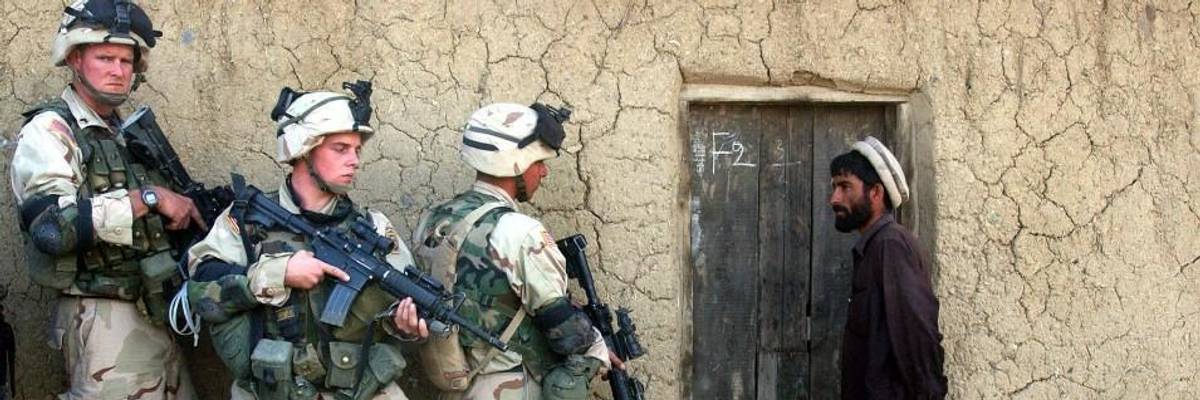
All that Trump has done since he took office is increase the number of U.S. troops that had been serving, at least initially, and most recently walk away without warning from the years-long effort to sign a peace deal with the Taliban. (Photo: Scott Nelson/Getty Images)
On the 18th anniversary of the war in Afghanistan, President Donald Trump said on Twitter, "... it is time for us to get out of these ridiculous Endless Wars, many of them tribal, and bring our soldiers home." He added, "WE WILL FIGHT WHERE IT IS TO OUR BENEFIT, AND ONLY FIGHT TO WIN." But rather than referring to the U.S. war in Afghanistan, Trump was actually talking about the role of U.S. troops in northern Syria, about which he had just made a serious decision. One wonders whether Trump would take greater interest in the longest official war in U.S. history if he had real estate interests in Kabul. He made absolutely no mention of Afghanistan on the anniversary of the war. But neither did most members of Congress.
There was a near blackout of the anniversary in the media as well. Of the major newspapers, only the New York Times paid some attention to it with a lengthy special called 'We Are Inside the Fire': An Oral History of the War in Afghanistan. While the report centered on the voices of Afghans, the paper minimized the role of the U.S. For example, the first section covering 1989 to 2001 was described in this way: "After the Soviet occupation, Afghanistan fell into a civil war between factions that were mostly bound by personal loyalties." The Times did not see fit to add the civil war was largely fueled by U.S. weapons and cash flooding into the hands of the anti-Soviet jihadi warlords the CIA had deployed against the USSR. Those warlords and weapons set the stage for the Taliban and the brutality that followed. Still, the Afghan voices in the narrative consistently mentioned the futility of the U.S. war, with one doctor in Kandahar saying:
It would be better if Americans had never come here. Fewer people would have died. This war is not Afghanistan's war; it is the war of the world, but they are fighting it in Afghanistan.
All that Trump has done since he took office is increase the number of U.S. troops that had been serving, at least initially, and most recently walk away without warning from the years-long effort to sign a peace deal with the Taliban. Although the president rails about the "endless wars" that the U.S. is engaged in, the longest of all wars is the seemingly never-ending one in Afghanistan that he appears to have swept under the rug for now. But this is par for the course. In its 18 years, the Afghan war has never quite managed to capture the attention of presidents or the public for any sustained period of time. It was the reason why my co-author James Ingalls and I titled our 2005 book about the war "Bleeding Afghanistan: Washington, Warlords, and the Propaganda of Silence." Nearly 14 years after its publication, the phrase "Propaganda of Silence" remains tragically relevant.
When the U.S. first invaded Afghanistan on Oct. 7, 2001, less than a month after the Sept. 11 attacks, President George W. Bush's stated goals were to stop the country from being a haven for terrorists like the 9/11 hijackers and rescue ordinary Afghans from the brutality of the Taliban--an attempt at claiming "humanitarian intervention." In practice, the war was essentially retaliation for the terrorist attacks on the World Trade Center and Pentagon. Afghan babies born when the war began are now old enough to vote, but it is highly unlikely that most of them cast ballots in the recent Sept. 28 elections, postponed twice because of a major spike in violent attacks by the Taliban.
On election day, Afghanistan was on lockdown, paralyzed by Taliban threats of a bloodbath and Afghan government security efforts to thwart any attacks. Reports indicate that only 20% to 30% of registered voters showed up to the polls. According to The Guardian newspaper, "Militants attacked communications towers to take down mobile phone networks, cutting off nearly 1,000 polling stations from their headquarters in Kabul. More than 2,000 polling stations never opened on Saturday because of Taliban threats." Although about 10 people were killed across the nation (double the official estimate), that relatively low figure was more a measure of poor turnout than a peaceful election. Compare this to 15 years ago, when 90% of the electorate registered to vote and 60% to 83% actually voted in the nation's first post-Taliban presidential elections, a reflection of the excitement then among Afghans for a chance at democratic participation.
The results of this year's race are expected in mid-October with the same two rivals that ran in elections five years ago facing off for the second time: Ashraf Ghani and Abdullah Abdullah. In 2014, vote counts were too close to call and both men declared themselves the victor. Their political stalemate ended only after the U.S. cobbled together a clumsy power-sharing deal, installing Ghani as president and Abdullah as his chief executive. This time around both men are once more claiming victory and say they would refuse a similar deal. Reports of electoral fraud through ballot box-stuffing are also adding uncertainty to the race. Ultimately the real winners will likely be the Taliban, whose intention was to thwart the elections and who are reveling in reports of low turnout. In a statement, the organization said the low number of voters reflected an "absolute rejection and boycott by the nation," but made no mention of the relentless threats, intimidation and violence it has inflicted on the Afghan people.
There are few good options left for the war other than ending it. In the past, American troops offered some measure of strength to government-backed forces against the Taliban and provided security for government officials. But the U.S.'s presence has had such an overall negative impact that as the doctor from Kandahar told the New York Times, "It would be better if Americans had never come here." Today, even with U.S. troops present, a return to a pre-Oct. 7, 2001, era is more likely than ever. By the Department of Defense's own assessment, "The Afghan National Defense and Security Forces remain in control of most of Afghanistan's population centers and all of the provincial capitals, while the Taliban control large portions of Afghanistan's rural areas, and continue to attack poorly defended government checkpoints and rural district centers."
Just as Afghans born at the war's start are now coming of age, Americans born at the same time are now old enough to serve. Private Hunter Nines was only 7 months old when the U.S. invaded Afghanistan. He now heads to Afghanistan to serve in a war that more than three quarters of a million American troops have served in. In an interview with ABC News, Nines revealed the same ignorance about the war in Afghanistan as our politicians and media, saying, "Honestly, I don't think a lot about it." All he knows is that "I've got a job to do, and that we're still over there right now and it's not done yet."
Dear Common Dreams reader, It’s been nearly 30 years since I co-founded Common Dreams with my late wife, Lina Newhouser. We had the radical notion that journalism should serve the public good, not corporate profits. It was clear to us from the outset what it would take to build such a project. No paid advertisements. No corporate sponsors. No millionaire publisher telling us what to think or do. Many people said we wouldn't last a year, but we proved those doubters wrong. Together with a tremendous team of journalists and dedicated staff, we built an independent media outlet free from the constraints of profits and corporate control. Our mission has always been simple: To inform. To inspire. To ignite change for the common good. Building Common Dreams was not easy. Our survival was never guaranteed. When you take on the most powerful forces—Wall Street greed, fossil fuel industry destruction, Big Tech lobbyists, and uber-rich oligarchs who have spent billions upon billions rigging the economy and democracy in their favor—the only bulwark you have is supporters who believe in your work. But here’s the urgent message from me today. It's never been this bad out there. And it's never been this hard to keep us going. At the very moment Common Dreams is most needed, the threats we face are intensifying. We need your support now more than ever. We don't accept corporate advertising and never will. We don't have a paywall because we don't think people should be blocked from critical news based on their ability to pay. Everything we do is funded by the donations of readers like you. When everyone does the little they can afford, we are strong. But if that support retreats or dries up, so do we. Will you donate now to make sure Common Dreams not only survives but thrives? —Craig Brown, Co-founder |
On the 18th anniversary of the war in Afghanistan, President Donald Trump said on Twitter, "... it is time for us to get out of these ridiculous Endless Wars, many of them tribal, and bring our soldiers home." He added, "WE WILL FIGHT WHERE IT IS TO OUR BENEFIT, AND ONLY FIGHT TO WIN." But rather than referring to the U.S. war in Afghanistan, Trump was actually talking about the role of U.S. troops in northern Syria, about which he had just made a serious decision. One wonders whether Trump would take greater interest in the longest official war in U.S. history if he had real estate interests in Kabul. He made absolutely no mention of Afghanistan on the anniversary of the war. But neither did most members of Congress.
There was a near blackout of the anniversary in the media as well. Of the major newspapers, only the New York Times paid some attention to it with a lengthy special called 'We Are Inside the Fire': An Oral History of the War in Afghanistan. While the report centered on the voices of Afghans, the paper minimized the role of the U.S. For example, the first section covering 1989 to 2001 was described in this way: "After the Soviet occupation, Afghanistan fell into a civil war between factions that were mostly bound by personal loyalties." The Times did not see fit to add the civil war was largely fueled by U.S. weapons and cash flooding into the hands of the anti-Soviet jihadi warlords the CIA had deployed against the USSR. Those warlords and weapons set the stage for the Taliban and the brutality that followed. Still, the Afghan voices in the narrative consistently mentioned the futility of the U.S. war, with one doctor in Kandahar saying:
It would be better if Americans had never come here. Fewer people would have died. This war is not Afghanistan's war; it is the war of the world, but they are fighting it in Afghanistan.
All that Trump has done since he took office is increase the number of U.S. troops that had been serving, at least initially, and most recently walk away without warning from the years-long effort to sign a peace deal with the Taliban. Although the president rails about the "endless wars" that the U.S. is engaged in, the longest of all wars is the seemingly never-ending one in Afghanistan that he appears to have swept under the rug for now. But this is par for the course. In its 18 years, the Afghan war has never quite managed to capture the attention of presidents or the public for any sustained period of time. It was the reason why my co-author James Ingalls and I titled our 2005 book about the war "Bleeding Afghanistan: Washington, Warlords, and the Propaganda of Silence." Nearly 14 years after its publication, the phrase "Propaganda of Silence" remains tragically relevant.
When the U.S. first invaded Afghanistan on Oct. 7, 2001, less than a month after the Sept. 11 attacks, President George W. Bush's stated goals were to stop the country from being a haven for terrorists like the 9/11 hijackers and rescue ordinary Afghans from the brutality of the Taliban--an attempt at claiming "humanitarian intervention." In practice, the war was essentially retaliation for the terrorist attacks on the World Trade Center and Pentagon. Afghan babies born when the war began are now old enough to vote, but it is highly unlikely that most of them cast ballots in the recent Sept. 28 elections, postponed twice because of a major spike in violent attacks by the Taliban.
On election day, Afghanistan was on lockdown, paralyzed by Taliban threats of a bloodbath and Afghan government security efforts to thwart any attacks. Reports indicate that only 20% to 30% of registered voters showed up to the polls. According to The Guardian newspaper, "Militants attacked communications towers to take down mobile phone networks, cutting off nearly 1,000 polling stations from their headquarters in Kabul. More than 2,000 polling stations never opened on Saturday because of Taliban threats." Although about 10 people were killed across the nation (double the official estimate), that relatively low figure was more a measure of poor turnout than a peaceful election. Compare this to 15 years ago, when 90% of the electorate registered to vote and 60% to 83% actually voted in the nation's first post-Taliban presidential elections, a reflection of the excitement then among Afghans for a chance at democratic participation.
The results of this year's race are expected in mid-October with the same two rivals that ran in elections five years ago facing off for the second time: Ashraf Ghani and Abdullah Abdullah. In 2014, vote counts were too close to call and both men declared themselves the victor. Their political stalemate ended only after the U.S. cobbled together a clumsy power-sharing deal, installing Ghani as president and Abdullah as his chief executive. This time around both men are once more claiming victory and say they would refuse a similar deal. Reports of electoral fraud through ballot box-stuffing are also adding uncertainty to the race. Ultimately the real winners will likely be the Taliban, whose intention was to thwart the elections and who are reveling in reports of low turnout. In a statement, the organization said the low number of voters reflected an "absolute rejection and boycott by the nation," but made no mention of the relentless threats, intimidation and violence it has inflicted on the Afghan people.
There are few good options left for the war other than ending it. In the past, American troops offered some measure of strength to government-backed forces against the Taliban and provided security for government officials. But the U.S.'s presence has had such an overall negative impact that as the doctor from Kandahar told the New York Times, "It would be better if Americans had never come here." Today, even with U.S. troops present, a return to a pre-Oct. 7, 2001, era is more likely than ever. By the Department of Defense's own assessment, "The Afghan National Defense and Security Forces remain in control of most of Afghanistan's population centers and all of the provincial capitals, while the Taliban control large portions of Afghanistan's rural areas, and continue to attack poorly defended government checkpoints and rural district centers."
Just as Afghans born at the war's start are now coming of age, Americans born at the same time are now old enough to serve. Private Hunter Nines was only 7 months old when the U.S. invaded Afghanistan. He now heads to Afghanistan to serve in a war that more than three quarters of a million American troops have served in. In an interview with ABC News, Nines revealed the same ignorance about the war in Afghanistan as our politicians and media, saying, "Honestly, I don't think a lot about it." All he knows is that "I've got a job to do, and that we're still over there right now and it's not done yet."
On the 18th anniversary of the war in Afghanistan, President Donald Trump said on Twitter, "... it is time for us to get out of these ridiculous Endless Wars, many of them tribal, and bring our soldiers home." He added, "WE WILL FIGHT WHERE IT IS TO OUR BENEFIT, AND ONLY FIGHT TO WIN." But rather than referring to the U.S. war in Afghanistan, Trump was actually talking about the role of U.S. troops in northern Syria, about which he had just made a serious decision. One wonders whether Trump would take greater interest in the longest official war in U.S. history if he had real estate interests in Kabul. He made absolutely no mention of Afghanistan on the anniversary of the war. But neither did most members of Congress.
There was a near blackout of the anniversary in the media as well. Of the major newspapers, only the New York Times paid some attention to it with a lengthy special called 'We Are Inside the Fire': An Oral History of the War in Afghanistan. While the report centered on the voices of Afghans, the paper minimized the role of the U.S. For example, the first section covering 1989 to 2001 was described in this way: "After the Soviet occupation, Afghanistan fell into a civil war between factions that were mostly bound by personal loyalties." The Times did not see fit to add the civil war was largely fueled by U.S. weapons and cash flooding into the hands of the anti-Soviet jihadi warlords the CIA had deployed against the USSR. Those warlords and weapons set the stage for the Taliban and the brutality that followed. Still, the Afghan voices in the narrative consistently mentioned the futility of the U.S. war, with one doctor in Kandahar saying:
It would be better if Americans had never come here. Fewer people would have died. This war is not Afghanistan's war; it is the war of the world, but they are fighting it in Afghanistan.
All that Trump has done since he took office is increase the number of U.S. troops that had been serving, at least initially, and most recently walk away without warning from the years-long effort to sign a peace deal with the Taliban. Although the president rails about the "endless wars" that the U.S. is engaged in, the longest of all wars is the seemingly never-ending one in Afghanistan that he appears to have swept under the rug for now. But this is par for the course. In its 18 years, the Afghan war has never quite managed to capture the attention of presidents or the public for any sustained period of time. It was the reason why my co-author James Ingalls and I titled our 2005 book about the war "Bleeding Afghanistan: Washington, Warlords, and the Propaganda of Silence." Nearly 14 years after its publication, the phrase "Propaganda of Silence" remains tragically relevant.
When the U.S. first invaded Afghanistan on Oct. 7, 2001, less than a month after the Sept. 11 attacks, President George W. Bush's stated goals were to stop the country from being a haven for terrorists like the 9/11 hijackers and rescue ordinary Afghans from the brutality of the Taliban--an attempt at claiming "humanitarian intervention." In practice, the war was essentially retaliation for the terrorist attacks on the World Trade Center and Pentagon. Afghan babies born when the war began are now old enough to vote, but it is highly unlikely that most of them cast ballots in the recent Sept. 28 elections, postponed twice because of a major spike in violent attacks by the Taliban.
On election day, Afghanistan was on lockdown, paralyzed by Taliban threats of a bloodbath and Afghan government security efforts to thwart any attacks. Reports indicate that only 20% to 30% of registered voters showed up to the polls. According to The Guardian newspaper, "Militants attacked communications towers to take down mobile phone networks, cutting off nearly 1,000 polling stations from their headquarters in Kabul. More than 2,000 polling stations never opened on Saturday because of Taliban threats." Although about 10 people were killed across the nation (double the official estimate), that relatively low figure was more a measure of poor turnout than a peaceful election. Compare this to 15 years ago, when 90% of the electorate registered to vote and 60% to 83% actually voted in the nation's first post-Taliban presidential elections, a reflection of the excitement then among Afghans for a chance at democratic participation.
The results of this year's race are expected in mid-October with the same two rivals that ran in elections five years ago facing off for the second time: Ashraf Ghani and Abdullah Abdullah. In 2014, vote counts were too close to call and both men declared themselves the victor. Their political stalemate ended only after the U.S. cobbled together a clumsy power-sharing deal, installing Ghani as president and Abdullah as his chief executive. This time around both men are once more claiming victory and say they would refuse a similar deal. Reports of electoral fraud through ballot box-stuffing are also adding uncertainty to the race. Ultimately the real winners will likely be the Taliban, whose intention was to thwart the elections and who are reveling in reports of low turnout. In a statement, the organization said the low number of voters reflected an "absolute rejection and boycott by the nation," but made no mention of the relentless threats, intimidation and violence it has inflicted on the Afghan people.
There are few good options left for the war other than ending it. In the past, American troops offered some measure of strength to government-backed forces against the Taliban and provided security for government officials. But the U.S.'s presence has had such an overall negative impact that as the doctor from Kandahar told the New York Times, "It would be better if Americans had never come here." Today, even with U.S. troops present, a return to a pre-Oct. 7, 2001, era is more likely than ever. By the Department of Defense's own assessment, "The Afghan National Defense and Security Forces remain in control of most of Afghanistan's population centers and all of the provincial capitals, while the Taliban control large portions of Afghanistan's rural areas, and continue to attack poorly defended government checkpoints and rural district centers."
Just as Afghans born at the war's start are now coming of age, Americans born at the same time are now old enough to serve. Private Hunter Nines was only 7 months old when the U.S. invaded Afghanistan. He now heads to Afghanistan to serve in a war that more than three quarters of a million American troops have served in. In an interview with ABC News, Nines revealed the same ignorance about the war in Afghanistan as our politicians and media, saying, "Honestly, I don't think a lot about it." All he knows is that "I've got a job to do, and that we're still over there right now and it's not done yet."