SUBSCRIBE TO OUR FREE NEWSLETTER
Daily news & progressive opinion—funded by the people, not the corporations—delivered straight to your inbox.
5
#000000
#FFFFFF
To donate by check, phone, or other method, see our More Ways to Give page.
Daily news & progressive opinion—funded by the people, not the corporations—delivered straight to your inbox.
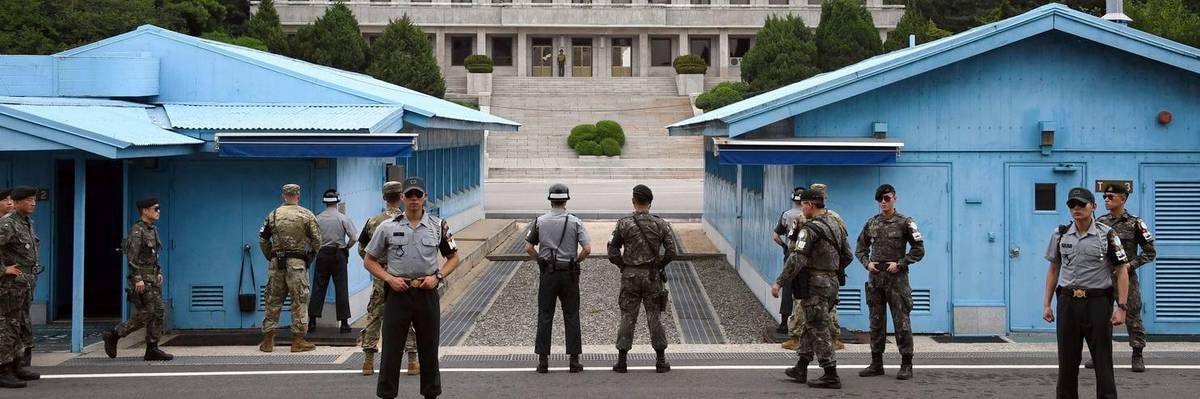
Soldiers of South Korea and the United States stand guard during a commemorative ceremony for the anniversary of the signing of the Korean War Armistice Agreement at the truce village of Panmunjom in the Demilitarized Zone (DMZ) dividing the two Koreas. (Photo: Jung Yeon-Je/AP)
In 2015, we were among 30 women from around the world who came together to cross the Korean demilitarized zone (DMZ), the infamous strip of land that has separated North and South Korea since a "temporary" cease-fire halted the Korean War 65 years ago.
We marched to show this anachronistic conflict need no longer separate families, prohibit communication, and provide excuses for land mines, nuclear weapons and an expensive, ongoing U.S. military commitment. Among us were women who had won Nobel Peace Prizes for helping to bring peace to Liberia and Northern Ireland.
Despite criticism that we were naively playing into the sinister plans of one side or the other, we held a peace symposium in Pyongyang with hundreds of North Korean women, and marched with thousands in the capital and in Kaesong. After crossing the DMZ, we walked with thousands of South Korean women along the barbed-wire fence in Paju.
We never could have predicted that only three years later, the leaders of South and North Korea would meet in the DMZ and declare that "there will be no more war on the Korean Peninsula." This put in motion the kind of steps toward peace that we had marched for -- soldiers from both sides shaking hands and removing guard posts, the beginning of land-mine removal from the DMZ. The new reality is a tribute to Korean leaders and their determination to end the standoff that has separated their people for three generations.
Sadly, the chances for peace depend on Washington, where the division of Korea along the 38th parallel was first drawn on a National Geographic map by two U.S. officers. Yet much of the U.S. leadership is singularly focused on forcing North Korea to unilaterally denuclearize as a precondition for peace talks.
It should show America's commitment to peace by introducing a resolution that formally ends U.S. participation in the Korean War and calls on the president to begin a process toward the signing of a peace agreement.
This approach is backward. To convince somebody to put down a gun, you first have to convince them they will not be harmed. We need to establish peace first to create the necessary conditions for denuclearization.
Although most likely driven by his desire to do what prior presidents could not -- truly end the Korean War -- President Trump might actually achieve a breakthrough on this front. Stephen E. Biegun, the U.S. special representative on North Korea, said this month, "President Trump is ready to end this war. It is over. It is done." His second summit with North Korean leader Kim Jong Un, at the end of this month, provides a perfect opening. A process for ending America's oldest war and moving toward peace should be on their agenda.
Still, it's risky to let hopes rest on the president's credibility given Trump's erratic nature and lack of respect for such past nuclear agreements as the Iran deal and the Intermediate-Range Nuclear Forces treaty.
That's where the new Congress comes in. It should show America's commitment to peace by introducing a resolution that formally ends U.S. participation in the Korean War and calls on the president to begin a process toward the signing of a peace agreement.
And now that Congress has the greatest number of women in history, it should seek to ensure that women are involved in every part of the process. All too often, we've witnessed women being left out of peace talks, even though studies show that when women play authoritative roles, agreements are far more likely to be signed and to last.
Recognizing this, Congress passed, and Trump signed into law, the Women, Peace, and Security Act of 2017, aimed at increasing women's participation in peace processes to prevent, end and rebuild after conflict. Now is the time to implement it.
The women elected to Congress brought with them commitment to such popular issues as Medicare-for-all, free college tuition and confronting climate change. Yet these goals will remain dreams as long as funding is constrained by the $700 billion a year the United States spends on the military. Thus, ending the Korean conflict is crucial not only to Koreans, but to Americans as well.
Most Americans don't know what a pivotal role the Korean War played in creating the military-industrial complex. As University of Chicago historian Bruce Cumings has written, it "was the occasion for transforming the United States into a very different country than it had ever been before: one with hundreds of permanent military bases abroad, a large standing army and a permanent national security state at home."
As two women who defied naysayers by crossing the DMZ, we may never know what difference we made. But we saw firsthand the impact of the war on Korean lives, and we know the impact of massive U.S. military spending on our own lives. It is time to end this longest war.
This country and this world are at a monumental crossroads. US voters have an opportunity to beat back the forces of fascism and confront the billionaires who are rigging the economy, our media system, and our democracy, making it increasingly impossible for ordinary people to get by. We’re not just talking about the election. We’re talking about what must be done once these fascist elements are vanquished from power. We need a bolder set of solutions than what either major party has so far been willing to offer and a working-class movement ready to fight like hell for it. Trump didn't emerge from nowhere. The conditions that fueled MAGA authoritarianism were created by decades of radical neoliberal economic policies and a corrupt political system dominated by corporate interests. They slashed taxes on the super-rich, promising that the benefits would trickle down. They said giveaways to the corporate titans would make life more affordable for the rest of us. It was all bullshit. And when a bitter, betrayed populace searches for someone to blame, right-wing demagogues have little trouble finding scapegoats. People know when they're being lied to, but you won't hear any of this from the corporate media. Only independent journalism—powered and funded by people who believe in building a better world—can deliver truly trustworthy daily news. If you share our vision, please contribute whatever you can to sustain our work. |
In 2015, we were among 30 women from around the world who came together to cross the Korean demilitarized zone (DMZ), the infamous strip of land that has separated North and South Korea since a "temporary" cease-fire halted the Korean War 65 years ago.
We marched to show this anachronistic conflict need no longer separate families, prohibit communication, and provide excuses for land mines, nuclear weapons and an expensive, ongoing U.S. military commitment. Among us were women who had won Nobel Peace Prizes for helping to bring peace to Liberia and Northern Ireland.
Despite criticism that we were naively playing into the sinister plans of one side or the other, we held a peace symposium in Pyongyang with hundreds of North Korean women, and marched with thousands in the capital and in Kaesong. After crossing the DMZ, we walked with thousands of South Korean women along the barbed-wire fence in Paju.
We never could have predicted that only three years later, the leaders of South and North Korea would meet in the DMZ and declare that "there will be no more war on the Korean Peninsula." This put in motion the kind of steps toward peace that we had marched for -- soldiers from both sides shaking hands and removing guard posts, the beginning of land-mine removal from the DMZ. The new reality is a tribute to Korean leaders and their determination to end the standoff that has separated their people for three generations.
Sadly, the chances for peace depend on Washington, where the division of Korea along the 38th parallel was first drawn on a National Geographic map by two U.S. officers. Yet much of the U.S. leadership is singularly focused on forcing North Korea to unilaterally denuclearize as a precondition for peace talks.
It should show America's commitment to peace by introducing a resolution that formally ends U.S. participation in the Korean War and calls on the president to begin a process toward the signing of a peace agreement.
This approach is backward. To convince somebody to put down a gun, you first have to convince them they will not be harmed. We need to establish peace first to create the necessary conditions for denuclearization.
Although most likely driven by his desire to do what prior presidents could not -- truly end the Korean War -- President Trump might actually achieve a breakthrough on this front. Stephen E. Biegun, the U.S. special representative on North Korea, said this month, "President Trump is ready to end this war. It is over. It is done." His second summit with North Korean leader Kim Jong Un, at the end of this month, provides a perfect opening. A process for ending America's oldest war and moving toward peace should be on their agenda.
Still, it's risky to let hopes rest on the president's credibility given Trump's erratic nature and lack of respect for such past nuclear agreements as the Iran deal and the Intermediate-Range Nuclear Forces treaty.
That's where the new Congress comes in. It should show America's commitment to peace by introducing a resolution that formally ends U.S. participation in the Korean War and calls on the president to begin a process toward the signing of a peace agreement.
And now that Congress has the greatest number of women in history, it should seek to ensure that women are involved in every part of the process. All too often, we've witnessed women being left out of peace talks, even though studies show that when women play authoritative roles, agreements are far more likely to be signed and to last.
Recognizing this, Congress passed, and Trump signed into law, the Women, Peace, and Security Act of 2017, aimed at increasing women's participation in peace processes to prevent, end and rebuild after conflict. Now is the time to implement it.
The women elected to Congress brought with them commitment to such popular issues as Medicare-for-all, free college tuition and confronting climate change. Yet these goals will remain dreams as long as funding is constrained by the $700 billion a year the United States spends on the military. Thus, ending the Korean conflict is crucial not only to Koreans, but to Americans as well.
Most Americans don't know what a pivotal role the Korean War played in creating the military-industrial complex. As University of Chicago historian Bruce Cumings has written, it "was the occasion for transforming the United States into a very different country than it had ever been before: one with hundreds of permanent military bases abroad, a large standing army and a permanent national security state at home."
As two women who defied naysayers by crossing the DMZ, we may never know what difference we made. But we saw firsthand the impact of the war on Korean lives, and we know the impact of massive U.S. military spending on our own lives. It is time to end this longest war.