SUBSCRIBE TO OUR FREE NEWSLETTER
Daily news & progressive opinion—funded by the people, not the corporations—delivered straight to your inbox.
5
#000000
#FFFFFF
To donate by check, phone, or other method, see our More Ways to Give page.
Daily news & progressive opinion—funded by the people, not the corporations—delivered straight to your inbox.
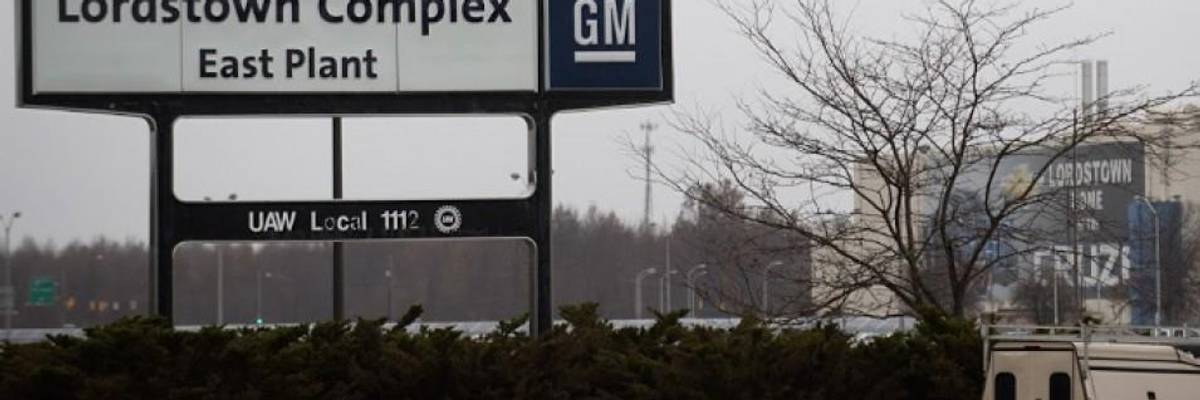
Prior to the tax cut, the biggest gift GM got from the government was a bailout in 2009 of more than $50 billion. (Photo: Jeff Swensen/Getty Images)
Donald Trump's "America first" economic nationalism is finally crashing into the reality of America's shareholder-first global capitalism.
Last week, General Motors announced it would cut about 14,000 jobs, most of them in the politically vital swing states of Michigan and Ohio.
This doesn't quite square with the giant $1.5 trillion tax cut Trump and the Republicans in Congress enacted last December, whose official rationale was to help big corporations make more investments in America and thereby create more jobs. Trump told Ohio residents "don't sell your homes," because lost automaking jobs "are all coming back."
GM got a nice windfall from the tax cut. The company has already saved more than $150 million this year. But some of those Ohio residents probably should have sold their homes.
Trump is (or is trying to appear) furious, tweeting up a storm of threats against GM, including taking away its federal subsidies.
Neither last year's tax cut nor the 2009 bailout required GM to create or preserve jobs in America.
In reality, GM gets very few direct subsidies. Prior to the tax cut, the biggest gift GM got from the government was a bailout in 2009 of more than $50 billion.
But neither last year's tax cut nor the 2009 bailout required GM to create or preserve jobs in America. Both government handouts simply assumed that, as former GM CEO Charles Erwin "Engine" Wilson put it when he was nominated as secretary of defense by Dwight Eisenhower in 1953, "What's good for General Motors is good for the country."
Yet much has changed since 1953. Then, GM was the largest employer in America and had only a few operations around the rest of the world. Now, GM is a global corporation that makes and sells just about everywhere.
Moreover, in the 1950s a third of America's workforce was unionized, and GM was as accountable to the United Auto Workers as it was to GM's shareholders. That's why, in the 1950s, GM's typical worker received $35 an hour (in today's dollars).
In the 1950s a third of America's workforce was unionized, and GM was as accountable to the United Auto Workers as it was to GM's shareholders. That's why, in the 1950s, GM's typical worker received $35 an hour (in today's dollars).
Today, GM's typical American worker earns a fraction of that. The bargaining clout of the United Auto Workers has been weakened not only by automation but also by the ease with which GM can get cheaper labor abroad.
In 2010, when GM emerged from the bailout and went public again, it even boasted to Wall Street that it was making 43 percent of its cars in places where labor cost less than $15 an hour, while in North America it could now pay "lower-tiered" wages and benefits for new employees.
So this year, when the costs of producing many of its cars in Ohio and Detroit got too high (due in part to Trump's tariffs on foreign steel) GM simply decided to shift more production to Mexico in order to boost profits.
In light of GM's decision, Trump is also demanding that GM close one of its plants in China.
But this raises a second reality of shareholder-first global capitalism that's apparently been lost on Trump: GM doesn't make many cars in China for export to the United States. Almost all of the cars it makes in China are for sale there.
In fact, GM is now making and selling more cars in China than it does in the United States. "China is playing a key role in the company's strategy," says GM CEO Mary Barra.
Even as Trump has escalated his trade war with China, GM has invested in state-of-the-art electrification, autonomous vehicles and ride-sharing technologies there.
Which brings us to a third fallacy behind Trump's "America first" economic nationalism. Trump accuses China of stealing technology from American businesses. But big American corporations like GM are eager to invest in China regardless.
In shareholder-first global capitalism, technology doesn't belong to any nation. It goes wherever the profits are.
In shareholder-first global capitalism, technology doesn't belong to any nation. It goes wherever the profits are.
"Making America great again" has nothing to do with making American corporations great again. Big American-based corporations are doing wonderfully well, as are their shareholders.
The real challenge is to make American workers great again. They don't just need any job. They need good jobs, akin to those that GM's unionized workers had a half-century ago. Most Americans haven't had a raise in decades, considering inflation.
The difference between China and America is that big Chinese companies are either state-owned or dependent on capital from government-run financial institutions. This means they exist to advance China's national interests, including more and better jobs for the Chinese people.
American corporations exist to advance the interests of their shareholders, who aren't prepared to sacrifice profits for more and better jobs for Americans.
If Trump were serious about his aims, he'd try to reduce the chokehold of Wall Street investors on American corporations while strengthening the hand of American labor unions.
Don't hold your breath.
This country and this world are at a monumental crossroads. US voters have an opportunity to beat back the forces of fascism and confront the billionaires who are rigging the economy, our media system, and our democracy, making it increasingly impossible for ordinary people to get by. We’re not just talking about the election. We’re talking about what must be done once these fascist elements are vanquished from power. We need a bolder set of solutions than what either major party has so far been willing to offer and a working-class movement ready to fight like hell for it. Trump didn't emerge from nowhere. The conditions that fueled MAGA authoritarianism were created by decades of radical neoliberal economic policies and a corrupt political system dominated by corporate interests. They slashed taxes on the super-rich, promising that the benefits would trickle down. They said giveaways to the corporate titans would make life more affordable for the rest of us. It was all bullshit. And when a bitter, betrayed populace searches for someone to blame, right-wing demagogues have little trouble finding scapegoats. People know when they're being lied to, but you won't hear any of this from the corporate media. Only independent journalism—powered and funded by people who believe in building a better world—can deliver truly trustworthy daily news. If you share our vision, please contribute whatever you can to sustain our work. |
Donald Trump's "America first" economic nationalism is finally crashing into the reality of America's shareholder-first global capitalism.
Last week, General Motors announced it would cut about 14,000 jobs, most of them in the politically vital swing states of Michigan and Ohio.
This doesn't quite square with the giant $1.5 trillion tax cut Trump and the Republicans in Congress enacted last December, whose official rationale was to help big corporations make more investments in America and thereby create more jobs. Trump told Ohio residents "don't sell your homes," because lost automaking jobs "are all coming back."
GM got a nice windfall from the tax cut. The company has already saved more than $150 million this year. But some of those Ohio residents probably should have sold their homes.
Trump is (or is trying to appear) furious, tweeting up a storm of threats against GM, including taking away its federal subsidies.
Neither last year's tax cut nor the 2009 bailout required GM to create or preserve jobs in America.
In reality, GM gets very few direct subsidies. Prior to the tax cut, the biggest gift GM got from the government was a bailout in 2009 of more than $50 billion.
But neither last year's tax cut nor the 2009 bailout required GM to create or preserve jobs in America. Both government handouts simply assumed that, as former GM CEO Charles Erwin "Engine" Wilson put it when he was nominated as secretary of defense by Dwight Eisenhower in 1953, "What's good for General Motors is good for the country."
Yet much has changed since 1953. Then, GM was the largest employer in America and had only a few operations around the rest of the world. Now, GM is a global corporation that makes and sells just about everywhere.
Moreover, in the 1950s a third of America's workforce was unionized, and GM was as accountable to the United Auto Workers as it was to GM's shareholders. That's why, in the 1950s, GM's typical worker received $35 an hour (in today's dollars).
In the 1950s a third of America's workforce was unionized, and GM was as accountable to the United Auto Workers as it was to GM's shareholders. That's why, in the 1950s, GM's typical worker received $35 an hour (in today's dollars).
Today, GM's typical American worker earns a fraction of that. The bargaining clout of the United Auto Workers has been weakened not only by automation but also by the ease with which GM can get cheaper labor abroad.
In 2010, when GM emerged from the bailout and went public again, it even boasted to Wall Street that it was making 43 percent of its cars in places where labor cost less than $15 an hour, while in North America it could now pay "lower-tiered" wages and benefits for new employees.
So this year, when the costs of producing many of its cars in Ohio and Detroit got too high (due in part to Trump's tariffs on foreign steel) GM simply decided to shift more production to Mexico in order to boost profits.
In light of GM's decision, Trump is also demanding that GM close one of its plants in China.
But this raises a second reality of shareholder-first global capitalism that's apparently been lost on Trump: GM doesn't make many cars in China for export to the United States. Almost all of the cars it makes in China are for sale there.
In fact, GM is now making and selling more cars in China than it does in the United States. "China is playing a key role in the company's strategy," says GM CEO Mary Barra.
Even as Trump has escalated his trade war with China, GM has invested in state-of-the-art electrification, autonomous vehicles and ride-sharing technologies there.
Which brings us to a third fallacy behind Trump's "America first" economic nationalism. Trump accuses China of stealing technology from American businesses. But big American corporations like GM are eager to invest in China regardless.
In shareholder-first global capitalism, technology doesn't belong to any nation. It goes wherever the profits are.
In shareholder-first global capitalism, technology doesn't belong to any nation. It goes wherever the profits are.
"Making America great again" has nothing to do with making American corporations great again. Big American-based corporations are doing wonderfully well, as are their shareholders.
The real challenge is to make American workers great again. They don't just need any job. They need good jobs, akin to those that GM's unionized workers had a half-century ago. Most Americans haven't had a raise in decades, considering inflation.
The difference between China and America is that big Chinese companies are either state-owned or dependent on capital from government-run financial institutions. This means they exist to advance China's national interests, including more and better jobs for the Chinese people.
American corporations exist to advance the interests of their shareholders, who aren't prepared to sacrifice profits for more and better jobs for Americans.
If Trump were serious about his aims, he'd try to reduce the chokehold of Wall Street investors on American corporations while strengthening the hand of American labor unions.
Don't hold your breath.