SUBSCRIBE TO OUR FREE NEWSLETTER
Daily news & progressive opinion—funded by the people, not the corporations—delivered straight to your inbox.
5
#000000
#FFFFFF
To donate by check, phone, or other method, see our More Ways to Give page.
Daily news & progressive opinion—funded by the people, not the corporations—delivered straight to your inbox.
No one can know for sure what the incoming Trump administration will do, but President-elect Donald Trump has repeatedly criticized and threatened the media in the United States. In lieu of attempting the impossible and predicting the future, we've gathered all of Trump's stated positions on free speech and freedom of the press. If you are aware of any additional statements that we have not included, please email kate@eff.org with a link to your source material, and we will consider it for inclusion.
No one can know for sure what the incoming Trump administration will do, but President-elect Donald Trump has repeatedly criticized and threatened the media in the United States. In lieu of attempting the impossible and predicting the future, we've gathered all of Trump's stated positions on free speech and freedom of the press. If you are aware of any additional statements that we have not included, please email kate@eff.org with a link to your source material, and we will consider it for inclusion.
While running for president, Trump made his general feelings about the press very clear. He has called the media "dishonest" and described reporters as "scum," "sleaze," and "horrible people." At a rally last February, he famously said, "I'm going to open up our libel laws so when they write purposely negative and horrible and false articles, we can sue them and win lots of money."
In the past, Trump has filed frivolous lawsuits against media defendants that threaten to silence critics and draw scarce resources away from important reporting work. For example, in 1984, Trump sued the Chicago Tribune and its Pulitzer Prize-winning architecture critic, Paul Gapp for an article that made fun of Trump's proposal to build a 150-story skyscraper on landfill in New York. In 2006, Trump sued Time Warner Books and an author for publishing a book that reported Trump was worth substantially less than he claimed. He sued for $5 billion in damages. And during the election, Trump sued Univision and its head of programming for dropping coverage of the Miss Universe pageant (in response to Trump's comments that Mexicans are rapists), and for posting a picture of Trump next to a picture of convicted murderer Dylan Roof on Instagram with the comment "Sin commentaries." Although none of these statements met the libel standard and Trump failed to win any case, in each the media defendants had to hire--and pay--lawyers to defend themselves--all the way to the appellate court in at least one case. Trump said, about one case he lost, "I liked it because I cost him a lot of time and a lot of energy and a lot of money."
Trump has repeatedly denied the media access. During his campaign, he pulled out of two debates because he reportedly didn't like the way he was treated by Fox News and its reporter, Megyn Kelly.
He also pulled the credentials of several national media outlets, including the Washington Post, for ideological disagreements, and, in the Post's case, for an arguably inaccurate headline. The Post's Executive Editor Marty Baron called the move, "nothing less than a repudiation of a free and independent press." Trump's campaign also blacklisted reporters from Gawker, BuzzFeed, Foreign Policy, Politico, Fusion, Univision, Mother Jones, the New Hampshire Union Leader, the Des Moines Register, the Daily Beast and Huffington Post. That left reporters having "to try to walk into public events with the general crowd rather than being escorted into the press section." However, when one Politico reporter tried to report from the general audience section at a Trump rally instead of the press pen, Trump's staff kicked him out and then denied him credentials to a later campaign event.
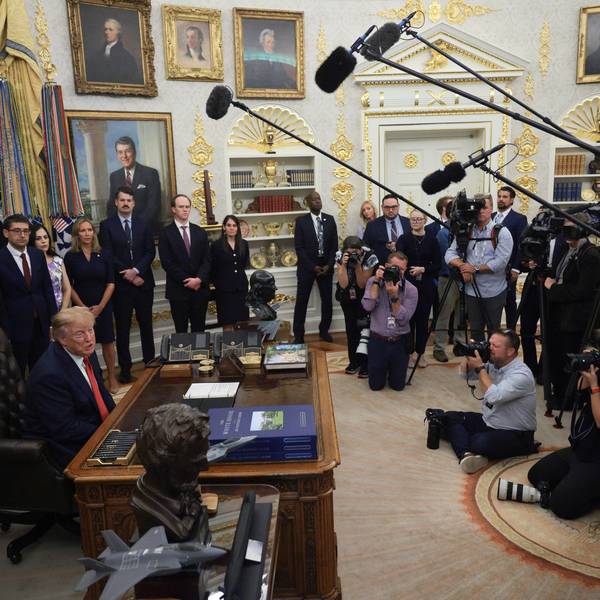
Since winning the election, the incoming administration has broken from the practices of past incoming presidents in ways that could impact how the press reports on and the public learns about its activities. For example, Trump broke from "decades of tradition" by not traveling with a press pool during his campaign and continued to do so even after the election. This meant that the public often learned about Trump's conversations with leaders of foreign countries from the countries themselves, rather than the press. And Trump's incoming Chief of Staff, Reince Priebus, implied in an interview last week that the new administration may do away with daily press briefings in the White House.
Dear Common Dreams reader, It’s been nearly 30 years since I co-founded Common Dreams with my late wife, Lina Newhouser. We had the radical notion that journalism should serve the public good, not corporate profits. It was clear to us from the outset what it would take to build such a project. No paid advertisements. No corporate sponsors. No millionaire publisher telling us what to think or do. Many people said we wouldn't last a year, but we proved those doubters wrong. Together with a tremendous team of journalists and dedicated staff, we built an independent media outlet free from the constraints of profits and corporate control. Our mission has always been simple: To inform. To inspire. To ignite change for the common good. Building Common Dreams was not easy. Our survival was never guaranteed. When you take on the most powerful forces—Wall Street greed, fossil fuel industry destruction, Big Tech lobbyists, and uber-rich oligarchs who have spent billions upon billions rigging the economy and democracy in their favor—the only bulwark you have is supporters who believe in your work. But here’s the urgent message from me today. It's never been this bad out there. And it's never been this hard to keep us going. At the very moment Common Dreams is most needed, the threats we face are intensifying. We need your support now more than ever. We don't accept corporate advertising and never will. We don't have a paywall because we don't think people should be blocked from critical news based on their ability to pay. Everything we do is funded by the donations of readers like you. When everyone does the little they can afford, we are strong. But if that support retreats or dries up, so do we. Will you donate now to make sure Common Dreams not only survives but thrives? —Craig Brown, Co-founder |
No one can know for sure what the incoming Trump administration will do, but President-elect Donald Trump has repeatedly criticized and threatened the media in the United States. In lieu of attempting the impossible and predicting the future, we've gathered all of Trump's stated positions on free speech and freedom of the press. If you are aware of any additional statements that we have not included, please email kate@eff.org with a link to your source material, and we will consider it for inclusion.
While running for president, Trump made his general feelings about the press very clear. He has called the media "dishonest" and described reporters as "scum," "sleaze," and "horrible people." At a rally last February, he famously said, "I'm going to open up our libel laws so when they write purposely negative and horrible and false articles, we can sue them and win lots of money."
In the past, Trump has filed frivolous lawsuits against media defendants that threaten to silence critics and draw scarce resources away from important reporting work. For example, in 1984, Trump sued the Chicago Tribune and its Pulitzer Prize-winning architecture critic, Paul Gapp for an article that made fun of Trump's proposal to build a 150-story skyscraper on landfill in New York. In 2006, Trump sued Time Warner Books and an author for publishing a book that reported Trump was worth substantially less than he claimed. He sued for $5 billion in damages. And during the election, Trump sued Univision and its head of programming for dropping coverage of the Miss Universe pageant (in response to Trump's comments that Mexicans are rapists), and for posting a picture of Trump next to a picture of convicted murderer Dylan Roof on Instagram with the comment "Sin commentaries." Although none of these statements met the libel standard and Trump failed to win any case, in each the media defendants had to hire--and pay--lawyers to defend themselves--all the way to the appellate court in at least one case. Trump said, about one case he lost, "I liked it because I cost him a lot of time and a lot of energy and a lot of money."
Trump has repeatedly denied the media access. During his campaign, he pulled out of two debates because he reportedly didn't like the way he was treated by Fox News and its reporter, Megyn Kelly.
He also pulled the credentials of several national media outlets, including the Washington Post, for ideological disagreements, and, in the Post's case, for an arguably inaccurate headline. The Post's Executive Editor Marty Baron called the move, "nothing less than a repudiation of a free and independent press." Trump's campaign also blacklisted reporters from Gawker, BuzzFeed, Foreign Policy, Politico, Fusion, Univision, Mother Jones, the New Hampshire Union Leader, the Des Moines Register, the Daily Beast and Huffington Post. That left reporters having "to try to walk into public events with the general crowd rather than being escorted into the press section." However, when one Politico reporter tried to report from the general audience section at a Trump rally instead of the press pen, Trump's staff kicked him out and then denied him credentials to a later campaign event.
Since winning the election, the incoming administration has broken from the practices of past incoming presidents in ways that could impact how the press reports on and the public learns about its activities. For example, Trump broke from "decades of tradition" by not traveling with a press pool during his campaign and continued to do so even after the election. This meant that the public often learned about Trump's conversations with leaders of foreign countries from the countries themselves, rather than the press. And Trump's incoming Chief of Staff, Reince Priebus, implied in an interview last week that the new administration may do away with daily press briefings in the White House.
No one can know for sure what the incoming Trump administration will do, but President-elect Donald Trump has repeatedly criticized and threatened the media in the United States. In lieu of attempting the impossible and predicting the future, we've gathered all of Trump's stated positions on free speech and freedom of the press. If you are aware of any additional statements that we have not included, please email kate@eff.org with a link to your source material, and we will consider it for inclusion.
While running for president, Trump made his general feelings about the press very clear. He has called the media "dishonest" and described reporters as "scum," "sleaze," and "horrible people." At a rally last February, he famously said, "I'm going to open up our libel laws so when they write purposely negative and horrible and false articles, we can sue them and win lots of money."
In the past, Trump has filed frivolous lawsuits against media defendants that threaten to silence critics and draw scarce resources away from important reporting work. For example, in 1984, Trump sued the Chicago Tribune and its Pulitzer Prize-winning architecture critic, Paul Gapp for an article that made fun of Trump's proposal to build a 150-story skyscraper on landfill in New York. In 2006, Trump sued Time Warner Books and an author for publishing a book that reported Trump was worth substantially less than he claimed. He sued for $5 billion in damages. And during the election, Trump sued Univision and its head of programming for dropping coverage of the Miss Universe pageant (in response to Trump's comments that Mexicans are rapists), and for posting a picture of Trump next to a picture of convicted murderer Dylan Roof on Instagram with the comment "Sin commentaries." Although none of these statements met the libel standard and Trump failed to win any case, in each the media defendants had to hire--and pay--lawyers to defend themselves--all the way to the appellate court in at least one case. Trump said, about one case he lost, "I liked it because I cost him a lot of time and a lot of energy and a lot of money."
Trump has repeatedly denied the media access. During his campaign, he pulled out of two debates because he reportedly didn't like the way he was treated by Fox News and its reporter, Megyn Kelly.
He also pulled the credentials of several national media outlets, including the Washington Post, for ideological disagreements, and, in the Post's case, for an arguably inaccurate headline. The Post's Executive Editor Marty Baron called the move, "nothing less than a repudiation of a free and independent press." Trump's campaign also blacklisted reporters from Gawker, BuzzFeed, Foreign Policy, Politico, Fusion, Univision, Mother Jones, the New Hampshire Union Leader, the Des Moines Register, the Daily Beast and Huffington Post. That left reporters having "to try to walk into public events with the general crowd rather than being escorted into the press section." However, when one Politico reporter tried to report from the general audience section at a Trump rally instead of the press pen, Trump's staff kicked him out and then denied him credentials to a later campaign event.
Since winning the election, the incoming administration has broken from the practices of past incoming presidents in ways that could impact how the press reports on and the public learns about its activities. For example, Trump broke from "decades of tradition" by not traveling with a press pool during his campaign and continued to do so even after the election. This meant that the public often learned about Trump's conversations with leaders of foreign countries from the countries themselves, rather than the press. And Trump's incoming Chief of Staff, Reince Priebus, implied in an interview last week that the new administration may do away with daily press briefings in the White House.