SUBSCRIBE TO OUR FREE NEWSLETTER
Daily news & progressive opinion—funded by the people, not the corporations—delivered straight to your inbox.
5
#000000
#FFFFFF
To donate by check, phone, or other method, see our More Ways to Give page.
Daily news & progressive opinion—funded by the people, not the corporations—delivered straight to your inbox.
Joe Biden finally announced on Thursday what everyone already knew. With the release of a three-and-a-half minute promotional video, the former vice president officially threw his name in the ever-expanding ring of Democratic primary contenders seeking to win the opportunity to challenge Donald Trump for the presidency in 2020.
Joe Biden finally announced on Thursday what everyone already knew. With the release of a three-and-a-half minute promotional video, the former vice president officially threw his name in the ever-expanding ring of Democratic primary contenders seeking to win the opportunity to challenge Donald Trump for the presidency in 2020. Biden has already seen his share of coverage, and was the second-most-mentioned Democratic candidate on cable news during the first three months of 2019.
Biden has pledged that his 2020 campaign won't take in any direct donations from lobbyists. But on the first night of his official candidacy, Biden hit the suburbs of Philadelphia to attend a $2,800 per person fundraiser at the home of David L. Cohen, the executive vice president and chief of lobbying for Comcast.
Comcast, one of the biggest lobbying spenders in Washington, also owns MSNBC, which has showered Biden with favorable coverage both before and since his announcement.
In March, Nevada lieutenant gubernatorial candidate Lucy Flores published an article in New York Magazine (3/29/19) that described how Biden inappropriately kissed her at a campaign event. Biden has quite a long history of awkward and inappropriate touching, kissing or groping of women and girls.
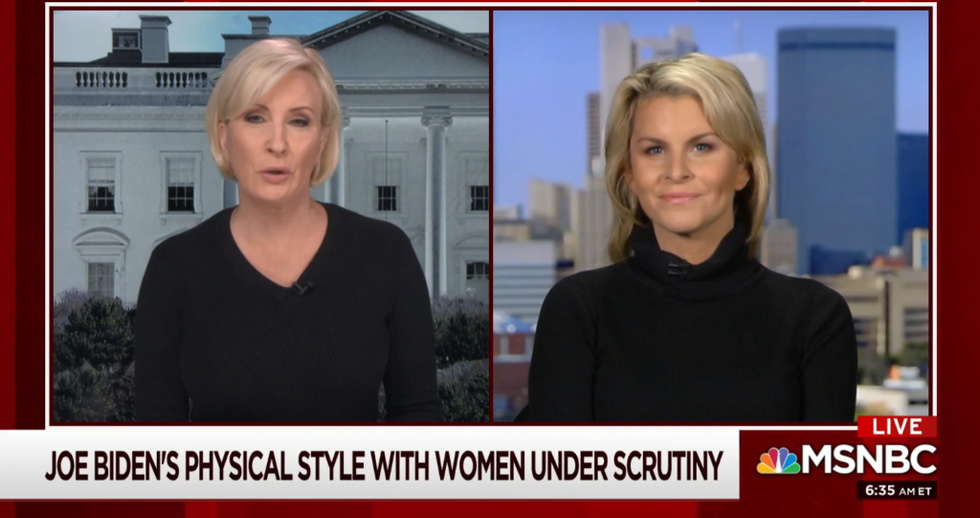
Mika Brzezinski (MSNBC, 4/1/19) defends Biden's "physical style with women" with former DCCC staffer Adrienne Elrod.
Mika Brzezinski, co-host of MSNBC's Morning Joe, was one of the first to defend Biden (4/1/19). Brzezinski suggested that Flores' allegation was politically motivated, citing Flores as a "huge Bernie person," and asking, "Are we just supposed to take all the words and the fact she said she was violated at face value?" Her guests later that day (4/1/19), former DCCC chief of staff Adrienne Elrod and former CIA and DoD chief of staff Jeremy Bash, seemed to agree that such #MeToo accusations against Biden were "meaningless moments," and merely baseless finger-pointing from Biden's political opponents.
Brzezinski continued her defense of Biden the following day and later in the week on Morning Joe, after another woman came forward with allegations of inappropriate behavior (4/2/19, 4/5/19). Brzezinski said that the allegations were "sad," and that Biden is a "nice guy" and "not a predator." She continued:
This is ridiculous. The conversation has gotten out of control, and Democrats and those on the left who want to tweet me today and go nuts and get all woke, you're eating your young. You're eating those who can beat Trump. You're killing the very people who have been pushing women ahead, who've been fighting for equal pay, who have been doing everything they can to respect women in their lives. We're going to after Joe Biden for being affectionate to women of all ages, and to men as well? It's ridiculous.
While he is indeed a frontrunner, defense of Biden as supposedly the only candidate with the ability to beat Trump is frequently parroted by many corporate Democrats (and by totally, definitely well-meaning Republican Party figures as well). MSNBC contributor Mike Barnicle recently re-upped this trope (4/24/19) on the day of Biden's announcement, though to his credit, Axios' Jim Vandehei did push back on this narrative.
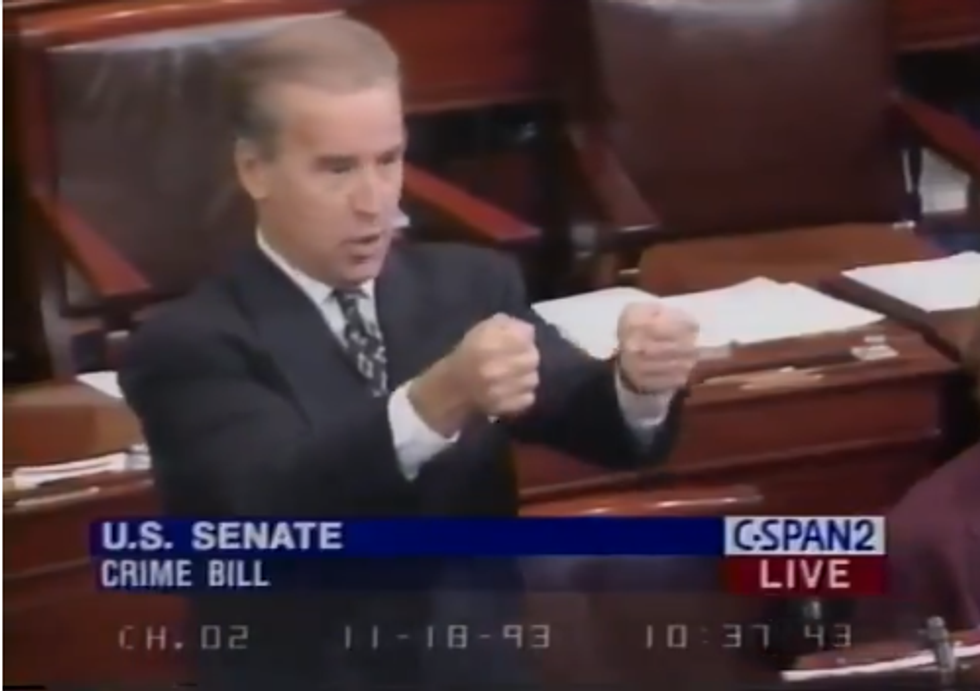
Joe Biden (11/18/93) assures the Senate: "It doesn't matter whether or not they're the victims of society. The end result is they're about to knock my mother on the head with a lead pipe, shoot my sister, beat up my wife, take on my sons."
On another Morning Joe panel (4/26/19), MSNBC correspondent Rev. Al Sharpton criticized Biden's role in drafting and sponsoring the 1984, 1986, 1988 and 1994 crime bills, and his treatment of Anita Hill during the Clarence Thomas confirmation hearings. Biden recently issued a half-apology phone call 28 years after the fact to Hill, who told the New York Times (4/25/19) that the call "left her feeling deeply unsatisfied." (Biden continued to dance around giving a full-throated apology to Hill in an appearance on The View--4/26/19.) But despite Sharpton's misgivings about Biden's history, he maintained that Biden somehow had the "equipment despite the hurdles" to appeal to both "blue collar white workers" and "black and brown communities."
On the same program, Joe Scarborough castigated Biden detractors, maintaining that they failed to understand the context of Biden's past support for harsh drug laws, opposition to school integration and support for the Iraq War. He later added that "it's easy for you to sit there behind your laptop, drinking your soy lattes in 2019 judging [him] for trying to make the country better." Sharpton chimed in with further attacks on so-called "latte liberators" and "limousine liberals."
But despite his folksiness (Extra!, 4/13), if there is anyone who serves the interests of financial giants who spend most of their time in limousines, it's Joe Biden. Since the late 1970s, Biden has been the chief defender of the Delaware-based credit card industry in Congress, and played a crucial role in the passage of the 2005 bankruptcy law, which made it harder for Americans to wipe out and restructure unreasonable debts through Chapter 7 bankruptcy. Indeed, credit card company MBNA (formerly owned by Bank of America) was Biden's second-largest donor throughout his Senate career. When Biden drafted the original version of the bankruptcy bill in 2000, he was strongly opposed by then-Harvard Law professor Elizabeth Warren, who was integral in getting the Clinton administration to block its passage. Biden has also been a consistent supporter of further financial deregulation, such as the Gramm-Bliley-Leach Act, which has been pointed to as a partial cause of the 2008 financial collapse.
Yet Biden's extremely checkered political history, where he was consistently on the wrong sides of issues like women's rights, racial equality, financial regulation, drugs and criminal justice, surveillance, and war, still doesn't seem to be enough for the media to deem him damaged goods. In fact, outlets like MSNBC still play up Biden as the most viable candidate, despite the fact that there are others with similarly long tenures in politics who didn't make Biden's same mistakes.
Earlier in the year, Alex Altman came on MSNBC to praise Biden's "electability" (2/21/19), while this week Steve Kornacki devoted a whole segment to prove just how "electable" Joe Biden is for the Democrats in a 2020 matchup against Trump (4/25/19). No other candidate, not even the other front runners, received such a segment from the network.
Indeed, calling Biden the most "electable" candidate is really just code for the most "moderate" or white candidate. Such a designation for Biden discounts the appeal of candidates who are left-wing, female or people of color. In particular, left-wing candidates like Bernie Sanders (the other frontrunner) and Elizabeth Warren are each frequently dogged in corporate media by accusations that they are somehow not "electable" enough.
There is perhaps an underlying logic to these attacks. Warren and Sanders have each called for heightened antitrust regulation. (Amy Klobuchar and Corey Booker have also called for increased antitrust enforcement, but are a bit more tepid on the issue than Sanders and Warren.) Big tech companies, agricultural conglomerates, food and beverage companies, banks and telecom companies like Comcast would surely come under the antitrust microscope and be targeted for breakups if one of these candidates were to win the Democratic nomination. Comcast, in particular, stands out as a major target, considering they have interests in both media content production as well as distribution.
Comcast, along with other internet service providers (ISPs) like Verizon and AT&T, holds what are essentially regional monopolies, where they very rarely directly compete with one another in a given area. As of 2017, almost 80 percent of US households have access to just a single ISP that offers broadband speeds of over 100 Mbps. This has a striking impact on US internet users: The nation has just the 20th fastest average internet speed in the world, and, according to the FCC, US consumers pay more for broadband than most other comparable countries. Of course, ISPs are also famous for their unmatched customer service record-Comcast ranks as one of America's most hated companies year in and year out, along with many other ISPs.
Much of the power of Comcast and other telecom companies to maintain their monopolies can be attributed to the revolving door that shuffles telecom lobbyists in and out of government positions. The current FCC chair, Ajit Pai, is the former general counsel for Verizon, while its past chair, Tom Wheeler, was a longtime telecom industry lobbyist for trade groups with connections to Comcast. Meredeth Attwell Baker, a former FCC commissioner under Obama, joined Comcast just four months after giving the greenlight for Comcast's merger with NBC Universal. The acquisition marked the beginning of other vertical mergers between content distributors and content producers, including AT&T's acquisition of Time Warner, which owns CNN.
During his Senate career, Biden was far from a hawk on antitrust, supporting antitrust exemptions for the soda industry after receiving donations from Coca-Cola. Judging by the Obama administration's extremely lax antitrust approach, a hypothetical Biden administration would follow the same friendly approach towards corporate interests. Biden hasn't stayed away from discussing the issue of antitrust so far in his campaign, but he has remarked that big corporations shouldn't be "singled out." At a speech last year to the Brookings Institution, he remarked, "I don't think 500 billionaires are the reason we're in trouble. The folks at the top aren't bad guys."
Such deference to massive and unpopular corporate monopolies is anathema to both a healthy economy and contrary to the views of most Americans. But potential antitrust targets like Comcast and AT&T have the ability to manufacture positive press for pro-corporate water carriers like Biden through their news properties. Powerful executives like Comcast's David Cohen might not be shooting out daily emails to MSNBC staff ordering them to promote Biden's candidacy, but employees will often gravitate towards what their employers want. After all, they are well aware of who signs the checks.
Likewise, top MSNBC news personalities exist within the same elite circle of Washington insiders that Biden has inhabited for the past 40 years-in just about every one of the aforementioned segments, one host or guest remarked on their personal relationship with Joe Biden. The insider DC cocktail party circuit doesn't contain very many people who want to attack their corporate benefactors.
It's notable that even before its acquisition by Comcast, MSNBC had a history of tacking to the right and a distinct reluctance to challenge entrenched corporate interests. What's more, the network devotes little interest to economic policy, let alone antitrust, preferring to spend most of its time covering Russiagate.
However, this could change. Since entering the race, Biden has been subject to criticism from his left flank, and will likely remain a target. Sanders recently fired shots at Biden in a fundraising email, calling out his fundraiser with Cohen. Warren added to her long history of criticizing Biden by attacking him for his support of banks and credit card companies during the financial crisis.
However, MSNBC has failed to even mention Biden's fundraiser with Cohen. I can't imagine why.

Michael Copps is a former FCC commissioner who at one point served as acting chair of the Federal Communications Commission. A former deputy assistant and assistant secretary of commerce, he holds a PhD in United States history, is one of our most articulate public interest advocates and currently leads the Media and Democracy Reform Initiative at Common Cause.
"They're trying to get rid of every rule and regulation they ever had that had to do with broadcast, they don't want anything to do with net neutrality and an open Internet."
We spoke the other day just as the House of Representatives passed the Save the Internet bill restoring net neutrality rules that keep the Internet open to all without paying higher fees for fast lane preferential treatment. As of now, Senate Majority Leader Mitch McConnell has said that the bill will never reach the Senate floor, doubtless because he fears putting GOP colleagues on the record in support of the telecom and media giants despite the vast majority of voters - including Republicans - strongly supporting net neutrality and an open Internet.
The conversation also took place just a few days after the passing of former Democratic Senator Fritz Hollings of South Carolina with whom Copps worked and remained friends. He was 97. As noted in the Washington Post's obituary, "[Hollings] served in the Senate from 1966 to 2005 and was instrumental in enacting laws to alleviate childhood hunger, increase vehicle efficiency after the Arab oil embargo and expand competition in telecommunications when the Internet was in its infancy."
We began by talking about Hollings and segued into a discussion about media reform that has been edited for length and clarity. You can listen to the complete interview here:
Your colleague Senator Fritz Hollings from South Carolina has died. You were his chief of staff for a dozen years or so. What do you remember about him and which of his accomplishments do you think will be most remembered?
He was probably the most formidable human being I have ever met from the standpoint of just a bright sparkling wit, knowing how to get along with people, just a wonderfully entertaining human being to be with. He believed in public service and he believed in it deeply. He used to cite that wonderful Edmund Burke quotation: "Your representative owes you, not his industry only, but his judgment; and he betrays, instead of serving you, if he sacrifices it to your opinion."
Fritz believed part of the responsibility of his job was the education of his constituency. He didn't come to Washington to bash Washington and then go home and get reelected so he could come back to Washington. He actually believed in public service.
I worked for him for over 15 years, and I remember on issue after issue, whether it was national security or feeding the hungry or the environment or the Panama Canal treaties - he was the first southern US senator to come out in favor of what Jimmy Carter was going to do with the Panama Canal - he would closet himself with experts for a week and get all sides of an issue and then he'd write this long newsletter to his constituents and mail it throughout South Carolina. And on some of these issues they disagreed with Fritz, but he got elected six or seven times because they knew they were getting the truth from the fellow, they knew they were getting what he actually thought and a considered judgment, so he kept getting elected, from 1966 through his last election in 1998.
He was described in his obituaries as a populist.
I think he was. I'm a populist historian and the term gets wrenched out of its context so that it's almost meaningless. Nowadays it can be a xenophobe or something, but I think of populism as the reform era of the late 19th century and the farmers against Wall Street and the big banks that were choking the rural heartlands and all of that. So from the standpoint of trying to protect against the ravages of the oil and gas industry or the banks, Fritz was a champion of that.
He was a segregationist originally but wound up endorsing Jesse Jackson for president in 1988...
He did. He evolved. He actually voted against Thurgood Marshall [to be the first black Supreme Court justice in 1967] - he said it was the vote that bothered him most during his terms in the Senate. He came around and was a leader in civil rights. Tremendous contribution on things environmental. He was the father of NOAA, the National Oceanic and Atmospheric Administration, the Coastal Zone Management Acts, all of that stuff. He worked very closely with [late Wisconsin senator and founder of Earth Day] Gaylord Nelson back in the 1970's on fashioning environmental legislation... He was a man of very strong conviction, you had a hard time changing his mind, but he always listened.
The kind of politician that we don't have enough of these days?
He worked across the aisle. Back in those days there was still a considerable measure of civility in the Senate and every Wednesday night he and a group of senators would gather at one of their houses... Some were Republicans, some were Democrats, they would have a few drinks together, they'd eat dinner, talk and discuss.
They'd listen to each other on the floor of the Senate; now nobody listens to anybody else, they all run across the street, where big industries and the political parties have their townhouses, and dial for dollars. Fritz's last big crusade was bemoaning and agitating against the corrupting power of big money in politics, and finally saying I can't do this [fundraising] anymore, it just detracts so much from the job of representing the people and trying to craft legislation in the public interest.
So let's make the turn now and ask, how would you characterize telecommunications policy in this age of Trump?
Our telecommunications ecosystem is seriously in danger insofar as the American people go. And the state of that industry, and I include media in that, carries a huge threat for the future of our democracy to be able to support a vital civil dialogue. I don't believe that you can have a self-governing country unless you have an informed electorate...
The media has been so consolidated with so much loss of community and local radio and TV stations, such damage to journalism - we've lost over half of our newsroom employees since the beginning of the century.
What we see is infotainment substituting for real journalism, opinion-mongering substituting for fact, the demise of in-depth investigative journalism, politics turned into a reality show, which is basically what the 2016 election was - who's going to get voted off the island, who's going to make a rhetorical gaffe rather than digging into the issues that bedevil this country of ours.
So I think we're in danger and a lot of that goes back to the federal policy of encouraging all of these mergers, the big media giants, half a dozen of them, coming in and buying up community stations, closing the newsroom, shuttering it, throwing reporters out on the streets. So many of them are walking the street in search of a job rather than walking a beat in search of a story. I don't think we can sustain that very much longer, I really don't.
You get to a point where you really start making dumb decisions as a country. I think you can make a pretty good argument that we've made some dumb decisions in recent years. We don't have any free pass to the future, America has no automatic free pass to the future. We've got some really serious challenges to confront and to overcome, and it's going to take an informed electorate, which is what democracy is all about, to grapple with those problems and solve them, but you can't grapple and solve unless you know about them, and that's where I believe the media is falling down.
This is my passion, this is what I worked on at the Federal Communications Commission and what I'm working on at Common Cause right now. I don't think there is any more serious issue facing us, and goodness knows, we have so many issues - health, environment, diversity, equal opportunity, global affairs, disability rights. All of that is important and none of it is going to get resolved unless the people have a knowledge of the issues and understand the importance of the issues, and then you build from the grassroots up.
There's nothing very good that's going to come out of Washington in the next three years, maybe the next five years, maybe longer than that. This country is in such dire need of reform, it's going to have to come from the grassroots, but in the final analysis, isn't that where substantive reform in American history has always come from? Starts at the grassroots, then you get the politicians on board, then you get legislation.
I remember that you've always been fond of saying that whatever your issues, all of them depend on media reform.
That's right. When I go around and do town hall meetings, I always like to pick out five or six folks and ask, "What's your biggest issue? What's the most dangerous challenge facing the country?" You'll get answers like jobs, health, environment, climate change. And I'll say, "Well, that's all well and good but those issues aren't going to get resolved unless you get on board with this media and telecommunication policy and get us a journalism that will help you resolve those issues. So if it's not your number one issue, you'd better put it way up there on your scale of rankings."
Your colleague FCC Commissioner Jessica Rosenworcel recently told Congress, "Too often the FCC has acted at the behest of the corporate forces that surround it, shortchanging the American people and undermining our digital future."
She's right on target. Before I went to the FCC, I thought, this is going to be the coolest job on God's green earth. I'm going to be dealing with all these edge-of-the-envelope issues with the Internet and technology. I'm going to meet all these innovators and entrepreneurs.
Then I got there [in 2001], and the first call I got was from the chairman, Michael Powell, and he was seeking my help - would you please approve this broadcast merger deal? As soon as I hung up, I realized I was going to be spending an inordinate amount of my time just meeting with the CEO's of these big media companies and the telecom companies: "We have to get larger, we have to take over this other company. It's economies of scale, we're going to go bankrupt, blah blah blah." They'd tell me that, then they'd go to New York and tell all the Wall Street people how great they were doing...
[I]t's pernicious, and one of the things I really tried to do and Jessica is trying to do, is get the FCC to go on the road, talk to the people, find out what they're really thinking about these issues. You sit there [in DC] and are just flooded with all these beautifully gift-wrapped ex parte submissions from big industry with all these big names on them and researched and beautifully presented [but] 88, 90 percent of the American people never hear about any of that and they don't even know the FCC is considering media consolidation or net neutrality or privacy or any of these things that are so important to America right now.
My colleague [FCC Commissioner] Jonathan Adelstein and I probably held sixty or seventy or more town hall meetings around the county and we found that when you went into the communities there was a tremendous interest and an understanding that something has gone wrong with our local media.
I remember being in Sioux Falls late one night -- some of these hearings went on for eight or nine hours, Jonathan and I would always stay until the end -- and this Native American woman got up and she was in tears: "We never get covered, my tribe, my community. When we do get covered it's suicide, unemployment, alcohol, but the things we're contributing and the good things that we're doing and trying to do never get covered." That's true, not just for them but for so many different groups...
I'm encouraged that people are starting to talk a little about this now, that, gee, something's gone wrong here with the local news, what can we do about it? We have to take that discussion and really broaden it to include everybody. We have to get local news and local broadcast journalism back. And then we have to think about our national news and our global news.
You mentioned Michael Powell, who was the Republican FCC chair when you started in 2001, and is now an industry lobbyist...
He's head of the big cable association in Washington, making a couple of million dollars a year, I guess...
The revolving door between government and big business.
The revolving door has really been active in two places: the FCC and the United States Trade Representative, both very, very important agencies in our government.
I think the goal of this administration and perhaps even the chairman of the FCC is to put [the FCC] out of business. They're trying to get rid of every rule and regulation they ever had that had to do with broadcast, they don't want anything to do with net neutrality and an open Internet. [They want to] give it all to the FTC, theFederal Trade Commission, which has very weak enforcement authority, it has no power even to write rules.
But yet they're saying, get it out of here, put it over there and pretty soon they'll be able to put a "Going Out of Business" sign over the front door of the Federal Communications Commission, which is an agency established in 1934 to serve the public interest. [Congress] gave the FCC a lot of powers, which the current Republican majority just denies... because they don't believe in government.
Going back to that, the current Republican FCC chair Ajit Pai, has he lived up - or down! - to your expectations?
He's lived up to Donald Trump's expectations. From the standpoint of the president of the United States, I think Ajit Pai has been one of the most effective appointments that he made, because [Pai] is denuding the Federal Communications Commission, essentially getting rid of so many rules and regulations and that's what the Trump administration is all about.
When you read last week that in agriculture the administration is saying, well, let the pork industry do its own inspection of pork that's sold in the United States. Wow... It's the same across all these agencies: environment, health, the whole ball of wax.
You've mentioned net neutrality a couple of times. One of the first things Trump's chair Ajit Pai did was to tear down the net neutrality rules, the Open Internet order which the FCC put into effect in February 2014 and which public advocacy groups had fought so hard for. But luckily, that repeal is being fought against very hard.
Yeah, thank goodness we have a Save the Internet bill that has gone through on the House side... It would restore the net neutrality rules that the Democratic FCC under [then-Chair] Tom Wheeler put into effect back in 2015. And we need that. You're giving all this power to a few telecommunications and content companies just to determine where you can go, what you can do, can you organize or can't you organize on the Internet.
The Internet was supposed to be the open, dynamic technology of our time, and I started talking about the dangers of the Internet back in 2002 and 2003, if we didn't have some public service obligations and regulations for it.
People said, "Copps, you're way off base. This is an open, dynamic technology, power is at the edges. We've got the power, there's no central power and you don't have to worry about it." But now, lots of Americans have come to realize that while the technology may be out there and dynamic, the business model isn't -- the business model is the same as every industry we've ever seen.
It's a trend toward consolidation and monopoly markets, so this wonderful Internet, which still holds such promise for the future, which could one day if it's not too late still be the town square of our democracy, paved with broadband bricks, so to speak, is now coming under the control of a few who are going to be able to say, "No, you can't start your website here, we don't like the political views of NARAL or something like that, we're going to block this, block that... If content producers play ball with us, we'll speed up their stuff to consumers and slow down everybody else."
That's not what the Internet is supposed to be and we need to get hold of that. Net neutrality is the prerequisite of an open Internet. You can't have an open Internet without net neutrality.
But, and it gets more complicated here, net neutrality by itself is not the realization of an open Internet. You've still got all the problems with these huge companies, consolidation, commercialization. And where is the model on the Internet for online journalism? Yes, there are a few sites, Pro Publica and others, but we haven't begun to get on the Internet the depth of journalism that we used to have in traditional media. We've lost far more than we have gained.
You have companies like Facebook that are taking the news that journalists like you and others produce and they aren't giving a dime for it. They run it along all these ads that bring them billions and billions of dollars without putting anything back into journalism. They'll say, "Well, we gave a million dollar grant a year or so ago." We're talking something much more major than that if you're going to have real journalism on the Internet.
How is artificial intelligence going to affect the Internet and affect us all, affect our jobs - all these are questions revolving around the Internet that we have to have a serious national conversation about and bring people's attention to...
You have to get net neutrality done. Whether Mitch McConnell will ever give it any kind of green light [in the Senate] or that Trump will sign it I doubt, but at least we're laying the base and if we get a different agency or different administration in the future maybe we can do that.
The interesting thing to me, when you go around the country, this is not a partisan issue. I can run around Capitol Hill until I'm blue in the face trying to find a Republican who will support net neutrality or get serious against the kind of consolidation I'm talking about. But look at the polls... 75, 80, 85 percent of the American people -- Republicans, independents, Democrats - all say it was a mistake for the FCC to repeal those [net neutrality] rules... It is not a partisan issue outside the fabled Beltway but we are so under the partisanship mantra in Washington, DC, right now that you can't get anything of substance accomplished.
We have a White House that was opposed to the AT&T Time Warner merger, but [to punish CNN] not for altruistic media reform reasons.
Yeah, I've read that, too (laughs). The Justice Department did end up opposing the merger and they went to court and in one of the most ridiculous court decisions that I have ever read, the presiding judge okayed the merger and he said, well, we don't really deal much in what we call vertical mergers - that's where you would have both the content and the distribution. We only deal in horizontal mergers where companies of like services are joining forces.
But if you control the distribution of something and you control the content, if that isn't in my mind the classic definition of monopoly back to John D. Rockefeller or the old robber barons, I mean, that's how they got a hammerlock on this economy. It worries me, because if we get a brighter day legislatively and in the regulatory agencies, in the long term, a lot of this stuff ends up in court, and the direction of the court, with all the court-packing that Mitch McConnell and his friends are doing, putting in so many judges who don't believe in regulation, who don't believe in rules for the public interest, it could take us a long while to get us out of the hole that we have dug ourselves.
Speaking of the courts, we had mentioned the net neutrality fight in Congress but there's also an ongoing fight in the courts.
There's a decision that's imminent in the next few months. Judging from the questions that were asked in the panels and all, I still have a little bit of optimism - and this would do so much to help restore my faith in the courts - that they would reject what Chairman Pai did in repealing the rules and say let's go back to treating the Internet as a telecom service so that the public interest rules and regulations apply to it - you can't block and throttle and slow down or speed up. I hope that happens, I wouldn't bet the family farm on it, but I'm hopeful.
Is there any validity to industry arguments that net neutrality has a bad effect on business, on improving services and investment in broadband?
That's what they tell the press and the politicians. But when they go to New York and talk to the investors and the analysts, it's all, we're doing great and we're going to do so much better... The whole media atmosphere, telecommunications, too, has just fallen under the delusion that profits are king... I realize that lots of industries have consolidated and that seems to be a trend in the kind of capitalism that we have right now. But I'm taking about an industry that's based on the public good, something that's really important, that's different, something that we'd better make sure works to serve the common purpose of the American people.
People going back to George Washington, James Madison, Thomas Jefferson understood this; that, for example, the newspapers of the time had to get out to all the citizens of the country. So what did they do? They subsidized the distribution of newspapers, they built postal roads and post offices.
When he was president, George Washington had a fellow who worked for him named Ebenezer Hazard and Ebenezer refused to spend the monies that they had to help build postal roads. Washington fired him. He said we have to have money for this. This kind of continental government was a new experiment, could that big a republic or democracy survive without an informed public? These statesmen decided, no, it could not.
So fast forward now to the era of Reagan and Bush - "Oh no, the free market can do it all. The free market can get broadband out to every American." You really shouldn't expect some of these companies to go into remote America without some kind of partnership with the government because there's no profit, no business case for it. I'd like to see them do that as a public service but they're not going to do it.
What we've really gotten away from is the private-public partnership between the states, the federal government and the private sector to build infrastructure. That's how we built our bridges and roads and canals and interstate highways and all that stuff throughout the course of our history. But now it's free markets and let's get government off our backs.
For decades, there was a public service commitment that was considered part of the reason that you got to have your broadcast license, a commitment to news and public affairs and community service.
All gone now: "Are you getting out and talking to members of your community about what they want to see? Are you offering opportunities for opposing viewpoints? Are you covering the economy, are you covering diversity? Are you putting some limits on ads on children's programming?" All that stuff is gone.
When I started out in broadcasting there was a procedure called "ascertainment." Anyone could come in off the street and look at the station logs and determine whether you were fulfilling that mandate.
The broadcasters didn't like that. They redbaited it out of existence - "That's communism," and like that. While some of these things were not written down as hard and fast rules, the stations knew they had to come in every three years and make a case to the FCC that they were serving the public interest. All those guidelines are gone. Now, every eight years they send in a postcard, it's little more than sending a postcard and you get your license back [without having] to worry about how you're serving the common good or advancing the public interest.
I wanted to ask you about diversity.
The diversity that we have in our media ecosystem right now is pretty sad. Women own 7.4 percent of full-power commercial television stations. Hispanics own six percent. African-Americans own 0.9 percent. How can you expect to have diversity in broadcasting if you don't have it in ownership? I think it's related. Like the old golden rule, he who has the gold makes the rules, he who has the stations determines the content of the programming for all.
It's not just ownership, it's management jobs and all the rest. The tech companies are no better and probably worse in these statistics. This is a country whose strength is premised on diversity, and if we're going to turn it all over to white, male big business control, it's not going to work.
Which, when it comes to diversity, makes an open Internet all the more important. What are some of your other priorities at Common Cause in terms of media reform and democracy?
We're looking at the media ownership rules and trying to reverse what the commission has done in court and with legislation. We're working on how to get broadband out to every American; there's a program called Lifeline that offers subsidized telecommunications and broadband. It's a very small subsidy, $9.25, but millions of people have taken advantage of it. The Pai commission is trying to scale it way back and get rid of it; we're trying o help preserve that program.
We're trying to advance something called the E-Rate, which brings high-speed broadband to our schools and libraries, libraries still being very important as places where people gather. You mentioned [Democratic FCC Commissioner] Jessica Rosenworcel; she talks about the education gap in different parts of America. If you're out in rural America or in the inner city where you don't have that access to broadband, what do the kids do to get broadband so that they can do their homework at the same level as the more advantaged and affluent people can? That's where getting broadband out to everybody and certainly making sure that the schools and libraries have it as we build toward the ubiquity of broadband is so highly important.
I was surprised at how many Americans don't have access to broadband. It's 162 million.
To me, access to broadband is a civil right, because I don't think you can be a fully functioning member of our society, in terms of being able to find a job or educate yourself, the list just goes on and on, without having access to that basic communications [tool]that so influences all of our lives, the lives of those who have it.
Something that has been coming up a lot, and I was curious to get your reaction, is the FCC and robocalls. I know that's something Jessica Rosenworcel has been pushing on and I know it's something I'm afflicted with.
Aren't we all?
It has gone from two billion calls a month to five billion a month just in the course of this administration, something like 2000 calls a second. What can be done?
It's a tough problem. Every day the technology advances for people who are doing this so they can hide their identities and call you more and more. There are a couple of things to be done: I know people have talked about some legislation to beef it up.
The agencies have to get serious. They talk about doing something about robocalls; they have to get really serious about enforcement and they have to get away from saying, ah, we finally found somebody who's doing it, we're going to fine them $5000 or something like that. Who cares? That's not even doing the cost of doing business for most of them. You've got to put some meaningful fines on them and make an example of some of those folks.
And then at the agencies, instead of firing people and making [agencies] smaller, you have to have the expertise of people who understand this stuff, the engineering expertise, so that they can deal with it and know what these spoofers and robocallers are doing. It's not an easy problem but I think that it's one that we could be doing more about and I think the impatience of the American people is rising. Maybe that will happen legislatively. I hope so.
AT&T and Verizon and a couple of others have said that they're going to offer free programs that will help block these calls.
"Watch what we do, not what we say."
What else?
There are so many problems. I think we've hit on the big ones. Hopefully we can get net neutrality, but then we do really have to have this national conversation about the future of the Internet and the other dangers that are out there for it. We all need to be a part of that. Journalists need to be a part of that. And I would like to see much more involvement on their part. People like Margaret Sullivan at The Washington Post and several others have written eloquently and she writes often about it.
I realize the challenges involved. A lot of journalists who are lucky enough to still have a job work for companies that don't give them the luxury of going out and getting involved in issues like that. But if an issue affects your craft, your very livelihood and your future and you feel strongly about it, you need to get involved.
What can people do?
Bring it up in conversations with your families, co-workers and colleagues. Organize in communities. Every time a member of Congress comes home and goes to a town hall meeting, somebody should be out there saying, what about media consolidation? Why aren't you for net neutrality? Why don't we have privacy legislation?
It works. I remember back when I was doing battle at the FCC with one of the chairmen [Michael Powell] over the media ownership rules, a congressman called me and said, "I never knew this was an issue. But I went home a few weeks ago and a couple of people in the audience raised their hands and said what are you doing about media consolidation?" That fellow came back and voted on the right side against media consolidation. That's where they need to hear from you -- back in the community so they know it's a local issue and that it affects the intentions of the people going to the polls in the next election.
Finally, as an academically-trained historian yourself, when all is said and done, what do you think future historians will make of the Trump years?
That this was a time of real troubles for the country. Democracy is a fragile thing and what can undermine it as much as anything is fear. We have so much of the politics of scare and fear and let's tear down trust in institutions.
So who do we trust nowadays to remedy these problems? We have to get back to some leader or some thing that will restore trust in institutions, and look to something or someone who can solve this. It [needs to be] all of us together demanding that... Maybe the sentiment's already there but we need to make politicians understand that. We need a far-reaching change in our regulatory agencies and legislatures in this country.
It's uphill, given the power of entrenched interests. I suppose you can make a case that it's too late to put the genie back in the bottle but as a small "d" democrat I think we should never fall victim to that kind of apathy and depression. We've been through tough times before. We can do this, so let's start working and get it done.

After having been a mainstream TV news pundit, I'm unfortunately addicted to cable news (mostly MSNBC and CNN) and all the blather and repetition--laughably overhyped as "breaking news." Even when it's the same news that's been breaking... and breaking... for hours or days.
But I'm more bothered by the repetition of pundits and the narrowness of discussion, resulting in a number of unexamined cliches. Although the Democratic race for president has barely launched, mainstream media bias is already in orbit.
As everyone in politics knows--and mainstream pundits acknowledge--the Democratic Party is seriously divided in two. The conflict today may be as intense as during the 2016 primary battle:
Strange thing: only the corporate Democratic side is regularly represented on MSNBC and CNN, and in mainstream media at large.
(Actually it's not so strange, given the powerful economic forces that own and sponsor mainstream news:Comcast, Time Warner, Jeff Bezos, etc.)
The now daily MSNBC and CNN discussions of the Democratic 2020 race--which usually include mainstream print reporters and Democratic operatives singing the same tune--feature a chorus of corporate Democratic talking points (standards like "go moderate"), while the progressive wing of the party is often alluded to but rarely heard from.
During the Hillary vs. Bernie battle of 2016, CNN made a fleeting attempt to add a few pro-Bernie voices to balance the many on-air Clintonites. That effort faded when the primaries did--and you could almost sense the relief among network executives now that calls for taxing the rich, breaking up big banks, Medicare for all, and free public college were once again muted.
The absence of pundits firmly allied with the progressive wing of the party leads to un-rebutted establishment cliches, such as: "Democrats who are too progressive can't win the votes of moderate and swing voters." This line persists despite Hillary Clinton, the candidate of supposed moderation and realism, having lost the White House to the most disliked candidate in the history of polling. And despite Clinton's narrow losses in Michigan (by 11,000 votes), Wisconsin (23,000 votes) and Pennsylvania (44,000 votes)--with survey data indicating that the number of voters who supported the unabashedly progressive Sanders in primaries and then voted for Trump in the general--was far larger than Clinton's margin of defeat: 48,000 voters in Michigan, 51,000 in Wisconsin and 117,000 in Pennsylvania.
It's not hard to find these swing voters. I co-produced a soon-to-be-released documentary, "The Corporate Coup D'Etat," and our film team easily located and interviewed working-class people in Ohio who voted for both Obama and Bernie . . . and then chose Trump over Hillary in November 2016. Watch the trailer:
If genuinely progressive pundits were present in mainstream media, they'd argue that anti-corporate, populist candidates are often better positioned to win a large portion of swing voters. By definition, swing voters are not heavily political, partisan or ideological; they are assuredly not activists for feminism or Black Lives Matter. But in 2016, Bernie never shrank from his strong support of civil rights, abortion rights and gay rights (arguably stronger than Hillary on those issues), and he was capable of winning swing votes that Hillary could not.
Yet in major news outlets, the truism remains that "moderate Democrats" (meaning corporate-cozy, non-populists) have a better chance of winning in swing states or districts.
Let's be clear: One reason mainstream journalists were so wrong about the 2016 election is because they are largely divorced from poor and working-class voters of all races. They seem especially clueless about "non-college-educated whites." Which may explain their obsession with a group of swing voters they can better relate to: "moderate Republicans in the suburbs."
On last Friday's "Meet the Press Daily," MSNBC host Chuck Todd brought on Markos Moulitsas of Daily Kos for a segment largely pooh-poohing Bernie Sanders' chances in 2020. That's not an unusual topic for Todd or Markos. But in introducing the segment, Todd confusingly described Moulitsas as the publisher of an outlet that represents "the same part of the Democratic Party that embraced Sanders early on in the 2016 campaign." A more accurate and helpful introduction would have been: "Markos is a longtime skeptic and critic of Bernie Sanders, beginning early on in the 2016 campaign."
Unlike Moulitsas, who wants to bridge the party's competing factions, there are genuine advocates for the progressive wing of the party and they're easy to find. As mainstream media accelerate their discussions of Democratic strategies and candidates in 2019, how hard would it be to include advocates for both the establishment and progressive wings of the party? How hard for MSNBC and CNN to add a progressive to balance regular Neera Tanden of the Center for American Progress, a fervent Clinton loyalist and militant foe of the Democratic left? Tanden is now waging a war against progressive critics of Beto O'Rourke--just as she did in 2016 against criticism of Clinton's flawed candidacy.
When it comes to assessing which Democrat is "electable" in a general election, the last group I'd rely on would be the current narrow array of mainstream pundits who dominate the TV networks. If they were reliable, we'd now be awaiting Hillary Clinton's second State of the Union address.

Democratic Congressman Beto O'Rourke of Texas, who is running to unseat Republican Sen. Ted Cruz in next week's midterm election, blasted President Donald Trump in a televised interview on Tuesday night for inviting the nation "to hate openly, unapologetically" and inciting violence.
"I think he's trying to play upon the worst impulses of this country instead of speaking to our ambitions, our hopes, our dreams, those things that we can achieve if we all come together."
--Congressman Beto O'Rourke
His comments during a town hall at the University of Houston broadcast on MSNBC's "Hardball with Chris Matthews" followed a gunman killing 11 people at a synagogue in Pittsburgh last weekend and a man who owns a van plastered in Trump stickers allegedly sending explosive devices to billionaire financier George Soros, high-profile Democrats including former President Barack Obama and the president's 2016 challenger Hillary Clinton, and the Time Warner Center in New York City, the location of CNN's headquarters.
"The invitation to hate openly, unapologetically; to call Mexican immigrants rapists and criminals; to call asylum-seekers animals, an infestation; to describe white nationalists, Klansmen, neo-Nazis as 'very fine people'; that has certainly contributed to the environment that we see in this country at this moment," said O'Rourke. "I think he's trying to play upon the worst impulses of this country instead of speaking to our ambitions, our hopes, our dreams, those things that we can achieve if we all come together."
While urging voters to challenge Trump's rhetoric and policies by turning out for "this defining midterm election," the congressman also responded to an audience member's question with criticism of Trump's frequent attacks on the media, which the president often calls "fake news."
"This idea fronted by the president that somehow the press are the enemy of the people, reinforced by him tweeting out images of a reporter being hit by a train, body-slammed in a wrestling ring, is incitement to violence. I don't know any other way to call it. That undermines an essential pillar of the American democracy," he said. "Nothing guarantees us a 243rd or a 244th year, unless all of us stand up for the institutions that make us so strong in the first place."
"So, I think we need to vigorously defend the freedom of the press," he continued. "We need to call out violations, not just in this country, in countries like Mexico, one of the most dangerous places to be a journalist, the killing of Khashoggi by the Saudi Arabian government. There has to be consequence. There has to be accountability. There has to be justice. This is our chance to lead on one of the most important issues to our democracy and to freedom around the world."
Watch:

This is a breaking news story and may be updated...
Just 24 hours after a suspected bomb was found in the mailbox of billionaire financier and philanthropist George Soros, the U.S. Secret Service said on Wednesday that it has intercepted two "potential explosive devices" addressed to former Secretary of State Hillary Clinton's residence in New York and former President Barack Obama's home in Washington, D.C.
"The packages were immediately identified during routine mail screening procedures as potential explosive devices and were appropriately handled as such," the Secret Service announced in a statement. "The protectees did not receive the packages nor were they at risk of receiving them."
Minutes after the Secret Service made its announcement on the potential explosives targeting Clinton and Obama, news broke that a suspicious package was sent to the Time Warner Center in New York City, the location of CNN's headquarters. The Time Warner Center was forced to evacuate. Law enforcement officials are reportedly treating the incidents as if they are all related.
While reports initially suggested a suspicious package was also addressed to the White House, Reuters later refuted these reports, citing an official familiar with the situation.
Speaking anonymously to the Washington Post, a law enforcement official said the device sent to Clinton's home in Chappaqua, New York was a "homemade bomb" that is "suspected to be the work of the same person who sent a similar device" to Soros on Tuesday.
The Secret Service said it has "initiated a full scope criminal investigation that will leverage all available federal, state, and local resources to determine the source of the packages and identify those responsible."
In a statement on Wednesday, White House Press Secretary Sarah Huckabee Sanders said, "These terrorizing acts are despicable, and anyone responsible will be held accountable to the fullest extent of the law."
"We condemn the attempted violent attacks recently made against President Obama, President Clinton, Secretary Clinton, and other public figures," Sanders added.

Arguing that President Donald Trump has crossed the line from "verbal attacks on the press" that are protected under the his First Amendment rights into using his authority to punish journalists and media outlets he dislikes with threats of intimidation or reprisal, the literary rights group PEN America has announced a lawsuit against the president in order to bring an end to such attacks.
The lawsuit (pdf) brought in a Manhattan federal court on Tuesday--with PEN represented by the nonpartisan nonprofit Protect Democracy and the Yale Law School Media Freedom and Information Access Clinic as co-counsel--states that while Trump has constitutionally-protected rights and "is free to criticize the press vehemently," the president "is not free to use the power and authority of the United States government to punish and stifle it."
Citing specific incidents in which Trump threatened the business interests of owners or parent companies of media outlets as well as intimidating journalists whose coverage he appeared to dislike, PEN America highlighted the following incidents:
"Trump's anti-press actions are taking place at a time when autocrats around the world, including in Hungary, Poland, Saudi Arabia and Turkey, have been ramping up their attacks on a free press," said Kristy Parker, Counsel with Protect Democracy. "The difference between the United States and those countries is that the United States has a long-standing constitutional tradition that prevents such behavior and an independent court system designed to step in when violations occur."
Jennifer Egan and Suzanne Nossel, PEN America's president and chief executive officer respectively, said PEN America's mission compels them to act and while Trump's "tirades against the press are not new," specific attacks on the free press must not go unchallenged.
"When President Trump crosses the line and threatens to use his authority to punish the media, or actually does so," said Egan and Nossel in a public letter, "it is vital for the courts to step in and affirm that such threats and reprisals are unconstitutional. We have worked closely with leading First Amendment scholars and practitioners in private practice and academia in order to hone a request to the court to do just that."
Nossel, speaking with the Associated Press in an interview, said that beyond his spurious use of terms like "fake news" and "enemy of the people," Trump has said and done numerous things to raise concerns that he is "actually extracting reprisals on the media for coverage he considers unfavorable" to him and his agenda.
According to AP, PEN is asking that Trump be enjoined from "directing or ordering any officer, employee, agency, or other agent or instrumentality of the United States government to take any action against any person or entity with intent to retaliate against, intimidate, or otherwise constrain speech critical of him or his Administration."
The group is seeking no money beyond "costs, including attorneys' fees," and other "relief as the Court deems just and proper."
Correction: Due to editing errors, an earlier version of this piece characterized Protect Democracy as a party to the lawsuit, not the legal firm representing PEN America in its complaint. Those details have been corrected. Other language has also been adjusted to clarify the specific nature of the complaints against the president.

The Trump Justice Department has approved a $69 billion merger between CVS, the nation's largest drugstore chain, and insurance giant Aetna. It's the largest health insurance deal in history.
Executives say the combination will make their companies more efficient, allowing them to gain economies of scale and squeeze waste out of the system.
Rubbish. This is what big companies always say when they merge.
The real purpose is to give Aetna and CVS more bargaining power over their consumers and employees, as well as pharmaceutical companies and healthcare providers (which have also been consolidating).
The result: Higher prices. Americans already spend far more on healthcare and medications per person than do citizens in any other developed country - and our health is among the worst.
America used to have antitrust laws that permanently stopped corporations from monopolizing markets, and often broke up the biggest culprits.
But now, especially with Trump as president and lobbyists and CEOs running much of the government, giant corporations like Aetna and CVS are busily weakening antitrust enforcement and taking over the economy.
They're also keeping down wages. Workers with less choice of whom to work for have a harder time getting a raise. So when local labor markets are dominated by a major drug chain like CVS or a big box retailer like Walmart, these firms essentially set wage rates for the area.
These massive corporations also have a lot of political clout - another reason they're consolidating.
We see the same pattern across the economy. Wall Street's five largest banks now account for 44 percent of America's banking assets - up from about 10 percent thirty years ago. That means higher interest rates on loans, higher late fees, and a greater risk of another "too-big-to-fail" bailout.
But politicians don't dare bust them up because Wall Street pays part of their campaign expenses.
Oh, and why does the United States have the highest broadband prices among advanced nations and the slowest speeds?
Because more than 80 percent of Americans have no choice but to rely on their local cable company for high capacity wired data connections to the Internet - usually Comcast, AT&T, or Verizon. And these corporations are among the most politically powerful in America. (In a rare exception to Trump's corporate sycophancy, the Justice Department is appealing a district court's approval of AT&T's merger with Time Warner.)
Have you wondered why your airline ticket prices have remained so high even though the cost of jet fuel has plummeted?
Because U.S. airlines have consolidated into a handful of giant carriers that divide up routes and collude on fares. As recently as 2005 the U.S. had nine major airlines. Now we have just four. And all are politically well-connected.
Why does food cost so much? Because the four largest food companies control 82 percent of beef packing, 85 percent of soybean processing, 63 percent of pork packing, and 53 percent of chicken processing.
Monsanto alone owns the key genetic traits to more than 90 percent of the soybeans planted by farmers in the United States, and 80 percent of the corn. Big Agribusiness wants to keep it this way.
Google's search engine is so dominant "google" has become a verb. A few years ago the staff of the Federal Trade Commission recommended suing Google for "conduct [that] has resulted - and will result - in real harm to consumers and to innovation." But the commissioners decided against the lawsuit, perhaps because Google is also the biggest lobbyist in Washington.
The list goes on, industry after industry, across the economy. Antitrust has been ambushed by the giant companies it was designed to contain.
Under Trump and the Republicans, Congress has further squeezed the budgets of the antitrust division of the Justice Department and the Bureau of Competition of the Federal Trade Commission. Politically-powerful interests have squelched major investigations and lawsuits. Right-wing judges have stopped or shrunk the few cases that get through.
Trump and his Republican enablers rhapsodize about the "free market," yet have no qualms about allowing big corporations to rig it to boost profits at the expense of average people. As the late Robert Pitofsky, former chairman of the Federal Trade Commission, once noted, "antitrust is a deregulatory philosophy. If you're going to let the free market work, you'd better protect the free market."
We're now in a new Gilded Age of wealth and power similar to the first Gilded Age of the late nineteenth century when the nation's antitrust laws were enacted. But unlike then, today's biggest corporations have enough political clout to neuter antitrust.
Unless government un-rigs the market through bold antitrust action to restore competition, the hidden upward distributions from consumers and workers to corporate chieftains and major investors will grow even larger.
If Democrats ever get back in power, one of the first things they need to do is revive antitrust.

At over $102 billion dollars at close, including equity and debt, the deal combines one of the biggest telecommunications companies with one of the biggest corporate content-creation machines.
That means AT&T, often one of the only means of access to the internet, news and entertainment programming, will have control over a vast catalog of channels, media and movie studios, all of which it has a direct financial interest in seeing you spend your limited time consuming.
Last week the Justice Department lost its (poorly argued) case to block the merger, and the judge's approval of the deal is likely to embolden other media companies to merge. Already Disney and Comcast are in a bidding war over 21st Century Fox. These mergers will raise prices and diminish choices.
And in the absence of any Net Neutrality rules, companies like AT&T and Comcast will have the power and incentive to crush competition, limit access of new entrants to the media marketplace, stifle critical voices and promote their own content.
The Justice Department is tasked with enforcing the country's antitrust laws and went to trial in late 2017 to block the merger, arguing that an AT&T-Time Warner conglomerate would lead to "higher monthly television bills" and the resulting company would engage in anti-competitive behavior.
However, the Department chose to fight with one hand tied behind its back. Due to the administration's attack on the Net Neutrality rules, it chose to focus on a narrow set of competitive harms regarding access to cable programming -- instead of the universe of harms we expect to see with AT&T now able to leverage its market power to discriminate against its competitors' video content across the internet and other platforms.
Despite the court's many options for reining in the behavior of the new AT&T, like requiring divestiture of parts of Time Warner, or setting merger conditions on how AT&T must behave in the market, U.S. District Court Judge Richard Leon blessed the union of the two companies, potentially paving the way for other companies to attempt similar mergers.
Judge Leon urged the Justice Department not to seek a stay of his ruling, a decision that allowed the merger to be finalized last week. However, it remains to be seen if the Department will appeal the decision to a higher court while its antitrust division chief mulls over possible "next steps".
The Trump FCC's repeal of the 2015 Net Neutrality rules, which prevented blocking, throttling, paid prioritization and other anti-consumer practices, went into effect on June 11. That means companies like AT&T now have a whole suite of previously illegal practices they can use to maintain their market dominance and leverage that power to favor the content they own on the internet, instead of having to provide the unfettered access to the entire internet as they were previously required to.
This means AT&T has the legal right and perhaps the financial incentive to:
Block or degrade access to online video services it doesn't own. This would make it harder, or slower, to access services like Hulu, Netflix or YouTube -- and easier to access HBO, which AT&T now owns.
Prioritize AT&T's vast new media library, which includes CNN, the Turner cable networks and the Warner Bros. movie studios. It can do this by either speeding up access to this content or providing financial incentives to its customers to access it.
Leveraging its market position as the world's biggest telecom company to charge new entrants to the media marketplace for access to its customers -- turning the internet into something like cable TV.
Don't take our word for it. Since the deal closed, AT&T CEO Randall Stephenson told CNBC that "The more distribution points and customers we enable to consume premium content, the more we want to own and invest in premium content itself."
He added that the company plans to leverage its "170 million direct-to-consumer relationships" to facilitate the delivery of content it owns, including Time Warner's vast advertising network, to further inundate its customers with online advertising.
While AT&T hasn't yet announced that it will play games with network traffic to steer its customers to media it owns, the company has deployed its significant market power to offer customers access to part of its content library for free through a new product called "AT&T Watch TV". Customers who aren't on the AT&T wireless unlimited-data plan will have to pay an extra $15 per month to access the bundle of TV channels on the service.
AT&T is already exploiting its newfound market power to put its thumb on the scales of the video and content marketplace. We won't be surprised if there's more to come.
In late 2016, the FCC passed strong privacy rules that prevented internet service providers like AT&T from snooping on their customers' internet traffic.
However, those were among the first rules the new Republican Congress axed in early 2017. Since these rules were reversed, people must rely on the FTC (an agency with little rule-making authority) to enforce broadband providers' meager promises that they won't spy on customers and sell their personal information to data brokers and other companies -- a deal the ISPs can change at any time.
Now that AT&T owns a massive media company it has a huge platform to monetize the massive amount of personal information it can collect from its customers to serve them ads and use their browsing habits to shape the media they consume and have delivered to them.
By positioning itself as the gatekeeper to so many millions of people in the United States, AT&T has the ability to set the terms by which new media makers, especially those from marginalized communities without access to vast amounts of capital, can access their customers. This is antithetical to the principles of the open internet and the idea that -- on the internet at least -- a good idea should be able to speak for itself and creators should not have to ask permission, or pay extra to an ISP, to get access to anyone online.
Unless the Justice Department appeals the decision or Congress finally addresses the problem of media consolidation the merger is on the books. It's bad news for competition, the open internet and privacy. Free Press will continue to oppose mergers and to fight consolidation in the media and internet marketplace.
For now, however, people will face higher prices and even fewer choices online.

"The pressure is working!" declared the advocacy group Free Press, a critic of media consolidation, in response to Federal Communications Commission (FCC) Chairman Ajit Pai's remarks on Monday that he has "serious concerns" about right-wing Sinclair Broadcast Group's proposed $3.9 billion merger with Tribune Media.
In a statement (pdf) announcing a draft order that would require merger applicants to attend a hearing in front of an administrative law judge, Pai said Monday: "Based on a thorough review of the record, I have serious concerns about the Sinclair/Tribune transaction. The evidence we've received suggests that certain station divestitures that have been proposed to the FCC would allow Sinclair to control those stations in practice, even if not in name, in violation of the law."
"This is a giant win for the public, and a huge setback for Sinclair's mega-merger plans."
--Matt Wood, Free Press
Reuters reported that the FCC has the three votes needed to approve Pai's proposal, and the draft order--which has not been publicly released--notes that "Sinclair's actions here potentially involve deception" and possible "misconduct."
"This is a giant win for the public, and a huge setback for Sinclair's mega-merger plans," responded Free Press policy director Matt Wood.
"Public outcry has been building over Sinclair's takeover of local television for months. Just last week, Common Cause and its allies delivered over 600,000 signatures to the FCC urging the agency to block Sinclair's merger," noted Michael Copps, Common Cause special adviser and a former FCC commissioner. "The message is loud and clear: local news should reflect the concerns and interests of the communities they serve, not the will of a wealthy, powerful few. Sinclair's merger would make it too large and too powerful."
Although the Communications Act requires that the FCC allow applicants to argue their case before a merger can be denied, as Wood explained, "it is extremely rare for transactions to be sent to a hearing in the first place, much less for parties to fight it out and beat the FCC in that hearing. That's why analysts and investors rightly see today's news as potentially a fatal blow for this merger."
In other words, an approved hearing order kicks off "a lengthy administrative process often viewed as a deal-killer," Politico pointed out. "The agency used the same move in 2015 with the Comcast-Time Warner Cable deal, which the companies abandoned rather than go through the hearing process."
Wood added that perhaps "the most interesting part of Pai's announcement is his recognition that several of the divestitures Sinclair proposed are a sham that would leave the company in control of stations it purportedly sells off to relatives and cronies of Sinclair executives."
Earlier this year, 15 members of the Coalition to Save Local Media, including Common Cause, sent a letter to the FCC raising alarm about "sidecar arrangements" that Sinclair planned to use to make the merger appear to comply with federal audience-cap rules, even though the company would continue providing all services to the "sold" stations.
"Too many of this agency's media policies have been custom built to support the business plans of Sinclair Broadcasting. With this hearing designation order, the agency will finally take a hard look at its proposed merger with Tribune."
-- Jessica Rosenworcel, FCC commissioner
"We're encouraged by Chairman Pai's apparent recognition that Sinclair's proposed divestiture of stations to shell companies is in fact unlawful," Wood concluded. "We encourage the FCC to examine all other such shell-company arrangements held by Sinclair, Tribune, and other broadcasters, too."
The development came as a surprise considering that Pai is a Trump appointee and former Verizon lawyer who often has been accused of being too cozy with industries and companies he's charged with regulating--including Sinclair.
The sole Democratic FCC commissioner, Jessica Rosenworcel, welcomed (pdf) the chairman's move.
"As I have noted before, too many of this agency's media policies have been custom built to support the business plans of Sinclair Broadcasting. With this hearing designation order, the agency will finally take a hard look at its proposed merger with Tribune," she said. "This is overdue and favoritism like this needs to end."
Rosenworcel, who said she voted in favor of the order, added on Twitter:

Open internet advocates are cheering after California lawmakers on Thursday reached a deal on proposed legislation that puts the state on the path to having the strongest net neutrality bill in the nation.
The news, said Evan Greer, deputy director of Fight for the Future, "shows the power of the internet to overcome business as usual and win real victories for the public."
As the San Jose Mercury News sums up,
The effort in California, headed by state Sens. Scott Wiener, D-San Francisco, and Kevin de Leon, D-Los Angeles, seemed doomed after an Assembly committee effectively gutted SB822, Wiener's bill, a couple of weeks ago. De Leon had agreed to pair his bill, SB460, with Wiener's bill, but Assemblyman Miguel Santiago, D-Los Angeles, objected and introduced amendments to weaken SB822.
Wiener in fact declared that it became "a fake net neutrality " bill after being "mutilated" by the industry-friendly provisions of Santiago's amendments.
That development, as Katharine Trendacosta, policy analysts at the Electronic Frontier Foundation writes, sparked "an outcry from Team Internet in California, making clear how important effective, strong net neutrality protections are."
Wiener, de Leon, Santiago, and assemblymember Rob Bonta (D) were able to come together, though, to hammer out a new proposal that consolidates the two bills into one package. As Trendacosta explains, the combination goes a long way to restore the protections the large Internet Service Providers (ISPs), like Verizon and Comcast, had wanted removed:
The ban on blocking, throttling, and paid prioritization remains--paid prioritization has been a particular target of misleading ISP arguments. The ban on certain kinds of zero rating--the kinds that lead consumers to services that ISPs want them to use rather than giving them choices--also remains. And so does the ban on access fees, which means ISPs will not be able to get around these protections by charging fees at the places where data enters their networks.
"This is what real net neutrality looks like," she adds. "And it all happened because people spoke out. You sent emails, called offices, crowdfunded a billboard--all of that was heard. People's voices trumped company money this time."
Wiener, for his part, tweeted that SB822 "will have its strong protections reinstated" and "will be the strongest net neutrality law in the U.S."
"If the federal government won't protect the internet, California will," he said.
"After Donald Trump's FCC obliterated net neutrality," Wiener added in a statement, "we stepped in to protect California residents and businesses and to ensure an open internet. For months, we have worked with a broad coalition to pass strong and enforceable net neutrality protections. As internet service providers and media companies like AT&T and Time Warner consolidate, net neutrality is more important than ever."
The bill still needs approval from the legislature by the end of August, after which it would head to Gov. Jerry Brown's desk.
With that deadline in mind, Fight for the Future is encouraging constituents to call state assembly members to make sure they support the bill. "Let's keep the fight going!" the group says.
Another group applauding the new proposal is the Center for Media Justice, which stressed the importance of net neutrality to confront "the rising authoritarianism of the Trump administration."
"We are in a moment of crisis in this country with a federal administration that has demonstrated its capacity for inhumanity," Steven Renderos, the group's organizing director, said Friday. "Against this backdrop, the ability of marginalized people to dissent is of greater urgency than ever. We cannot fight to end the separation of families and to #AbolishICE if we can't be heard online."