

SUBSCRIBE TO OUR FREE NEWSLETTER
Daily news & progressive opinion—funded by the people, not the corporations—delivered straight to your inbox.
5
#000000
#FFFFFF
To donate by check, phone, or other method, see our More Ways to Give page.
Daily news & progressive opinion—funded by the people, not the corporations—delivered straight to your inbox.
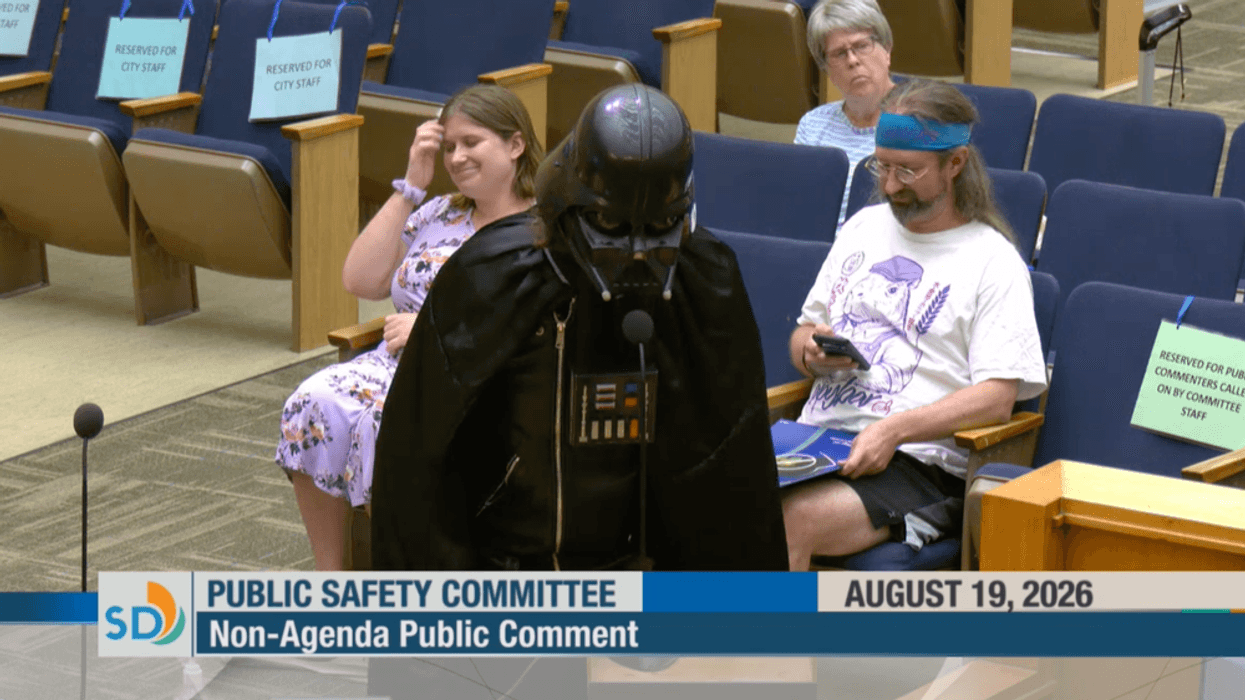
"We must continue utilizing Flock technologies so that we can follow and surveil the rebel scum as they move from playground to playground, from playground to pool, from pool to gymnasium."
Residents of San Diego are up in arms about Flock cameras. But for those seeking to keep tabs on "rebel scum," the omnipotent surveillance technology has its uses.
That's according to one Darth Vader, who took the podium during the public comment period at a Public Safety and Livable Neighborhoods Committee Meeting in the California city on Wednesday night to sing, or more accurately, bellow his praises for the company, whose automatic license-plate reading (ALPR) cameras are fast being installed around the nation.
"The emperor is a fan of Flock, and we must continue utilizing Flock technologies so that we can follow and surveil the rebel scum as they move from playground to playground, from playground to pool, from pool to gymnasium," the person dressed as the infamous Star Wars villain said.
"Because we all know that the Flock cameras are not only following the license [plates]; they are following children. They are following children in parks and gymnasiums, and we need this," the sith lord continued. "I need this so I can stalk my ex-girlfriend."
There are more than 550 Flock cameras installed across the city of San Diego, according to a public database by the activist group DeFlock.
And while the person who embodied the dark lord has not yet been identified, the satirical performance gave voice to some of the well-documented ways that the technology has been used to create a nationwide panopticon that enables widespread warrantless spying.
One database published earlier this month by the Institute for Justice, a libertarian nonprofit law firm, found over 100 documented cases of police using the technology for “romantic stalking, wrongful stops and detentions, non-law enforcement use, and other types of misconduct.”
Vader was also not exaggerating about the use of Flock cameras to spy on children. As the Electronic Frontier Foundation (EFF), an internet-focused civil liberties group, found, some school districts have enlisted cops to track families in order to root out "residency fraud" and prove that they live in the district.
"A search of ALPR data will show a lot more than whether a family lives within the right zone," wrote Dave Maass, EFF’s director of investigations, and Rindala Alajaji, a legislative activist with the group. "Every time a plate is searched, it can reveal personal information about a family: when they go to the doctor, when they go to worship, when they go out at night, and where they travel on vacation. None of that is the school district's business, and these searches are a huge invasion of privacy."

Critics like Fight for the Future fear that "these bills would allow Trump's FTC to wipe abortion, sex ed, and LGBTQ resources off the internet while instating nationwide age verification requirements."
The US Senate Commerce Committee on Wednesday advanced a package of bills intended to protect children online, despite free speech and privacy concerns long raised by civil liberties groups about such proposals, particularly those that require or urge websites to implement age verification systems.
The panel moved forward the Kids Online Safety Act (KOSA)—versions of which have been considered in Congress for years—as well as the Children's Artificial Intelligence Toy Safety Act; the Children's Health, Advancement, Trust, Boundaries, and Oversight in Technology (CHATBOT) Act; and the Youth AI Privacy Act
Some advocacy groups welcomed the development, with Fairplay executive director Josh Golin saying that "the Senate version of KOSA is the most protective, popular, and bipartisan of all children's online safety legislation under consideration. It would be the most important new law to protect kids online in nearly 30 years."
"We are also pleased to see the committee advance both the Youth AI Privacy Act and the CHATBOT Act," Golin continued. "The danger AI chatbots pose to children and teens is a growing crisis. These bills would add deeply needed protections to help mitigate chatbot harms, including strong default settings for long-term memory use, a ban on advertising to minors through a chatbot, a ban on using the data of minors to train AI models, and prohibitions on features that cause compulsive use."
The committee did not advance the Shielding Children's Retinas from Egregious Exposure on the Net (SCREEN) Act, which would require pornography websites to verify users' ages so they can block minors, because low attendance led to a failure to meet quorum.
Ahead of the bill markup, the Center for Democracy & Technology wrote to committee Chair Ted Cruz (R-Texas) and Ranking Member Maria Cantwell (D-Wash.) to raise alarm about KOSA, the CHATBOT Act, and the SCREEN Act, while acknowledging that the Youth AI Privacy Act "would create important safeguards for the use of minors' data by generative AI services."
The group also stressed that "enacting comprehensive consumer privacy legislation that meaningfully realigns consumer expectations and incentives for online business models is the best path forward to protecting children and everyone online and to addressing root causes of harms related to minors’ activities on social media, generative AI models, and other internet-enabled services."
CDT supports tackling the data practices that put young people at risk. But proposals that encourage age verification or restrict access to lawful content risk undermining privacy and constitutional rights. Read our letter:
[image or embed]
— Center for Democracy & Technology (@cdt.org) August 5, 2026 at 12:09 PM
The Senate action came after a bipartisan vote by the House of Representatives in June to pass the Kids Internet and Digital Safety (KIDS) Act, which "took portions from 14 digital safety bills—including the SCREEN Act," as The Hill reported Wednesday. "The House's version of KOSA eliminated a 'duty of care' provision that is a redline for the Senate's co-authors, Sens. Marsha Blackburn (R-Tenn.) and Richard Blumenthal (D-Conn.), who called the package 'dead on arrival' in the Senate last month."
"The provision would have legally required platforms to 'exercise reasonable care' to prevent harms to minors. Harms include eating disorders, suicide, substance use disorders, and sexual exploitation," the outlet detailed. "The KIDS Act faces long odds in the Senate as a result, making Cruz's decision to take up some of the bills individually instead not surprising."
Earlier this week, the Electronic Frontier Foundation argued that "the Senate should reject KOSA's privacy risks," emphasizing that the duty of care obligations included in the upper chamber's version "only work if online services know which users are minors. That means more platforms will be pressured to implement age verification or age estimation systems."
Ahead of the House vote earlier this year, the ACLU's Jenna Leventoff and Christopher Anders similarly noted that "KOSA, although purporting not to require age verification, would nevertheless strongly incentivize it."
The ACLU experts warned that age verification will "severely jeopardize user privacy by turning droves of information over to platforms" and "threatens the First Amendment rights of adults," who may not be able "to verify their ages (because they lack valid identification, face technological difficulties, or lack digital skills), or can but "might still be reluctant to access information online over a fear that a data breach could lead to the disclosure of sensitive information contained within their browsing history."
After the Senate votes on Wednesday, Leventoff reiterated: "Bills that incentivize or require age verification promise safety, but all they deliver is a future where everyone has to undergo invasive identity verification measures that will almost certainly put their sensitive data at risk. We shouldn't need to fork over our IDs, biometrics, or personal information to access the internet, but that's exactly what will happen if these bills become law."
"When the data used to verify a users' age is combined with other commercially available data," she warned, "it can enable adversarial nations to track and attack troops, allow stalkers to locate their victims, and allow scammers to target those who will be most susceptible to their schemes."
Together, these bills would allow Trump’s FTC to wipe abortion, sex ed, & LGBTQ resources off the Internet while instating nationwide age verification requirements. This could mean scanning your face or sending in your government ID just to post on Bluesky! ❌Take action: fftf.link/bib
[image or embed]
— Fight for the Future (@fightforthefuture.org) August 4, 2026 at 12:09 PM
Fight for the Future also called out the Senate panel on Wednesday, with campaign director Sarah Philips saying that "Congress is once again doing political theater instead of actually meaningfully regulating the business model of Big Tech companies."
"The Senate Commerce Committee is rushing out bad internet bills so they can go out and campaign on them even knowing they are doomed to failure, either because they will be rejected by the House or overturned by the courts for being unconstitutional," Philips said. "Young people have been calling and emailing Congress on this issue for years, and have been rallying around the world against proposals to fence them off from the internet for a reason. They can see through these efforts. They know more censorship and surveillance, more data collection for companies, and all of us having to turn over ID in order to interact online is not safety."
"We've had hearing after hearing on this issue for the last few years instead of actually moving against the tide of tech corporate power that is making our future unlivable and exploiting our data for profit," Philips added. "We want to protect kids, but we want those proposals to actually do the work, instead of just making an easy headline for congressional leadership. Anyone in Congress still pushing censorship and surveillance bills under the facade of kids safety has failed us, especially members that claim to support trans kids and every community currently being attacked by the Trump administration."

"Age verification requirements will help the Trump administration carry out its vendetta against the press by creating new avenues to identify journalists’ confidential sources," warned two press freedom advocates.
Opponents of a bill that is purported to protect children online said Monday night, after the legislation passed in the US House, that laws are "urgently" needed to stop Big Tech companies from preying on kids' vulnerabilities.
"The KIDS Act is not that piece of legislation," said Rep. Pramila Jayapal (D-Wash.), who was one of 117 lawmakers who voted against the Kids Internet and Digital Safety (KIDS) Act, which passed with 267 votes, while 47 members of Congress did not vote.
The bipartisan bill requires online platforms to use new safety features and parental controls, restricts the use of minors' personal data to target ads, and establishes new restrictions for AI chatbots and online games.
But ahead of the bill's passage, the Electronic Frontier Foundation (EFF) was among the opponents raising alarm about other provisions "buried inside the KIDS Act" that would "push online services to verify all users’ ages, require government-directed moderation policies for online speech, and even create new rules about private and encrypted communications."
The legislation, drawing from portions of 14 different online safety bills, "is a mess, with different age-gating schemes for different services, using different standards," wrote EFF senior policy analyst Joe Mullin. "It’s a lot of complexity, and a lot of legal risk. Faced with that, many companies will conclude that the safest option is restrictive age-checking practices across their entire platforms."
As Mullin explained:
Throughout the KOSA section of the legislation, special protections, controls, messaging settings, and parental tools are required whenever a website or app “knows or should have known” a user is a child (defined in the bill as anyone under 13) or a teen (defined as anyone between 13 and 16 years old).
The problem is a website operator doesn’t need actual knowledge that a user is a minor to get in legal trouble. It applies when a platform “knows or should have known” a user’s age—a low, negligence-style standard of knowledge. If an online service gets it wrong, it’s going to be up to courts and regulators to decide, after the fact, if an online service “should” have known a user was 16.
To try to avoid liability, services will have to determine which users are teenagers and which are not. Most won’t be able to simply trust their users. They’ll have to collect more information about age, before any lawsuit or government action arises. Some companies may respond by requesting driver's licenses or passports. Others will rely on age-estimation systems that attempt to guess users' ages by looking at existing activity or doing facial scans.
At The Intercept, Caitlin Vogus of the Freedom of the Press Foundation and Aliya Bhatia of the Center for Democracy and Technology’s Free Expression Project warned ahead of the bill's passage that while the legislation is ostensibly meant to protect children, the age verification requirement could impact all users' ability to access social media platforms without revealing their identities—chilling anonymous speech and threatening would-be whistleblowers.
"Threats to online anonymity harm everyone, but one group is often overlooked: journalists and the sources who talk to them," wrote Vogus and Bhatia. "Age verification requirements will help the Trump administration carry out its vendetta against the press by creating new avenues to identify journalists’ confidential sources."
While the KIDS Act says it won't require online platforms to collect government IDs for age verification, they said, "at least some platforms will likely choose this route to comply with the law or offer it as a fallback approach when other methods inevitably fail."
Former Republican congressman Justin Amash, a libertarian, accused the lawmakers who voted "yes" on the legislation of betraying "the Constitution and the American people."
Other opponents of the legislation, including Jayapal, argued that the bill would allow tech companies to continue targeting children with algorithms that send harmful content to the youngest users.
The legislation omits a "duty of care" provision that was included in the Kids Online Safety Act (KOSA), which was passed by the US Senate in 2024—a requirement that tech firms "exercise reasonable care” to prevent harms to children.
Jayapal noted that the bill, which faces an uphill battle in the Senate, leaves "suicide, depression, addiction, substance use disorders, and eating disorders from the list of harms" that tech companies like Meta must address in their algorithms.
The "duty of care" provision has been criticized as too vague by several digital rights groups, while some child safety groups said its omission in the KIDS Act would "let Big Tech off the hook."
"We have seen time and again that these corporations cannot be trusted to put children's safety over their own profit margins," said Jayapal. "We cannot keep exposing our kids to platforms that are either completely indifferent to their safety or a direct threat to it."
The KIDS Act, Jayapal said, also includes provisions "that do not do enough to actually address the harms of" artificial intelligence.
"I voted no," said Jayapal, "because we have a real opportunity to pass bipartisan legislation that holds these companies to not just be transparent about the harms and mitigate them, but to actually prevent them."

"We won't allow President Trump and Stephen Miller to continue invading our privacy," said the ACLU.
President Donald Trump took to his Truth Social platform on Wednesday to call for a "clean" extension of a key spying power as lawmakers across the political spectrum and privacy advocates throughout the United States demand reforms before Congress passes a reauthorization bill.
Section 702 of the Foreign Intelligence Surveillance Act (FISA) empowers the US government to spy on electronic communications of noncitizens located outside the country, without a warrant. It expires April 20. House Speaker Mike Johnson (R-La.) planned to try to push through legislation this week, but he delayed it due to a lack of support.
Trump noted Wednesday that Johnson and Senate Majority Leader John Thune (R-SD) have been working to pass a clean extension. He said that "when used properly, FISA is an effective tool to keep Americans safe," and called for reauthorizing the power for 18 months.
"HOWEVER, the Critical and Common Sense Reforms that were made in the last Reauthorization of FISA must remain intact to protect the American People from abuses. Nobody understands this better than me, as I was a victim of the worst and most illegal abuse of FISA in our Nation's History, by Radical Left Lunatics who lied to the FISA Court to spy on my 2016 Presidential Campaign in their attempt to RIG the Election in favor of Crooked Hillary Clinton," the president continued.
"That is why, since the first day of my already Historic Second Term, my Administration has worked tirelessly to ensure these Reforms are being aggressively executed at every level of the Executive Branch to keep Americans safe, while protecting their sacred Civil Liberties guaranteed by our Great Constitution," Trump claimed, before trying to use his war on Iran—which has not been authorized by Congress—to make the case for a swift reauthorization.
"With the ongoing successful Military activities against the Terrorist Iranian Regime, it is more important than ever that we remain vigilant, PROTECT our Homeland, Troops, and Diplomats stationed abroad, and maintain our ability to quickly stop bad actors seeking to cause harm to our People and our Country," he said. "The fact is, whether you like FISA or not, it is extremely important to our Military. I have spoken to many Generals about this, and they consider it vital. Not one said, even tacitly, that they can do without it—especially right now with our brilliant Military Operation in Iran."
The controversial law known as FISA Section 702 is up for renewal in Congress. It allows government to spy on Americans’ communications without a warrant.Use our action center to tell Congress to reform Section 702 and end mass warrantless surveillance!
[image or embed]
— Freedom of the Press Foundation (@freedom.press) March 22, 2026 at 7:35 PM
Sharing Trump's Truth post on the social media platform X, Politico's Jordain Carney noted that "he's been telling people for a while privately this is what he wants."
Carney and her colleagues reported last month that "Stephen Miller, the influential senior White House domestic policy adviser, is a leading advocate within the administration for extending the program that lets the government collect the data of noncitizens abroad without a warrant."
Critics of a clean extension have argued that, as more than 90 groups said in a letter earlier this month, "supporting Stephen Miller's warrantless surveillance agenda would be a massive detriment to the privacy and civil rights and liberties of people in the United States."
We won't allow President Trump and Stephen Miller to continue invading our privacy.Tell Congress to refuse to reauthorize Section 702 of the Foreign Intelligence Surveillance Act, which would expand the federal government's power to secretly spy on us.
[image or embed]
— ACLU (@aclu.org) March 24, 2026 at 9:31 AM
Section 702 was last reauthorized in April 2024, during the Biden administration. Many critics of the spying power were unsatisfied with that legislation, the Reforming Intelligence and Securing America Act (RISAA).
As India McKinney, director of federal affairs at the Electronic Frontier Foundation, wrote Friday:
It's important to note RISAA was just a reauthorization of this mass surveillance program with a long history of abuse. Prior to the 2024 reauthorization, Section 702 was already misused to run improper queries on peaceful protesters, federal and state lawmakers, congressional staff, thousands of campaign donors, journalists, and a judge reporting civil rights violations by local police. RISAA further expanded the government's authority by allowing it to compel a much larger group of people and providers into assisting with this surveillance. As we said when it passed, overall, RISAA is a travesty for Americans who deserve basic constitutional rights and privacy whether they are communicating with people and services inside or outside of the US.
In the Section 702 debates over the years, critical members of Congress and advocacy groups have specifically called for a warrant requirement for Americans and closing the data broker loophole that intelligence and law enforcement agencies use to buy their way around the Fourth Amendment to the US Constitution, which is supposed to protect against unreasonable searches and seizures.
Reporting on the president's Wednesday push for a clean extension, The Hill highlighted that "Trump has gotten some notable lawmakers to move with him" on FISA, pointing to House Judiciary Chair Jim Jordan (R-Ohio) and Rep. Darrell Issa (R-Calif.), a former leader of the chamber's oversight panel, who are both supporting a clean extension.
McKinney called Jordan's shift "disappointing," and argued that "Section 702 should not be reauthorized without any additional safeguards or oversight."
She pointed to three bills—the Government Surveillance Reform Act, Protect Liberty and End Warrentless Surveillance Act, and Security and Freedom Enhancement Act—that she said are not "perfect," but "are all significantly better than the status quo."
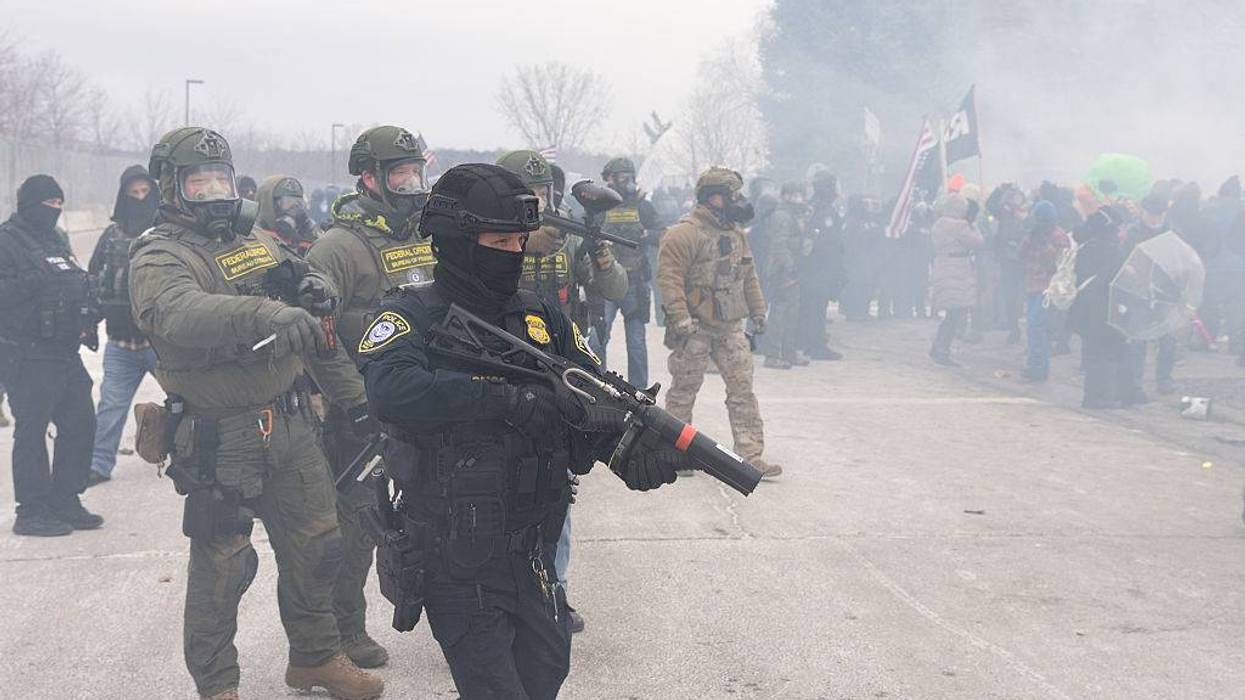
"Milquetoast calls for better identification, bodycams, and training fall far short of what is required of you to meet this moment."
A broad coalition of organizations is calling on the US Congress to block funding for the mass surveillance programs being used by federal immigration enforcement officials.
In a letter sent to members of Congress, the groups decry US Immigration and Customs Enforcement (ICE) agents for "leveraging a multi-billion dollar budget to terrorize our communities and build a surveillance panopticon" with no accountability from elected officials.
The letter then singles out several mass surveillance projects being carried out under the US Department of Homeland Security (DHS) that it says are worthy of defunding, including "building databases of biometrics, sensitive personal data, and daily movements of not only immigrants, but everybody in the US"; "purchasing technology to surveil all the phones in a neighborhood without a warrant"; and "recklessly relying on facial recognition technology that is banned in some states, and misusing that data to intimidate protesters and witnesses."
The groups call on Congress to completely defund ICE or, if that is not politically feasible, to "severely restrict what ICE can spend money on, including a complete moratorium on the purchase and use of surveillance tech" such as facial recognition and license plate readers.
"We urge you to do everything within your power in order to block ICE’s reign of terror in our communities and halt the build out of surveillance tech infrastructure that will make it impossible for everyday people to do anything at all without Big Brother watching," the groups conclude. "Milquetoast calls for better identification, bodycams, and training fall far short of what is required of you to meet this moment."
Signatories of the letter include the Yale Privacy Lab, digital rights organization Fight for the Future, and several local chapters of progressive political organizing group Indivisible.
ICE's big investments in surveillance technology were documented in an Electronic Frontier Foundation (EFF) report published earlier this month, which found ICE "is going on a shopping spree, creating one of the largest, most comprehensive domestic surveillance machines in history."
The EFF report highlighted the role played by Cellebrite, a company that helps ICE unlock protesters' phones and "take a complete image of all the data on the phone, including apps, location history, photos, notes, call records, text messages, and even Signal and WhatsApp messages."
This is particularly important, the report noted, because the number of phones searched by ICE and other agencies has been steadily increasing, hitting a record high last year.
ICE also has a contract with Paragon, the company behind the spyware Graphite that "is able to harvest messages from multiple different encrypted chat apps such as Signal and WhatsApp without the user ever knowing."
One critic predicted the policy would "exacerbate civil liberties harms" if enacted.
Visiting the US as a tourist could soon become significantly more onerous under a new plan being mulled by the Trump administration.
According to a Tuesday report in the New York Times, US Customs and Border Protection (CBP) this week filed a new proposal that would force visitors to submit up to five years' worth of social media posts for inspection before being allowed to enter the country.
In addition to social media history, CPB says it plans to ask prospective tourists to provide them with email addresses they've used over the last decade, as well as "the names, birth dates, places of residence, and birthplaces of parents, spouses, siblings, and children."
The policy would apply even to citizens of countries that have long been US allies, including the UK, Germany, Australia, and Japan, which have long been exempt from visa requirements.
Sophia Cope, a senior staff attorney for the Electronic Frontier Foundation, told the Times that the CBP policy would "exacerbate civil liberties harms."
Cope added that such policies have "not proven effective at finding terrorists and other bad guys" but have instead "chilled the free speech and invaded the privacy of innocent travelers, along with that of their American family, friends and colleagues."
Journalist Bethany Allen, head of China investigations at the Australian Strategic Policy Institute, expressed shock that the US would take such drastic measures to scrutinize the social media posts of tourists.
"Wow," she wrote in a post on X, "even China doesn't do this."
In addition to concerns about civil liberties violations, there are also worries about what the new policy would do to the US tourism industry.
The Times noted in its report that several tourism-dependent businesses last month signed a letter opposing an administration proposal to collect a $250 "visa integrity fee," and one travel industry official told the paper that the CBP's new proposal appears to be "a significant escalation in traveler vetting."
The American tourism industry has already taken a blow during President Donald Trump's second term, even without a policy of forcing tourists to share their social media history.
A report released on Wednesday from Democrats on the Senate's Joint Economic Committee (JEC) found that US businesses that have long depended on tourism from Canada to stay afloat have been getting hit hard, as Canadian tourists stay away in protest of Trump's trade war against their country.
Overall, the report found that "the number of passenger vehicles crossing the US-Canada border declined by nearly 20% compared to the same time period in 2024, with some states seeing declines as large as 27%."
Elizabeth Guerin, owner of New Hampshire-based gift shop Fiddleheads, told the JEC that Canadians used to make up to a quarter of her custom base, but now "I can probably count the number of Canadian visitors on one hand."
Christa Bowdish, owner of the Vermont-based Old Stagecoach Inn, told the JEC that she feared a long-term loss in Canadian customers, even if Trump ended his feud with the nation tomorrow.
"This is long-lasting damage to a relationship and emotional damage takes time to heal," she said. "While people aren’t visiting Vermont, they’ll be finding new places to visit, making new memories, building new family traditions, and we will not recapture all of that."

"This is what cruel, abusive men seeking to exert power over women do," said a pair of reproductive rights reporters.
Police in Texas—led by a county sheriff later charged with an unrelated felony sex crime—lied about their motive for using artificial intelligence-powered surveillance technology to search for a woman who allegedly self-administered a medication abortion, new documents obtained by 404 Media and Electronic Frontier Foundation revealed on Tuesday.
In May, 404 Media's Joseph Cox and Jason Koebler reported that the Johnson County Sheriff's Office tapped into 83,000 automatic license plate reader (ALPR) cameras manufactured by Flock Safety while conducting a nationwide search for an unnamed woman who authorities said took abortion medication in alleged violation of a 2021 state ban that empowers anti-abortion vigilantes to sue anyone who “aids or abets” the medical procedure.
Since thata law's passage—and the right-wing US Supreme Court's overturning of Roe v. Wade in Dobbs v. Jackson Women's Health Organization the following year—Texas has passed additional forced birth laws banning nearly all abortions as well as targeting providers who mail abortion pills from other states.
According to Cox and Koebler, Johnson County Sheriff's deputies accessed Flock cameras in states where abortion is legal, including Illinois and Washington. Johnson County Sheriff Adam King told 404 Media at the time that his department searched for the woman because "her family was worried that she was going to bleed to death, and we were trying to find her to get her to a hospital.”
“We weren’t trying to block her from leaving the state or whatever to get an abortion,” King said. “It was about her safety.”
NEW: Cops in Texas told 404 Media in May they used Flock to find a woman who self-administered an abortion out of concern for her safety. Documents now show police were conducting a “death investigation” and discussed whether they could charge her with a crime: www.404media.co/police-said-...
[image or embed]
— 404 Media (@404media.co) October 7, 2025 at 6:30 AM
King's office, forced birth advocates, and Flock Safety subsequently attempted to gaslight those who reported that deputies searched for the woman as part of a probe into potential violations of state laws.
However, new documents and court records obtained by the digital rights group Electronic Frontier Foundation (EFF) and shared with 404 Media show that Johnson County Sheriff's deputies initiated a "death investigation" of a "nonviable fetus" and discussed prosecuting the woman for allegedly self-administering an abortion.
"To no one's surprise, they were full of shit," Jessica Valenti and Kylie Cheung wrote Tuesday for Valenti's Abortion, Every Day Substack.
As EFF's Dave Maass and Rindala Alajaji noted:
In recent years, anti-abortion advocates and prosecutors have increasingly attempted to use “fetal homicide” and “wrongful death” statutes—originally intended to protect pregnant people from violence—to criminalize abortion and pregnancy loss. These laws, which exist in dozens of states, establish legal personhood of fetuses and can be weaponized against people who end their own pregnancies or experience a miscarriage.
In fact, a new report from Pregnancy Justice found that in just the first two years since the Supreme Court’s decision in Dobbs, prosecutors initiated at least 412 cases charging pregnant people with crimes related to pregnancy, pregnancy loss, or birth—most under child neglect, endangerment, or abuse laws that were never intended to target pregnant people. Nine cases included allegations around individuals’ abortions, such as possession of abortion medication or attempts to obtain an abortion—instances just like this one. The report also highlights how, in many instances, prosecutors use tangentially related criminal charges to punish people for abortion, even when abortion itself is not illegal.
"By framing their investigation of a self-administered abortion as a 'death investigation' of a 'nonviable fetus,' Texas law enforcement was signaling their intent to treat the woman’s self-managed abortion as a potential homicide, even though Texas law does not allow criminal charges to be brought against an individual for self-managing their own abortion," Maass and Alajaji added.
Valenti and Cheung asserted that "this is what cruel, abusive men seeking to exert power over women do: harass them over their abortions."
They were referring not only to the Texas woman's "vindictive, controlling partner" who tipped off police—and was later convicted of pistol-whipping and choking her—but also to King, who, despite being recently arrested and indicted on four felony sexual harassment charges, was allowed to return to work part-time. King was also previously indicted in August for alleged sexual harassment and corrupt influence for allegedly retaliating against a witness.
"These are the kind of men who target women for their abortions," Valenti and Cheung wrote. "It’s a trend that AED warned about in our 2025 predictions: that the anti-abortion movement would increasingly rely on aggrieved and abusive men to do their dirty work."
They continued:
Since November, top Texas-based anti-abortion activists have bragged about recruiting men to sue over their partner’s abortions. Jonathan Mitchell is one of the anti-abortion attorneys leading that charge: after his client Marcus Silva sued his ex’s friends over her abortion, he tried to use the case to blackmail her into resuming a sexual relationship. At this point, even Texas Attorney General Ken Paxton is reportedly recruiting men for this purpose.
"This isn’t about a few bad actors—but the predictable outcome of living in a reproductive police state bent on surveillance and punishment," Valenti and Cheung said. "And in a moment when pregnancy criminalization is on the rise, it’s vital we understand how this police state operates."
The willingness of Republicans including US Vice President JD Vance to embrace the tracking of women who have or are seeking abortions has raised alarms among reproductive rights advocates.
"Reproductive dragnets are not hypothetical concerns. These surveillance tactics open the door for overzealous, anti-abortion state actors to amass data to build cases against people for their abortion care and pregnancy outcomes," Ashley Kurzweil, senior policy analyst in reproductive health and rights at the National Partnership for Women & Families, told 404 Media Tuesday.
“Law enforcement exploitation of mass surveillance infrastructure for reproductive health criminalization promises to be increasingly disruptive to the entire abortion access and pregnancy care landscape," Kurzweil added. "The prevalence of these harmful data practices and risks of legal action drive real fear among abortion seekers and helpers—even intimidating people from getting the care they need."
One watchdog leader noted that the president's deal involves "one of his major crypto business partners that generates tens of millions of dollars a year for the Trump family."
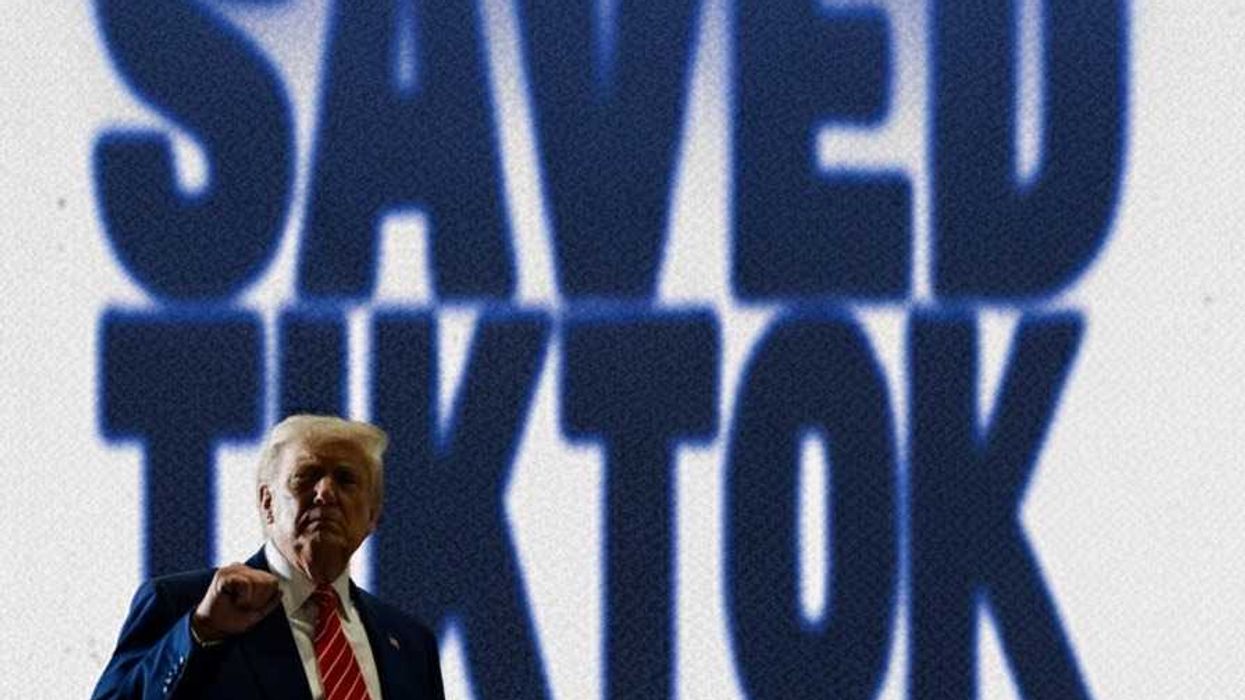
President Donald Trump on Thursday issued an executive order claiming to "save" TikTok from a federal law that would ban the video-sharing platform in the United States, but critics are condemning the Republican's deal as yet another case of him "picking winners and losers in government policy based on who is enriching his family."
Trump initially kicked off efforts to force TikTok's Chinese parent company ByteDance to divest with an August 2020 executive order, but Democratic former President Joe Biden signed the bipartisan legislation that would ban the platform based on national security concerns last year.
Since returning to office, Trump has pledged to "save" TikTok, delaying enforcement of the law and negotiating a deal under which, according to a White House fact sheet, the US application "will be majority-owned by US investors, operated in the US by a board of directors with national security and cybersecurity credentials, and subject to strict rules to protect Americans' data and our national security."
The fact sheet also confirms that "ByteDance will hold less than 20% of the stock as required by law," and "Oracle—one of the nation's leading technology companies—will act as TikTok’s security provider and independently monitor and assure the safety of all operations in the US."
Critics have expressed alarm about both the anticipated quality of the US platform and the reported investors.
OpenSecrets noted Thursday that Oracle co-founder Larry Ellison is "a Trump supporter and major bankroller of Republican candidates and causes," and the company "has spent at least $11 million on federal-level government lobbying during each of the past four full years," a trend that is set to continue this year.
Citing unnamed sources, CNBC reported Thursday that, in addition to Oracle, the main investors will be Silver Lake and Abu Dhabi's MGX. Previous reporting has also suggested involvement from venture capitalists Marc Andreessen and Ben Horowitz.
Trump on the TikTok deal: "Rupert Murdoch is involved."
[image or embed]
— Aaron Rupar (@atrupar.com) September 25, 2025 at 4:35 PM
While some opponents of the Trump plan have highlighted his ties to Ellison, Andreessen, and Horowitz, Tony Carrk, executive director of the watchdog group Accountable.US, focused on his relationship with MGX in a Thursday statement.
"President Trump's use of his office to enrich himself and his friends seems to know no bounds," Carrk said. "His grand scheme to 'save' TikTok just so happens to involve the enrichment of one of his major crypto business partners that generates tens of millions of dollars a year for the Trump family."
"That's no coincidence for the only US president in history that has seen his bottom line grow by billions from the White House," he asserted. "Meanwhile, working Americans see their costs continue to increase, from groceries to healthcare to housing. It's clear the president's priority is himself, not the rest of us."
Trump's Thursday order affirms that the deal complies with last year's law and allows another 120 days to finalize the details.
The Associated Press reported that "Trump said Thursday that Chinese leader Xi Jinping has agreed to move forward with it. However, the Chinese embassy in Washington didn't immediately respond to an AP inquiry seeking confirmation that China has formally signed off on the proposed framework deal."
US political leaders have long claimed that under ByteDance's control, users may encounter content favored by the Chinese government. The Electronic Frontier Foundation said earlier this week that "if the concern had been that TikTok could be a conduit for Chinese government propaganda—a concern the Supreme Court declined to even consider—people can now be concerned that TikTok could be a conduit for US government propaganda."
Joining Trump in the Oval Office for the executive order signing on Thursday, Vice President JD Vance seemed to confirm that's the plan, telling reporters that "the US company will have control over how the algorithm pushes content to users, and that was a very important part of it."
Responding to Vance's remarks, one social media user quipped, "Ahh, so it was just an issue of *whose* propaganda."
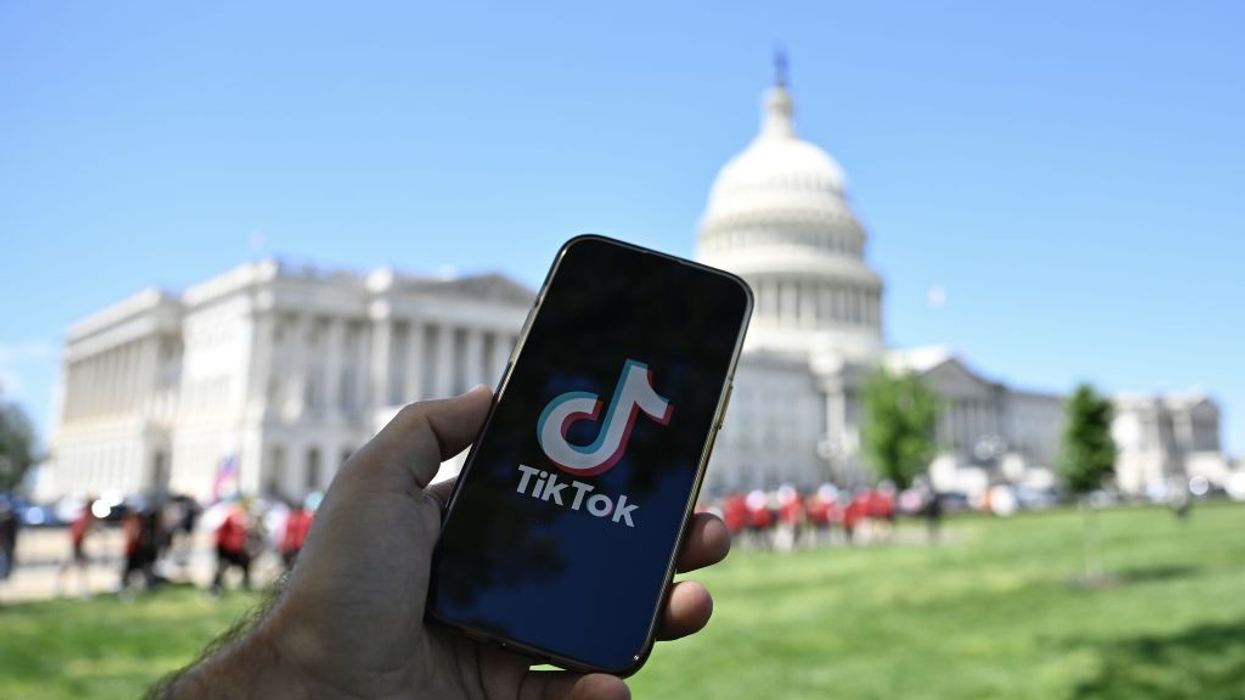
"People can now be concerned that TikTok could be a conduit for US government propaganda," said the Electronic Frontier Foundation.
As a prospective deal takes shape to hand partial ownership and control of social media giant TikTok to US tech giant Oracle, progressive critics are warning that it could soon become a source of pro-Trump propaganda while giving right-wing oligarchs another powerful media mouthpiece.
As reported by The Wall Street Journal last week, the current plan is to put TikTok's US business under the control of a consortium that will include Oracle, as well as investment firm Silver Lake, and venture capital firm Andreessen Horowitz.
Oracle was founded by Larry Ellison, who was one of Trump's first backers in Silicon Valley. Andreessen Horowitz's Marc Andreessen donated $2.5 million to Trump's super PAC during the 2024 election campaign and he currently serves as an economic adviser to the president.
In addition to those two, right-wing media mogul Rupert Murdoch and computer pioneer Michael Dell are also rumored to be part of the consortium.
The idea of the world's most popular video platform in the world being under the control of billionaire Trump allies has set off alarms among critics who warn that it could be used to sway public opinion with a barrage of MAGA propaganda.
The Electronic Frontier Foundation (EFF) pointed to statements made by Trump allies to warn that the TikTok deal could greatly damage the free flow of information in the US.
"If the concern had been that TikTok could be a conduit for Chinese government propaganda—a concern the Supreme Court declined to even consider—people can now be concerned that TikTok could be a conduit for US government propaganda," EFF said. "An administration official reportedly has said the new TikTok algorithm will be 'retrained' with US data to make sure the system is 'behaving properly.'"
New Yorker journalist Clare Malone wrote in a recent article that "the supposed national-security concerns of TikTok will go largely unaddressed" under the proposed deal, which she argued would do more to "bolster an emerging media conglomerate, under the auspices of the Ellison family, who are assiduously friendly to Trump."
To put this into perspective, wrote Malone, the Ellison family could soon "own a movie studio, multiple television streamers, two news networks, and have a significant stake in the world’s fastest-growing social-media platform, all while hosting the data of millions of users and providing much of the cloud-computing infrastructure that powers corporate America—a level of vertical integration that, even in an age of rapid consolidation, is unprecedented."
Former US Labor Secretary Robert Reich also noted that TikTok isn't the only media platform being eyed by Ellison.
"[Ellison's] media company owns CBS News and is plotting a bid for Warner Bros., which owns CNN," he wrote. "When billionaires take control of communication platforms, it’s not a win for free speech. It’s a win for oligarchy."
This major consolidation also caught the attention of former CBS News anchor Dan Rather, who recently told The Hollywood Reporter that he had serious concerns about the Ellisons buying up his one-time employer, as well as potentially owning CNN as well.
“I do think... without preaching about it, but that we, all of us, all the Americans, have to be concerned about the consolidation of huge billionaires getting control of nearly all of the major news outlets,” Rather said. “This is not healthy for the country, and it is something to worry about... It’s pretty hard to be optimistic about the possibilities of the Ellisons buying CNN.”
"This is a major constitutional ruling on one of the most abused provisions of FISA," said one ACLU leader. "Section 702 is long overdue for reform by Congress, and this opinion shows why."
"Better late than never."
That's how Electronic Frontier Foundation (EFF) surveillance litigation director Andrew Crocker and senior policy analyst Matthew Guariglia responded to a federal court ruling unsealed late Tuesday that found warrantless searches conducted under Section 702 of the Foreign Intelligence Surveillance Act (FISA) violate the Fourth Amendment to the U.S. Constitution.
Section 702 allows for warrantless spying on noncitizens abroad to acquire foreign intelligence information—but that also leads to the collection of Americans' communications. Abuse of the related database, particularly by the Federal Bureau of Investigation (FBI), has led privacy advocates including EFF to demand that Congress pass significant reforms.
The December decision from U.S. District Judge LaShann DeArcy Hall in the Eastern District of New York, unsealed earlier this week, stems from over a decade of litigation in United States v. Hasbajrami. Agron Hasbajrami was arrested at a New York City airport in 2011 and charged with attempting to provide material support to a terrorist group. The U.S. resident pleaded guilty, and after he was serving his sentence, the government revealed some evidence was obtained without a warrant thanks to Section 702.
In 2017, EFF and the ACLU filed an amicus brief arguing to the U.S. Court of Appeals for the 2nd Circuit that "Section 702 surveillance, including the surveillance of Mr. Hasbajrami here, lacks safeguards for Americans that the Constitution requires." In 2019, the appellate court "found that backdoor searches constitute 'separate Fourth Amendment events' and directed the district court to determine a warrant was required," Crocker and Guariglia explained Wednesday. "Now, that has been officially decreed."
Throughout the litigation, Congress has repeatedly reauthorized Section 702 on a bipartisan basis—most recently for two years last April, meaning it is unlikely to be debated on Capitol Hill again before next year. Still, pro-privacy campaigners and experts welcomed the district judge's recent ruling as a crucial victory and used it to renew calls for congressional action.
"This is a major constitutional ruling on one of the most abused provisions of FISA," Patrick Toomey, deputy director of ACLU's National Security Project, said in a Wednesday statement. "As the court recognized, the FBI's rampant digital searches of Americans are an immense invasion of privacy, and trigger the bedrock protections of the Fourth Amendment. Section 702 is long overdue for reform by Congress, and this opinion shows why."
Crocker and Guariglia argued that the Foreign Intelligence Surveillance Court—which has primary judicial oversight of Section 702—should immediately "amend its rules for backdoor searches and require the FBI to seek a warrant before conducting them."
In the longer term, the EFF experts wrote, "we ask Congress to uphold its responsibility to protect civil rights and civil liberties by refusing to renew Section 702 absent a number of necessary reforms, including an official warrant requirement for querying U.S. persons data and increased transparency."
"On April 15, 2026, Section 702 is set to expire," they added. "We expect any lawmaker worthy of that title to listen to what this federal court is saying and create a legislative warrant requirement so that the intelligence community does not continue to trample on the constitutionally protected rights to private communications."
Although Hall's ruling was issued against the Biden administration, it was unsealed a day after Republican U.S. President Donald Trump returned to power—backed by narrow GOP majorities in both chambers of Congress. Patrick G. Eddington, a senior fellow in homeland security and civil liberties at the Cato Institute, a libertarian think tank, wondered Wednesday, "Will the new Trump administration appeal the decision?"
"Attorney general nominee Pam Bondi testified under oath at her confirmation hearing that she supported the FISA Section 702 program, though the issue of warrantless 'backdoor' searches did not come up as I recall," Eddington noted.
Tulsi Gabbard, Trump's pick for director of national intelligence "has gone from FISA Section 702
opponent to supporter in record time," he added. "Assuming Gabbard gets a confirmation hearing, asking her about Hall's ruling should be the first question posed to her."