SUBSCRIBE TO OUR FREE NEWSLETTER
Daily news & progressive opinion—funded by the people, not the corporations—delivered straight to your inbox.
5
#000000
#FFFFFF
To donate by check, phone, or other method, see our More Ways to Give page.
We're barely more than a week into 2013, but Michigan has been very busy lately. As a pre-holiday gift to workers, Governor Rick Snyder signed a "right-to-work" bill into law after the Republican-controlled state house passed it 58-51, making the payment of union dues voluntary for most unions and thus severely weakening their power. Just over two weeks later, Snyder signed another bill into law restricting abortion access for the state's women. The bill prohibits telemedicine prescriptions for medical abortion, hampers clinics with new costly and challenging requirements and places new barriers between women and the procedure they seek through "coercion screenings."

Michigan already holds the distinction of being one of the worst states for women's pay equity. It ranks number seven at the bottom of the list, with women making just seventy-four cents for every dollar Michigan men earn. The right-to-work bill will only make this problem worse. The Economic Policy Institute has found that these laws lower wages for both union and nonunion workers in a state by an average of $1,500 per year. That's a huge amount of money to lose for women who are already behind. Meanwhile, it finds no link between these laws and economic growth. In fact, if Michigan wanted to change its place at the bottom of the list for paying women equally, it would be promoting unionization. A study by Center for Economic and Policy Research found that unionization raised women's wages by over 11 percent, or about $2 per hour, compared to non-union women. Being in a union makes a woman more likely to have health insurance or a pension than getting a four-year college degree.
The low-income women who will bring in less in the wake of the right-to-work law will also now likely have to shell out more money should they have an unwanted pregnancy. They already likely struggle to pay for abortion, as the state prohibits public funding for the procedure to women who are enrolled in state medical assistance program except if the pregnancy threatens her life or is the result of rape or incest. But the new bill will go further. The new regulations that abortion clinics will have to meet could be so costly that clinics could be forced to close their doors. That would mean women who seek abortions would have to travel farther away--an expense in itself, on top of the cost of taking any time off work. By also reducing access to telemedicine, even more women would be cut off from services. Low-income and rural women who don't have doctors nearby are able to access safe and necessary abortion services remotely through telemedicine--but that's now prohibited.
This should already make you infuriated. But the worst part may be that Michigan is far from unique. Many other states pushed anti-union measures last year. Indiana also became a right-to-work state. New Hampshire and Minnesota pushed to join that group. Few can forget Wisconsin Governor Scott Walker's attacks on collective bargaining rights. Arizona and South Dakota tried the same thing. Meanwhile, state capitols were also busy restricting women's right to choose. According to the Guttmacher Institute, last year saw the second-highest number of abortion restrictions ever--ever in the country's history--only bested by 2011, which still holds the record. Over half of those laws happened in just a handful of states, including some of the ones pushing anti-union measures like Arizona, Wisconsin and South Dakota.
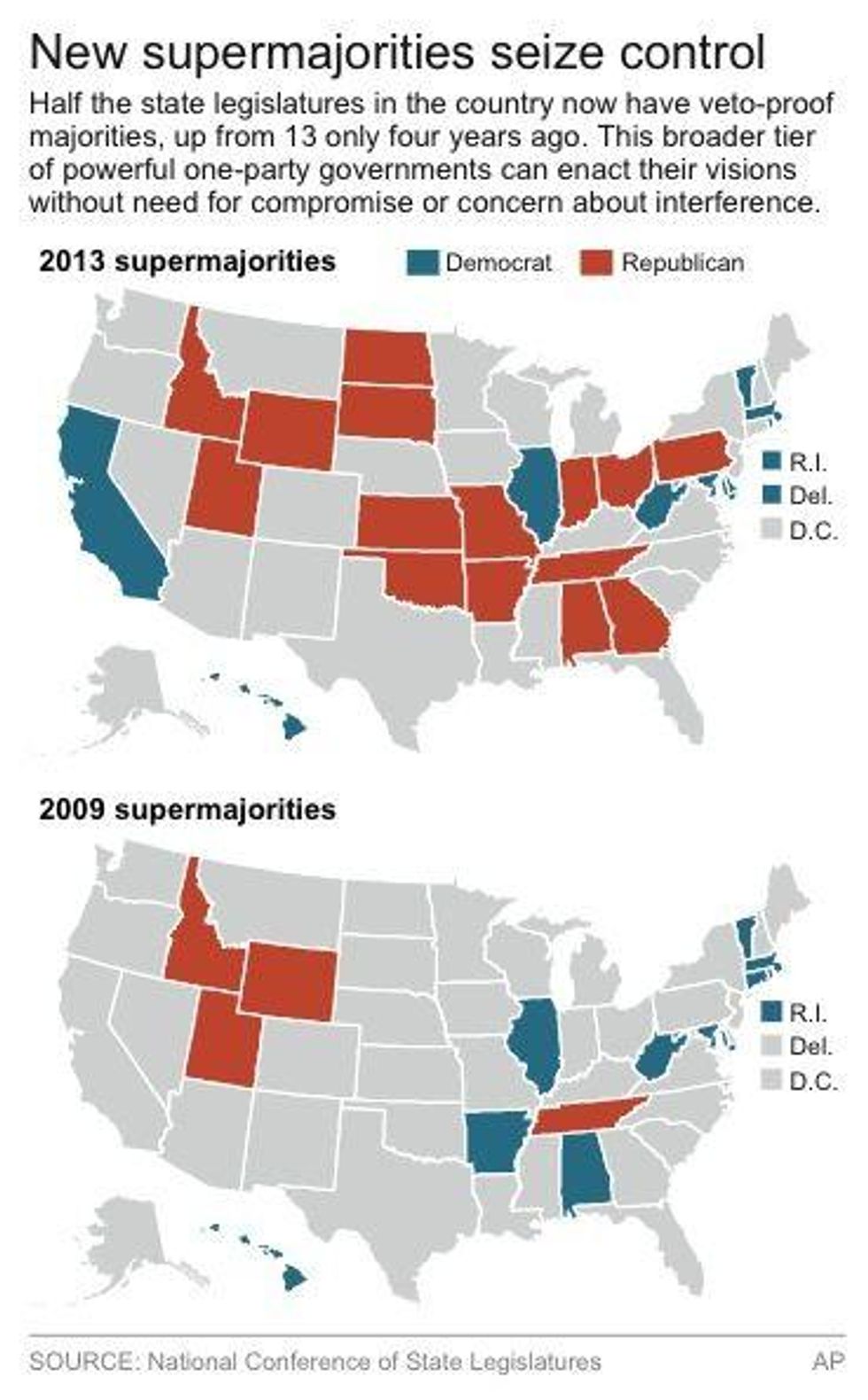
Don't expect 2013 to go any better. Half of all state legislatures now have veto-proof majorities, able to ram through their agendas without hindrance, up from thirteen only four years ago. All but three states, Iowa, Kentucky and New Hampshire, have one-party control. This means that Democrats run some states, but Republicans now have supermajority control in fifteen states, a lot more than the nine that Dems hold. See the map:
The groups behind Michigan's right-to-work bill are vowing to push for the same measure in other states. The crushing tide of bills that attack reproductive rights is likely to roll on--four states already have plans to move ahead with such efforts. And low-income women will continue to be the primary victims of both efforts. That's no coincidence--but it should embolden the opposition to work together in combating the right-wing state-level agenda.
For more on state-level poverty politics, check out Melissa Harris-Perry's panel segment from this weekend.
We're barely more than a week into 2013, but Michigan has been very busy lately. As a pre-holiday gift to workers, Governor Rick Snyder signed a "right-to-work" bill into law after the Republican-controlled state house passed it 58-51, making the payment of union dues voluntary for most unions and thus severely weakening their power. Just over two weeks later, Snyder signed another bill into law restricting abortion access for the state's women. The bill prohibits telemedicine prescriptions for medical abortion, hampers clinics with new costly and challenging requirements and places new barriers between women and the procedure they seek through "coercion screenings."
Michigan already holds the distinction of being one of the worst states for women's pay equity. It ranks number seven at the bottom of the list, with women making just seventy-four cents for every dollar Michigan men earn. The right-to-work bill will only make this problem worse. The Economic Policy Institute has found that these laws lower wages for both union and nonunion workers in a state by an average of $1,500 per year. That's a huge amount of money to lose for women who are already behind. Meanwhile, it finds no link between these laws and economic growth. In fact, if Michigan wanted to change its place at the bottom of the list for paying women equally, it would be promoting unionization. A study by Center for Economic and Policy Research found that unionization raised women's wages by over 11 percent, or about $2 per hour, compared to non-union women. Being in a union makes a woman more likely to have health insurance or a pension than getting a four-year college degree.
The low-income women who will bring in less in the wake of the right-to-work law will also now likely have to shell out more money should they have an unwanted pregnancy. They already likely struggle to pay for abortion, as the state prohibits public funding for the procedure to women who are enrolled in state medical assistance program except if the pregnancy threatens her life or is the result of rape or incest. But the new bill will go further. The new regulations that abortion clinics will have to meet could be so costly that clinics could be forced to close their doors. That would mean women who seek abortions would have to travel farther away--an expense in itself, on top of the cost of taking any time off work. By also reducing access to telemedicine, even more women would be cut off from services. Low-income and rural women who don't have doctors nearby are able to access safe and necessary abortion services remotely through telemedicine--but that's now prohibited.
This should already make you infuriated. But the worst part may be that Michigan is far from unique. Many other states pushed anti-union measures last year. Indiana also became a right-to-work state. New Hampshire and Minnesota pushed to join that group. Few can forget Wisconsin Governor Scott Walker's attacks on collective bargaining rights. Arizona and South Dakota tried the same thing. Meanwhile, state capitols were also busy restricting women's right to choose. According to the Guttmacher Institute, last year saw the second-highest number of abortion restrictions ever--ever in the country's history--only bested by 2011, which still holds the record. Over half of those laws happened in just a handful of states, including some of the ones pushing anti-union measures like Arizona, Wisconsin and South Dakota.
Don't expect 2013 to go any better. Half of all state legislatures now have veto-proof majorities, able to ram through their agendas without hindrance, up from thirteen only four years ago. All but three states, Iowa, Kentucky and New Hampshire, have one-party control. This means that Democrats run some states, but Republicans now have supermajority control in fifteen states, a lot more than the nine that Dems hold. See the map:
The groups behind Michigan's right-to-work bill are vowing to push for the same measure in other states. The crushing tide of bills that attack reproductive rights is likely to roll on--four states already have plans to move ahead with such efforts. And low-income women will continue to be the primary victims of both efforts. That's no coincidence--but it should embolden the opposition to work together in combating the right-wing state-level agenda.
For more on state-level poverty politics, check out Melissa Harris-Perry's panel segment from this weekend.
We're barely more than a week into 2013, but Michigan has been very busy lately. As a pre-holiday gift to workers, Governor Rick Snyder signed a "right-to-work" bill into law after the Republican-controlled state house passed it 58-51, making the payment of union dues voluntary for most unions and thus severely weakening their power. Just over two weeks later, Snyder signed another bill into law restricting abortion access for the state's women. The bill prohibits telemedicine prescriptions for medical abortion, hampers clinics with new costly and challenging requirements and places new barriers between women and the procedure they seek through "coercion screenings."
Michigan already holds the distinction of being one of the worst states for women's pay equity. It ranks number seven at the bottom of the list, with women making just seventy-four cents for every dollar Michigan men earn. The right-to-work bill will only make this problem worse. The Economic Policy Institute has found that these laws lower wages for both union and nonunion workers in a state by an average of $1,500 per year. That's a huge amount of money to lose for women who are already behind. Meanwhile, it finds no link between these laws and economic growth. In fact, if Michigan wanted to change its place at the bottom of the list for paying women equally, it would be promoting unionization. A study by Center for Economic and Policy Research found that unionization raised women's wages by over 11 percent, or about $2 per hour, compared to non-union women. Being in a union makes a woman more likely to have health insurance or a pension than getting a four-year college degree.
The low-income women who will bring in less in the wake of the right-to-work law will also now likely have to shell out more money should they have an unwanted pregnancy. They already likely struggle to pay for abortion, as the state prohibits public funding for the procedure to women who are enrolled in state medical assistance program except if the pregnancy threatens her life or is the result of rape or incest. But the new bill will go further. The new regulations that abortion clinics will have to meet could be so costly that clinics could be forced to close their doors. That would mean women who seek abortions would have to travel farther away--an expense in itself, on top of the cost of taking any time off work. By also reducing access to telemedicine, even more women would be cut off from services. Low-income and rural women who don't have doctors nearby are able to access safe and necessary abortion services remotely through telemedicine--but that's now prohibited.
This should already make you infuriated. But the worst part may be that Michigan is far from unique. Many other states pushed anti-union measures last year. Indiana also became a right-to-work state. New Hampshire and Minnesota pushed to join that group. Few can forget Wisconsin Governor Scott Walker's attacks on collective bargaining rights. Arizona and South Dakota tried the same thing. Meanwhile, state capitols were also busy restricting women's right to choose. According to the Guttmacher Institute, last year saw the second-highest number of abortion restrictions ever--ever in the country's history--only bested by 2011, which still holds the record. Over half of those laws happened in just a handful of states, including some of the ones pushing anti-union measures like Arizona, Wisconsin and South Dakota.
Don't expect 2013 to go any better. Half of all state legislatures now have veto-proof majorities, able to ram through their agendas without hindrance, up from thirteen only four years ago. All but three states, Iowa, Kentucky and New Hampshire, have one-party control. This means that Democrats run some states, but Republicans now have supermajority control in fifteen states, a lot more than the nine that Dems hold. See the map:
The groups behind Michigan's right-to-work bill are vowing to push for the same measure in other states. The crushing tide of bills that attack reproductive rights is likely to roll on--four states already have plans to move ahead with such efforts. And low-income women will continue to be the primary victims of both efforts. That's no coincidence--but it should embolden the opposition to work together in combating the right-wing state-level agenda.
For more on state-level poverty politics, check out Melissa Harris-Perry's panel segment from this weekend.