SUBSCRIBE TO OUR FREE NEWSLETTER
Daily news & progressive opinion—funded by the people, not the corporations—delivered straight to your inbox.
5
#000000
#FFFFFF
To donate by check, phone, or other method, see our More Ways to Give page.
But the longer history of this special place belongs to the indigenous people of Alaska. The term nan kat in Gwich'in Athabascan translates into 'on the land'.
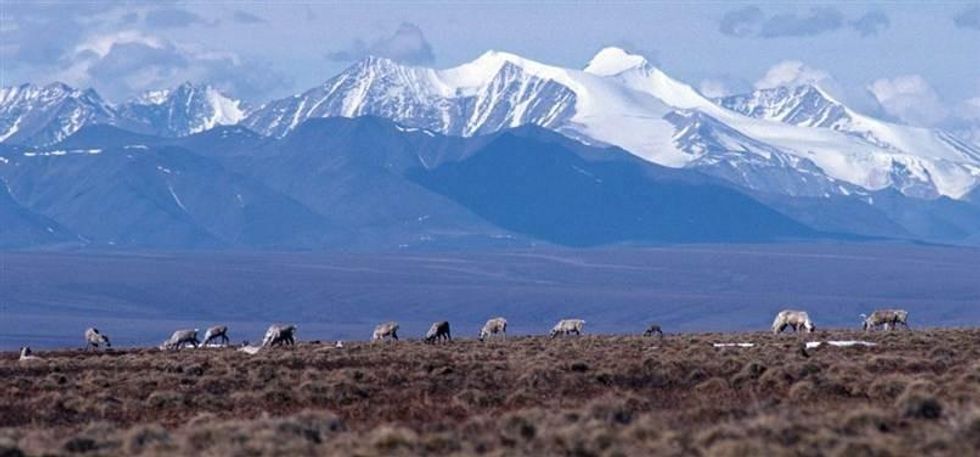
It is this land, today referred to as the Arctic National Wildlife Refuge that is the home to hundreds of species of birds and animals and it is the coastal plain of the Refuge that is the birthplace and nursery grounds of the Porcupine Caribou Herd. Each spring, between 40-50,000 calves are born there. It is because of the vadzaih - the caribou - that we as Gwich'in people have been able to maintain our way of life. For thousands of years we depended upon this herd for our sustenance, for clothing, shelter, tools and even games. To this day, the Porcupine Caribou now 170,000 strong continues to feed thousands of Gwich'in men, women, and children living in the remote Arctic villages scattered along the migratory route of the herd in both Northeast Alaska and Northwest Canada.
Every society needs sacred places.
Another Gwich'in term explains much of our relationship to the caribou and that is gwintl'ee daachii or 'the animal gave itself up for sustenance'. In this way, we are living with the understanding that there is a balance to life and that we must take care of and respect the land and animals. This is why, in 1988, with an increased threat of oil and gas development in the birthplace and nursery grounds of the Porcupine Caribou Herd, the Gwich'in Nation came together and agreed unanimously to speak with one voice in opposition to oil and gas development. To accomplish this task the communities established the Gwich'in Steering Committee. This coming summer will mark 25 years of the Gwich'in Steering Committee's efforts to protect the Arctic Refuge and our way of life.
The late Native American scholar and activist Vine Deloria, Jr. said:
"Every society needs sacred places. A society that cannot remember its past, and honor it, is in peril of losing its soul."
The coastal plain of the Arctic National Wildlife Refuge is sacred. It is sacred, not only to the Gwich'in, but to millions of Americans who have time and time again voiced their steadfast support of permanent protection of the Refuge. After all, Webster's definition of a 'refuge' is: a shelter, a place that gives protection from danger or distress. And the Arctic Refuge lives up to this name. Most recently, the Fish & Wildlife Service received close to a million comments in support of Wilderness for the Arctic Refuge the results of which we hope to see at the end of January 2013.
In a world of climate change, the Refuge has become increasingly important to polar bears who den and nurse their young on the coastal plain and are the first vertebrate species to be listed by the US Endangered Species Act as threatened by extinction due to climate change. Additionally, of the entire North Slope of Alaska the Arctic Refuge is the only 5% that is protected by law from oil leasing and development. I don't think that Presidents Eisenhower and Carter, or Mardy Murie and all the many notable activists that have worked on protecting the Arctic Refuge could have foreseen the great peril that the world is in today or how significant this Refuge would become.
For the Gwich'in, we are grateful that so many see the logic in protecting the Arctic National Wildlife Refuge. To open the Refuge up to oil and gas development would take an act of Congress and if this travesty were to occur it would set a precedent for the United States that no place is truly protected, no place is truly sacred.
Today though, a grandmother up in Arctic Village, Alaska is preparing a pot of caribou soup for her grandchildren. Today we give thanks for our ancestors, for the caribou that gave itself up so that we can survive, and we give thanks for the many, many good people in the world who are doing all they can to protect our Mother Earth for future generations. Happy birthday, Arctic National Wildlife Refuge, may we see many more to come!
But the longer history of this special place belongs to the indigenous people of Alaska. The term nan kat in Gwich'in Athabascan translates into 'on the land'.
It is this land, today referred to as the Arctic National Wildlife Refuge that is the home to hundreds of species of birds and animals and it is the coastal plain of the Refuge that is the birthplace and nursery grounds of the Porcupine Caribou Herd. Each spring, between 40-50,000 calves are born there. It is because of the vadzaih - the caribou - that we as Gwich'in people have been able to maintain our way of life. For thousands of years we depended upon this herd for our sustenance, for clothing, shelter, tools and even games. To this day, the Porcupine Caribou now 170,000 strong continues to feed thousands of Gwich'in men, women, and children living in the remote Arctic villages scattered along the migratory route of the herd in both Northeast Alaska and Northwest Canada.
Every society needs sacred places.
Another Gwich'in term explains much of our relationship to the caribou and that is gwintl'ee daachii or 'the animal gave itself up for sustenance'. In this way, we are living with the understanding that there is a balance to life and that we must take care of and respect the land and animals. This is why, in 1988, with an increased threat of oil and gas development in the birthplace and nursery grounds of the Porcupine Caribou Herd, the Gwich'in Nation came together and agreed unanimously to speak with one voice in opposition to oil and gas development. To accomplish this task the communities established the Gwich'in Steering Committee. This coming summer will mark 25 years of the Gwich'in Steering Committee's efforts to protect the Arctic Refuge and our way of life.
The late Native American scholar and activist Vine Deloria, Jr. said:
"Every society needs sacred places. A society that cannot remember its past, and honor it, is in peril of losing its soul."
The coastal plain of the Arctic National Wildlife Refuge is sacred. It is sacred, not only to the Gwich'in, but to millions of Americans who have time and time again voiced their steadfast support of permanent protection of the Refuge. After all, Webster's definition of a 'refuge' is: a shelter, a place that gives protection from danger or distress. And the Arctic Refuge lives up to this name. Most recently, the Fish & Wildlife Service received close to a million comments in support of Wilderness for the Arctic Refuge the results of which we hope to see at the end of January 2013.
In a world of climate change, the Refuge has become increasingly important to polar bears who den and nurse their young on the coastal plain and are the first vertebrate species to be listed by the US Endangered Species Act as threatened by extinction due to climate change. Additionally, of the entire North Slope of Alaska the Arctic Refuge is the only 5% that is protected by law from oil leasing and development. I don't think that Presidents Eisenhower and Carter, or Mardy Murie and all the many notable activists that have worked on protecting the Arctic Refuge could have foreseen the great peril that the world is in today or how significant this Refuge would become.
For the Gwich'in, we are grateful that so many see the logic in protecting the Arctic National Wildlife Refuge. To open the Refuge up to oil and gas development would take an act of Congress and if this travesty were to occur it would set a precedent for the United States that no place is truly protected, no place is truly sacred.
Today though, a grandmother up in Arctic Village, Alaska is preparing a pot of caribou soup for her grandchildren. Today we give thanks for our ancestors, for the caribou that gave itself up so that we can survive, and we give thanks for the many, many good people in the world who are doing all they can to protect our Mother Earth for future generations. Happy birthday, Arctic National Wildlife Refuge, may we see many more to come!
But the longer history of this special place belongs to the indigenous people of Alaska. The term nan kat in Gwich'in Athabascan translates into 'on the land'.
It is this land, today referred to as the Arctic National Wildlife Refuge that is the home to hundreds of species of birds and animals and it is the coastal plain of the Refuge that is the birthplace and nursery grounds of the Porcupine Caribou Herd. Each spring, between 40-50,000 calves are born there. It is because of the vadzaih - the caribou - that we as Gwich'in people have been able to maintain our way of life. For thousands of years we depended upon this herd for our sustenance, for clothing, shelter, tools and even games. To this day, the Porcupine Caribou now 170,000 strong continues to feed thousands of Gwich'in men, women, and children living in the remote Arctic villages scattered along the migratory route of the herd in both Northeast Alaska and Northwest Canada.
Every society needs sacred places.
Another Gwich'in term explains much of our relationship to the caribou and that is gwintl'ee daachii or 'the animal gave itself up for sustenance'. In this way, we are living with the understanding that there is a balance to life and that we must take care of and respect the land and animals. This is why, in 1988, with an increased threat of oil and gas development in the birthplace and nursery grounds of the Porcupine Caribou Herd, the Gwich'in Nation came together and agreed unanimously to speak with one voice in opposition to oil and gas development. To accomplish this task the communities established the Gwich'in Steering Committee. This coming summer will mark 25 years of the Gwich'in Steering Committee's efforts to protect the Arctic Refuge and our way of life.
The late Native American scholar and activist Vine Deloria, Jr. said:
"Every society needs sacred places. A society that cannot remember its past, and honor it, is in peril of losing its soul."
The coastal plain of the Arctic National Wildlife Refuge is sacred. It is sacred, not only to the Gwich'in, but to millions of Americans who have time and time again voiced their steadfast support of permanent protection of the Refuge. After all, Webster's definition of a 'refuge' is: a shelter, a place that gives protection from danger or distress. And the Arctic Refuge lives up to this name. Most recently, the Fish & Wildlife Service received close to a million comments in support of Wilderness for the Arctic Refuge the results of which we hope to see at the end of January 2013.
In a world of climate change, the Refuge has become increasingly important to polar bears who den and nurse their young on the coastal plain and are the first vertebrate species to be listed by the US Endangered Species Act as threatened by extinction due to climate change. Additionally, of the entire North Slope of Alaska the Arctic Refuge is the only 5% that is protected by law from oil leasing and development. I don't think that Presidents Eisenhower and Carter, or Mardy Murie and all the many notable activists that have worked on protecting the Arctic Refuge could have foreseen the great peril that the world is in today or how significant this Refuge would become.
For the Gwich'in, we are grateful that so many see the logic in protecting the Arctic National Wildlife Refuge. To open the Refuge up to oil and gas development would take an act of Congress and if this travesty were to occur it would set a precedent for the United States that no place is truly protected, no place is truly sacred.
Today though, a grandmother up in Arctic Village, Alaska is preparing a pot of caribou soup for her grandchildren. Today we give thanks for our ancestors, for the caribou that gave itself up so that we can survive, and we give thanks for the many, many good people in the world who are doing all they can to protect our Mother Earth for future generations. Happy birthday, Arctic National Wildlife Refuge, may we see many more to come!