
SUBSCRIBE TO OUR FREE NEWSLETTER
Daily news & progressive opinion—funded by the people, not the corporations—delivered straight to your inbox.
5
#000000
#FFFFFF
To donate by check, phone, or other method, see our More Ways to Give page.


Daily news & progressive opinion—funded by the people, not the corporations—delivered straight to your inbox.
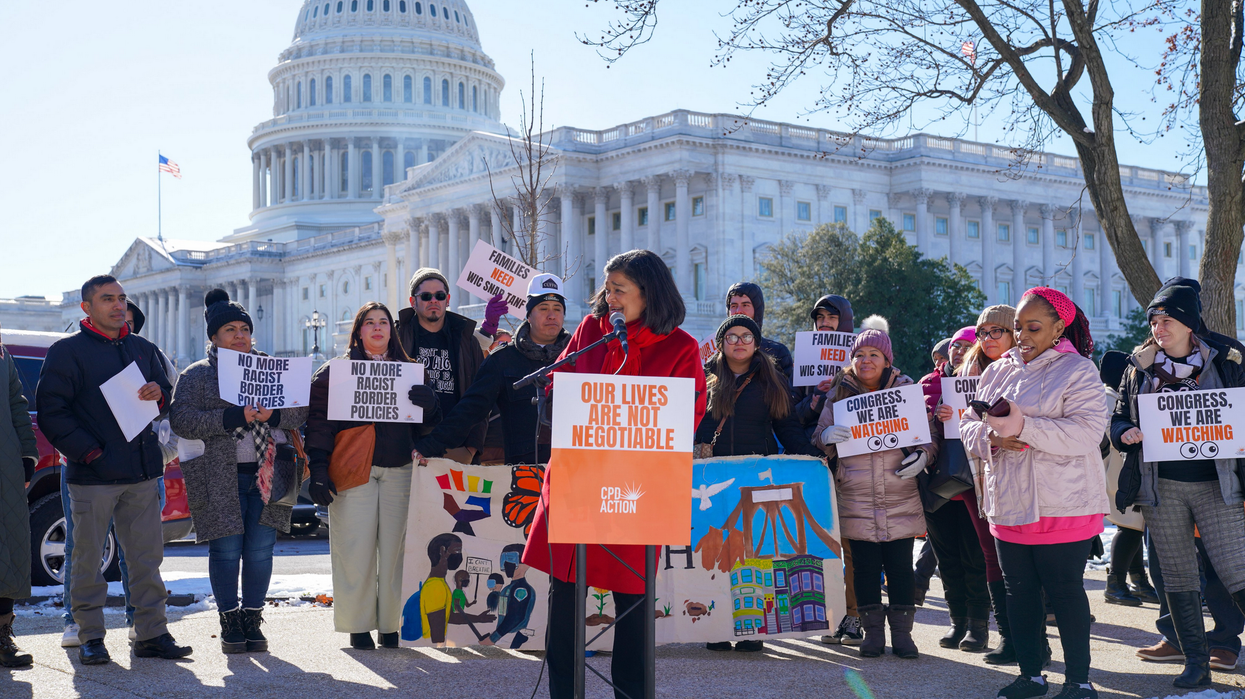
"Trump and congressional Republicans have driven America headfirst into a government shutdown," said one campaigner. "It is poor women and children who will feel the impacts first and worst."
A federal food program serving vulnerable women and children could run out of money next week due to the Republican government shutdown, a prospect that on Thursday spurred calls for Congress to pass a bipartisan funding bill that protects nutritional assistance for needy Americans.
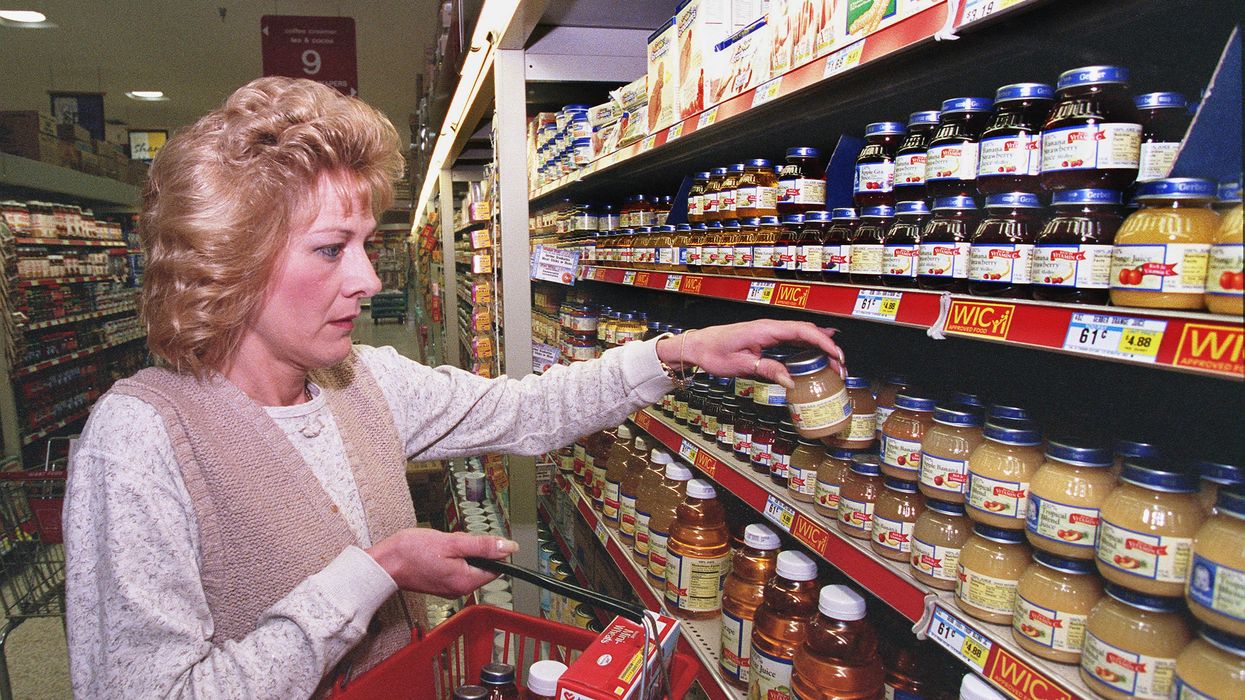
The Special Supplemental Nutrition Program for Women, Infants, and Children (WIC) provides free staples including fresh produce, milk, and formula vouchers for nearly 7 million pregnant and breastfeeding parents and children under the age of 5. The program currently benefits more than 1 in 4 young US children.
“We will have babies being born to low-income women who will not have any breastfeeding support, and they will have no way to get infant formula if they’re not breastfeeding,” Nicole Flateboe, executive director of Nutrition First, Washington state’s WIC association, recently told the Washington State Standard, calling the specter of defunding a "disaster."
The Trump shutdown is threatening to force kids to go hungry. We need, at the very least, a bipartisan spending bill that protects access to food and clean water.
[image or embed]
— Food & Water Watch (@foodandwater.bsky.social) October 9, 2025 at 7:58 AM
In Puerto Rico, 76% of children under age 5 rely upon WIC. In California, that figure is 38%, followed by 35% in New York and 34% in Delaware and North Carolina.
"WIC is a lifeline that helps new parents keep their babies fed. But thanks to Republicans' government shutdown, WIC funds could run out in a matter of weeks," Congresswoman Ayanna Pressley (D-Mass.) said Thursday on social media. "Republicans must reopen the government NOW and stop playing with people's lives."
Food & Water Watch warned Thursday that over 5 million US children stand to lose food assistance, with many likely to go hungry, if the government shutdown is not resolved.
“Trump and congressional Republicans have driven America headfirst into a government shutdown," Food & Water Watch managing director of policy and litigation Mitch Jones said in a statement Thursday. "It is poor women and children who will feel the impacts first and worst."
Democrats in Congress have introduced a short-term appropriations bill that would fully fund WIC, a proposal that stands in stark contrast with Republican legislation that would maintain current funding levels for the program. The GOP proposal is the equivalent of a $600 million cut, due to inflation and price pressures, according to Food & Water Watch.
Making matters worse, the One Big Beautiful Bill Act (OBBBA) signed by President Donald Trump in July stripped Supplemental Nutrition Assistance Program benefits from more than 2 million people. The legislation contains the deepest cuts to Medicaid and SNAP in history while slashing billions from other essential social programs to fund massive tax breaks for billionaires and corporations.
The OBBBA ends health coverage and food assistance for millions of people at a time when more than 47 million Americans—including 1 in 5 US children—are living in food insecure households.
The Trump administration's staffing and funding cuts at the US Department of Agriculture (USDA), which administers SNAP, have also hamstrung the government's ability to provide assistance to those in need.
“It’s a big mess,” Flateboe said. “We don’t have a lot of trust that the USDA is going to handle this real seamlessly.”
While Trump said this week that he would use tariff revenues to temporarily fund WIC, it is unclear how he could do so absent an act of Congress.
"Congressional Republicans need to put food back on the table for struggling families by passing a bipartisan spending bill that protects food access," Jones said.
Congresswoman Nydia Velazquez (D-NY) said on social media: "Families shouldn’t pay the price for GOP dysfunction. We must protect WIC and the people who rely on it."
If we help families survive rocky times rather than fall deeper into poverty, all of us benefit as a society; if we don’t, then millions of stories like mine won’t be possible.
Life is unpredictable. And sometimes, no matter how hard you work, life throws curve balls that hit you in the gut.
That’s what our tax dollars are supposed to be for—a helping hand when we’re most in need. More than once in my life, the social safety net came through for my family. And thanks to that help, we’re able to give back today.
My mother worked hard as a carpenter and educator for most of the years I was growing up. But her income just wasn’t enough to pay for rent, food, childcare, and other basic needs.
Imagine what our nation would look like if we fully invested in the programs most of us need at one time or another rather than constantly fighting to keep the little we have.
Thankfully, she kept us fed with WIC (the Women, Infants, and Children nutrition assistance program), SNAP (then called “food stamps”), and frequent visits to food pantries. And after living in a shelter for the first three years of my life, we were able to get Section 8 housing.
But life continued to throw curve balls.
My mom suffered a stroke while pregnant with my brother, who was born prematurely in 2002. She had to relearn how to walk and talk—and my brother needed serious health interventions due to complications of his premature birth. Thankfully, we got some help from Social Security and Medicare.
All of these supports enabled me to get an education, get into college, and help my family.
When my mother’s health failed to the point that she was on dialysis, my 10-year-old little brother needed to be cared for. So I moved him halfway across the country to live with me. Suddenly, I was a student, a worker, and a young single caretaker.
My mother recently passed away. But thanks to her hard work and the help we got from public programs, I was able to get a master’s degree. After experiencing the vital importance of those programs, I knew I had to devote my life to helping others access the same assistance that had been life-saving for me and my family.
I now work at an organization in Indianapolis, where I help residents achieve their family goals through basic needs support, community engagement, and case management. Ultimately, we explore the barriers keeping families from economic stability and work with them to find solutions.
My little brother, meanwhile, is 21 and a trade school graduate. He’s gainfully employed as an aircraft cleaner at the local airport and a production associate at a manufacturing company. I’m so proud of all that we’ve been able to accomplish because help was there for us when we needed it.
Yet even as I tell my story, there are lawmakers who would cut affordable housing and rental assistance programs. They would slash nutrition programs and Medicaid. There are even lawmakers and cities who seek to criminalize homelessness, which has now gotten the attention of the Supreme Court.
The deep cuts to social programs the House majority has proposed would slash investments that are already insufficient. Due to the lack of affordable housing in this country, only 1 in 4 eligible families actually receive housing vouchers like my family relied on. These cuts would make it even harder.
Thanks to the help we got, we give back as good as we received and more—that’s how a healthy system works. If we help families survive rocky times rather than fall deeper into poverty, all of us benefit as a society. If we don’t, then millions of stories like mine won’t be possible.
Imagine what our nation would look like if we fully invested in the programs most of us need at one time or another rather than constantly fighting to keep the little we have. We shouldn’t be cutting our public programs—we should be expanding them.
Welcoming a child should never be the reason a family plunges into poverty, especially in one of the wealthiest countries in the world.
I had a baby in 2021 and quickly learned how parenting and child care expenses add up.
My husband and I had saved up for months to afford my unpaid maternity leave—I kept working even after my water broke because we needed every penny. It was a dream come true to have a career that I was proud of and finally be welcoming a child into our lives.
But I had no idea how hard it would really be.
While I was on unpaid maternity leave that cost us our health benefits, my husband was let go from his job. Already reliant on WIC—the federal food aid program for women, infants, and children—we were forced to go to food pantries, apply for Medicaid, and referred to a diaper bank. We were in survival mode: exhausted, stressed out, and worried.
Congress must put our tax dollars and policies toward strong support for families.
Despite a litany of postpartum complications that continue to plague me more than two years later, I ended up only taking seven weeks of leave before I returned to work out of desperation.
I wondered: Why doesn’t the U.S. have a paid parental leave policy?
Instead, my first and only experience with motherhood was marred by stress and trauma. Again and again, I had to choose between my health and a paycheck, which can feel like a punishment. I’d proudly served my country on a one-year assignment overseas working on foreign aid, and it didn’t matter.
We found child care at a loving, quality child care center, but the tuition kept increasing. Now the monthly cost is almost twice our mortgage. In fact, child care costs exceed college tuition where we live in North Carolina, as well as in at least 27 other states. My stomach gets in a knot every six months when I know the tuition will increase again.
I wondered: Why don’t we invest more in early care and education?
Meanwhile, the crises causing outsized harm to families throughout the pandemic compounded: a diaper shortage, a formula shortage, inflation, and wages that wouldn’t keep up. So many people are struggling to get back on their feet and desperately need balance and some peace of mind. The stress took its toll, and my husband and I separated in spring 2023.
I wondered: If only we’d had more support, would we have made it?
I have an advanced degree and work as a communications director at a nonprofit while also freelancing. After paying for necessities, we have nothing left, so I get food and supplies from neighbors and friends. I work so hard as a single mom to try to achieve the dreams I have for myself and my baby boy—the dreams that all mothers have. I don’t want my child to deal with the stress and constant refrain of “we don’t have the money for that,” like I did growing up.
Families desperately need, want, and deserve better. Welcoming a child should never be the reason a family plunges into poverty, especially in one of the wealthiest countries in the world. We shouldn’t be sacrificing health, quality early learning, or stability in exchange for a roof over our heads and food. Instead, we should be building strong foundations and generational wealth for our kids.
We need federally mandated paid parental and medical leave. We need additional dedicated funding for programs like WIC that support over 6 million families.
And we need to continue expanding the Child Tax Credit. In North Carolina alone, the monthly Child Tax Credits received in 2021 helped the families of 140,000 children lift themselves out of poverty. Nationally, the credit cut child poverty by over 40% before Congress let the pandemic expansion expire at the end of 2021.
Congress must put our tax dollars and policies toward strong support for families. Let’s ensure no parent experiences welcoming a child as a financial catastrophe and make this country a place where families prosper.