SUBSCRIBE TO OUR FREE NEWSLETTER
Daily news & progressive opinion—funded by the people, not the corporations—delivered straight to your inbox.
5
#000000
#FFFFFF
To donate by check, phone, or other method, see our More Ways to Give page.

Daily news & progressive opinion—funded by the people, not the corporations—delivered straight to your inbox.
The message these tactics send is clear: Decades of public service experience can be dismissed in minutes if an AI system suggests your role is redundant.
Earlier this month, software firm Workday announced that it would be laying off more than 1,700 workers—or about 8.5% of its workforce—to redirect investment toward artificial intelligence. The announcement was the latest in a series of mass layoffs that have put hundreds of thousands of workers at Amazon, Intel, Microsoft, and other tech companies out of work over the past several years. Google and Meta are among the tech giants that have cited the need to invest resources in AI development as the reason for cutting jobs. AI is also a part of the rationale behind the raft of mass federal employees layoffs.
Much of the narrative about AI and jobs has focused on the threat of automation: What can AI do as well as—or better than—humans? Research on AI-driven job displacement often focuses on forecasting which jobs or tasks machines could perform in the future, and then estimating how many workers might be displaced due to this automation. A report might tell us that 30% of work hours could be automated by 2030, or a study might predict that 5% of work tasks across the economy could be performed by AI in the next 10 years.
While automation is a risk that needs to be understood and taken seriously, this framing misses a key aspect of what's happening in the economy now. After many tech firms overhired during the pandemic, companies are cutting jobs and investing in AI not to directly replace workers with machines, but to signal to investors that they're focused on future growth and profitability.
Fortunately, workers and unions are fighting back, both against AI-driven job displacement in private industry and against DOGE's attempts to dismantle the public service.
Mass layoffs are nothing new. As Les Leopold argues in his book Wall Street's War on Workers, for decades corporations have carried out mass layoffs not out of fiscal desperation, but as part of a strategy to further enrich wealthy shareholders through stock buybacks and leveraged buyouts. But now we are seeing how AI hype has become the latest justification for firing workers en masse. Tech firms aren't waiting around to see what roles AI can and can't replace before laying workers off. Instead, they're slashing jobs and redirecting resources to AI initiatives because the mere promise of AI-driven efficiency is enough to excite investors and drive up stock prices.
This strategy creates a self-fulfilling prophecy where tech firms devalue human labor to make automation seem inevitable. By carrying out mass layoffs, tech firms signal to investors and workers themselves that workers are replaceable. By reinvesting those resources in AI, firms make it more likely that AI will eventually become capable enough to replace the workers they already decided to eliminate.
The strategy of hyping AI to justify mass layoffs is exemplified by Swedish tech firm Klarna. As Noam Scheiber reports in The New York Times, when the company laid off 700 customer service workers last year, CEO Sebastian Siemiatkowski didn't just announce the cuts—he celebrated them. In media appearances and investor calls, Siemiatkowski proudly predicted that the company's workforce would eventually shrink to less than half its size thanks to AI-enabled productivity gains. As Scheiber reports, Siemiatkowski may even have overstated Klarna's progress in automating jobs to try to make the company more appealing to investors. For example, while the CEO claimed that AI enabled the company to become so efficient that it halted all new hiring a year and a half ago, journalists have found that the company continues to post job listings for vacant positions. The Klarna example shows how, for some companies, automation isn't just about replacing workers with machines; it is about redefining human labor as a temporary necessity to be tolerated until AI makes it obsolete. Like many tech firms, Klarna is betting that by hyping AI's potential while disinvesting in workers, they can make their vision of an automated future into a self-fulfilling prophecy.
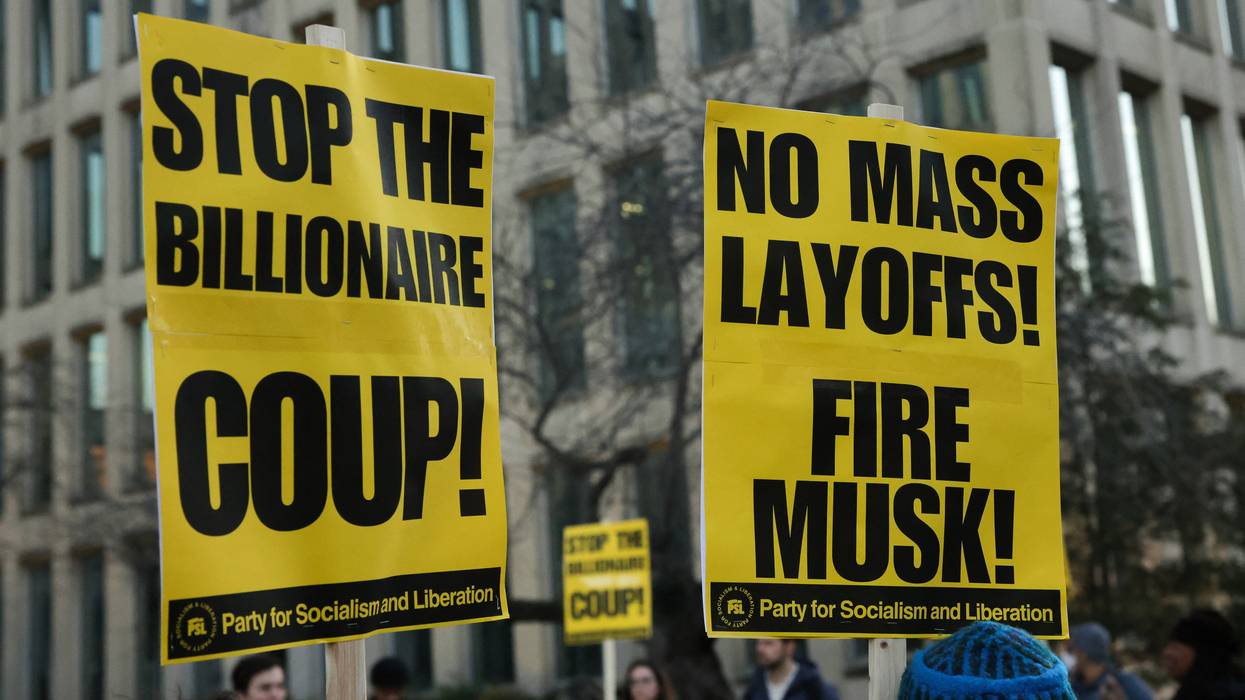
Elon Musk's so-called Department of Government Efficiency (DOGE) is now bringing the AI-fueled mass layoff strategy to the federal government. Through DOGE, Musk and his allies are experimenting with AI tools "to identify budget cuts and detect waste and abuse," in agencies like the Department of Education and the General Services Administration (GSA). Staffers report that DOGE aims to reduce GSA's budget by up to 50%. As The Washington Post reports, "DOGE associates have been feeding vast troves of government records and databases into artificial intelligence tools, looking for unwanted federal programs and trying to determine which human work can be replaced by AI, machine-learning tools, or even robots." In other words, Musk is exploring how he can use AI as justification for carrying out mass layoffs across the federal government. The message these tactics send is clear: Decades of public service experience can be dismissed in minutes if an AI system suggests your role is redundant.
The DOGE-led mass layoffs are part of a decades-long conservative project of shrinking the federal workforce and weakening the administrative state. But what's new is how AI hype, and the guise of Silicon Valley efficiency, is being used to add a veneer of technological inevitability to this political project. "The federal government is suddenly being run like an AI startup," writes Kyle Chayka in a recent piece in The New Yorker. When DOGE staffers cite AI assessments as justification for eliminating positions, they're following the same playbook as tech CEOs: using speculative claims about AI capabilities to make workforce reduction seem like an unavoidable consequence of progress rather than a deliberate choice. DOGE's promises of AI-driven efficiency mask the reality that many government functions still require human judgment, institutional knowledge, and public service experience that no algorithm can replace. This combination of hostile management and AI hype isn't just about cutting costs—it's about redefining public service as something that can be evaluated by an algorithm and eliminated at the whims of a tech oligarch.
Fortunately, workers and unions are fighting back, both against AI-driven job displacement in private industry and against DOGE's attempts to dismantle the public service.
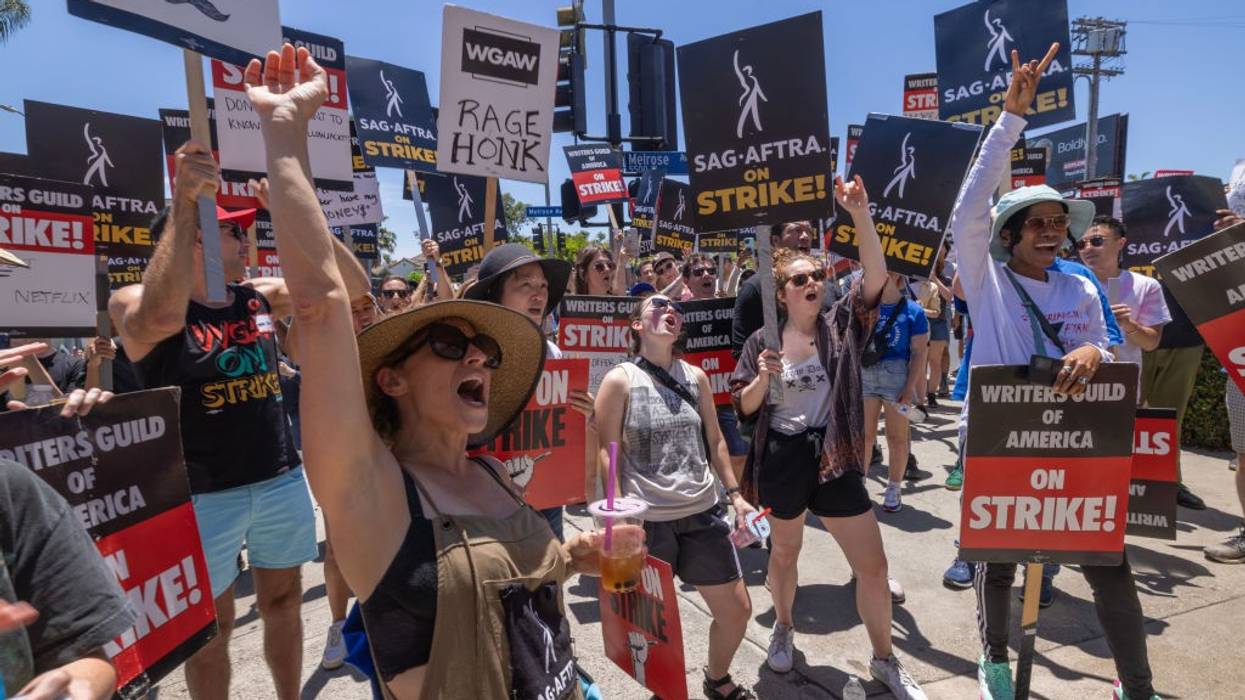
Workers are successfully using collective action to establish guardrails around AI usage and ensure technology serves rather than replaces human labor. The nearly five-month strike by the Writers Guild of America (WGA) and the Screen Actors Guild-American Federation of Television and Radio Artists (SAG-AFTRA) in 2023 was motivated in large part by concerns that Hollywood studios would seek to use AI in ways that undermine workers or replace them altogether. SAG-AFTRA and WGA eventually won contracts that established frameworks for how studios can and cannot use AI during the production process, ensuring that AI cannot replace human writers and actors without their consent and fair compensation. As labor journalist Alex Press reports, similar fights have played out across workplaces in the hospitality, tech, and logistics industries. Through effective strikes and collective bargaining, workers can influence how AI is implemented in the workplace, and secure protections against mass layoffs.
Unions representing federal employees are also mounting a host of legal challenges to protect workers and preserve government services. The American Federation of Government Employees (AFGE) and several other unions filed suit to block what it called "arbitrary and capricious" job cuts laid out in the Trump administration's federal worker buyout program. Meanwhile, the National Treasury Employees Union, which represents workers at the Consumer Financial Protection Bureau, has filed a lawsuit challenging Trump's directive to halt the bureau's operations, which the union alleges violates the constitutional separation of powers. While not directly a response to DOGE's use of AI, the lawsuits show how unions are taking action to oppose efforts to weaken federal agencies and devalue the work of career civil servants. As DOGE looks to use AI to justify mass layoffs, these lawsuits could establish important legal precedents to help protect workers from arbitrary dismissal based on algorithmic assessments.
Recent job cuts in the tech sector and in the federal government show how AI hype is being used to justify mass layoffs. Through collective action, workers are showing that AI's impact isn't predetermined by technology—it can be shaped through worker power.
This article first appeared on Power at Work and is republished here with permission.
The announcement came the same day that OpenAI—the company behind ChatGPT—unveiled a new tool called Sora that can generate a minute-long video from a written prompt, upping the regulatory stakes.
The Federal Trade Commissionproposed a new rule on Thursday that would ban the impersonation of individuals, including with the use of artificial intelligence, or AI, technology.
The announcement came the same day that OpenAI—the company behind ChatGPT—unveiled a new tool called Sora that can generate a minute-long video from a written prompt, raising new concerns about how the technology might be abused to create deepfakes videos of real people doing or saying things they did not in fact do or say.
"Sooner or later, we need to adapt to the fact that realism is no longer a marker of authenticity," Princeton University computer science professor Arvind Narayanan told The Washington Post in response to Sora's emergence.
"Today's proposed rules to ban the use of AI tools from impersonating individuals are an important change to existing regulations and will help to protect consumers from AI generated scams."
For its part, the FTC is mostly concerned about how technology can be used to fool consumers. In its announcement, the commission said that it had introduced the new rule for public comment because it had been getting a growing number of complaints about impersonation-based fraud, which has generated a "public outcry."
"Emerging technology—including AI-generated deepfakes—threatens to turbocharge this scourge, and the FTC is committed to using all of its tools to detect, deter, and halt impersonation fraud," the commission said.
The proposed rule comes the same day as the FTC finalized a rule giving it the ability to seek financial compensation from scammers who impersonate companies or the government and builds on that regulation.
"Fraudsters are using AI tools to impersonate individuals with eerie precision and at a much wider scale. With voice cloning and other AI-driven scams on the rise, protecting Americans from impersonator fraud is more critical than ever," FTC Chair Lina Khan said in a statement. "Our proposed expansions to the final impersonation rule would do just that, strengthening the FTC's toolkit to address AI-enabled scams impersonating individuals."
The FTC also said that it wanted public comment on whether the rule should prohibit AI or other companies from knowingly allowing their products to be used by individuals who are in turn using them to commit fraud through impersonation.
Public Citizen, which has advocated for greater regulation of AI technology, welcomed the FTC's proposal.
"The FTC under Chair Kahn continues to be bold and use all the tools in their toolkit to protect consumers from emerging threats," Lisa Gilbert, executive vice president of Public Citizen, said in a statement. "Today's proposed rules to ban the use of AI tools from impersonating individuals are an important change to existing regulations and will help to protect consumers from AI-generated scams."
OpenAI's preview of Sora raises the stakes in the debate surrounding AI regulation. So far, the technology is only being made available to certain professionals in film and the visual arts for feedback, as well as "red teamers—domain experts in areas like misinformation, hateful content, and bias"—to help assess risks, OpenAI said on social media.
"We'll be taking several important safety steps ahead of making Sora available in OpenAI's products," the company said.
One major concern surrounding deepfakes is that they could be used to manipulate voters in elections, including the upcoming 2024 presidential election in the U.S. The campaign of Florida Gov. Ron DeSantis, for example, raised alarms by using false images of former President Donald Trump embracing former White House Coronavirus Task Force chief Anthony Fauci in a video ad.
There are obvious errors in the Sora sample videos, as OpenAI acknowledged. Narayanan pointed out that a woman's right and left legs switch positions in a video of a Tokyo street, but also said that not every viewer might catch details like this and that the technology would likely be used to create harder-to-discredit deepfakes.
Another concern is the impact the technology could have on jobs and labor, especially in the arts. Director Michael Gracey, an expert on visual effects, told The Washington Post that the technology would likely enable a director to make an animated film on their own, instead of with a team of 100 to 200 people. The use of AI was a major sticking point in strikes by the Screen Actors Guild-American Federation of Television and Radio Artists and Writers Guild of America last year, as Oxford Internet Institute visiting policy fellow Mutale Nkonde pointed out. Nkonde told the Post she also worried about the technology being used to dramatize hateful or violent prompts.
"From a policy perspective, do we need to start thinking about ways we can protect humans that should be in the loop when it comes to these tools?" Nkonde asked.
"We have sacrificed too much to capitulate to their stonewalling and greed," said SAG-AFTRA.
The screen actors union in the United States on Thursday accused film studios of using "bully tactics" to pressure its 160,000 members into ending a historic strike after the Alliance of Motion Picture and Television Producers announced it was walking away from the latest round of negotiations, saying the two sides are too far apart on key issues.
The Screen Actors Guild-American Federation of Television and Radio Artists (SAG-AFTRA) called on members to return to picket lines Thursday morning to continue working to "help shape a fair industry for everyone" as leaders accused the AMPTP and four top studio CEOs directly involved in talks of trying to mislead the union about its latest offer.
Despite the studios' efforts, said SAG-AFTRA, "our fight continues."
The AMPTP said the talks were being suspended largely because of the actors' demand for a revenue sharing plan for successful streaming shows.
Union members should be entitled to revenue sharing amounting to about 2% of the money a show makes on streaming platforms, SAG-AFTRA has maintained since it went on strike July 14, allowing cast members "to share in the success of high-performing shows."
The AMPTP, joined by the "Gang of Four"—Netflix co-CEO Ted Sarandos, NBCUniversal chair Donna Langley, Warner Bros Discovery CEO David Zaslav, and Disney CEO Bob Iger—claimed Wednesday that the plan would be an "untenable economic burden" for studios, costing over $2.4 billion over the course of a three-year SAG-AFTRA contract, or about $800 million per year.
The four companies' annual profits range from $12 billion to $33 billion. SAG-AFTRA said in its statement Thursday morning that the revenue sharing proposal would cost the companies 57 cents per streaming platform subscriber per year and accused the AMPTP of "intentionally" misrepresenting the cost of the proposal to the press.
The studios overstated the cost "by 60%," SAG-AFTRA said.
The union also said the AMPTP's latest offer claims to protect "consent" for performers before their digital replicas can be used for artificial intelligence (AI), while the studios are actually "continuing to demand 'consent' on the first day of employment for use of a performer's digital replica for an entire cinematic universe (or any franchise project)."
"The companies are using the same failed strategy they tried to inflict on the WGA [Writers Guild of America]—putting out misleading information in an attempt to fool our members into abandoning our solidarity and putting pressure on our negotiators," said the union. "But, just like the writers, our members are smarter than that and will not be fooled."
In August, talks between the WGA and the AMPTP also stalled after the studios released an offer the union said was rife with "limitations and loopholes and omissions," including "disingenuous" claims that writers would be provided with increased residuals, AI protections, and working standards.
The WGA ultimately ended its own strike this week after securing a contract that includes higher pay than the AMPTP was originally willing to provide, better healthcare benefits, viewership-based streaming residuals, and AI regulations.
"We feel the pain these companies have inflicted on our members, our strike captains, IATSE, Teamsters and Basic Crafts union members, and everyone in this industry," said SAG-AFTRA. "We have sacrificed too much to capitulate to their stonewalling and greed."
WGA-East urged its members to continue picketing alongside unionized performers until AMPTP provides a satisfactory contract offer that allows working actors to earn a living wage amid rising inflation.
"Let's help pack our union family's picket lines today to show the AMPTP we're not going anywhere until we ALL have fair contracts," said the writers union.
This is the moment for policymakers to demonstrate leadership and act in the best interest of the workers who keep our economy and our society functioning.
We are in an unprecedented moment in history for the modern American labor movement, with widespread labor strikes that stretch from coast to coast. From machinists to movie stars, worker-led actions are reverberating across sectors and sending a powerful message: Workers demand more.
Right now, more than 170,000 media professionals and writers are on strike demanding fair compensation from the Alliance of Motion Picture and Television Producers, and there are 146,000 workers represented by the United Auto Workers (UAW) ready to strike on September 15 if the Big Three American automakers (Ford, General Motors, and Stellantis) fail to improve working conditions and compensation. A strike by the UAW would increase the number of American workers on strike to the highest level since 1983. The scale of these strikes represents a significant shift in labor relations and a unique opportunity to shape an economic future that values and respects the dignity of work and the rights of workers.
For the first time in decades, the public is overwhelmingly on the side of workers. According to Gallup surveys, public support for labor unions is at its highest level in nearly 60 years. This surge in approval signals a significant societal shift and an awakening to the reality of working conditions in a 21st-century economy that often prioritizes profit over people.
Today’s labor movement, emboldened by a call for solidarity, represents a watershed moment for the advocacy and protection of workers’ rights.
Historically, labor unions have been instrumental in securing essential rights and protections for workers, from a five-day workweek to safer working conditions.
Today’s labor movement, emboldened by a call for solidarity, represents a watershed moment for the advocacy and protection of workers’ rights.
Yet, while public sentiment may be evolving, policy and legislation have been slower to catch up. A fair and thriving society needs laws protecting labor that keep pace with the changing workplace landscape. The recent wave of technological innovations, the Covid-19 pandemic, and rising global temperatures are all reshaping how we work, and policymakers must rise to the occasion. In an era marked by increasing employer power over workers and the growing prevalence of precarious work, policies that strengthen the right to strike and to collective bargaining are more critical than ever.
After years of corporate attacks, current labor policies do not respect and promote the collective power of workers. Rather, they enable harmful practices like union-busting, wage theft, and even corporate exploitation of children. Enacting laws that promote labor protections is not just a matter of economic justice—it is a question of human dignity. The right to fair compensation for work, to safe conditions, and to collective bargaining are cornerstones of a just society.
This is the moment for policymakers to demonstrate leadership and act in the best interest of the workers who keep our economy and our society functioning. It is a pivotal opportunity to strengthen labor laws, protect the right to strike and bargain collectively, and, ultimately, pave the way for a more equitable and fair society. The labor reforms available are wide-ranging: Policymakers can end at-will employment, support sectoral bargaining, center workers in workforce development, and raise the decision-making power of workers and unions.
The resurgence of the labor movement is not a temporary disruption to be weathered; it’s a clarion call for change to be embraced. Let’s ensure that this watershed moment in labor history leads to lasting change for the millions of workers who deserve nothing less.
"Even a plurality of voters who have an unfavorable opinion of labor unions (48%) support the strikes."
Two-thirds of likely U.S. voters support the ongoing writers' and actors' union strikes, while an overwhelming majority of voters across party lines agree with the strikers' demands, according to a Data For Progress poll published Friday.
The poll found 67% overall support for the Writers Guild of America (WGA) and Screen Actors Guild-American Federation of Television and Radio Artists (SAG-AFTRA) strikes, while just 18% of respondents opposed the actions.
Likely Democratic voters showed the strongest support for the strikes, at 82%, while 68% of Independents and 49% of Republicans back the labor stoppage.
"Even a plurality of voters who have an unfavorable opinion of labor unions (48%) support the strikes," Data for Progress noted.
Voters also overwhelmingly agree with the strikers' demands:
On the other hand, only 21% of survey respondents said they have a favorable view of Hollywood studios.
SAG-AFTRA national executive director and chief negotiator Duncan Crabtree-Ireland said in a statement: "The data shows that most people understand why the union was forced to go on strike. I suspect many are seeing the same dynamic playing out in their own lives, with employers undervaluing their contributions."
"That's why this fight is so important," he added. "Our demands aren't unreasonable, and it's a fundamental principle of fairness that workers should be fairly compensated for the value they bring their employer—in every industry."
From thousands of writers and actors in Hollywood to thousands of airport workers at major travel hubs nationwide to hotel workers in southern California, working people are embracing their power in unprecedented ways.
Workers have had enough.
In what many have labeled “hot labor summer,” hundreds of thousands of laborers are raising their voices and taking to the streets to demand living wages and better working conditions.
From thousands of writers and actors in Hollywood to thousands of airport workers at major travel hubs nationwide to hotel workers in southern California, working people, across the country and across industries, are embracing their power in unprecedented ways. Starbucks workers are boldly calling out corporate greed and fighting for a fair contract; hundreds of thousands of UPS drivers have possibly averted what would have been one of the largest walkouts in U.S. history at a single employer by flexing their muscles to win a historic contract; and laborers with the Union of Southern Service Workers are challenging the legacy of Jim Crow in the South as they call out exploitative employers like Waffle House.
The power of this moment is impossible to ignore. Beyond grabbing headlines, the wave of recent strikes and union activity is driving change across industries. Workers are standing together to challenge a system that puts all the power in the hands of employers. From A-list actors to fast-food cooks, workers are united in their fight against the rapacious CEOs padding company profits while working people struggle to survive.
While employers dig in to protect the status quo, workers’ united demands are simple: Choose justice, end poverty, save lives.
Workers joining together and speaking out have helped make unions more popular than they have been in years, with more than 70% of Americans saying they approve of unions (the highest that number has been since 1965)—and it’s no surprise why. Workers in unions earn an average of 18% more than non-union workers and have better access to paid leave and healthcare. This is part of why union membership serves as a way to combat racial and gender wealth gaps and lessens income inequality.
While employers dig in to protect the status quo, workers’ united demands are simple: Choose justice, end poverty, save lives. Workers are building on a long history in the United States of framing living wages and a voice on the job as a moral issue. President Franklin D. Roosevelt adopted the moral argument of the Social Gospel when he declared that “no business which depends for existence on paying less than living wages to its workers has any right to continue in this country.”
Not only is raising pay and giving workers a voice on the job the right thing to do, it’s a matter of life or death. Researchers at the University of California, Riverside, recently released a study showing that poverty is the fourth leading cause of death in America, killing hundreds of thousands every year. In the U.S., poverty is a death sentence. It kills more people than homicide, respiratory disease, gun violence, and opioid overdoses—and that was before the Covid-19 pandemic.
It has been 14 years and three presidents since Congress last raised the federal minimum wage. In 2021, 112 million people—one in three people—were poor or low-income, and 52 million of those people were working for less than $15 an hour. Wages are not keeping pace with inflation and the skyrocketing cost of housing, and the end of pandemic-era federal programs is only worsening the crisis for low-income families who work tirelessly to put food on the table and keep a roof over their heads. Our demand for a living wage is the moral issue our nation’s leaders should be focused on. Isaiah 10 says, “Woe unto those who legislate evil and rob the poor of their rights, and make women and children their prey.” It is a moral travesty for us to stand idly by as the wealthy in this nation continue to become richer while our country’s most vulnerable are being denied basic human rights like healthcare and living wages.
While corporate profits are skyrocketing—with the S&P 500 hurtling toward another record high this year—close to 6.5 million working people are living below the poverty line. Executive pay has soared by close to 1,500% over the past 43 years, and, this year, the revenue threshold for making the Fortune 500 list went up 13% from last year to $7.2 billion. As corporations hoard money and power year after year, the workers who help generate that wealth continue to be exploited while seeing none of the earnings. The situation isn’t just absurd, it’s dangerous, and the cost is death.
Instead of listening to their workers, corporations have threatened to wait out strikes until workers are homeless or delay and delay negotiations with the hope that workers lose steam. While workers brave the heat, corporations have been ruthless, like airline contractors who failed to provide cabin cleaners with water in 110°F heat or Hollywood studios who cut down the trees that provided striking writers with shade on the picket line.
It’s clear who has the moral high ground here.
It’s time for our elected leaders to show us whose side they’re on and stand with the millions of working people who serve as the backbone of our economy and communities.
If wealthy companies won’t act, our elected leaders need to force them to do the right thing. We need bold proposals like the Third Reconstruction resolution proposed by members of Congress to bring about economic justice in the United States and a comprehensive approach to address poverty and other systemic injustices. Drawing on the history of the Reconstruction following the Civil War and the Second Reconstruction of the civil rights struggles of the 20th century, the resolution’s sweeping set of 20+ proposals seeks to prioritize the needs of our nation’s 140 million poor and low-income people by raising the minimum wage to a living wage; updating the obsolete official poverty measure to reflect what it takes to secure a decent standard of living today as a new baseline for anti-poverty and welfare programs; expanding unemployment insurance and paid family leave; enshrining the right to form or join a union; and guaranteeing access to basic needs like housing, water and health care.
It’s time for our elected leaders to show us whose side they’re on and stand with the millions of working people who serve as the backbone of our economy and communities. Poor and low-wealth people make up nearly 40% of potential voters. If our nation’s leaders fail to act, we’ll find them at the polls, and right this wrong ourselves.
This summer’s worker uprising isn’t just a moment in time, it’s a movement that will continue to grow in strength and numbers until economic justice becomes a reality for all of us. From coast to coast, working people are raising the heat and making their demands loud and clear—and it’s long past time for greedy corporations to pay up.
Inter-union collaboration is scaffolding a historic U.S. strike wave.
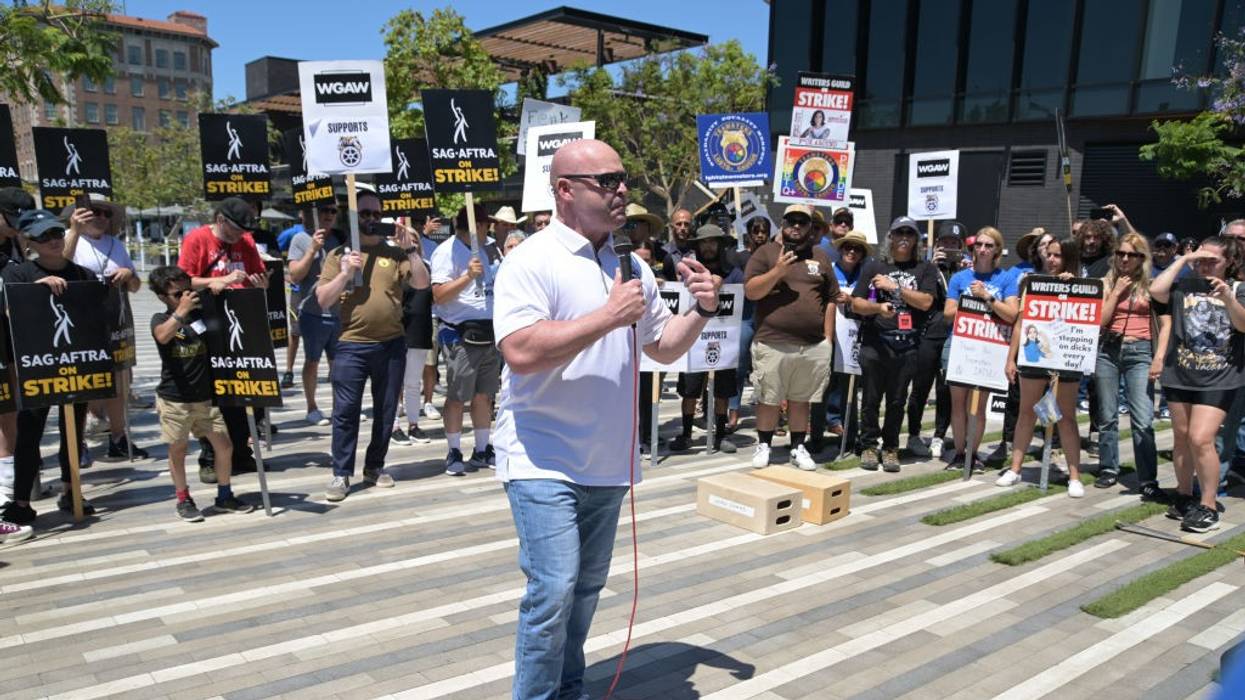
Speaking outside Amazon Studios in Culver City, California, last week to a crowd of striking actors, writers, and Amazon delivery drivers, Teamsters General President Sean O’Brien spotlighted the growing prominence of cross-union solidarity in the United States.
“The great thing that’s happening right now in the labor movement, we are for one time—and I’ve been a Teamster for 33 years—collaborating with each other in a power collaboration to truly effectuate change,” O’Brien said.
Citing Amazon’s powerful role in both the logistics and entertainment industries, O’Brien called the tech behemoth a “common enemy.” (This spring, 84 Amazon drivers in Southern California unionized with Teamsters Local 396 and have been on strike since June 24 over alleged unfair labor practices.)
“It’s very simple for us to stand together, and that’s obviously something that we haven’t done throughout our history here in Hollywood.”
“We can have our arguments amongst ourselves right here and that’s okay,” the Teamsters president said to the assembled picketers from multiple unions. “But… we identify who our common enemies are and… we make certain they understand that you take one of us on, you take all of us on.”
Since July 14, 160,000 film and television actors with the Screen Actors Guild-American Federation of Television and Radio Artists (SAG-AFTRA) have been on strike alongside 11,000 screenwriters with the Writers Guild of America (WGA), who themselves have been on strike since May 2.
The two unions are fighting to secure new contracts from the big studios and streamers that include improvements around job security, healthcare, and residuals, as well as protections from the use of artificial intelligence.
The Teamsters and the International Alliance of Theatrical Stage Employees (IATSE)—the unions representing Hollywood’s “below-the-line” workers such as camera operators, gaffers, costumers, makeup artists, mechanics, drivers, and others—have repeatedly expressed solidarity with the striking writers and actors.
In the early weeks of the writers’ strike, before SAG-AFTRA’s work stoppage served to halt all filming, IATSE and Teamsters members were instrumental in shutting down production on several TV shows by refusing to work on sets where WGA members were picketing. The Teamsters and IATSE contracts protect members from employer discipline when they choose to honor other unions’ picket lines.
With production shut down or slowed down, below-the-line workers are facing furloughs and unemployment, yet are still showing their support for the strikes. Rank-and-file writers and directors recently launched the Union Solidarity Coalition to help raise money for crewmembers who have lost their health insurance during the strikes.
In a statement, IATSE International President Matthew D. Loeb blamed the studios for the financial hardship: “Make no mistake—if the studios truly cared about the economic fallout of their preemptive work slowdown against below-the-line crewmembers, they could continue to pay crewmembers and fully fund their healthcare at any moment, as they did in 2020 during the onset of the Covid-19 pandemic.”
Such inter-union collaboration has not always been prevalent in the U.S. labor movement, especially in Hollywood, where it has been 63 years since both the writers’ and actors’ guilds were on strike together.
More notoriously, Hollywood’s craft unions have an ugly history of battling each other over jurisdiction, such as when IATSE and the short-lived Conference of Studio Unions feuded in the mid-1940s over who would get to represent set decorators. That dispute exploded into a violent brawl between hundreds of members of the two rival unions outside Warner Bros. Studios on October 5, 1945, an event often remembered as “Hollywood Black Friday.”
“It’s very simple for us to stand together, and that’s obviously something that we haven’t done throughout our history here in Hollywood,” Teamsters Motion Picture Division director Lindsay Dougherty told the crowd at last week’s Amazon Studios picket. “But we’re changing the history in Hollywood right fucking now.”
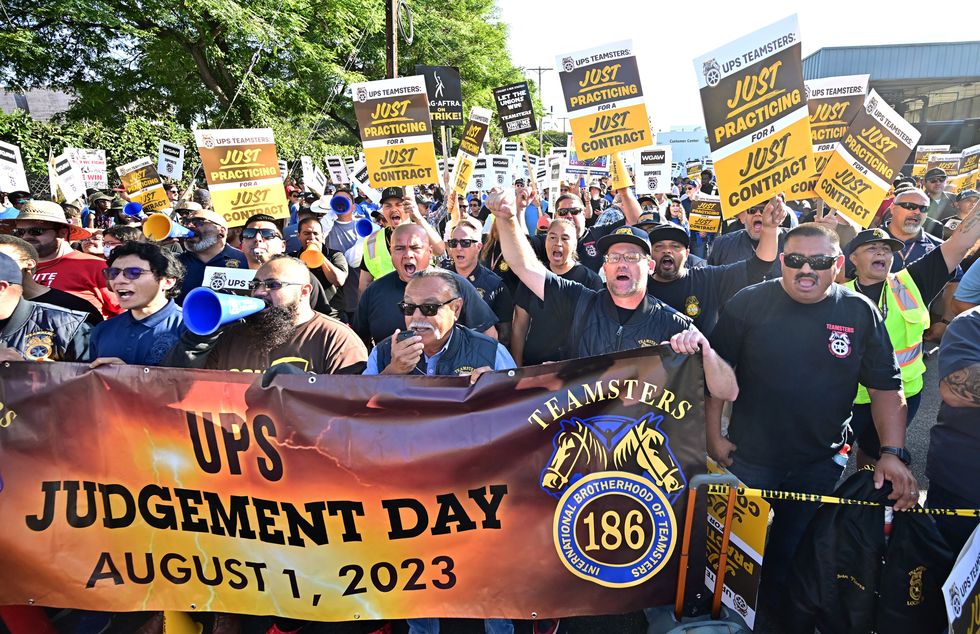
UPS Teamsters rally in Los Angeles.
(Photo: Frederic J. Brown/AFP via Getty Images)Beyond Hollywood, on July 25, the Teamsters secured what the union calls “the most historic tentative agreement for workers in the history of UPS” just six days before a possible strike at the shipping giant would have started. With the union representing 340,000 delivery drivers, loaders, and sorters at UPS, it would have been one of the largest single-employer strikes in U.S. history.
The tentative deal includes historic pay increases (including a $21-per-hour minimum wage for new part-time employees), a commitment from the company to install air conditioning in trucks, and an end to the two-tier wage system, among other significant improvements.
In the run-up to the potential work stoppage, the Independent Pilots Association (IPA), the union representing the 3,300 pilots who operate UPS’s fleet of nearly 280 aircrafts, had promised to stand with the Teamsters.
“If Teamsters decide they need to go on strike, then without even questioning, the pilots say we’re gonna honor that picket line.”
In a July 3 letter to O’Brien, IPA President Capt. Ron Travis vowed “to honor any potential [Teamsters] strike and act in sympathy with our fellow workers at UPS by not working.”
“As joint allies in the pursuit of enhanced safety standards, industry leading wages and benefits, and improved quality of life for our members, let’s continue to ensure that our organizations communicate, collaborate, and support each other as much as possible,” Travis wrote. “Unity generates success.”
In the past, the Teamsters similarly pledged to stand with the pilots during the IPA’s own contract negotiations. The IPA’s current contract with UPS expires in 2025.
IPA spokesperson Brian Gaudet told In These Times that the close relationship between the two unions was “cemented” during the Teamsters’ historic 16-day strike at UPS in 1997, when “not one of our pilots crossed the picket line.”
“If Teamsters decide they need to go on strike, then without even questioning, the pilots say we’re gonna honor that picket line,” Gaudet said before the tentative deal was reached. “These unions have each other’s back.”
At the same time, UPS’s 111 flight dispatchers—who are members of Transport Workers Union (TWU) Local 592 and based in Louisville, Kentucky—had also promised to honor the potential Teamsters’ work stoppage.
“If the Teamsters put a picket line up at UPS in Louisville, where our air dispatchers work, we’re not going to cross that picket line. It’s as simple as that,” said TWU International President John Samuelsen.
“It’s just the right thing to do to support the Teamsters in their fight,” Samuelsen told In These Times, adding that unions honoring each other’s strikes is crucial to victory. “If the labor movement is going to be strong, this is how it must be,” he said.
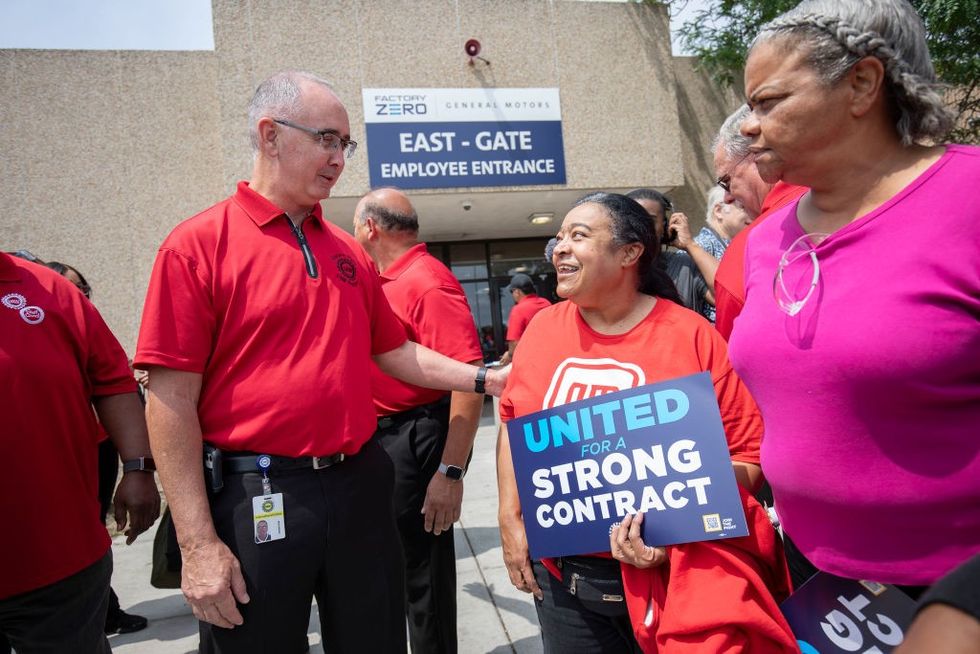
United Auto Workers president Shawn Fain speaks with and does “members’ handshakes” with General Motors workers at GM Factory Zero on July 12, 2023 in Detroit, Michigan.
(Photo: Bill Pugliano/Getty Images)
To gear up for a potential strike, in the two weeks before a tentative agreement was reached, thousands of UPS Teamsters and their labor allies organized numerous practice pickets and rallies around the country.
At one such rally held in New Hyde Park, New York, on July 15, local Teamsters were joined by members of the United Auto Workers (UAW) and recently-elected UAW President Shawn Fain.
This fall, 150,000 UAW members at the Big 3 automakers could also go on strike to secure a new contract. With the current contract set to expire in September, negotiations between the union and Ford, General Motors, and Stellantis began earlier this month.
“Wall Street would love for us to think that factory workers, that delivery drivers, that hotel workers, that writers and actors have nothing in common.”
“The Teamsters’ fight is our fight. Our fight’s got to be theirs,” Fain told The Upsurge’s Teddy Ostrow at the New Hyde Park event. “Labor has to come together—no matter what sector, no matter what division, no matter what the work is. You look at the Teamsters’ path, you look at our path. It’s parallel.”
Samuelsen of the TWU predicted that the Teamsters’ practice pickets, along with the pledges of solidarity from his union and the IPA, could avert a strike.
“The best way to avoid a strike is to be prepared to win a strike,” Samuelsen told In These Times before the Teamsters and UPS reached a deal. “I wouldn’t be shocked if UPS—in a typically cowardly, sort of bully, boss mentality—once they realize that the workforce is prepared to win, they’ll settle.”
Back in Southern California, WGA and SAG-AFTRA strikers have been exercising labor unity by joining the picket lines of the 15,000 striking Los Angeles hotel workers with UNITE HERE Local 11 and the striking Amazon drivers with Teamsters Local 396.
“Wall Street would love for us to think that factory workers, that delivery drivers, that hotel workers, that writers and actors have nothing in common,” SAG-AFTRA Executive Vice President Ben Whitehair said at a recent labor solidarity rally in Los Angeles. “But you all know that is not the case.”
At last week’s picket outside Amazon Studios, Teamsters president O’Brien promised continued solidarity with other unions.
“Once we’re done kicking the shit out of UPS, which is gonna be very soon, we’re gonna focus on kicking the shit out of all these greedy white-collar criminals known as Hollywood,” O’Brien said. “When you fuck with SAG, you fuck with the screenwriters, you fuck with the Teamsters, put your helmets on, buckle your chinstraps—it’s a full-contact sport.”
Hollywood writers are only the latest workers to join thousands of nurses, baristas, teachers, railroad workers, and others standing up to their bosses.
Every television series or film begins and ends with writers. They pen the iconic lines that actors deliver, like “Just one more thing,” “There’s no crying in baseball!,” and “Rosebud.”
Good stories, like good lines, can last for generations. But for the writers who create them, just making it to the next paycheck has become a struggle.
Writers are facing an existential crisis. According to the Writers Guild of America (WGA), the median weekly pay for writers declined 23% over the last decade after adjusting for inflation.
If the studios won’t make a fair offer, your favorite shows could be in trouble—but that’s not the only reason this strike matters.
With the rise of streaming, the big studios are having no trouble maximizing their profits. But streaming productions tend to pay less than traditional film and TV, and with less stable employment due to shorter seasons. Streaming has also taken a huge chunk of revenue writers could once count on from broadcast TV reruns.
That’s the context behind this spring’s WGA strike. With 11,500 writers walking out, it’s Hollywood’s first strike in 15 years. If the studios won’t make a fair offer, your favorite shows could be in trouble—but that’s not the only reason this strike matters.
The WGA members demand increases in minimum pay, residuals for streaming, and health and pension improvements from the most profitable companies in the entertainment industry—including Disney, Netflix, Apple, Amazon, NBC Universal, Paramount, Discovery-Warner, and Sony.
The union calculates that its proposals would provide writers with an additional $429 million a year. The studios, represented by the Alliance of Motion Picture and Television Producers (AMPTP), have counter-offered around $86 million and called it a “generous increase.” The two sides aren’t even remotely close to meeting in the middle.
Moreover, reminiscent of a dystopian Black Mirror episode, the studios have refused to guarantee that AI will not be used to replace human writers, which is another key WGA contract demand. Netflix has already experimented with replacing artists with AI.
The writers strike is only the latest chapter of an ongoing struggle for worker rights in today’s “gig economy.”
For years now, Big Tech corporations have been rebranding workers as independent contractors or “gig workers” in order to deny them rights and benefits. These workers, whether drivers for Uber or warehouse employees for Amazon, are made easily replaceable—if not by someone else, then perhaps by AI
With major tech companies like Netflix, Apple, and Amazon now at the streaming table, this trend is reverberating throughout the film industry.
In 2021, behind-the-scenes television and film workers represented by the International Alliance of Theatrical Stage Employees (IATSE) nearly went on strike because studios owned by the likes of Amazon and Netflix were contributing less to worker benefits and requiring shorter turnaround times between shifts.
Whether starting a career or well-established, workers across the economy now put in longer hours for less pay without the guarantees of a sustainable career, health care, paid sick leave, or retirement. Extreme income inequality is compounding matters, with annual bonuses alone for Wall Street bankers greatly surpassing what ordinary workers take home all year.
That’s why Hollywood writers are only the latest workers to join thousands of nurses, baristas, teachers, railroad workers, and others standing up to their bosses. Solidarity across these labor struggles could help rebuild this economy for all working people.
Ultimately, this dispute is bigger than its immediate impact on television and film productions. Worker dignity and the universal right to an adequate standard of living are also at stake.
The film companies should take a cue from one of cinema’s wisest aliens. As Spock concluded in Star Trek II: The Wrath of Khan (thanks to late screenwriter Jack B. Sowards): “The needs of the many outweigh the needs of the few.”