

SUBSCRIBE TO OUR FREE NEWSLETTER
Daily news & progressive opinion—funded by the people, not the corporations—delivered straight to your inbox.
5
#000000
#FFFFFF
To donate by check, phone, or other method, see our More Ways to Give page.
Daily news & progressive opinion—funded by the people, not the corporations—delivered straight to your inbox.
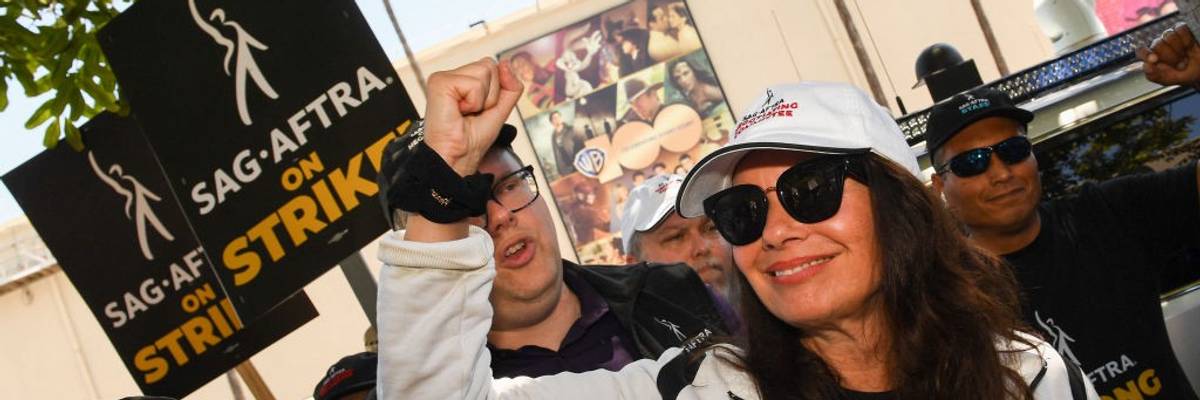
SAG-AFTRA President Fran Drescher joins Writers Guild members at a picket line outside of Warner Bros studio in Burbank, California, on July 14, 2023.
"We have sacrificed too much to capitulate to their stonewalling and greed," said SAG-AFTRA.
The screen actors union in the United States on Thursday accused film studios of using "bully tactics" to pressure its 160,000 members into ending a historic strike after the Alliance of Motion Picture and Television Producers announced it was walking away from the latest round of negotiations, saying the two sides are too far apart on key issues.
The Screen Actors Guild-American Federation of Television and Radio Artists (SAG-AFTRA) called on members to return to picket lines Thursday morning to continue working to "help shape a fair industry for everyone" as leaders accused the AMPTP and four top studio CEOs directly involved in talks of trying to mislead the union about its latest offer.
Despite the studios' efforts, said SAG-AFTRA, "our fight continues."
The AMPTP said the talks were being suspended largely because of the actors' demand for a revenue sharing plan for successful streaming shows.
Union members should be entitled to revenue sharing amounting to about 2% of the money a show makes on streaming platforms, SAG-AFTRA has maintained since it went on strike July 14, allowing cast members "to share in the success of high-performing shows."
The AMPTP, joined by the "Gang of Four"—Netflix co-CEO Ted Sarandos, NBCUniversal chair Donna Langley, Warner Bros Discovery CEO David Zaslav, and Disney CEO Bob Iger—claimed Wednesday that the plan would be an "untenable economic burden" for studios, costing over $2.4 billion over the course of a three-year SAG-AFTRA contract, or about $800 million per year.
The four companies' annual profits range from $12 billion to $33 billion. SAG-AFTRA said in its statement Thursday morning that the revenue sharing proposal would cost the companies 57 cents per streaming platform subscriber per year and accused the AMPTP of "intentionally" misrepresenting the cost of the proposal to the press.
The studios overstated the cost "by 60%," SAG-AFTRA said.
The union also said the AMPTP's latest offer claims to protect "consent" for performers before their digital replicas can be used for artificial intelligence (AI), while the studios are actually "continuing to demand 'consent' on the first day of employment for use of a performer's digital replica for an entire cinematic universe (or any franchise project)."
"The companies are using the same failed strategy they tried to inflict on the WGA [Writers Guild of America]—putting out misleading information in an attempt to fool our members into abandoning our solidarity and putting pressure on our negotiators," said the union. "But, just like the writers, our members are smarter than that and will not be fooled."
In August, talks between the WGA and the AMPTP also stalled after the studios released an offer the union said was rife with "limitations and loopholes and omissions," including "disingenuous" claims that writers would be provided with increased residuals, AI protections, and working standards.
The WGA ultimately ended its own strike this week after securing a contract that includes higher pay than the AMPTP was originally willing to provide, better healthcare benefits, viewership-based streaming residuals, and AI regulations.
"We feel the pain these companies have inflicted on our members, our strike captains, IATSE, Teamsters and Basic Crafts union members, and everyone in this industry," said SAG-AFTRA. "We have sacrificed too much to capitulate to their stonewalling and greed."
WGA-East urged its members to continue picketing alongside unionized performers until AMPTP provides a satisfactory contract offer that allows working actors to earn a living wage amid rising inflation.
"Let's help pack our union family's picket lines today to show the AMPTP we're not going anywhere until we ALL have fair contracts," said the writers union.
Dear Common Dreams reader, It’s been nearly 30 years since I co-founded Common Dreams with my late wife, Lina Newhouser. We had the radical notion that journalism should serve the public good, not corporate profits. It was clear to us from the outset what it would take to build such a project. No paid advertisements. No corporate sponsors. No millionaire publisher telling us what to think or do. Many people said we wouldn't last a year, but we proved those doubters wrong. Together with a tremendous team of journalists and dedicated staff, we built an independent media outlet free from the constraints of profits and corporate control. Our mission has always been simple: To inform. To inspire. To ignite change for the common good. Building Common Dreams was not easy. Our survival was never guaranteed. When you take on the most powerful forces—Wall Street greed, fossil fuel industry destruction, Big Tech lobbyists, and uber-rich oligarchs who have spent billions upon billions rigging the economy and democracy in their favor—the only bulwark you have is supporters who believe in your work. But here’s the urgent message from me today. It's never been this bad out there. And it's never been this hard to keep us going. At the very moment Common Dreams is most needed, the threats we face are intensifying. We need your support now more than ever. We don't accept corporate advertising and never will. We don't have a paywall because we don't think people should be blocked from critical news based on their ability to pay. Everything we do is funded by the donations of readers like you. When everyone does the little they can afford, we are strong. But if that support retreats or dries up, so do we. Will you donate now to make sure Common Dreams not only survives but thrives? —Craig Brown, Co-founder |
The screen actors union in the United States on Thursday accused film studios of using "bully tactics" to pressure its 160,000 members into ending a historic strike after the Alliance of Motion Picture and Television Producers announced it was walking away from the latest round of negotiations, saying the two sides are too far apart on key issues.
The Screen Actors Guild-American Federation of Television and Radio Artists (SAG-AFTRA) called on members to return to picket lines Thursday morning to continue working to "help shape a fair industry for everyone" as leaders accused the AMPTP and four top studio CEOs directly involved in talks of trying to mislead the union about its latest offer.
Despite the studios' efforts, said SAG-AFTRA, "our fight continues."
The AMPTP said the talks were being suspended largely because of the actors' demand for a revenue sharing plan for successful streaming shows.
Union members should be entitled to revenue sharing amounting to about 2% of the money a show makes on streaming platforms, SAG-AFTRA has maintained since it went on strike July 14, allowing cast members "to share in the success of high-performing shows."
The AMPTP, joined by the "Gang of Four"—Netflix co-CEO Ted Sarandos, NBCUniversal chair Donna Langley, Warner Bros Discovery CEO David Zaslav, and Disney CEO Bob Iger—claimed Wednesday that the plan would be an "untenable economic burden" for studios, costing over $2.4 billion over the course of a three-year SAG-AFTRA contract, or about $800 million per year.
The four companies' annual profits range from $12 billion to $33 billion. SAG-AFTRA said in its statement Thursday morning that the revenue sharing proposal would cost the companies 57 cents per streaming platform subscriber per year and accused the AMPTP of "intentionally" misrepresenting the cost of the proposal to the press.
The studios overstated the cost "by 60%," SAG-AFTRA said.
The union also said the AMPTP's latest offer claims to protect "consent" for performers before their digital replicas can be used for artificial intelligence (AI), while the studios are actually "continuing to demand 'consent' on the first day of employment for use of a performer's digital replica for an entire cinematic universe (or any franchise project)."
"The companies are using the same failed strategy they tried to inflict on the WGA [Writers Guild of America]—putting out misleading information in an attempt to fool our members into abandoning our solidarity and putting pressure on our negotiators," said the union. "But, just like the writers, our members are smarter than that and will not be fooled."
In August, talks between the WGA and the AMPTP also stalled after the studios released an offer the union said was rife with "limitations and loopholes and omissions," including "disingenuous" claims that writers would be provided with increased residuals, AI protections, and working standards.
The WGA ultimately ended its own strike this week after securing a contract that includes higher pay than the AMPTP was originally willing to provide, better healthcare benefits, viewership-based streaming residuals, and AI regulations.
"We feel the pain these companies have inflicted on our members, our strike captains, IATSE, Teamsters and Basic Crafts union members, and everyone in this industry," said SAG-AFTRA. "We have sacrificed too much to capitulate to their stonewalling and greed."
WGA-East urged its members to continue picketing alongside unionized performers until AMPTP provides a satisfactory contract offer that allows working actors to earn a living wage amid rising inflation.
"Let's help pack our union family's picket lines today to show the AMPTP we're not going anywhere until we ALL have fair contracts," said the writers union.
The screen actors union in the United States on Thursday accused film studios of using "bully tactics" to pressure its 160,000 members into ending a historic strike after the Alliance of Motion Picture and Television Producers announced it was walking away from the latest round of negotiations, saying the two sides are too far apart on key issues.
The Screen Actors Guild-American Federation of Television and Radio Artists (SAG-AFTRA) called on members to return to picket lines Thursday morning to continue working to "help shape a fair industry for everyone" as leaders accused the AMPTP and four top studio CEOs directly involved in talks of trying to mislead the union about its latest offer.
Despite the studios' efforts, said SAG-AFTRA, "our fight continues."
The AMPTP said the talks were being suspended largely because of the actors' demand for a revenue sharing plan for successful streaming shows.
Union members should be entitled to revenue sharing amounting to about 2% of the money a show makes on streaming platforms, SAG-AFTRA has maintained since it went on strike July 14, allowing cast members "to share in the success of high-performing shows."
The AMPTP, joined by the "Gang of Four"—Netflix co-CEO Ted Sarandos, NBCUniversal chair Donna Langley, Warner Bros Discovery CEO David Zaslav, and Disney CEO Bob Iger—claimed Wednesday that the plan would be an "untenable economic burden" for studios, costing over $2.4 billion over the course of a three-year SAG-AFTRA contract, or about $800 million per year.
The four companies' annual profits range from $12 billion to $33 billion. SAG-AFTRA said in its statement Thursday morning that the revenue sharing proposal would cost the companies 57 cents per streaming platform subscriber per year and accused the AMPTP of "intentionally" misrepresenting the cost of the proposal to the press.
The studios overstated the cost "by 60%," SAG-AFTRA said.
The union also said the AMPTP's latest offer claims to protect "consent" for performers before their digital replicas can be used for artificial intelligence (AI), while the studios are actually "continuing to demand 'consent' on the first day of employment for use of a performer's digital replica for an entire cinematic universe (or any franchise project)."
"The companies are using the same failed strategy they tried to inflict on the WGA [Writers Guild of America]—putting out misleading information in an attempt to fool our members into abandoning our solidarity and putting pressure on our negotiators," said the union. "But, just like the writers, our members are smarter than that and will not be fooled."
In August, talks between the WGA and the AMPTP also stalled after the studios released an offer the union said was rife with "limitations and loopholes and omissions," including "disingenuous" claims that writers would be provided with increased residuals, AI protections, and working standards.
The WGA ultimately ended its own strike this week after securing a contract that includes higher pay than the AMPTP was originally willing to provide, better healthcare benefits, viewership-based streaming residuals, and AI regulations.
"We feel the pain these companies have inflicted on our members, our strike captains, IATSE, Teamsters and Basic Crafts union members, and everyone in this industry," said SAG-AFTRA. "We have sacrificed too much to capitulate to their stonewalling and greed."
WGA-East urged its members to continue picketing alongside unionized performers until AMPTP provides a satisfactory contract offer that allows working actors to earn a living wage amid rising inflation.
"Let's help pack our union family's picket lines today to show the AMPTP we're not going anywhere until we ALL have fair contracts," said the writers union.

