SUBSCRIBE TO OUR FREE NEWSLETTER
Daily news & progressive opinion—funded by the people, not the corporations—delivered straight to your inbox.
5
#000000
#FFFFFF
To donate by check, phone, or other method, see our More Ways to Give page.

Daily news & progressive opinion—funded by the people, not the corporations—delivered straight to your inbox.
These ultra-wealthy individuals have outsized influence on our democratic system—and have actively worked to undermine it.
The top 15 wealthiest people in America are part of a very, very exclusive club: those with over $100,000,000,000 in net worth. After double checking those zeroes, we can confidently say that yes, there are 15 centi-billionaires living among us.
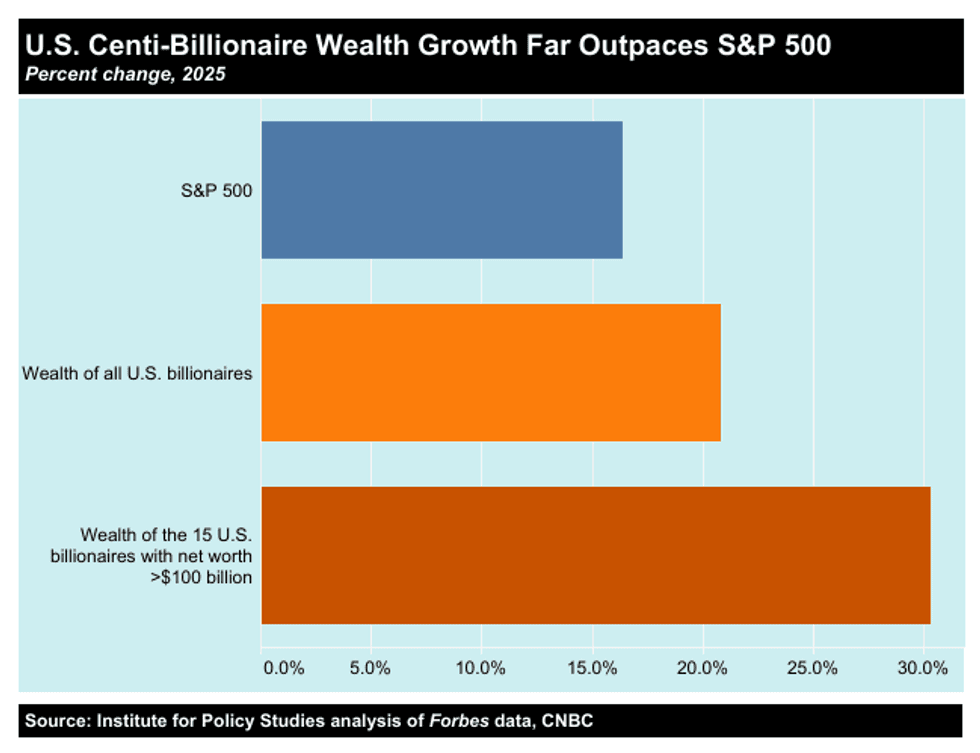
And, according to a new Institute for Policy Studies analysis of data from the Forbes real time billionaire list, the combined wealth of that 12-figure club grew from $2.4 trillion to $3.1 trillion over the course of 2025.
For context, that 30.3% rate of growth outpaced both the S&P 500 (16%) and billionaires in general (20.8%) over the last year. To put it succinctly, the wealthiest Americans are accumulating capital faster than everyone else.
The top 15 wealthiest billionaires aren’t the only ones doing well for themselves. Our analysis found that the number of US billionaires increased from 813 with combined wealth of $6.7 trillion at the end of 2024 to 935 US billionaires with combined assets of $8.1 trillion.
The top five wealthiest billionaires all saw huge wealth jumps in 2025.
The three wealthiest dynastic families in the US hold an estimated $757 billion, up from $657.8 billion at the end of 2024, a 16% gain. These are:
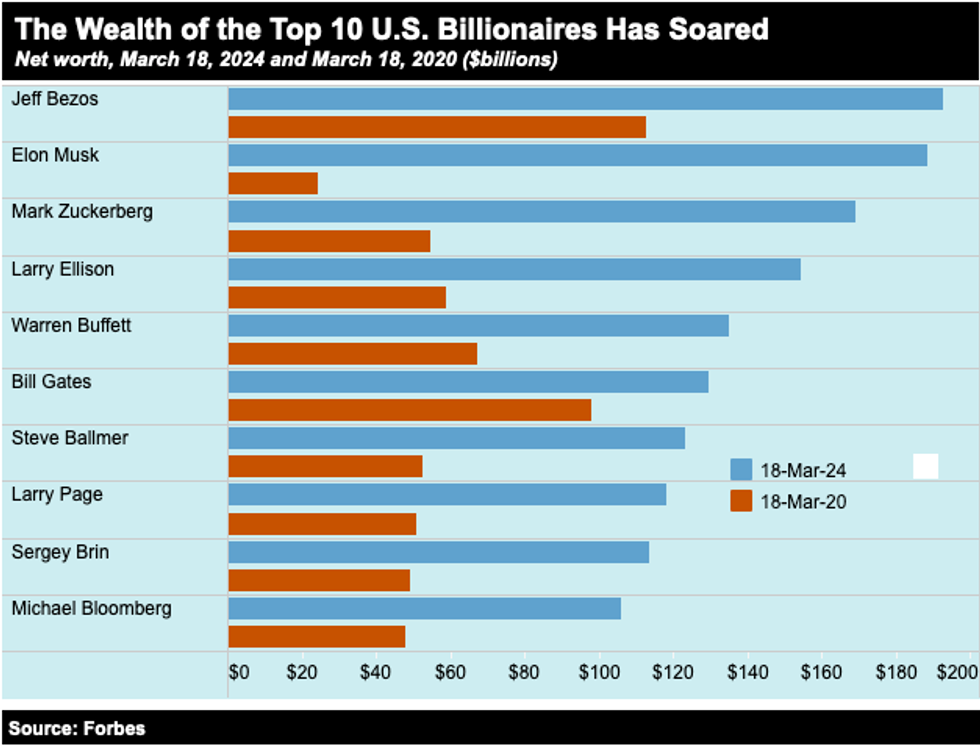
As we predicted it would at the time, the Covid-19 pandemic drastically accelerated wealth concentration.
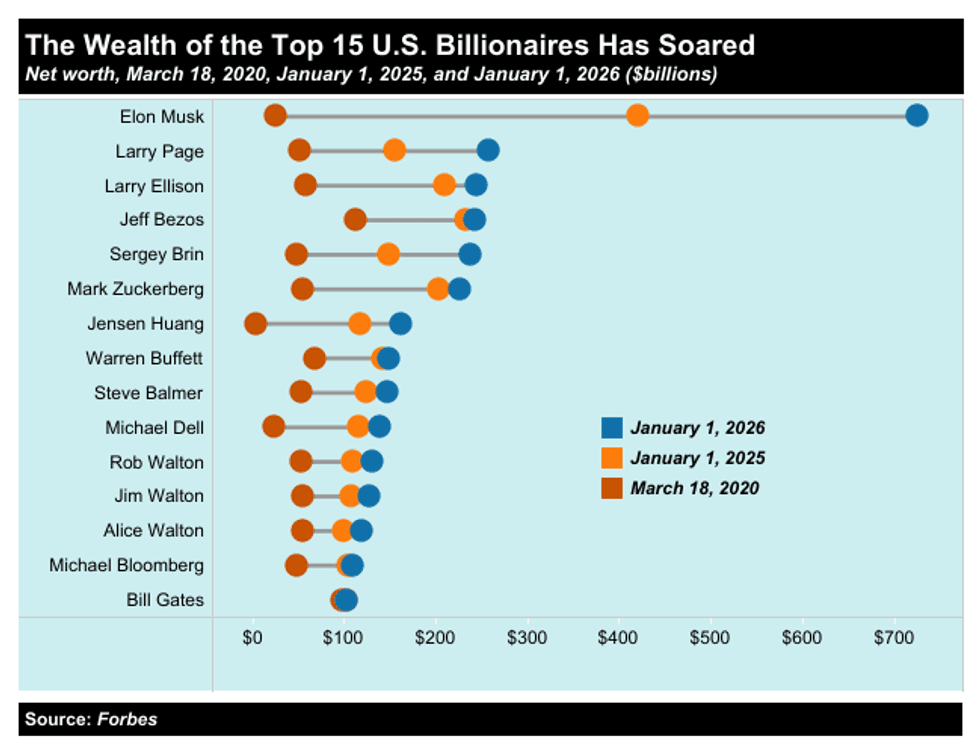
On March 18, 2020, for example, Elon Musk had wealth valued just under $25 billion. A little over five years at the end of 2025, Musk’s wealth is $726 billion, a dizzying 2,800% increase from before the onset of the pandemic.
Jeff Bezos saw his wealth rise from $113 billion on March 18, 2020 to $242 billion at the end of 2025.
Three Walton family members—Jim, Alice and Rob—saw their combined assets increase from $161.1 billion on March 18, 2020 to $378 billion at the end of 2025.
The extreme concentration of wealth that our continued analysis of billionaires underscores is deeply concerning for the future of our country. These ultra-wealthy individuals have outsized influence on our democratic system—and have actively worked to undermine it. And these spectacular riches comes at the expense of workers, the ones who are actually generating wealth. Social services are being cut while tax burdens are eased on the rich.
Fighting back against wealth concentration will take a two-pronged approach. We have to empower the working class, strengthening unions and improving living conditions. We also have to raise and taxes and close wealth accumulation loopholes, or else billionaire power will only grow.
Over 2025, the combined wealth of all US billionaires climbed to $8.1 trillion, a 21% increase over 2025, up from $6.7 trillion exactly a year ago.
The first year of the Trump administration was a very happy new year for the US billionaire class. The richest 15 billionaires, all with assets more than $100 billion, saw their combined wealth surge 33%, from $2.4 trillion to $3.2 trillion. This is double the growth of the S&P 500 over 2025, which was 16.4%.
Over 2025, the combined wealth of all US billionaires climbed to $8.1 trillion, a 21% increase over 2025, up from $6.7 trillion exactly a year ago.
Based on an Institute for Policy Studies analysis of data from the Forbes real time billionaire list from 2025, there are 935 billionaires in the United States with combined wealth totaling $8.1 trillion at the close of 2025 markets. This is an increase from 813 US billionaires at end close of 2024 markets, with combined wealth of $6.7 trillion.
The richest three American wealth dynasties—the Waltons, Mars, and Koch families—saw their wealth accelerate from $657.8 billion to $757 billion in one year.
Many top billionaires have seen their wealth surge during and after the Covid-19 pandemic at the beginning of 2020.
[Note: Bloomberg reported global billionaire wealth increased $2.2 trillion over 2025, in an analysis released several days before the market closed at 4:00 p.m. on December 31, 2025. The market fluctuated considerably in the final days of 2025.]
The top five current billionaires and their individual wealth on January 1, 2026, compared to January 1, 2025:
The three wealthiest dynastic families in the US hold an estimated $757 billion, up from $657.8 billion at the end of 2024, a 16% gain. These are:
Many top billionaires have seen their wealth surge during and after the Covid-19 pandemic at the beginning of 2020.
On March 18, 2020, Elon Musk had wealth valued just under $25 billion. Less than five years later, at the end of 2025, Musk’s wealth is $726 billion, a dizzying 2,800% increase from before the Covid-19 pandemic.
Jeff Bezos saw his wealth rise from $113 billion on March 18, 2020 to $242 billion at the end of 2025.
Three Walton family members—Jim, Alice, and Rob, saw their combined assets increase from $161.1 billion on March 18, 2020 to $378 billion at the end of 2025.
"Given the WelcomeFest lineup, it's clear that the donor class views Abundance as key to carrying out this self-serving crusade against populism."
Days after a national poll showed that the vast majority of Democratic voters want their party to focus on fighting corporate power and promoting policies that help working people instead of adopting the "Abundance" agenda pushed by centrist pundits and conservative Democrats, a watchdog revealed a new reason many voters may be unconvinced by the "Abundance universe."
According to an analysis by Revolving Door Project, the Abundance movement's political action committee counts a number of conservative, corporate-friendly billionaires among its funders, including members of the Walton family, former New York City billionaire Michael Bloomberg, and Wall Street executives Rob Granieri and Mark Heising.
The analysis was released the day before the centrist Welcome Party is set to host its annual event, WelcomeFest, featuring a lineup of speakers including U.S. Sen. Elissa Slotkin (D-Mich.), who has slammed progressives' use of the term "oligarchy," conservative Blue Dog Caucus chair Rep. Marie Gluesenkamp Perez (D-Wash.), and Derek Thompson, co-author of the book Abundance, which has been adopted in recent months a seminal text for politicians and commentators who reject progressives' demands for a true populist agenda.
The book argues partially that regulations and other bureaucratic "bottlenecks" make it harder to produce new housing and infrastructure.
"Given the WelcomeFest lineup, it's clear that the donor class views Abundance as key to carrying out this self-serving crusade against populism," said Henry Burke and Vishal Shankar of the Revolving Door Project.
Even more telling, said the group, is the list of donors to WelcomePAC, the Welcome Party's political action committee.
The PAC has received:
"The 'Abundance' movement is funded by GOP mega-donors," said Turner.
As Burke and Shankar wrote, organizers of WelcomeFest—or "Abundance Coachella"—are seeking to juxtapose their event with "the purportedly left-wing" Democratic National Convention, rejecting so-called "purity tests" but failing to offer "a compelling explanation for why swing and red state voters are flocking to the progressive-populist fight against oligarchy."
As it promises to offer "a vision for a depolarized United States, WelcomeFest "proudly touts the label of 'centrist insurgency.'"
The Welcome Party attempted to convince five House Republicans to caucus with Democrats in its push for depolarization, but "failed spectacularly," wrote Burke and Shankar—suggesting that the party and its agenda are now really focused only on moderation in one of the major political parties.
In a column at Common Dreams on Sunday, Aaron Regunberg of Public Citizen noted that proponents of the Abundance agenda like Adam Jentleson, former chief of staff to Sen. John Fetterman (D-Penn.), have taken pains to dismiss comparisons between "populist and abundance messaging."
The recent poll by Demand Progress made the comparisons impossible to ignore, Regunberg argued, showing that 81.6% of respondents said they'd be much more likely to vote for a candidate who wanted to "get money out of politics, break up corporate monopolies, and fight corruption."
Just 47.7% said they would prefer a candidate who promised to reduce "regulations that hold back the government and private sector from taking action" for working and middle-class Americans.
"At a moment when Democrats' efficacy in defeating Trumpism carries such existential stakes, these survey results demonstrate why many of us on the left have found the campaign to make abundance the new face of the Democratic Party so deeply concerning," wrote Regunberg. "If abundance isn't going to help Democrats defeat MAGA, then abundance advocates—or at least the ones who care about ending Trumpism—should stop trying to 'define the future of the Democratic Party.' Let's leave that work to the Democrats who are trying to orient our party around a vision that voters actually do find compelling."