SUBSCRIBE TO OUR FREE NEWSLETTER
Daily news & progressive opinion—funded by the people, not the corporations—delivered straight to your inbox.
5
#000000
#FFFFFF
To donate by check, phone, or other method, see our More Ways to Give page.
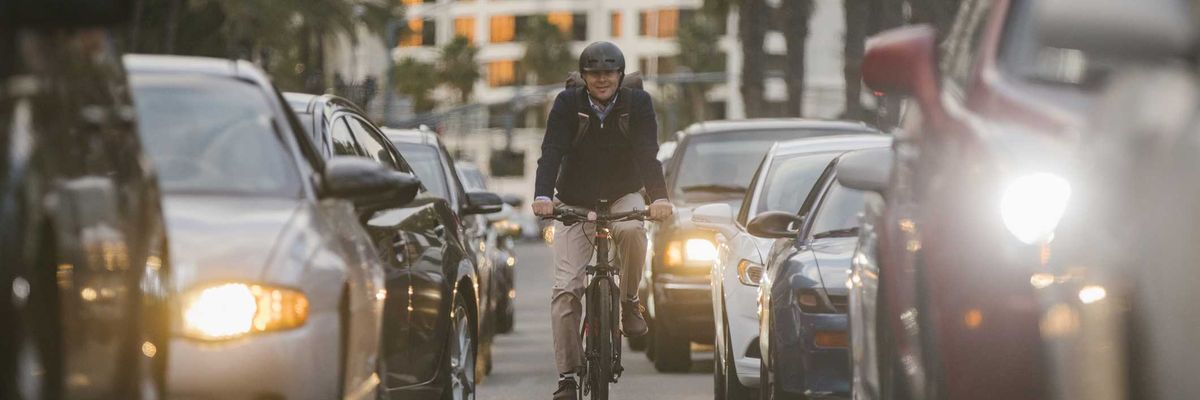
The US Department of Transportation began earlier this month to rescind federal funding for local projects across the country to improve street safety and add pedestrian trails and bike lanes, because they were deemed "hostile" to cars.
A report Monday in Bloomberg cited several examples of multimillion-dollar grants being axed beginning on September 9, all with the same rationale:
A San Diego County road improvement project including bike lanes “appears to reduce lane capacity and a road diet that is hostile to motor vehicles,” a US Department of Transportation official wrote, rescinding a $1.2 million grant it awarded nearly a year ago.
In Fairfield, Alabama, converting street lanes to trail space on Vinesville Road was also deemed “hostile” to cars, and “counter to DOT’s priority of preserving or increasing roadway capacity for motor vehicles.”
Officials in Boston got a similar explanation, as the Trump administration pulled back a previously awarded grant to improve walking, biking, and transit in the city’s Mattapan Square neighborhood in a way that would change the “current auto-centric configuration.” Another grant to improve safety at intersections in the city was terminated, the DOT said, because it could “impede vehicle capacity and speed.”
These are just a few of the projects cancelled in recent weeks by the Trump administration. According to StreetsBlog, others included a 44-mile walking trail along the Naugatuck River in Connecticut, which the administration reportedly stripped funding from because it did not "promote vehicular travel," and new miles of rail trail in Albuquerque for which DOT said funding would be reallocated to "'car-focused' projects instead."
The cuts are part of a broader effort by the Trump administration to slash discretionary federal grants under the Bipartisan Infrastructure Act signed by former President Joe Biden in 2021.
These include the RAISE infrastructure grant and Safe Streets and Roads for All programs, for which Congress has allocated a combined $2.5 billion annually to expand public transportation and address the US's worsening epidemic of pedestrian deaths.
Data published in July by the group Transportation for America revealed that the Trump administration has been implementing funds for safety grants at about 10% of the speed of the Biden administration.
According to a report published in July by the Governors Highway Safety Association, US drivers struck and killed 7,148 pedestrians in 2024, "enough to fill more than 30 Boeing 737 jets at maximum capacity." Though fatalities have decreased slightly from a 40-year peak in 2022, the number of fatalities last year was 20% higher than in 2016.
Research has overwhelmingly shown that adding bicycle and pedestrian lanes to streets can reduce these fatalities. Even the DOT's own Federal Highway Administration website recommends introducing "Road Diets" that reduce four-lane intersections to three lanes, making room for pedestrian refuge islands and bike lanes to serve as a "buffer" between automobile traffic and sidewalks.
According to the website, "studies indicate a 19 to 47% reduction in overall crashes when a Road Diet is installed on a previously four-lane undivided facility as well as a decrease in crashes involving drivers under 35 years of age and over 65 years of age."
Car crash fatalities are also up in general, according to preliminary data from the Department of Transportation: 39,345 were killed in motor accidents in 2024 compared with 32,744 a decade prior, a 20% increase.
Despite this, the Trump administration has made its preference for maximizing car travel abundantly clear. Trump has attempted to block California from constructing a massive new high-speed rail line from Los Angeles to San Francisco and has tried to stymie New York's wildly successful congestion pricing program.
Citing isolated cases of subway and train crime, he and other members of the Republican Party often paint public transit as excessively dangerous.
In one interview on Fox News in May, Transportation Secretary Sean Duffy ranted that, "if you're liberal, they want you to take public transportation." While stating that he was "OK with public transportation," he said, "the problem is that it's dirty. You have criminals. It's homeless shelters. It's insane asylums. It's a work ground for the criminal element of the city to prey upon the good people."
However, data show that between 2007 and 2023, deaths from automobile accidents were 100 times more likely than deaths on buses and 20 times more likely than on passenger trains.
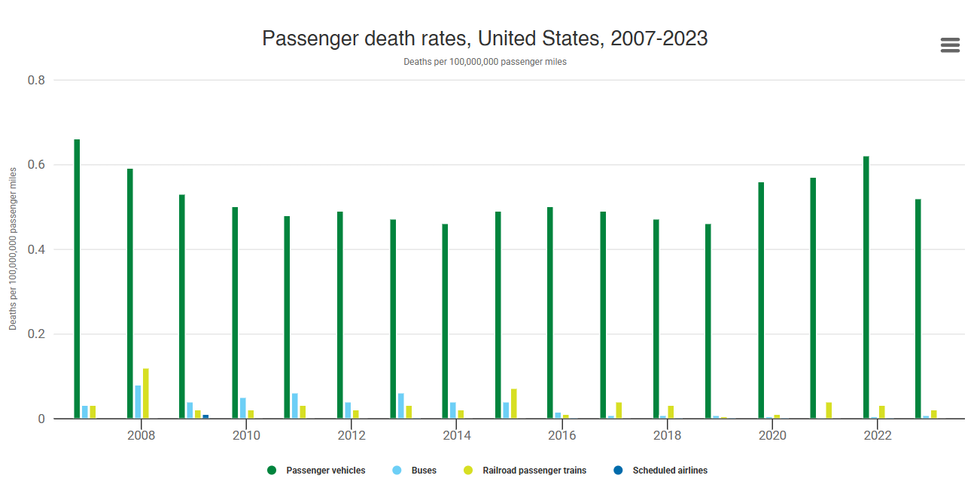 Data: Highway passenger deaths from the Fatality Analysis Reporting System (FARS) data. Railroad passenger deaths from the Federal Railroad Administration. Airline passenger deaths from the National Transportation Safety Board (NTSB). Passenger miles estimates from the Bureau of Transportation Statistics. All other figures are estimates from the National Safety Council. (Graphic: National Safety Council)
That hostility extends toward efforts to expand bicycle usage. In March, Duffy announced that the department would "review" all grants related to green infrastructure, including bike lanes, which was characterized as an effort to combat the previous president's attempts to reduce US transportation's carbon footprint.
Grant criteria sent to communities for the Safe Streets and Roads for All program explicitly warned communities that if "the applicant included infrastructure [resulting in] reducing lane capacity for vehicles," the application would be "viewed less favorably by the department."
When asked about this decision at a panel the next month, StreetsBlog reported that Duffy "grimaced and grumbled the word 'bikes' like it was an expletive, before repeating a string of corrosive myths about bike lanes that are all too common among people who only get around by car," including that they supposedly increase traffic congestion.
Many of the communities that have lost funding for their projects say they are still going to move ahead with them in some capacity. However, they argue that the government providing funds to improve road safety should be common sense.
Rick Dunne, the executive director of the Naugatuck Valley Council of Governments, stated that the effort to build a trail along the river will continue, even without the funding. But he expressed bewilderment at the administration's statement that investing in highway travel would better serve residents' "quality of life."
“Look, if your definition of improving quality of life is promoting vehicular travel, that's just, on its face, bad. Increase vehicle travel, increase pollution, increase safety risks,” Dunne told the CT Post. “Taking this money from this project, putting it into highway travel, is in no way going to increase economic efficiency. I don't see how you argue that it improves the quality of life of Americans, or the residents of this valley.”
The US Department of Transportation began earlier this month to rescind federal funding for local projects across the country to improve street safety and add pedestrian trails and bike lanes, because they were deemed "hostile" to cars.
A report Monday in Bloomberg cited several examples of multimillion-dollar grants being axed beginning on September 9, all with the same rationale:
A San Diego County road improvement project including bike lanes “appears to reduce lane capacity and a road diet that is hostile to motor vehicles,” a US Department of Transportation official wrote, rescinding a $1.2 million grant it awarded nearly a year ago.
In Fairfield, Alabama, converting street lanes to trail space on Vinesville Road was also deemed “hostile” to cars, and “counter to DOT’s priority of preserving or increasing roadway capacity for motor vehicles.”
Officials in Boston got a similar explanation, as the Trump administration pulled back a previously awarded grant to improve walking, biking, and transit in the city’s Mattapan Square neighborhood in a way that would change the “current auto-centric configuration.” Another grant to improve safety at intersections in the city was terminated, the DOT said, because it could “impede vehicle capacity and speed.”
These are just a few of the projects cancelled in recent weeks by the Trump administration. According to StreetsBlog, others included a 44-mile walking trail along the Naugatuck River in Connecticut, which the administration reportedly stripped funding from because it did not "promote vehicular travel," and new miles of rail trail in Albuquerque for which DOT said funding would be reallocated to "'car-focused' projects instead."
The cuts are part of a broader effort by the Trump administration to slash discretionary federal grants under the Bipartisan Infrastructure Act signed by former President Joe Biden in 2021.
These include the RAISE infrastructure grant and Safe Streets and Roads for All programs, for which Congress has allocated a combined $2.5 billion annually to expand public transportation and address the US's worsening epidemic of pedestrian deaths.
Data published in July by the group Transportation for America revealed that the Trump administration has been implementing funds for safety grants at about 10% of the speed of the Biden administration.
According to a report published in July by the Governors Highway Safety Association, US drivers struck and killed 7,148 pedestrians in 2024, "enough to fill more than 30 Boeing 737 jets at maximum capacity." Though fatalities have decreased slightly from a 40-year peak in 2022, the number of fatalities last year was 20% higher than in 2016.
Research has overwhelmingly shown that adding bicycle and pedestrian lanes to streets can reduce these fatalities. Even the DOT's own Federal Highway Administration website recommends introducing "Road Diets" that reduce four-lane intersections to three lanes, making room for pedestrian refuge islands and bike lanes to serve as a "buffer" between automobile traffic and sidewalks.
According to the website, "studies indicate a 19 to 47% reduction in overall crashes when a Road Diet is installed on a previously four-lane undivided facility as well as a decrease in crashes involving drivers under 35 years of age and over 65 years of age."
Car crash fatalities are also up in general, according to preliminary data from the Department of Transportation: 39,345 were killed in motor accidents in 2024 compared with 32,744 a decade prior, a 20% increase.
Despite this, the Trump administration has made its preference for maximizing car travel abundantly clear. Trump has attempted to block California from constructing a massive new high-speed rail line from Los Angeles to San Francisco and has tried to stymie New York's wildly successful congestion pricing program.
Citing isolated cases of subway and train crime, he and other members of the Republican Party often paint public transit as excessively dangerous.
In one interview on Fox News in May, Transportation Secretary Sean Duffy ranted that, "if you're liberal, they want you to take public transportation." While stating that he was "OK with public transportation," he said, "the problem is that it's dirty. You have criminals. It's homeless shelters. It's insane asylums. It's a work ground for the criminal element of the city to prey upon the good people."
However, data show that between 2007 and 2023, deaths from automobile accidents were 100 times more likely than deaths on buses and 20 times more likely than on passenger trains.
Data: Highway passenger deaths from the Fatality Analysis Reporting System (FARS) data. Railroad passenger deaths from the Federal Railroad Administration. Airline passenger deaths from the National Transportation Safety Board (NTSB). Passenger miles estimates from the Bureau of Transportation Statistics. All other figures are estimates from the National Safety Council. (Graphic: National Safety Council)
That hostility extends toward efforts to expand bicycle usage. In March, Duffy announced that the department would "review" all grants related to green infrastructure, including bike lanes, which was characterized as an effort to combat the previous president's attempts to reduce US transportation's carbon footprint.
Grant criteria sent to communities for the Safe Streets and Roads for All program explicitly warned communities that if "the applicant included infrastructure [resulting in] reducing lane capacity for vehicles," the application would be "viewed less favorably by the department."
When asked about this decision at a panel the next month, StreetsBlog reported that Duffy "grimaced and grumbled the word 'bikes' like it was an expletive, before repeating a string of corrosive myths about bike lanes that are all too common among people who only get around by car," including that they supposedly increase traffic congestion.
Many of the communities that have lost funding for their projects say they are still going to move ahead with them in some capacity. However, they argue that the government providing funds to improve road safety should be common sense.
Rick Dunne, the executive director of the Naugatuck Valley Council of Governments, stated that the effort to build a trail along the river will continue, even without the funding. But he expressed bewilderment at the administration's statement that investing in highway travel would better serve residents' "quality of life."
“Look, if your definition of improving quality of life is promoting vehicular travel, that's just, on its face, bad. Increase vehicle travel, increase pollution, increase safety risks,” Dunne told the CT Post. “Taking this money from this project, putting it into highway travel, is in no way going to increase economic efficiency. I don't see how you argue that it improves the quality of life of Americans, or the residents of this valley.”
The US Department of Transportation began earlier this month to rescind federal funding for local projects across the country to improve street safety and add pedestrian trails and bike lanes, because they were deemed "hostile" to cars.
A report Monday in Bloomberg cited several examples of multimillion-dollar grants being axed beginning on September 9, all with the same rationale:
A San Diego County road improvement project including bike lanes “appears to reduce lane capacity and a road diet that is hostile to motor vehicles,” a US Department of Transportation official wrote, rescinding a $1.2 million grant it awarded nearly a year ago.
In Fairfield, Alabama, converting street lanes to trail space on Vinesville Road was also deemed “hostile” to cars, and “counter to DOT’s priority of preserving or increasing roadway capacity for motor vehicles.”
Officials in Boston got a similar explanation, as the Trump administration pulled back a previously awarded grant to improve walking, biking, and transit in the city’s Mattapan Square neighborhood in a way that would change the “current auto-centric configuration.” Another grant to improve safety at intersections in the city was terminated, the DOT said, because it could “impede vehicle capacity and speed.”
These are just a few of the projects cancelled in recent weeks by the Trump administration. According to StreetsBlog, others included a 44-mile walking trail along the Naugatuck River in Connecticut, which the administration reportedly stripped funding from because it did not "promote vehicular travel," and new miles of rail trail in Albuquerque for which DOT said funding would be reallocated to "'car-focused' projects instead."
The cuts are part of a broader effort by the Trump administration to slash discretionary federal grants under the Bipartisan Infrastructure Act signed by former President Joe Biden in 2021.
These include the RAISE infrastructure grant and Safe Streets and Roads for All programs, for which Congress has allocated a combined $2.5 billion annually to expand public transportation and address the US's worsening epidemic of pedestrian deaths.
Data published in July by the group Transportation for America revealed that the Trump administration has been implementing funds for safety grants at about 10% of the speed of the Biden administration.
According to a report published in July by the Governors Highway Safety Association, US drivers struck and killed 7,148 pedestrians in 2024, "enough to fill more than 30 Boeing 737 jets at maximum capacity." Though fatalities have decreased slightly from a 40-year peak in 2022, the number of fatalities last year was 20% higher than in 2016.
Research has overwhelmingly shown that adding bicycle and pedestrian lanes to streets can reduce these fatalities. Even the DOT's own Federal Highway Administration website recommends introducing "Road Diets" that reduce four-lane intersections to three lanes, making room for pedestrian refuge islands and bike lanes to serve as a "buffer" between automobile traffic and sidewalks.
According to the website, "studies indicate a 19 to 47% reduction in overall crashes when a Road Diet is installed on a previously four-lane undivided facility as well as a decrease in crashes involving drivers under 35 years of age and over 65 years of age."
Car crash fatalities are also up in general, according to preliminary data from the Department of Transportation: 39,345 were killed in motor accidents in 2024 compared with 32,744 a decade prior, a 20% increase.
Despite this, the Trump administration has made its preference for maximizing car travel abundantly clear. Trump has attempted to block California from constructing a massive new high-speed rail line from Los Angeles to San Francisco and has tried to stymie New York's wildly successful congestion pricing program.
Citing isolated cases of subway and train crime, he and other members of the Republican Party often paint public transit as excessively dangerous.
In one interview on Fox News in May, Transportation Secretary Sean Duffy ranted that, "if you're liberal, they want you to take public transportation." While stating that he was "OK with public transportation," he said, "the problem is that it's dirty. You have criminals. It's homeless shelters. It's insane asylums. It's a work ground for the criminal element of the city to prey upon the good people."
However, data show that between 2007 and 2023, deaths from automobile accidents were 100 times more likely than deaths on buses and 20 times more likely than on passenger trains.
Data: Highway passenger deaths from the Fatality Analysis Reporting System (FARS) data. Railroad passenger deaths from the Federal Railroad Administration. Airline passenger deaths from the National Transportation Safety Board (NTSB). Passenger miles estimates from the Bureau of Transportation Statistics. All other figures are estimates from the National Safety Council. (Graphic: National Safety Council)
That hostility extends toward efforts to expand bicycle usage. In March, Duffy announced that the department would "review" all grants related to green infrastructure, including bike lanes, which was characterized as an effort to combat the previous president's attempts to reduce US transportation's carbon footprint.
Grant criteria sent to communities for the Safe Streets and Roads for All program explicitly warned communities that if "the applicant included infrastructure [resulting in] reducing lane capacity for vehicles," the application would be "viewed less favorably by the department."
When asked about this decision at a panel the next month, StreetsBlog reported that Duffy "grimaced and grumbled the word 'bikes' like it was an expletive, before repeating a string of corrosive myths about bike lanes that are all too common among people who only get around by car," including that they supposedly increase traffic congestion.
Many of the communities that have lost funding for their projects say they are still going to move ahead with them in some capacity. However, they argue that the government providing funds to improve road safety should be common sense.
Rick Dunne, the executive director of the Naugatuck Valley Council of Governments, stated that the effort to build a trail along the river will continue, even without the funding. But he expressed bewilderment at the administration's statement that investing in highway travel would better serve residents' "quality of life."
“Look, if your definition of improving quality of life is promoting vehicular travel, that's just, on its face, bad. Increase vehicle travel, increase pollution, increase safety risks,” Dunne told the CT Post. “Taking this money from this project, putting it into highway travel, is in no way going to increase economic efficiency. I don't see how you argue that it improves the quality of life of Americans, or the residents of this valley.”