

SUBSCRIBE TO OUR FREE NEWSLETTER
Daily news & progressive opinion—funded by the people, not the corporations—delivered straight to your inbox.
5
#000000
#FFFFFF
To donate by check, phone, or other method, see our More Ways to Give page.
Daily news & progressive opinion—funded by the people, not the corporations—delivered straight to your inbox.
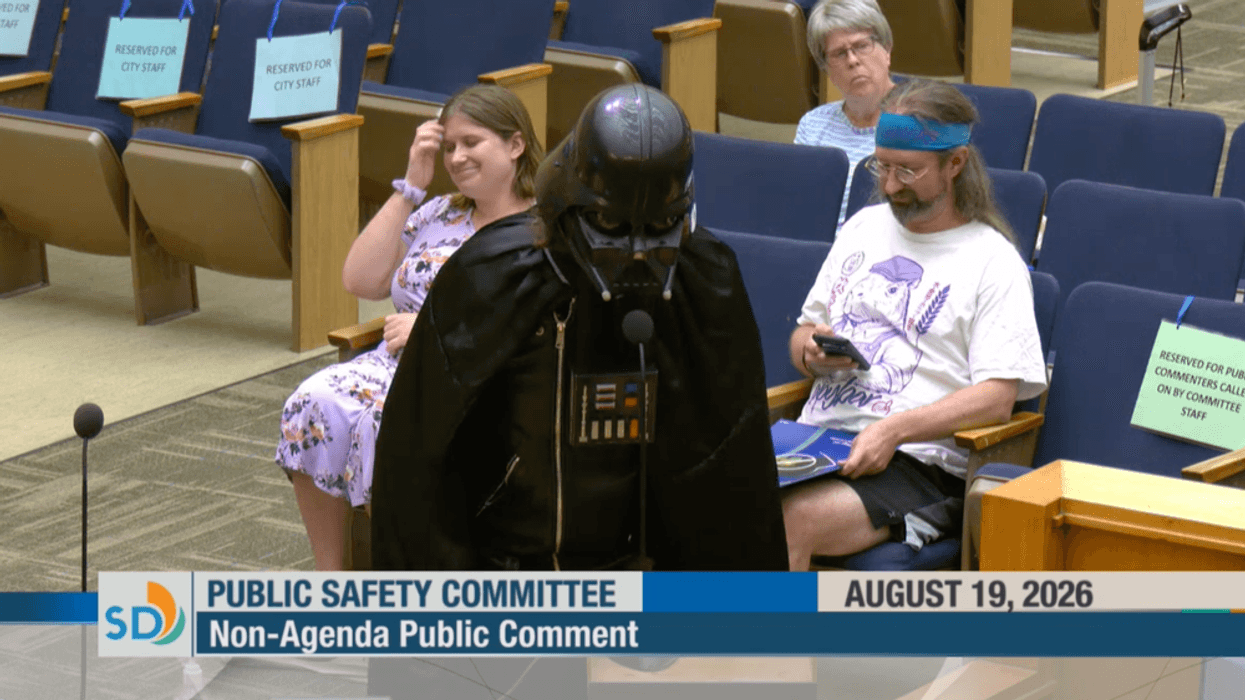
"We must continue utilizing Flock technologies so that we can follow and surveil the rebel scum as they move from playground to playground, from playground to pool, from pool to gymnasium."
Residents of San Diego are up in arms about Flock cameras. But for those seeking to keep tabs on "rebel scum," the omnipotent surveillance technology has its uses.
That's according to one Darth Vader, who took the podium during the public comment period at a Public Safety and Livable Neighborhoods Committee Meeting in the California city on Wednesday night to sing, or more accurately, bellow his praises for the company, whose automatic license-plate reading (ALPR) cameras are fast being installed around the nation.
"The emperor is a fan of Flock, and we must continue utilizing Flock technologies so that we can follow and surveil the rebel scum as they move from playground to playground, from playground to pool, from pool to gymnasium," the person dressed as the infamous Star Wars villain said.
"Because we all know that the Flock cameras are not only following the license [plates]; they are following children. They are following children in parks and gymnasiums, and we need this," the sith lord continued. "I need this so I can stalk my ex-girlfriend."
There are more than 550 Flock cameras installed across the city of San Diego, according to a public database by the activist group DeFlock.
And while the person who embodied the dark lord has not yet been identified, the satirical performance gave voice to some of the well-documented ways that the technology has been used to create a nationwide panopticon that enables widespread warrantless spying.
One database published earlier this month by the Institute for Justice, a libertarian nonprofit law firm, found over 100 documented cases of police using the technology for “romantic stalking, wrongful stops and detentions, non-law enforcement use, and other types of misconduct.”
Vader was also not exaggerating about the use of Flock cameras to spy on children. As the Electronic Frontier Foundation (EFF), an internet-focused civil liberties group, found, some school districts have enlisted cops to track families in order to root out "residency fraud" and prove that they live in the district.
"A search of ALPR data will show a lot more than whether a family lives within the right zone," wrote Dave Maass, EFF’s director of investigations, and Rindala Alajaji, a legislative activist with the group. "Every time a plate is searched, it can reveal personal information about a family: when they go to the doctor, when they go to worship, when they go out at night, and where they travel on vacation. None of that is the school district's business, and these searches are a huge invasion of privacy."
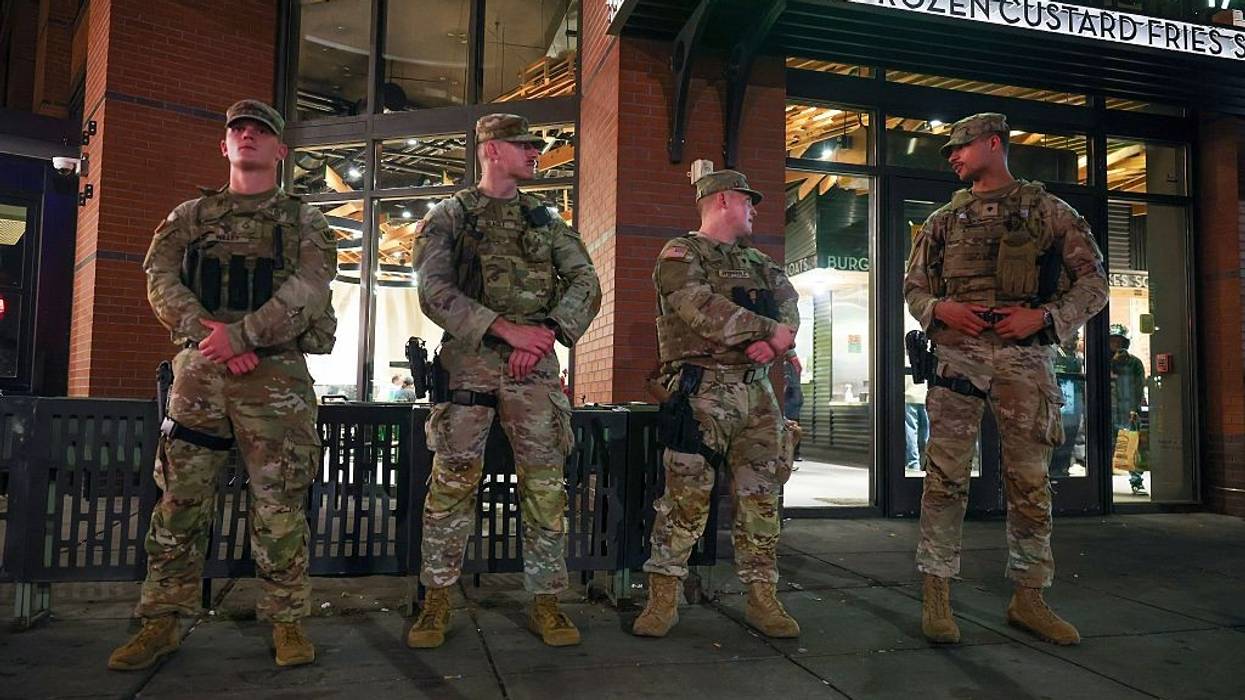
Democrats can go on offense by defining what it actually means to be serious about safety: not by stoking fear, but by advancing a clear, consistent, solutions-driven agenda that both prevents crime and breaks its cycle.
As the economy falters, prices surge, and yet another Middle East conflict grinds on with no clear endgame, Donald Trump’s presidency appears to be slipping into free fall. His support has eroded among the very voters who once powered his return to office, and Americans are losing confidence in the issues that once defined his appeal—especially the economy and immigration. With the midterms looming, Republicans are flailing.
But Trump and the Republicans always have a tried-and-true political playbook: fearmongering about crime. And unless Democrats go on the offensive, it just may work.
Trump has already signaled that crime will once again be a centerpiece of the midterms. In support of that aim, he has repeatedly urged Congress to pass “a tough new crime bill,” falsely taken credit for bringing down crime rates, and exploited crime victims to cast Democrats as cold and uncaring in the face of tragedy. But crime is not the strength it once was for Trump.
Thanks to his unpopular federal troop deployments and violent mass deportation tactics, voters are losing confidence in his approach to public safety.
As ICE, the National Guard, and other federal forces expand their footprint in communities across the country, voters are getting a clearer picture of what “tough-on-crime” governance looks like in practice—and most don’t like what they see.
To be clear, Republicans still hold an overwhelming advantage on crime in public opinion. But that edge is driven less by outcomes than by emphasis: They talk about crime relentlessly—even when rates are near historic lows—amplifying and exploiting understandable fears. Democrats, by contrast, too often cede the narrative—either by pivoting to safer ground or by trying to one-up Republicans with “tough-on-crime” rhetoric that voters don’t find convincing.
Today, Democrats of all stripes are talking loudly and often about affordability—the right tactic after being perceived as out of touch in the wake of the 2024 election. But they have yet to find a unified message around public safety, leaving them vulnerable to the inevitable barrage of GOP attack ads stoking fears of crime and immigration.
My team and I have briefed dozens of candidates and elected leaders over the past several months, and the message we are so often left with is one of hesitation and uncertainty around public safety. From our work with Hill offices to mayoral candidates, the reality is that the party is not prepared to truly address crime. Unless Democrats define the issue on their own terms, they’ll once again be forced to play defense on one of the most politically potent issues in American life.
Democrats cannot afford to go silent on crime, nor can they afford the “tough-on-crime” approach that some in the party are advocating—a familiar playbook that echoes the advice many received last year on immigration enforcement. But those who followed that guidance are now finding themselves under attack for it. Votes once seen as smart politics—backing measures like the Trump-backed Laken Riley Act, resolutions praising US Immigration and Customs Enforcement (ICE) officers, or increased funding for the Department of Homeland Security—are quickly becoming political liabilities. As ICE, the National Guard, and other federal forces expand their footprint in communities across the country, voters are getting a clearer picture of what “tough-on-crime” governance looks like in practice—and most don’t like what they see.
This moment presents an opportunity. Democrats can go on offense by defining what it actually means to be serious about safety: not by stoking fear, but by advancing a clear, consistent, solutions-driven agenda that both prevents crime and breaks its cycle. In a country where nearly half of all people have had a family member incarcerated and about 3 in 10 people say they or a member of their household have been a victim of a crime, we must chart a new path forward. Democrats don’t have to look far to see which solutions truly deliver on safety.
Democratic mayors are working to drive historic declines in crime—through sustained investments in youth programs, community violence intervention, crisis response, targeted gun enforcement, and rebuilding trust between police and the communities they serve. Leading cities of all sizes, they’ve seen firsthand how violence shatters families and makes everyday life feel unsafe. They’ve also seen the damage of blunt “law and order” approaches that destabilize neighborhoods, limit opportunity, and erode cooperation with law enforcement.
These leaders are channeling a broader political reality: Most Democratic and independent voters want leaders who are serious about safety, not a return to reflexive “tough-on-crime” politics. That means a comprehensive approach that responds swiftly to stop violence, solve crime, and prevent it in the first place. It pairs accountability with fairness—holding everyone to the same standard, including police and elected officials. And it reflects a continued belief that public safety is strengthened not just through enforcement, but by giving people a real chance to break cycles of incarceration and build stable lives. Importantly, as we head toward the midterms, polling shows that when Democrats demonstrate to voters that they are truly serious about safety, this approach consistently outperforms “tough-on-crime” rhetoric.
Notably, these local leaders come from across the Democratic spectrum. Regardless of whether they consider themselves progressives, moderates, or something in between, they share an approach that works to deliver safety and win elections. They know that safety isn’t about scoring political points; it’s about building credibility and delivering what works. It’s time Democrats learned that lesson as well.