

SUBSCRIBE TO OUR FREE NEWSLETTER
Daily news & progressive opinion—funded by the people, not the corporations—delivered straight to your inbox.
5
#000000
#FFFFFF
To donate by check, phone, or other method, see our More Ways to Give page.
Daily news & progressive opinion—funded by the people, not the corporations—delivered straight to your inbox.
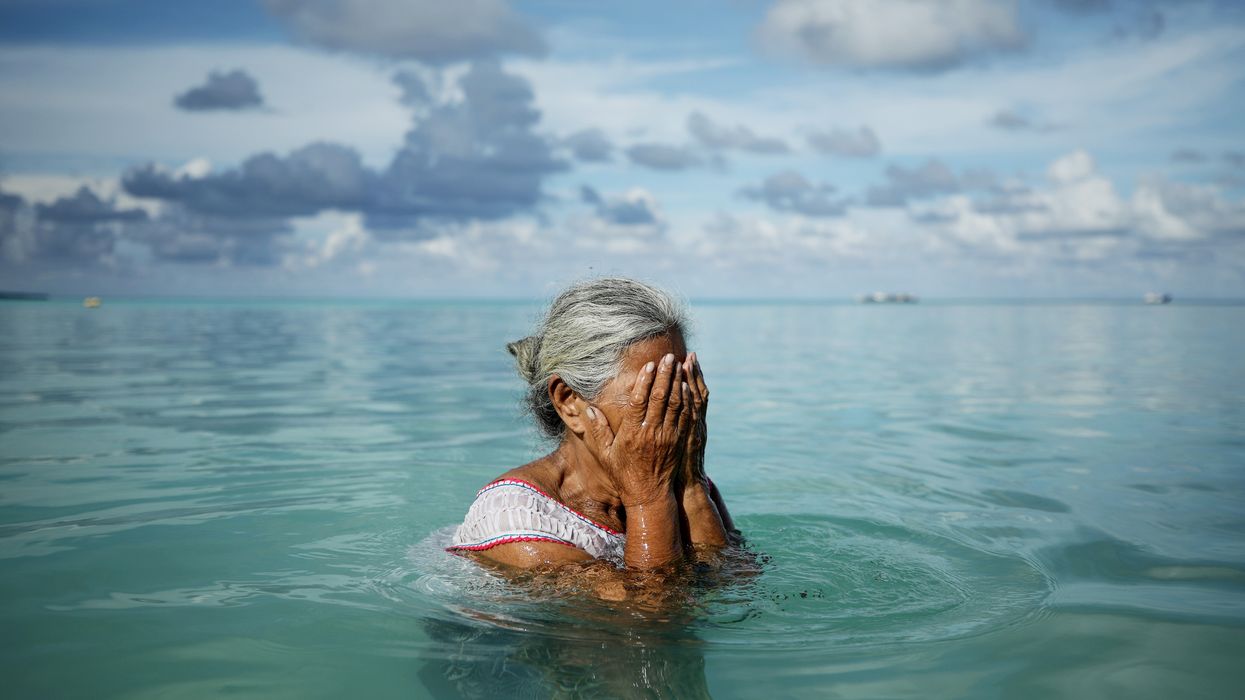
Scientists say the Pacific island nation will likely be uninhabitable by 2100.
With more than three weeks to go until the deadline for citizens of Tuvalu to apply for a limited number of visas as part of an agreement with Australia, nearly a third of people in the tiny Pacific island nation had registered by Thursday in hopes of emigrating from one of the world's most climate-vulnerable countries.
After a 2024 climate migration pact between the two nations, the Falepili Union, citizens of Tuvalu are eligible to apply for 280 Australian visas that will be given out each year.
Registration for the inaugural visas began last week, and within four days, 3,125 Tuvaluans had entered a lottery to win one. Tuvalu is home to about 10,643 people, according to 2022 census figures.
The Falepili Union was agreed to two years after leaders from Tuvalu proposed a fossil fuel nonproliferation treaty at the 27th United Nations Climate Change Conference in Sharm El-Sheikh, Egypt, making it the second Pacific island nation to demand an international agreement to stop the extraction of the planet-heating fossil fuels that have made Tuvalu one of the world's most vulnerable countries to the climate emergency.
Scientists say Tuvalu, which includes nine low-lying islands and atolls, could be uninhabitable by the end of the century due to rising sea levels.
The islands also see an average of one tropical cyclone in their vicinity per year, with storms often hitting in quick succession and exposing homes and other structures to high winds and extreme rainfall. The nation's gross domestic product fell by more than 25% in 2015 due to Cyclone Pam, which temporarily displaced 45% of the population, contaminated drinking water, and killed livestock. Due to the impact on agriculture across several Pacific Islands, roughly 166,000 people needed immediate food aid in the aftermath of the storm.
Two of the country's coral atolls have mostly been lost to sea-level rise, making the islands more vulnerable to storms.
By 2100, sea levels are projected to rise by more than two feet and Tuvalu is expected to face flooding for nearly a third of every year.
A spokesperson for Australia's Foreign Affairs Department told The Guardian that the Falepili Union is "the first agreement of its kind anywhere in the world, providing a pathway for mobility with dignity as climate impacts worsen."
Tuvaluans who obtain Australian visas under the pact will be eligible for Medicare, disability insurance, family tax benefits, childcare subsidies, and other benefits.
Earlier this month, Tuvalu was included in a draft list of countries where the Trump administration was considering imposing travel bans, in an internal cable sent by U.S. Secretary of State Marco Rubio. The administration said Tuvalu's inclusion was a mistake.
The pact with Australia commits the Australian government to defending Tuvalu from military aggression and health pandemics as well as "natural disasters."
"For the first time," Tuvaluan Prime Minister Feleti Teo said when the agreement was signed, "there is a country that has committed legally to recognize the future statehood and sovereignty of Tuvalu despite the detrimental impact of climate change-induced sea-level rise."
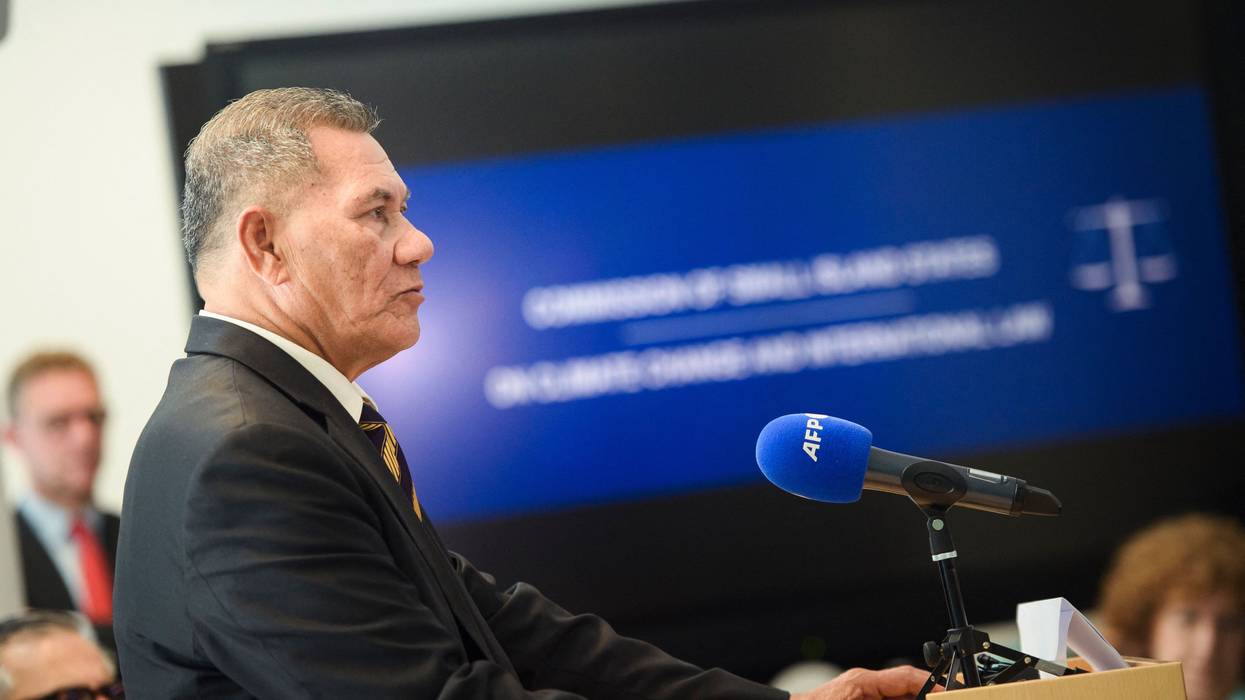
"The longer we remain addicted to fossil fuels, the longer we commit ourselves to mutual decline," Tuvaluan Prime Minister Kausea Natano said at the U.N. Climate Ambition Summit.
As heads of climate-wrecking nations like the United States, China, and Britain declined to attend Wednesday's United Nations Climate Ambition Summit in New York, leaders of Pacific island and other Global South countries renewed the push for a fossil fuel nonproliferation treaty.
The government of Tuvalu is working with neighbors Vanuatu, Fiji, Tonga, the Solomon Islands, and the self-governing New Zealand territory of Niue—all signatories to the Port Vila Call, a framework to a just transition to a fossil-free Pacific—and global partners to draft a FFNPT.
"The longer we remain addicted to fossil fuels, the longer we commit ourselves to mutual decline," Tuvaluan Prime Minister Kausea Natano said at the summit. "A negotiated fossil fuel nonproliferation treaty would complement the Paris agreement and ensure a global just transition.
"We've proven we can mobilize our collective ambition at the multilateral level. The scale of the challenge we face can now only be met with an even greater level of ambition and cooperation," he added. "I traveled thousands of miles over four days to be here today, because I believe in international cooperation and multilateralism. I have faith in our collective humanity and our ability to foster global solidarity to undertake what needs to be done."
Launched in 2020 and backed by hundreds of groups, thousands of scientists, and people around the world from youth to grandparents, the FFNPT is based on three pillars:
In addition to the aforementioned nations, the country of East Timor, the European Parliament, and the World Health Organization have called for a FFNPT. Scores of cities and other subnational governments have also endorsed the FFNPT, including London, Paris, Los Angeles, Sydney, Toronto, and the Hawaiian Legislature.
Earlier this month, California became the largest economy in the world to endorse the treaty.
"This climate crisis is a fossil fuel crisis," Democratic California Gov. Gavin Newsom said at Wednesday's summit. "It's not complicated. It's the burning of oil. It's the burning of gas. It's the burning of coal. And we need to call that out. For decades and decades, the fossil fuel industry has been playing each and every one of us in this room for fools."
Colombian President Gustavo Petro, another supporter of the treaty, said during Wednesday's summit that "the real goal that all countries should have is aiming for zero production and supply of carbon gas and oil. If we don't aim for that as our overarching goal, life will not be saved."
"If we keep on our current track it will be suicide," he added. "We live on coal and gas exports, but if we don't change course it will mean death because those industries are polluting the atmosphere. Fossil capital is a burden for humankind. Fossil fuel subsidies need to be completely eliminated worldwide. That would give us a prospect for the future."
Tzeporah Berman, chair of the Fossil Fuel Nonproliferation Treaty Initiative, said at a press conference Wednesday that "today was a turning point... A growing block of countries is calling for a FFNPT that would ensure an end to expansion of oil, gas, and coal projects, and cooperation on a plan for a managed wind-down that is fast, fair, and financed."
The climate action group Oil Change International blasted what it called wealthy nations' "display of inaction and indifference."
"The handful of rich countries driving oil and gas expansion failed to answer United Nations Secretary-General António Guterres' call for an end to new fossil fuel production," the group noted. "These countries, with the greatest financial means and responsibility to lead a fast and fair global phaseout of production, are instead leading in jeopardizing the global 1.5°C goal."
"Five Global North countries—the United States, Canada, Australia, Norway, and the United Kingdom—are responsible for 51% of carbon dioxide pollution threatened by new oil and gas extraction between 2023 and 2050," Oil Change continued. "If these planet-wreckers were to heed the United Nations secretary-general's call to halt new oil and gas, we could prevent a staggering 100 billion tons of carbon pollution from entering our atmosphere, equivalent to the lifetime emissions of over 620 new coal plants."
"In contrast, countries like Chile, Denmark, France, and Tuvalu were invited to speak at the summit," the group added, "as they have halted fossil fuel expansion and financing as needed to align with 1.5°C."
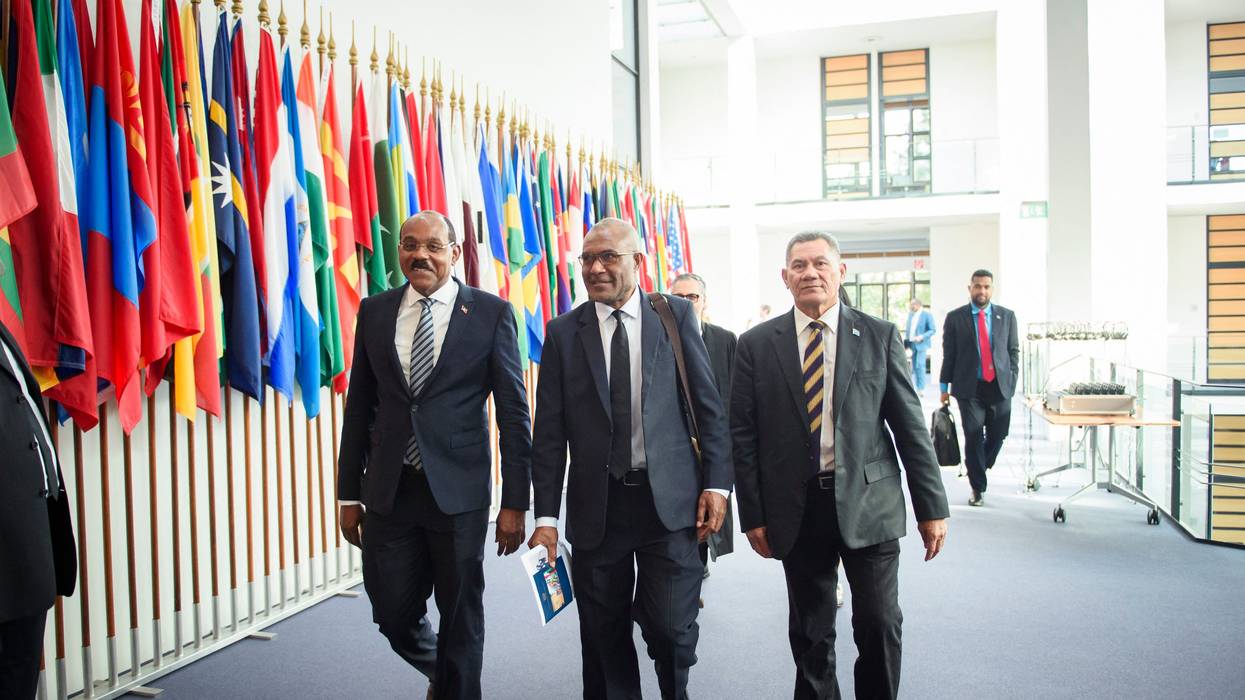
"We are confident that international courts and tribunals will not allow this injustice to continue unchecked," the prime minister of Tuvalu said.
Do greenhouse gas emissions from the burning of fossil fuels count as ocean pollution under the Law of the Sea?
That's the question that nine small island states that are low emitting but extremely vulnerable to the climate crisis have asked the International Tribunal for the Law of the Sea (ITLOS) in a landmark hearing that began Monday in Hamburg, Germany.
"We come here seeking urgent help, in the strong belief that international law is an essential mechanism for correcting the manifest injustice that our people are suffering as a result of climate change," Tuvalu's Prime Minister Kausea Natano said in a statement shared by Eureporter. "We are confident that international courts and tribunals will not allow this injustice to continue unchecked."
The 1982 United Nations Convention on the Law of the Sea governs the shared use and protection of the ocean. A total of 168 countries—the U.S. not among them—have ratified it.
Under Article 194(1), those 168 states have agreed to "take, individually or jointly as appropriate, all measures consistent with this convention that are necessary to prevent, reduce, and control pollution of the marine environment from any source." Yet, despite the fact that 25% of carbon dioxide emissions and 90% of global heating end up in the oceans, leading to threats like marine heatwaves, coral bleaching, ocean acidification, and more extreme tropical storms, it's still not clear what duties nations have to prevent climate pollution under international maritime law.
"What's the difference between having a toxic chimney spewing across a border to carbon dioxide emissions?" Payam Akhavan, lead counsel and chair of the committee of legal experts advising the nations that brought the question, asked The Guardian. "Some of these states will become uninhabitable in a generation and many will be submerged under the sea. This is an attempt to use all the tools available to force major polluters to change course while they still can."
"A positive advisory opinion could be essential to the global fight against climate change."
The island nations—organized as the Commission of Small Island States on Climate Change and International Law (COSIS)—first requested an advisory opinion from the tribunal in December 2022. COSIS formed in 2021 during the COP26 U.N. climate talks in Glasgow, Scotland, and its members include Antigua and Barbuda, Tuvalu, Palau, Niue, Vanuatu, Saint Lucia, Saint Vincent and the Grenadines, Saint Kitts and Nevis, and the Bahamas, according to ClientEarth.
These nations say they have only contributed 1% of global greenhouse gas emissions but contend with disproportionate climate impacts, from sea-level rise and saltwater intrusion to coastal erosion, The New York Times reported.
"Despite our negligible emission of greenhouse gases, COSIS's members have suffered and continue to suffer the overwhelming burden of climate change's adverse impacts," Antigua and Barbuda Prime Minister Gaston Alfonso Browne said in a statement shared by Eureporter. "Without rapid and ambitious action, climate change may prevent my children and grandchildren from living on the island of their ancestors, the island that we call home. We cannot remain silent in the face of such injustice."
The ITLOS hearing is scheduled to last through September 25. In addition to the members of COSIS, more than 50 nations will weigh in with written or oral arguments, according to The New York Times. Among them will be major greenhouse gas emitters like China, India, and European Union member states. A ruling is expected within months.
While COSIS is only asking for an advisory opinion for now, legal experts say the decision could have a major impact on climate litigation going forward, especially if ITLOS rules that signatories do have an obligation to protect the ocean from climate pollution.
"The islands could hold major emitters of greenhouse gases responsible for damage by their failure to implement the Paris climate accord," University of Edinburgh emeritus international law professor Alan Boyle told The New York Times.
That is the outcome that legal climate advocates like ClientEarth are hoping for.
"A positive advisory opinion could be essential to the global fight against climate change," the group wrote. "A legal interpretation by the tribunal that the Law of the Sea requires states all over the world mitigate their greenhouse gas emissions to prevent harm to the marine environment opens up the possibility that climate commitments such as those made under the Paris agreement may need to be enforced to protect the world's oceans."
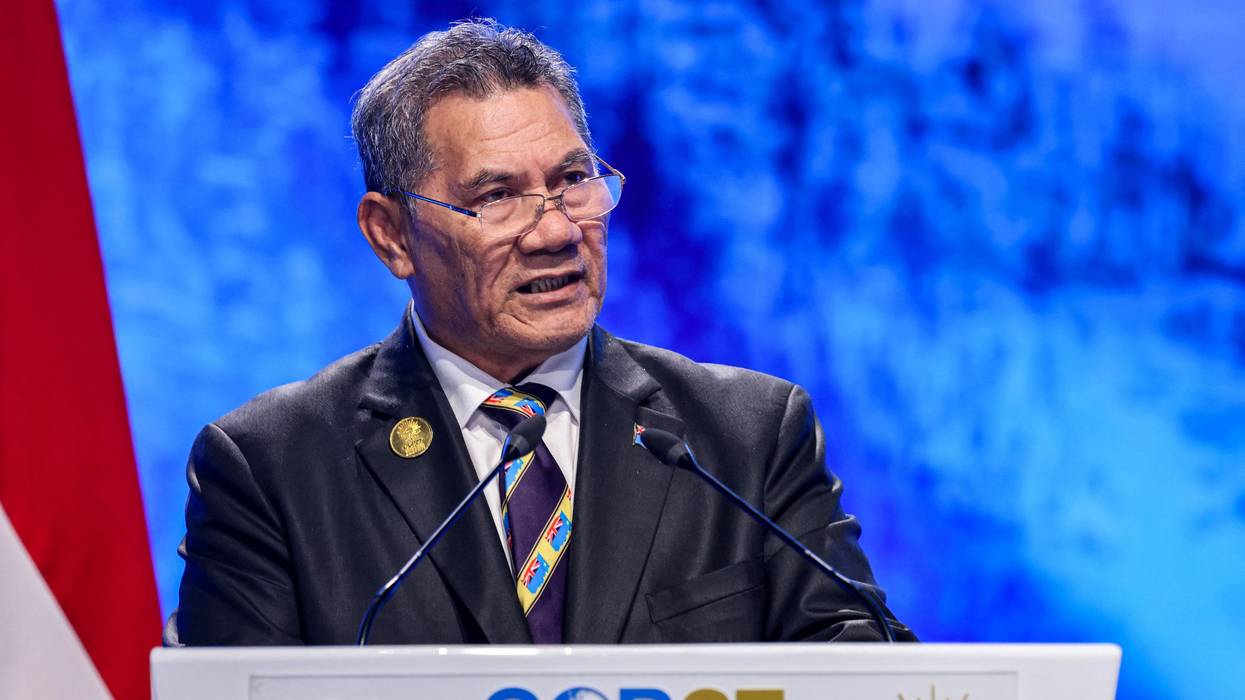
Campaigners on Tuesday applauded leaders in the Global South for continuing to lead the way in the fight for far-reaching climate action as the island nation of Tuvalu brought a proposal for a fossil fuel nonproliferation treaty to the United Nations' annual climate change conference.
"We all know that the leading cause of climate crisis is fossil fuels," Kausea Natano, prime minister of Tuvalu, told global leaders at COP27 in Sharm El-Sheikh, Egypt. "It's getting too hot and there is very [little] time to slow and reverse the increasing temperature. Therefore, it is essential to prioritize fast-acting strategies."
By formally endorsing the creation of a treaty, said the Fossil Fuel Non-Proliferation Treaty Initiative, Tuvalu is "proactively seeking solutions to phase out fossil fuels and offer hope to its population and the world."
Tuvalu became the second nation to endorse a treaty which would approach the extraction of fossil fuels as a danger as grave as nuclear weapons, which are the focus of a nonproliferation treaty signed by nearly 100 countries.
Vanuatu proposed a fossil fuel non-proliferation treaty at the U.N. General Assembly in September, and advocates celebrated last month when the European Union overwhelmingly passed a resolution formally endorsing the treaty--one year after lawmakers had voted it down.
Following Natano's statement at COP27, environmental scientist Amy Clarke tweeted that "there is an inexorable move towards" a fossil fuel nonproliferation treaty.
The treaty would ban the proliferation of coal, oil, and gas by ending all new production and extraction projects; phase out existing production; and ensure a just transition toward renewable energy that would "enable economic diversification" and "support every worker, community, and country."
Despite the support of the E.U. along with dozens of international cities, the World Health Organization and nearly 200 other global health groups, and more than 100 Nobel laureates in addition to Vanuatu and Tuvalu, The Washington Post reported that Natano's call "didn't get much engagement" from the assembled leaders at COP27.
"Pacific leaders continue to show what true climate leadership looks like," said climate activist Brianna Fruean. "From their key role in the Paris agreement, to the fight to limit warming to 1.5 degrees, to the historic endorsement of the fossil fuel treaty today."
"You may have heard the phrase '1.5 to stay alive' from young Pacific people at COP27 this year," Fruean added. "This is not an exaggeration or a catchy slogan, our very survival depends on whether or not leaders display the bravery and the political will to do everything in their power to limit us to 1.5 degrees of warming."
Caroline Lucas, a member of British Parliament representing the Green Party, denounced her own Tory-led government for offering new oil and gas leases to companies in the North Sea and handing out billions of dollars in fossil fuel subsidies since the Paris climate agreement was forged in 2015.
COP27 is being held on the heels of several devastating reports by global climate experts, warning that "urgent system-wide transformation" is imperative in order to keep the planet from warming an estimated 2.9degC over the preindustrial average by the end of the century, and that global carbon emissions are projected to rise 10.6% by 2030 under the status quo.
"Big ocean states have provided so much leadership to international policymaking," said Harjeet Singh, political lead for Climate Action Network International. "Big ocean states pushed for the 1.5degC target, they've pushed for loss and damage, and now they're pushing for a fossil fuel nonproliferation treaty. This is the next necessary step in international climate policy for climate justice."